
Pulp Fiction, 1881 · page 22 of 32
Beadle's New York Dime Library No. 125 — page 22: what you’re looking at
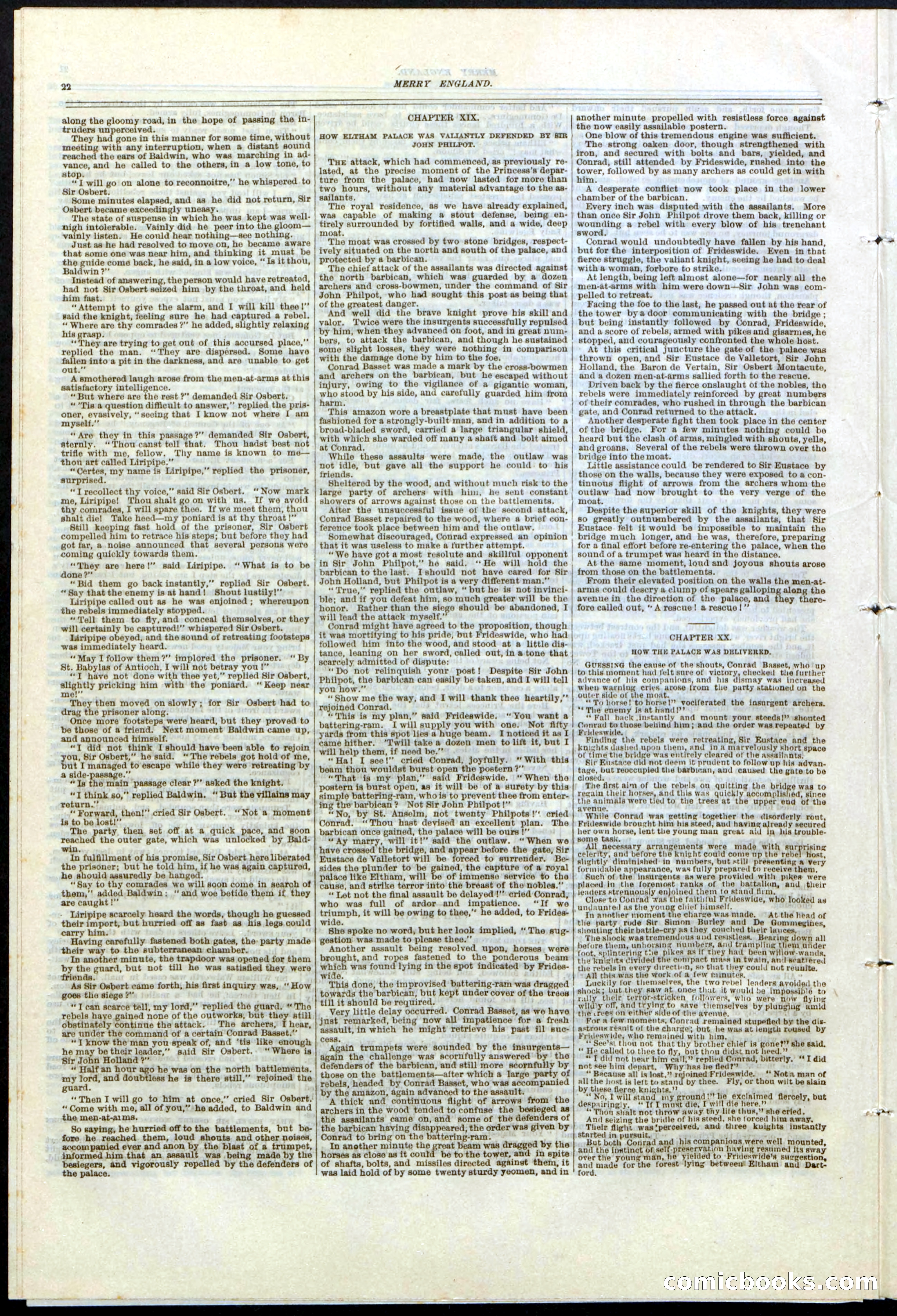
A restored page from Pulp Fiction, 1881. Page through the whole issue in the reader above.
📄 Transcribed text from this page (OCR, searchable)
Machine-transcribed from the original scan — historical spelling and the odd misread are preserved.
77 22 along the gloomy road, in the hope of passing the in- truders unperceived. They gone in this manner for some time, without meeting with any interruption, when a distant sound reached the ears of Baldwin, who was marching in ad- vance, and he called to the others,in a low tone, to stop. “I will go on alone to reconnoitre,” he whispered to Sir Osbert. Some minutes elapsed, and as he did not return, Sir Osbert became at aa uneasy. The state of suspense in which he was kept was well- nigh intolerable. Vainly did he peer into the gloom— vainly listen. He could hear nothing—see nothing. Just as he had resolved to move on, he became aware that some one was near him, and thinking it must be the guide come back, he said, in a low voice, “Is it thou, Baldwin ?” Instead of answering, the person would have retreated, had not Sir Osbert paled him by the throat, and held him fast. “Attempt to give the alarm, and I will kill thee!” said the knight, feeling sure he had captured a rebel. “ Where are thy comrades ?” he added, slightly relaxing “They are trying to get out of this accursed place,” replied the man. “They are dispérsed. Some have into a pit in the darkness, and are unable to get out.” A smothered laugh arose from the men-at-arms at this satisfactory intelligence. “But where are the rest ?” demanded Sir Osbert. “'Tis a Soe maa difficult to answer,” replied the pris- oner, evasively, “seeing that I know not where I am myself." “Are they in this passage?’ demanded Sir Osbert, sternly. “Thou canst tell that. Thou hadst best not trifle with me, fellow, Thy name is known to me— thon art called Liripipe.” “Certes, my name is Liripipe,’’ replied the prisoner, surprised. “T recollect thy voice,” said Sir Osbert. “Now mark me, Liripipe! Thou shalt goon with us. If we avoid thy comrades, I will spare thee. If we meet them, thou shalt die! Take heed—my poniard is at thy throat!” Still keeping fast hold of the prisoner, Sir Osbert compelled him to retrace his steps; but before they had got far, a noise announced that several persons were coming quickly towards them. fe nnn are here!” said Liripipe. “What is to be one ve “Bid them go back instantly,” replied Sir Osbert. “Say that the enemy is at hand! Shout lustily!” Liripipe called out as he was enjoined; whereupon the rebels immediately stopped. “Tell them to fly, and conceal themselves, or they will certainly be captured!”’ whispered Sir Osbert. liripipe obeyed, and the sound of retreating footsteps was immediately heard. “May I follow them?” implored the prisoner. “ By St. Babylas of Antioch, I will not betray you !” “T have not done with thee yet,” replied Sir Osbert, slightly pricking him with the poniard. “ Keep near me!” yg See moved on slowly; for Sir Osbert had to drag the prisoner along. Once more footsteps were heard, but they proved to be those of a friend. Next moment Baldwin came up, and announced himself. “TI did not think I should have been able to rejoin ht Sir Osbert,” he said. “The rebels got hold of me, ut I managed to escape while they were retreating by a side-passage.”” ; “Is the main passage clear ?’”’ asked the knight. re think so,” replied Baldwin. “ But the villains may return.’ “ Forward, then!” cried Sir Osbert.. “Not a moment is to be lost!” —_. , The Dyed then. set off at a quick pace, and soon reached the outer gate, which was unlocked by Bald- win In fulfillment of his promise, Sir Osbert here liberated the prisoner; but he told him, if he was again captured, he should assuredly be hanged. “Say to thy comrades we will soon come in cre of them,’' added Baldwin; ‘ and woe betide them if they are caught!’’ - Liripipe scarcely heard the words, Seen guessed their import, but burried off as fast as legs could Having carefully fastened both gates, the: party made their way to the subterranean chamber. ‘In another minute, the tra: was opened for them by the guard, but not till was satisfied they were friends As Sir Osbert came forth, his first inquiry was, ‘‘How goes the siege?” “T can scarce tél], my lord,” replied the guard. “The rebels haye te none of the outworks, but they still obstinately | nie the attack. The archers, I hear, are under the command of a certain Conrad Basset,’’ “T know the man you speak of, and ‘tis like h he may be their leader,” said Sir Osbert.. “Where is Sir John Holland ?” “ Half an hour et was on the north battlements. pt a and dou he is there still,” rejoined the gu “Then I will go to him at once,” cried Sir Osbert. “Come with me, all of you,” he added, to Baldwin and the men-at-alms. ‘ So saying, he hurried off to the battlements, but be- them, loud shouts and other noises, of a trumpet, made by the the defenders of “y MERRY ENGLAND. CHAPTER XIX. HOW ELTHAM PALACE WAS VALIANTLY DEFENDED BY SIR JOHN PHILPOT. Tue attack, which had commenced, as previously re- lated, at the precise moment of the Princess's depar- ture from the palace, had now lasted for more than two hours, without any material advantage to the as- sailants. The royal residence, as we have already explained, was capable of making a stout defense, being en- tirely surrounded by fortified walls, and a wide, deep moat. The moat was crossed by two stone bridges, respect- ively situated on the north and south of the palace, and protected by a barbican. The chief attack of the assailants was directed against the north barbican, which was guarded by a dozen archers and cross-bowmen, under the command of Sir John Philpot, who had sought this post as being that of the greatest danger. And well did the brave knight prove his skill and valor. Twice were the insurgents successfully repulsed by him, when they advanced on foot, and in great num- bers, to attack the barbican, and though he sustained some slight losses, they were nothing in comparison with the damage done by him to the foe. Conrad Basset was made a mark by the cross-bowmen and archers on the barbican, but he escaped without injury, owing to the by, gaan of a gigantic woman, who stood by his side, and carefully guarded him from harm. This amazon wore a breastplate that must have been fashioned for a strongly-built man, and in addition to a broad-bladed sword, carried a large triangular shield, with which she warded off many a shaft and bolt aimed at Conrad, While these assaults were made, the outlaw was not idle, but gave all the support he could to his friends. Sheltered by the wood, and without much risk to the large party of archers with him, he sent constant showers of arrows against those on the battlements. Atter the unsuccessful issue of the second attack, Conrad Basset repaired to the wood, where a brief con- ference took place between him and the outlaw. Somewhat discouraged, Conrad expressed an opinion that it was useless to make a further attempt. “Wo have got a most resolute and skillful opponent in Sir John Philpot,” he said. ‘He barbican to the last. Ishould not have cared for Sir John Holland, but Philpot is a very different man.”’ “True,” replied the outlaw, “ but he is not invinci- ble; and if you defeat him, so much ter will be the honor. Rather than the siege should be abandoned, I will lead the attack myself.’ Conrad might have agreed to the proposition, though it was mortifying to his pride, but Frideswide, who had followed him into the wood, and stood at a little dis- tance, leaning on her sword, called out, in a tone that scarcely admitted of dispute: “Do not relinquish your post! Despite Sir John Philpot, the barbican can easily be taken, and I will tell you how.” “Show me the way, and I will thank thee heartily,’’ rejoined Conrad. “This is my plan,” said Frideawide. “You want a battering-ram. I will supply you with one. Not fifty yards from this spot lies a huge beam. I noticed it as I came hither. ‘Twill take a dozen men to lift it, but I will help them, if need be.” “Hal I see!” cried Conrad, joyfally. “ With this beam thou wouldst burst open the postern ?” “That igs my plan,” said Frideswide. “When tho postern is burst open, as it will be of a surety by this simple battering-ram, whois to prevent thee from enter- ing the barbican? Not Sir John Philpot!” “No, by St. Anselm, not twenty Philpots!’' cried Conrad. “Thou hast devised an excellent plan. The barbican once gained, the palace will be ours !” “Ay marry, will it!" said the outlaw. “When wo have crossed the bridge, and appear before the , Sir Eustace de Valletort will be forced to surrender. Be- sides the plunder to be ed, the capture of a royal palace like Eltham, will of immense service to the cause, and strike terror into the breast of the nobles."’ “ Let not the final assault be delayed!” cried Conrad, who was full of ardor and impatience. “If we triumph, it will be owing to thee,” he added, to Frides- wide. She spoke no word, but her look implied, “ The sug- gestion was made to please thee.”’ Another assault being resolved. upon, horses. were brought, and ropes fastened to the ponderous beam which was found lying in the spot indicated by Frides- wide. This done, the improvised’ battering-ram was dragged towards the barbican, but kept under cover of the trees till it should be required. iG Very little delay occurred. Conrad Basset, as we have just remarked, being now all impatience for a fresh assault,in which he might retrieve his past ill suc- cess. ain trumpets were sounded by the insurgents— the challenge was scornfully answered the defenders of the barbican, and still more scornfully by those on the battlements—aiter which a large party of rebels, headed by Conrad Basset, who was accompanied by the amazon, again advanced to the assault. A thick and continuous flight of arrows from the archers in the wood tended to confuse the as the assailants came on, and some of the defenders of the barbican having disappeared, the order was given by Conrad to bring on the battering-ram. In another minute the beam was dragged by the horses as close as it could be to the tower, and in spite of shafts, bolts, and missiles directed against them, it was laid hold of by some twenty sturdy yeomen, and in will hold the | another minute propelled with resistless force against the now easily assailable postern. One blow of this tremendous engine was sufficient. The strong oaken door, though strengthened with iron, and secured with bolts and bars, yielded, and Conrad, still attended by Frideswide, rnshed into the aes followed by as many archers as could get in with m. A desperate conflict now took place in the lower chamber of the barbican. Every inch was disputed with the assailants. More than once Sir John Philpot drove them back, killing or en a rebel with every blow of his trenchant | sword. | Conrad would undoubtedly have fallen by his hand, | but for the interposition of Frideswide. Even in that | flerce struggle, the valiant knight, seeing he had to deal with a woman, forbore to strike. , At length, being left almost alone—for nearly all the | men-at-arms with him were down—Sir John was com- | pelled to retreat. | Facing the foe to the last, he passed out at the rear of | the tower byadoor communicating with the bridge ; but being instantly followed by Conrad, Frideswide, and a score of rebels, armed with pikes and gisarmes, he stopped, and courageously confronted the whole host. At this critical juncture the — of the palace was thrown open, and Sir Eustace de Valletort, Sir John Holland, the Baron de Vertain, Sir Osbert Montacute, and a dozen men-at-arms sallied forth to the rescue. Driven back by the fierce onslaught of the nobles, the rebels were immediately reinforced by great numbers | of their comrades, who rushed in through the barbican gate, and Conrad returned to the attack. Another desperate fight then took place in the center ofthe bridge. For a few minutes nothing could be heard but the clash of arms, mingled with shouts, yells, and groans. Several of the rebels were thrown over the bridge into the moat. Little assistance could be rendered to Sir Eustace by those on the walls, because they were ex d to a con- tinuous flight of arrows from the archers whom the emg tf had now brought to the very verge of the moat. Despite the superior skill of the knights, they were , 80 greatly outnumbered by the assailants, that Sir Eustace felt it would be impossible to maintain the _ bridge much longer, and he was, therefore, preparing for a final effort before re-entering the palace, when the sound of a trumpet was heard in the distance. At the same moment, loud and joyous shouts arose from those on the battlements. From their elevated position on the walls the men-at- arms could descry a clump of spears galloping along the avenue in the direction of the palace, and they tare. fore called out, “ A rescue! a rescue!” a CHAPTER XX. HOW THK PALACE WAS DELIVERED, GUESSING the cause of the shouts, Conrad Basset, who up to this moment had felt sure of victory, checked the further advance of his companions, and his dismay was increased when warning cries arose from the party stationed on the outer side of the moat. “To horse! to horse!” vociferated the insurgent archers. “*The enemy is at hand!’ | ‘Fall back instantly and mount your steeds!” shouted — - those behind him; and the order was repeated by rideswide, Finding the rebels were retreating, Sir Eustace and the knichts dashed upon them, and in a marvelously short space of time the bridge was entirely cleared of the assalinnts. Sir Eustace did not deem it prudent to follow up his advan- pe but reoccupled the barbican, and caused the gate to be closed. The first aim of the rebels on quitting the bridge was to regain their horses, and this was quickly accomplished, since the animals were tied to the trees at the upper ena of the avenue. . While Conrad was getting together the disorderly rout Frideswide brought him his steed, aud having already secured her own horse, lent the young man great aid in his trouble- some task. All necessary arrangements were made with surprising celerity, and before the knight could come up the rae t, slightly diminished: in numbers, but «till presenting a very formidable appearance, was fully prepared to receive them. Such of the insurgents as were provided with pikes were placed in the foremost ranks of the battalion, and their leaders strenuously enjolued them to stand firm, Close to Conrad was the faithful Frideswide, who looked as -undaunted as the young chief himself, OT In another moment the charge was made. At the head of the party rude Sir Simon Burley and De Gommegines, shouting their battle-cry fie they couched their lau ' The shock was tremendous avd resistlesa, Bearing daw ball before them, unhorsing numbers, and trampling der foot, splintering the pikes as if they had been willow-wanda, the Tenieiies Ccivided the compact mass in twain, andl scattered the rebels in every direction, so that they could not reunite, All this was the work of a few minutes. Luckily for themselves, the tworebel leaders avoided the shock; but they saw at once that it would be impossiblé to ah rheik a sa who were now fying wildly off, and trying to save themselves by plutyg ami the crees on either side of the avenue. ai ogg For a few moments, Conrad remained stupefied by the dis- astrous réanit of the aonree bot he was at length roused by Frideawide, who remained with him, “See’st thou not that thy brother chief is gone?’ she said. “ He called to thee to fly, but thon didst not heed.” — “T did not bear him call,” replied Conrad, bitterly, “I did not see him depart, Why has he fled?” —. “ Because all is lost,” rejoined Frideswide. ** Nota man of all the host is lett to stand by thee. Fly, or thou wilt be slain by these flerce knights,’ | ‘“*No, I will stand my ground!” lie exclaimed flercely, but despairingly, “If L mont die, Twill die here.” Ny, “Thon shalt not throw away thy life thus,” she erted. Ani seizing the bridle of his steed, she forced him away, Their flight was‘perceived, and three kuights instantly “ hen ents | is companions were well mounted u ne oun . and the A a a le vation bavi Tesuined its sway over the young man, he yielded to -Frideswide's nuggostion, and made for the forest lying between! Eltham Dart- ord. noo <S (E(©) (C (E(©)