
Pulp Fiction, 1881 · page 22 of 24
Beadle's New York Dime Library No. 124 — page 22: what you’re looking at
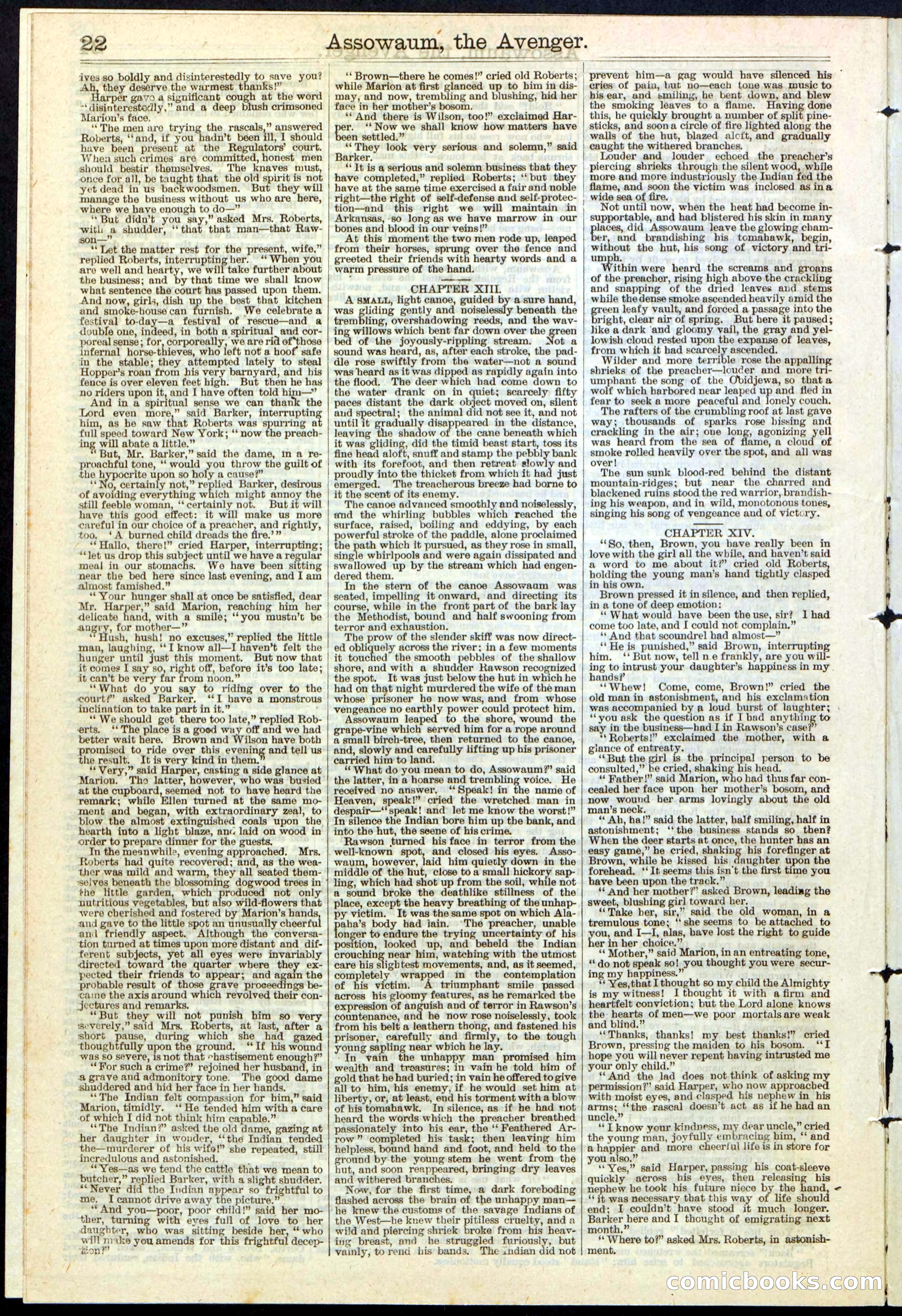
A restored page from Pulp Fiction, 1881. Page through the whole issue in the reader above.
📄 Transcribed text from this page (OCR, searchable)
Machine-transcribed from the original scan — historical spelling and the odd misread are preserved.
SS — — ee 8 er ee ee os . ———_— a — ae eer = pe ee Se ee el ——_ —o ives so boldly and disinterestedly to save they deserve the warmest thanks!” arper gavo a significant cough at the word ~‘disinterestedly,” and a deep blush crimsoned Marion’s face, “The men are trying. the rascals,” answered Roberts, ‘‘and, if you hadn’t been ill, I should have been present at the Regulators’ court. When such crimes are committed, honest men should bestir themselves, The knaves must, once for all, be taught that the old spirit is not yet dead in us backwoodsmen. But they will manage the business without us who are here, where we have enough to do—” “But didn’t you say,” asked Mrs. Roberts, with a shudder, ‘‘that that man—that Raw- son— ‘** Let the matter rest for the present, wife,” replied Roberts, interrupting her. “‘ When you are well and hearty, we will take further about the business; and by that time we shall know what sentence the court has passed upon them, And now, girls, dish up the best_that kitchen and smoke-house can furnish. We celebrate a festival to-day—a festival of rescue—and a double one, indeed, in both a spiritual_and cor- poreal sense; for, corporeally, we are rid of ‘those infernal horse-thieves, who left not a hoof’ safe in the stable; they attempted lately to steal Hopper’s roan from his very barnyard, and his fence is over eleven feet bigh. But then he has no riders upon it, and I have often told him—” And in a spiritual sense we can thank the Lord even more,” said Barker, interruptin him, as be saw that Roberts was spurring a full speed toward New York; ‘‘ now the preach- ing will abate a little.” ‘But, Mr. Barker,” said the dame, in a re- proachful tone, “ would you throw the guilt of the ME i het upon so holy a cause?” ‘* No, certainly not,” replied Barker, desirous of avoiding everything which might annoy the still feeble woman, ‘‘ certainly not. But it will have this good effect: it will make us more careful in our choice of a preacher, and rightly, too. ‘A burned child dreads the fire.’” ‘** Hallo, there!” cried Harper, interrupting; “let us drop this subject until we have a regular meal in our stomachs. We have been sitting near the bed here since last evening, and I am almost famished.” ‘Your hunger shall at once be satisfied, dear Mr. Harper,” said Marion, reaching him her delicate hand, with a smile; ‘you mustn’t be angiy: for mother—” ‘Hush, hush! no excuses,” replied the little man, laughing, ‘* I know all—I haven’t felt the hunger until just this moment. But now that if comes I say so, right off, before it’s too late; it can’t be very far from noon.” ‘““What do you say to riding over to the court?’ asked Barker, ‘‘I have a monstrous inclination to take part in it.” ‘We should get there too late,” replied Rob- erts. ‘‘ The place is a good way off and we had better wait here. Brown and Wilson have both promised to ride over this evening and tell us the result. It is very kind in them. ‘* Very,” said Harper, casting a side glance at Marion. Tho latter, however, who was busied at the cupboard, seemed not to have heard the you? remark; while Ellen turned at the same mo- ment and began, with extraordinary zeal, to blow the almost extinguished coals upon the hearth into a light blaze, anc laid on wood in order to prepare dinner for the guests. _ In the meanwhile, evening approached. Mrs. Roberts had quite recovered; and, as the wea- ther was mild and warm, they all seated them- ‘selves beneath the blossoming dogwood trees in the little garden, which produced not only nutritious vegetables, but also wild-flowers that were cherished and fostered by Marion’s hands and gave to the little spot an unusually cheerful ani friendly aspect. Although the conversa- tion turned at times upon more distant and dif- ferent subjects, yet all eyes were invariably directed toward the quarter where they ex- pected their friends to appear; and again the probable result of those grave proceedings be- caine the axis around which revolved their con- jectures and remarks. “But they will not punish him so very severely,” said Mrs. Roberts, at last, after a short Pa during which she had gazed thoughtfully upon the ground, “If his wound was So severe, is not that “hastisement enough?” “For such a crime?” rejoined her husband, in @ grave and ee tone. The good dame shuddered and hid her face in her hands, “The Indian felt compassion for him,” said Marion, timidly. ‘‘ He tended him with a care of which I did not think him capable.” *““The Indian?” asked the old dame, gazing at her daughter in wonder, ‘the Indian tended the—murderer of his wife!” she repeated, still incredulous and astonished. . ““Yes—as we tend the cattle that we mean to butcher,” papied Barker, with a slight shudder. *“Never did the Indian appre, so frightful to me. I cannot drive away the picture.” *“And you—poor, poor child!” said her mo- ther, turning with eves full of love to her daughter, who was sitting beside her, ‘ who will make you amends for this frightful decep- zon? | | | EE eee eee ee ee Sa ‘* Brown—there he comes!” cried old Roberts; | prevent him—a gag would have silenced his ~ | while Marion at first glanced up to him in dis- may, and now, trembling and blushing, hid her face in her mother’s bosom. ‘* And there is Wilson, too!” exclaimed Har- r. ‘* Now we shall know how matters have n settled.” ‘They look very serious and solemn,” said Barker. ‘*‘ It is a serious and solemn business that they have completed,” replied Roberts; ‘‘ but the have at the same time exercised a fair and noble right—the right of self-defense and self-protec- tion—and this right we will maintain in Arkansas, so long as we have marrow in our bones and blood in our veins!” At this moment the two men rode up, leaped from their horses, sprung over the fence and greeted their friends with hearty words and a warm pressure of the hand. CHAPTER XITIL. A SMALL, light canoe, guided by a sure hand, was gliding gently and noiselessly beneath the trembling, overshadowing reeds, and the wav- ing willows which bent far down over the green bed of the joyously-rippling stream. Not a sound was heard, as, after each stroke, the pad- dle rose swiftly from the water—not a sound was heard as it was dipped as rapidly again into the flood. The deer which had come down to the water drank on in quiet; scarcely fifty paces distant the dark object moved on, silent and spectral; the animal did not see it, and not | until if graduall inp Ue in the distance, leaving the shadow of the cane beneath which it was gliding, did the timid beast start, toss its fine head aloft, snuff and stamp the pebbly bank with its forefoot, and then retreat slow y and proudly into the thicket from which it had just emerged. The treacherous breeze had borne to it the scent of its enemy. The canoe advanced smoothly and noiselessly, and the whirling bubbles which reached the surface, raised, boiling and eddying, by each powerful stroke of the paddle, alone proclaimed the path which it pursued, as they rose in small single whirlpools and were again dissipated an swallowed up by the stream which had engen- dered them. In the stern of the canoe Assowaum was seated, impelling it onward, and directing its course, while in the front part of the bark lay the Methodist, bound and half swooning from terror and exhaustion. The prow of the slender skiff was now direct- ed obliquely across the river; in a few moments it touched the smooth pebbles of the shallow shore, and with a shudder Rawson recognized the spot. It was just below the hut in which he had on that night murdered the wife of the man whose prisoner he now was, and from whose vengeance no earthly power could protect him. Assowaum leaped to the shore, wound the ape-vine which served him for a rope around a small birch-tree, then returned to the canoe, and, slowly and carefully lifting up his prisoner carried him to land. ‘““What do you mean to do, Assowaum?” said the latter, in a hoarse and trembling voice. He received no answer. “Speak! in the name of Heaven, speak!” cried the wretched man in despair—‘‘ speak! and let me know the worst!” In silence the Indian bore him up the bank, and into the hut, the seene of his crime. Rawson turned his face in terror from the well-known spot, and closed his eyes. Asso- waum, bowever, laid him quietly down in the middle of the hut, close to a small hickory sap- ling, which had shot up from the soil, while not a sound broke the deathlike stillness of the place, except the heavy breathing of the unhap- py victim. It was the same spot on which Ala- aha’s body had iain. ©The preacher, unable onger to endure the trying uncertainty of his position, looked up, and beheld the Indian crouching near him, watching with the utmost care his slightest movements, and, as it seemed, completely wrapped in the contemplation of his victim. triumphant smile passed across his gloomy features, as he remarked the expression of anguish and of terror in Rawson’s countenance, and he now rose noiselessly, took from his belt a leathern thong, and fastened his prisoner, carefully and firmly, to the tough young sapling near which he lay. In vain the unhappy man promised him wealth and treasures; in vain he told him of gold that he had buried; in vain he offered to give all to him, his enemy, if he would set him at liberty, or, at least, end his torment with a blow of his tomahawk. In silence, as if he had not heard the words which the preacher breathed passionately into his ear, the ‘‘ Feathered Ar- row” ‘completed his task; then leaving him helpless, bound hand and foot, and held to the ground by the young stem he went from the hut, and soon reappeared, bringing dry leaves and withered branches. : Now, for the first time, a dark foreboding flashed across the brain of the unhappy man— ‘he knew the customs of the savage Indians of the West—he knew their pitiless cruelty, and a wild and piercing shriek broke from his heav- ing breast, and he struggled furiously, but vainly, torend his bands, The indian did not Assowaum, the Avenger. | | | en ee ee cries of pain, but no—each tone was. music to his ear, and smiling, he bent down, and blew the grr. gy ia to a flame. Having done this, he quickly brought a number of split pine- sticks, and soona circle of fire lighted along the walls of the hut, blazed alcft, and gradually caught the withered branches. Louder and louder echoed the preacher’s piercing shrieks through the silent wood, while more and more industriously the Indian fed the flame, and soon the victim was inclosed as ina _ wide sea of fire. Not until now, when the heat had become in- supportable, and had blistered his skin in many pao, did Assowaum leave the glowing cham- r, and brandishing his tomahawk, begin, without the hut, his song of victory and tri- “— ithin were heard the screams and groans of the preacher, rising high above the crackling and snapping of the dried leaves and stems while the dense smoke ascended heavily amid the een leafy vault, and forced a passage into the right, clear air of spring. But here it paused; like a dark ‘and gloomy vail, the gray and yel- lowish cloud rested upon the expanse of leaves, from which it bad ry ye. ascended. Wilder and more terrible rose the appalling shrieks of the preacher—loucer and more tri- | umphant the song of the Obidjewa, so thata wolf which harbored near leaped oP and fled in fear to seek a more peaceful and lonely couch, The rafters of the crumbling roof at last gave way; thousands of sparks rose hissing and crackling in the air; one long, agonizing yell was heard from the sea of flame, a cloud of smoke rolled heavily over the spot, and all was over! The sun sunk blood-red behind the distant mountain-ridges; but near the charred and blackened ruins stood the red warrior, brandish- ing his weapon, and in wild, monotonous tones, singing his song of vengeance and of victory. CHAPTER XIV. ‘“So, then, Brown, you bave really been in love with the girl all the while, and haven’t said a word to me about it?’ cried old Roberts holding the young man’s hand tightly clasped in his own. Brown pressed it in silence, and then replied, in a tone of deep emotion: ‘‘ What would have been the use, sir? I had come too late, and I could not complain.” ‘** And that scoundrel had almost—” ‘* He is punished,” said Brown, interrupting him. ‘‘ But now, tell ne frankly, are you will- ing to intrust your daugbter’s happiness in my hands?’ ‘‘*Whew! Come, come, Brown!” cried the old man in astonishment, and his exclamation was accompanied by a loud burst of laughter; . ‘‘you ask the question as if I bad anything to say in the business—had I in Rawson’s case?” ‘* Roberts!” exclaimed the mother, with a giance of entreaty. ‘‘But the girl is the principal person to be consulted,” be cried, shaking his head. “ Wather!” said Marion, who had thus far con- cealed her face upon her mother’s bosom, and now wound her arms lovingly about the old man’s neck, ** Ah, ha!” said the latter, balf smiling, half in astonishment; ‘‘the business stands so_ then? When the deer starts at once, the hunter has an easy game,” he cried, shaking his forefinger at Brown, while he kissed his daughter upon the forehead. ‘‘ It seems this isn't the first time you have been upon the track.” ‘¢ and her mother?” asked Brown, leading the sweet, blushing girl toward her, “Take her, sir,” said the old woman, in a tremulous tone; ‘‘she seems to be attached to ou, and I—I, alas, bave lost the right to guide er in her choice.” ‘‘ Mother,” said Marion, in an entreating tone, “do not speak so! you thought you were secur- ing my happiness.” ’ ‘* Yes,that I thought so my child the Almighty is my witness! I thought it with a firm and heartfelt conviction; but the Lord alone knows the hearts of men—we poor mortals are weak and blind.” ‘““Thanks, thanks! my best thanks!” cried Brown, pressing the maiden to his bosom. ‘‘I hope you will never repent having intrusted me your only child.” i “And the lad does not think of asking m permission?” said Harper, who now approsap with moist eyes, and clasped his nephew in_his arms; ‘‘the rascal doesn’t act as if he had an uncle,” “‘T know your kindness, my dear uncle,” cried the young man, joyfully embracing him, “* and a happier and more cheerful life is in store for you also.” ; ; ‘Yes,’ said Harper, passing his coat-sleeve quickly across his eyes, then pes his nephew he took his future niece by the hand ‘¢ it was necessary that this way of life should end: I couldn’t have stood it much longer. Barker here and I thought of emigrating next month,” e ** Where to?” asked Mrs. Roberts, in astonish- ment. ’ ; ‘ os ) | ' MICO KS (c Cc (0) (EO)