
Pulp Fiction, 1881 · page 20 of 24
Beadle's New York Dime Library No. 124 — page 20: what you’re looking at
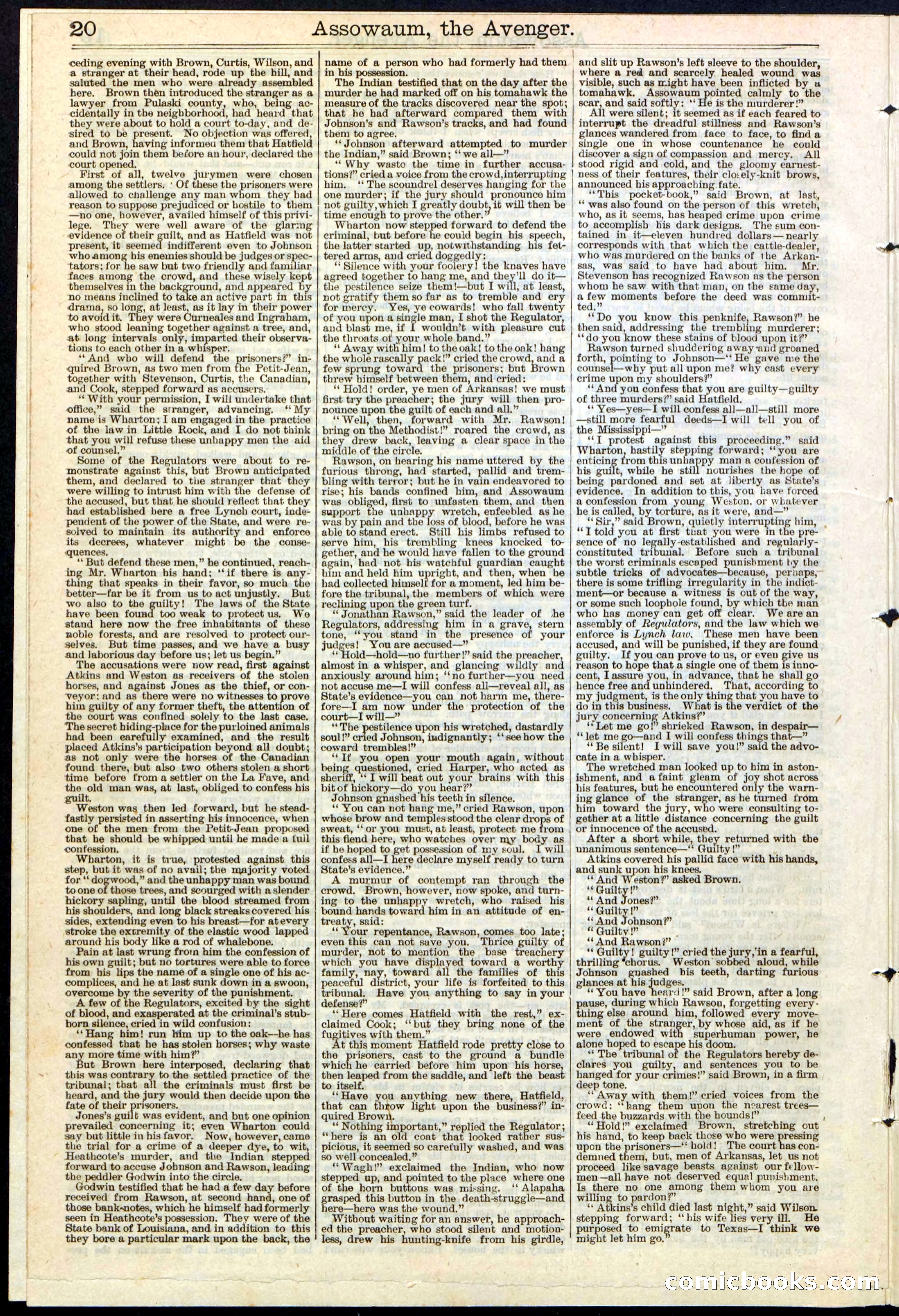
A restored page from Pulp Fiction, 1881. Page through the whole issue in the reader above.
📄 Transcribed text from this page (OCR, searchable)
Machine-transcribed from the original scan — historical spelling and the odd misread are preserved.
et Oe ee | ee eee =. —_— 2 =~ ~——- ese * a ~m -~ — 20 ee ee | ceding evening with Brown, Curtis, Wilson, and a stranger at their head, rode up the hill, and saluted the men who were already assembled here. Brown thén introduced the stranger as a lawyer from Pulaski county, who, being ac- cidentally in the neigbborhood, had heard that they were about to hold a court to-day, and de- sired to be chard g No objection was offered and Brown, having informed them that Hatfiel could not join them before an hour, declared the court ope First of all, twelve jurymen were chosen among the settlers. ‘ Of these the prisoners were allowed to challenge any man whom they had reason to suppose prejudiced or bostile to them —no one, however, availed himself of this privi- lege. They were well aware of the glarmng evidence of their guilt, and as Hatfield was not present, it seemed indifferent even to Johnson who among his enemies should be judges or spec- tators; for he saw but two friendly and familiar faces among the crowd, and these wisely kept themselves in the background, and appeared b no means inclined to take an active part in this drama, so long, at least, as it lay in their power to avoid it. They were Curneales and Ingraham, who stood leaning together against a tree, and, at long intervals only, imparted their observa- tions to each other in a whisper. ‘*And who will defend the prisoners?’ in- ired Brown, as two men from the Petit-Jean, together with Stevenson, Curtis, the Canadian, and Cook, stepped forward as accusers. ““With your permission, I will undertake that office,” said the stranger, advancing. ‘‘ My name is Wharton; I am engaged in the practice of the law in Little Rock, and I do not think that you will refuse these unhappy men the aid of counsel,” Some of the Regulators were about to re- monstrate against this, but Brown anticipated them, and declared to the stranger that they were willing to intrust him with the defense of the accused, but that he should reflect that they had established here a free Lynch court, inde- pendent of the power of the State, and were re- solved to maintain its authority and enforce its decrees, whatever might the conse- quences. ‘* But defend these men,” he continued, reach- ing Mr. Wharton his hand; ‘‘if there is nr thing that speaks in their favor, so much the better—far be it from us to act unjustly. But wo also to the guilty! The laws of the State have been found too weak to protect us. We stand here now the free inhabitants of these noble forests, and are resolved to protect our- selves. But time passes, and we have a busy and laborious day before us; let us begin.” The accusations were now read, first against Atkins and Weston as receivers of the stolen horses, and against Jones as the thief, or con- ‘veyor: and as there were no witnesses to prove him guilty of any former theft, the attention of the court was confined solely to the last case. The secret hiding-place for the purloined animals had been earefully examined, and the result placed Atkins’s participation beyond all doubt; as not only were the horses of the Canadian found there, but also two others stolen a short time before from a settler on the La Fave, and bor old wan was, at last, obliged to confess his guilt. Weston wag then led forward, but he stead- fastly persisted in asserting his innocence, when one of the men from the Petit-Jean proposed that he should be whipped until he made a tuill confession, Wharton, it is true, protested against this step, but it was of no avail; the majority voted for * << ” and the unhappy man was bound to one of those trees, and scourged with a slender hickory sapling, until the blood streamed from his shoulders, and long black streaks covered his sides, extending even to his breast—for atevery stroke the extremity of the elastic wood lapped around his body like a rod of whalebone. Pain at last wrung froin him the confession of his own guilt; but no tortures were able to force from his lips the name of a single one of his ac- complices, and he at last sunk down in a swoon, overcome by the severity of the punishment. A few of the Regulators, excited by the sight of blood, and exasperated at the criminal’s stub- born silence, cried in wild confusion: ‘‘Hang bim! run him up to the oak—-he has couiaaed that he has stolen horses; why waste any more time with him?’ ut Brown here interposed, declaring that this was contrary to the settled practice of the tribunal; tbat all the criminals must first be heard, and the jury would then decide upon the fate of their prisoners. Jones’s guilt was evident, and but one opinion prevailed concerning it; even Wharton could say but little in hisfavor. Now, however, came the trial for a crime of a deeper dye, to wit, ' Heatheote’s murder, and the Indian stepped forward to accuse Jobnson and Rawson, leading the peddJer Godwin into the circle. Godwin testified that he had a few day before received from Rawson, at second hand, one of those bank-notes, which he himself had formerly seen in Heathcote’s sion. They were of the State bank of Louisiana, and in addition to this they bore a particular mark upon the back, the —_— -—_——— name of a person who had formerly had them in bis possession. The Indian testified that on the day after the murder he had marked off on his tomahawk the measure of the tracks discovered near the spot; that he had afterward compared them with Johnson’s and Rawson’s tracks, and had found them to agree. ‘* Johnson afterward attempted to murder the Indian,” said Brown; ‘‘ we all—” ‘“Why wasto the time in further accusa- tions?” cried a voice from the crowd, interrupting him. ‘ The scoundrel deserves hanging for the one murder; if the jury should pronounce him not guilty,which I greatly doubt, it will then be time enough to prove the other.’ Wharton now stepped forward to defend the criminal, but before he could begin his speech, the latter started up, notwithstanding his fet- tered arms, and cried doggedl ‘¢ Silence with your foolery! the knaves have | agreed together to hang me, and perf do it— the pestilence seize them!—but I will, at least, not gratify them so far as to tremble and cry for merey. Yes, ye cowards! who fall twenty of you upon a single man, I shot the Regulator, and blast me, if 1 wouldn’t with pleasure cut the throats of your whole band.” ** Away with him! to the oak! to the oak! hang the whole rascally pack!” cried the crowd, and a fow sprung toward the prisoners; but Brown threw himself between them, and cried: ** Hold! order, ye men of Arkansas! we must first try the preacher; the jury will then pro- nounce upon the guilt of each and all.” ‘* Well, then, forward with Mr. Rawson! bring on the Methodist!” roared the crowd, as they drew back, leaving a clear space in the midale of the circle. Rawson, on hearing his name uttered by the furious throng, had started, pallid and trem- bling with terror; but he in vain endeavored to rise; his bands confined him, and Assowaum was obliged, first to unfasten them, and then support the unhappy wretch, enfeebled as he was by pain and the loss of blood, before he was able to stand erect. Still his limbs refused to serve him, his trembling knees knocked to- gether, and he would have fallen to the ground again, had not his watcbful —— caught him and held him upright, and then, when he had collected himself for a moment, led him be- fore the tribunal, the members of which were reclining upon the green turf. ‘‘ Jonathan Rawson,” said the leader of jhe Regulators, addressing him in a grave, stern tone, “you stand in the presence of your judges! You are aecused—” ** Hold—hold—no further!” said the preacher almost in a whisper, and glancing wildly and anxiously around him; ‘‘no further—you need not accuse me—I will confess all—reveal all, as State’s evidence—you can not harm me, there- fore—I am now under the protection of the court—I will—” ‘*The pestilence upon his wretched, dastardly soul!” cried Johnson, indignantly; ‘‘ see how the coward trembles!” ‘If you open your mouth again, without being questioned, cried Harper, who acted as sheriff, ‘‘ I will beat out your brains with this bitof hickory—do you hear?” Johnson gnuashed his teeth in silence. ** You can not hang me,” cried Rawson, upon whose brow and temples stood the clear drops of sweat, ‘Sor you must, at least, protect me from this fiend here, who watches over my body as if he hoped to get possession of my soul. I will confess all—I here declare myself ready to turn State’s evidence.” A murmur of contempt ran through the crowd. Brown, however, now spoke, and turn- ing to the unhappy wretch, who raised his bound hands toward him in an attitude of en- treaty, said: ‘Your repentance, Rawson, comes too late; even this can not save you. Thrice guilty of murder, not to mention the base treachery which you have displayed toward a worthy family, nay, toward all the families of this peaceful district, your life is forfeited to this tribunal. Have you anything to say in your defense?” [ ‘‘ Here comes Hatfield with the rest,” ex- claimed Cook; ‘‘but they bring none of the fugitives with them.” t this moment Hatfield rode pretty close to the prisoners, cast to the ground a bundle which he carried before him upon his horse then leaped from the saddle, and left the beast to itself. ‘‘Have you anything new there, Hatfield, that can throw light upon the business?” in- quired Brown. ‘“‘ Nothing important,” replied the Regulator ; “here is an old coat that looked rather sus- picious, it seemed so carefully washed, and was so well concealed.” **Wagh!” exclaimed the Indian, who now stepped up, and pointed to the place where one of the horn buttons was missing. ‘‘ Alapaha gaan this button in the death-struggle—and ere—here was the wound,” Without waiting for an answer, he approach- ed the preacher, who stood silent and motion- less, drew his hunting-knife from his girdle, Assowaum, the Avenger. | ness of t and slit up Rawson’s left sleeve to the shoulder, where a red and searcely healed wound was visible, such as might have been inflicted by u tomahawk, Assowaum pointed calmly to the scar, and said softly: ‘‘ He is the murderer!” All were silent: it seemed as if each feared to interrupt the dreadful stillness and Rawson’s glances wandered from face to face, to finda single one in whose countenance he could discover a sign of compassion and mercy. All stood ee and cold, and the gloomy earnest- ieir features, their cloc:ely-knit brows, announced his approaching fate. ‘*This pocket-book,” said Brown, at last, ‘** was also found on the person of this wretch, who, as it seems, has heaped crime upon crime to accomplish his dark designs. The sum con- tained in it—eleven hundred dollars— nearly corresponds with that which the cattle-dealer, who was murdered on the banks of the Arkan- sas, was said to have had about him. Mr, Stevenson has recognized Rawson as the person whom he saw with that man, on the same day, a a moments before the deed was commit- ted. ‘Do you know this penknife, Rawson?” he then said, addressing the trembling murderer; ‘*do you know these stains of blood upon it?’ Rawson turned shudéeriog away and groaned forth, pees to Johnson—‘' He gave me the counsel—why put all upon me? why cast every crime upon my shoulders?” ‘* And you confess that you are guilty—guilty of three murders?’ said Hatfield. ‘* Yes—yes—I will confess a]l—all—still more —still more fearful deeds—I will tell you of the Mississippi—” ‘“‘T protest against this proceeding.” said Wharton hastily stepping forward; ‘“‘you are enticing from this unha py man a confession of his guilt, while he still nourishes the hope of being pardoned and set at liberty as State’s evidence. In addition to this, you have forced a confession from young Weston, or whatever he is called, by torture, as it were, and—” “ Sir,” said Brown, quietly interrupting him, . “T told you at first that you were in the pre- sence of no legally-established and regularly- coustituted tribunal. Before such a tribunal the worst criminals escaped punishment tiy the subtle tricks of advocates—because, perlaps, there is some trifling irregularity in the indict- ment—or because a witness is out of the way, or some such loophole found, by which the man who has money can get off clear. We are an assembly of Regulators, and the law which we enforce is Lynch law, These men have been accused, and will be punished, if they are found guilty. If you can prove to us, or even give us reason to hope that a single one of them is inno- cent, I assure you, in advance, that he shall go hence free and unhindered, That, according to my judgment, is the only thing that you have to do in this business. What is the verdict of the jury concerning Atkins?’ ‘*Let me go!” shrieked Rawson, in despair— ‘let me go—and I will confess things that—” ** Be silent! I will save you!” said the advo- cate in a whisper. The wretched man looked up to him in aston- ishment, and afaint gleam of joy shot across his features, but he encountered only the warn- ing glance of the stranger, as he turned from him toward the jury, who were consulting to- gether at a little distance concerning the guilt or innocence of the accused. After a short while, they returned with the unanimous sentence—‘* Guilty !” : Atkins covered his pallid face with his hands, and sunk upon his knees, ** And Weston?” asked Brown. ** Guilty!” * And Jones?” ** Guilty!” ** And Johnson?” * Quilty!” ' ‘* And Rawson?” % Guilty! guilty!” cried the jury, in a fearful, thrilling “chorus. Weston sobbed aloud, while Johnson gnashed bis teeth, darting furious glances at his fndges. ‘You have heard!” said Brown, after a long pause, during which Rawson, forgetting every - thing else around him, followed every move- ment of the stranger, by whose aid, as if he were endowed with superhuman power, he alone hoped to escape his doom. “The tribunal of the Regulators hereby de- clares you guilty, and sentences you to be hanged for your crimes!” said Brown, in a firm deep tone. ‘‘ Away with them!” cried voices from the crowd: “hang them upon the nearest trees— feed the buzzards with the hounds!” “Hold!” exclaimed Brown, stretching out his hand, to keep back those who were pressing upon the prisoners—‘‘ hold! The court has con- demned them, but, men of Arkansas, let us not proceed like savage beasts against our fellow- men—all have not deserved equal punishment. Is there no one among them whom you are willing to pardon?” “ Afkins's child died last night,” said Wilson stepping forward; “‘his wife lies very ill. He kit go to emigrate to Texas—I think we might let him go, JOOKS m (EO) (C (E(0)