
Pulp Fiction, 1881 · page 12 of 24
Beadle's New York Dime Library No. 124 — page 12: what you’re looking at
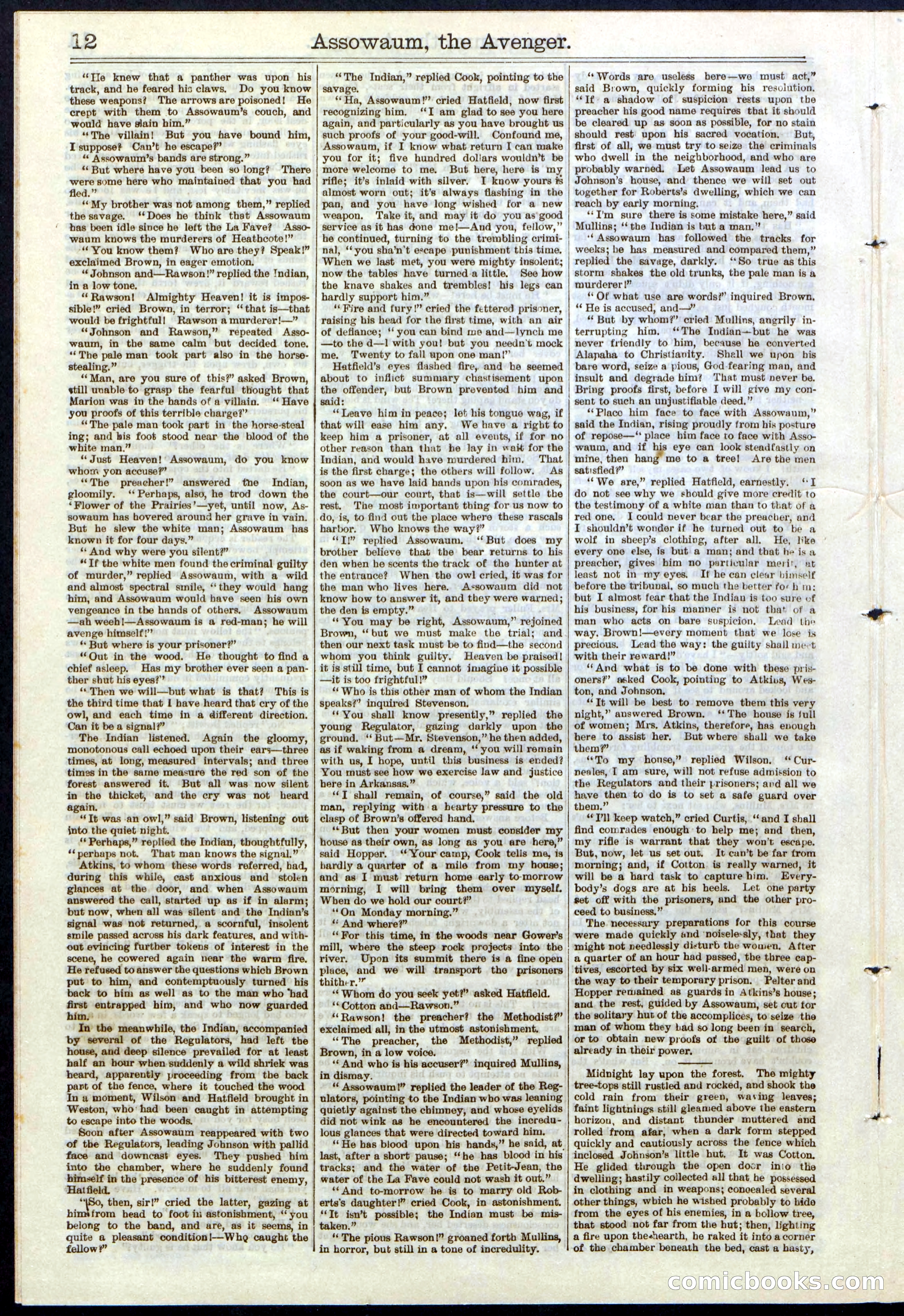
A restored page from Pulp Fiction, 1881. Page through the whole issue in the reader above.
📄 Transcribed text from this page (OCR, searchable)
Machine-transcribed from the original scan — historical spelling and the odd misread are preserved.
“Tle knew that a panther was upon his track, and he feared his claws, Do you know these weapons? The arrows are poisoned! He crept with them to Assowaum’s couch, and would have slain him.” “The villain! But you have bound him, I suppose? Can’t he escape?” “ Assowaum’s bands are strong.” “ But where have you been so long? There were some here who maintained that you had fled.” ‘“My brother was not among them,” replied the savage. ‘*Does he think that Assowaum has been idle since he left the La Fave? Asso- waum knows the murderers of Heathcote!” ‘You know them? Who are they? Speak!” exclaimed Brown, in eager emotion. “ Johnson and—Rawson!” replied the Indian, in a low tone, “Rawson! Almighty Heaven! it is impos- sible!” cried Brown, in terror; “that is—that would be frightful! Rawson a murderer!—” “Johnson and Rawson,” repeated Asso- waum, in the same calm but decided tone. ‘“‘The pale man took part also in the horse- stealing.” ‘‘Man, are you sure of this?’ asked Brown, still unable to grasp the fearful thought that Marion was in the hands of a villain. ‘‘ Have you proofs of this terrible charge?” “The pale man took part in the horse-steal ing; and bis foot stood near the blood of the white man.” “Just Heaven! Assowaum, do you know whom yon accuse?” “The preacher!” answered the Indian, gloomily. ‘* Perbaps, also, he trod down the ‘Flower of the Prairies’—yet, until now, As- sowaum has hovered around her grave in vain. But he slew the white man; Assowaum has known it for four days.” ** And why were you silent?” “If the white men found the criminal guilty of murder,” replied Assowaum, with a wild and almost spectral smile, “they would hang him, and Assowaum would have seen his own vengeance in the hands of others, Assowaum —ah weeh!|—Assowaum is a red-man; he will avenge himself!’’ ‘* But where is your prisoner?” ‘‘QOut in the wood. He thought to find a chief asleep. Has my brother ever seen a pan- ther shut his eyes?” ‘Then we will—but what is that? This is the third time that I have heard that cry of the owl, and each time in a different direction. Can it be a signal?” The Indian listened. Again the gloomy, monotonous call echoed upon their ears—three times, at long, measured intervals; and three times in the same measure the red son of the forest answered it. But all was now silent in the thicket, and the cry was not heard again. “It was an owl,” said Brown, listening out into the quiet night. ‘* Perhaps,” replied the Indian, thoughtfully, *‘perbaps not. That man knows the signal.” Atkins, to whom these words referred, bad, during this while, cast anxious and stolen glances at the door, and when Assowaum answered the call, started up as if in alarm; but now, when all was silent and the Indian’s signal was not returned, a scornful, insolent smile passed across his dark features, and with- out evincing further tokens of interest in the scene, he cowered again near the warm fire. He refused to answer the questions which Brown put to him, and contemptuously turned his back to him as well as to the man who ‘had first entrapped him, and who now guarded him, In the meanwhile, the Indian, accompanied by several of the Regulators, had left the house, and deep silence prevailed for at least half an hour when suddenly a wild shriek was heard, apparently proceeding from the back part of the fence, where it touched the wood In « moment, Wilson and Hatfield brought in Weston, who’ had been caught in attempting to escape into the woods, Secon after Assowaum reappeared with two of the Regulators, leading Johnson with pallid face and downcast eyes. They pushed him into the chamber, where he suddenly found himself in the presence of his bitterest enemy, Hat field. . “\So, then, sir!” cried the latter, gazing at himsfrom head to foot in astonishment, ‘ you belong to the band, and are, as it seems, in quite a pleasant condition|—Whe caught the fellow ?” — “The Indian,” replied Cook, pointing to the savage. **Ha, Assowaum!”’ cried Hatfield, now first recognizing him, ‘I am glad to see you here again, and particularly as you have brought us such proofs of your good-will. Confound me, Assowaum, if I know what return I can make you for it; five hundred dollars wouldn’t be more welcome to me. But here, here is my rifle; it’s inlaid with silver. I know yours és almost worn out; it’s always flashing in the pan, and you have long wished for a new weapon. Take it, and may it do you as’ good service as it has done me!—And you, fellow,” he continued, turning to the trembling crimi- nal, ‘‘ you sha’n't escape punishment this time. When we last met, you were mighty insolent; now the tables have turned:a little. See how the knave shakes and trembles! his legs can hardly support him.” ‘‘ Fire and fury!’ cried the fettered prisoner, raising his head for the first time, with an air of defiance; *‘ you can bind me and—lynch me —to the d—1l with you! but you needn't mock me. Twenty to fall upon one man!”’ Hatfield’s eyes flashed fire, and he seemed about to inflict summary chastisement upon the offender, but Brown prevented him and said: ‘‘Leave him in peace; let his tongue wag, if that will ease him any. We have a right to keep him a prisoner, at all eveuts, if for no other reason than that he lay in wait for the Indian, and would have murdered him, That is the first charge; the others will follow. As soon as we have laid bands upon his comrades, the court—our court, that is—will settle the rest, The most important thing for us now to do, is, to find out the place where these rascals harbor. Who knows the way?” “TT!” replied Assowaum. ‘But does my brother believe that the bear returns to his den when he scents the track of the hunter at the entrance? When the owl cried, it was for the man who lives here. Assowaum did not know how to answer it, and they were warned; the den is empty.” ‘““You may be right, Assowaum,” rejoined Brown, ‘but we must make the trial; and then our next task must be to find—the second whom you think guilty. Heaven be praised! it is still time, but I cannot imagine it possible —it is too frightful!” ‘* Who is this other man of whom the Indian speaks?” inquired Stevenson. ‘You shall know presently,” replied the young Regulator, gazing darkly upon the ground, ‘ But—Mr. Stevenson,” he then added, as if waking from a dream, ‘ you will remain with us, I hope, until this business is ended? You must see how we exercise law and justice here in Arkansas.” ‘*T shall remain, of course,” said the old man, replying with a hearty pressure to the clasp of Brown’s offered hand. ‘*But then your women must consider my house as their own, as long as you are here,” said Hopper. ‘Your camp, Cook telis ma, is bardly a quarter of a mile from my house; and as I must return home early to-morrow morning, I will bring them over myself. When do we hold our court?” ‘“‘On Monday morning.” * And where?” “For this time, in the woods near Gower’s mill, where the steep rock projects into the river. Upon its summit there is a fine open place, and we will transport the prisoners thither.” ‘Whom do you seek yet?” asked Hatfield. ‘“Cotton and—Rawson.” ‘‘Rawson! the preacher? the Methodist?’ exclaimed all, in the utmost astonishment, “The preacher, the Methodist,” replied Brown, in a low voice. ‘¢ And who is his accuser?” inquired Mullins, in dismay. “ Assowaum!” replied the leader of the Reg- ulators, pointing to the Indian who was leaning quietly against the chimney, and whose eyelids did not wink as he encountered the incredu- lous glances that were directed toward him. ‘He has blood upon his hands,” he said, at last, after a short pause; “he has blood in his tracks; and the water of the Petit-Jean, the water of the La Fave could not wash it out.” ‘*And to-morrow he is to marry old Rob- erts's daughter!” cried Cook, in astonishment. ‘Tt isn’t possible; the Indian must be mis- taken.” ‘The pious Rawson!” groaned forth Mullins, in horror, but still in a tone of incredulity. Assowaum, the Avenger. ee — ee ee e—™ ee See Ee ‘‘ Words are useless here—we must act,” said Brown, quickly forming his resointion, “Tf a shadow of suspicion rests upon the preacher his good name requires that it should be cleared up as soon as possible, for no stain should rest’ upon his sacred vocation. But, first of all, we must try to seize the criminals who dwell in the neighborhood, and who are probably warned. Let Assowaum lead us to Johnson’s house, and thence we will set out together for Roberts’s dwelling, which we can reach by early morning. ‘‘I’m sure there is some mistake here,” said Mullins; ‘‘ the Indian is but a man,” ‘‘Assowaum has followed the tracks for weeks; he has measured and compared them,” replied the savage, darkly. ‘So true as this storm shakes the old trunks, the pale man is a murderer |” ‘Of what use are words?” inquired Brown, ‘* He is accused, and—” ** But by whom?” cried Mullins, angrily in- terrupting him. “The Indian—but he was never friendly to him, because he converted Alapaha to Christianity. Shell we upon his bare word, seize a pious, God-fearing man, and insult and degrade him? That must never be. Bring proofs first, before I will give my con- sent to such an unjustifiable deed.” ‘‘Placo him face to face with Assowaum,” said the Indian, rising proudly from his posture of repose—‘ place him face to face with Asso- waum, and if his eye can look steadfastly on mine, then hang me to a tree! Are the men satisfied?’ ‘*'We are,” replied Hatfield, earnestly. ‘TI do not see why we should give more credit to the testimony of a white man than to that of a red one. I could never bear the preacber, and I shouldn’t wonder if he turned out to be a wolf in sheep’s clothing, after all, He, like every one else, is but a man; and that he is a preacher, gives bim no particular merit, at least not in my eyes. If he can clear himself before the tribunal, so much the better for h m: but I almost fear that the Indian is too sure of his business, for his manner is not that of a man who acts on bare suspicion, Lead the way. Brown!—every moment that we lose is precious. Lead the way: the guilty shall meet with their reward!” ‘‘And what is to be done with these pris- oners?” asked Cook, pointing to Atkius, Wes- ton, and Johnson, “‘Tt will be best to remove them this very night,” answered Brown. ‘* The house is full of women; Mrs, Atkins, therefore, has enough here to assist her. But where shall we take them?” ‘To my honse,” replied Wilson, Cur- neales, IT am sure, will not refuse admission to the Regulators and their prisoners; and all we have then to do is to set a safe guard over them.” | “Tl keep watch,” cried Curtis, “and I shall find comrades enough to help me; and then, my rifle is warrant that they won't escape. But, now, let us set out. It cun’t be far from morning; and, if Cotton is really warned, it will be a hard task to capture him. Every- body’s dogs are at his heels. Let one party set off with the prisoners, and the other pro- ceed to business,” The necessary preparations for this course were made quickly and ‘noisele-sly, that they might not needlessly disturb the wowen, After a quarter of an hour had passed, the three eap- tives, escorted by six well-armed men, were on the way to their temporary prison. Pelter and Hopper remained as guards in Atkins’s house; and the rest, guided by Assowaum, set out tor the solitary hut of the accomplices, to seize the man of whom they had so long been in search, or to obtain new proofs of the guilt of those already in their power, Midnight lay upon the forest, The mighty tree-tops still rustied and rocked, and shook the cold rain from their green, waving leaves; faint lightnings still gleamed above the eastern horizon, and distant thunder muttered and rolled from afar, when a dark form stepped quickly and cautiously across the fence which inclosed Johnson’s little but, It was Cotton. He glided through the open docr inio the dwelling; hastily collected all that he possessed in clothing and in weapons; concealed several other things, wbich he wished probably to hide from the eyes of his enemies, in a hollow tree, that stood not far from the hut; then, lighting a fire upon theehearth, be raked it into a corner of the chamber beneath the bed, cast a hasty, w~ EORNIELOOOLKS (E (E (0)