
Pulp Fiction, 1881 · page 2 of 32
Beadle's New York Dime Library No. 115 — page 2: what you’re looking at
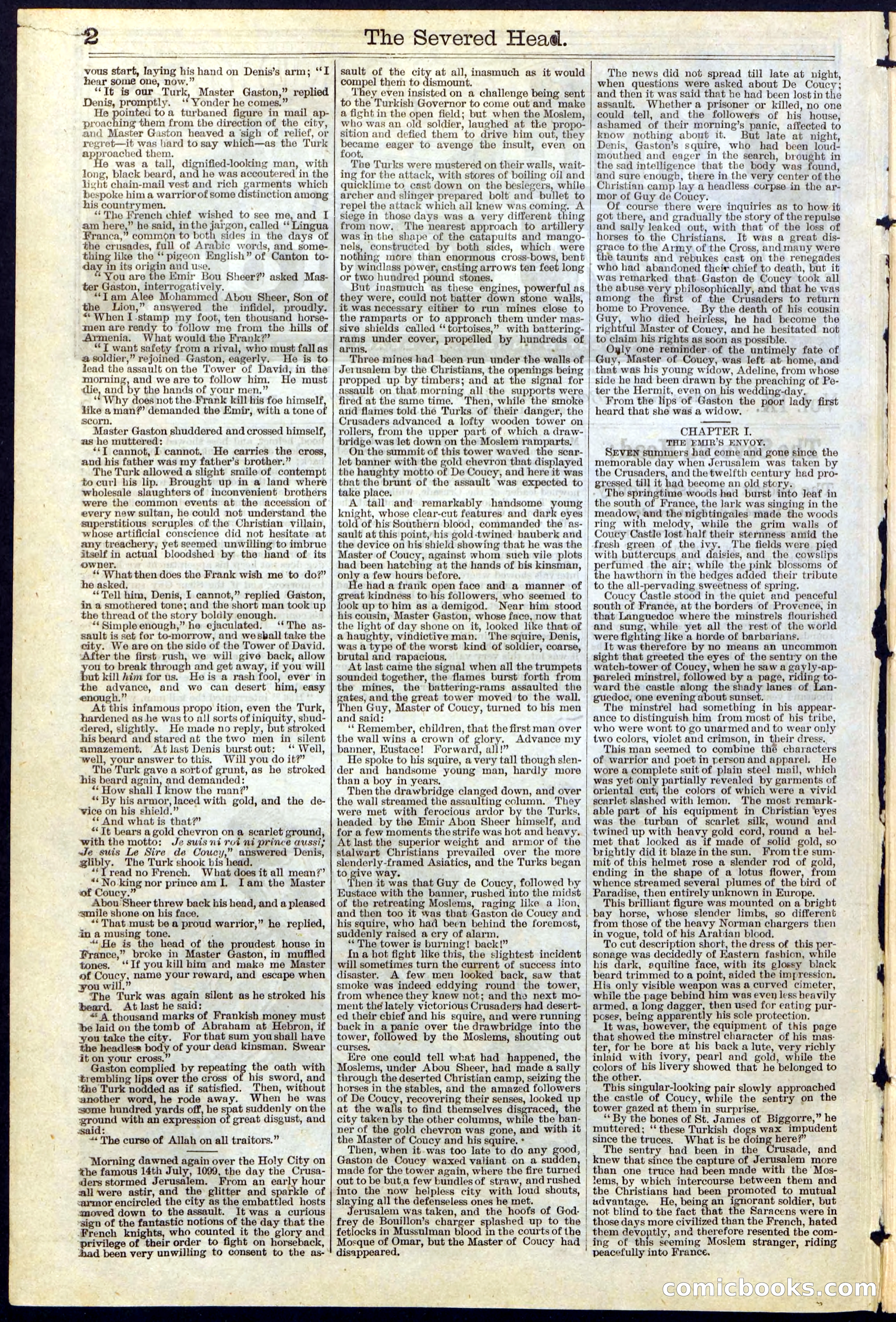
A restored page from Pulp Fiction, 1881. Page through the whole issue in the reader above.
📄 Transcribed text from this page (OCR, searchable)
Machine-transcribed from the original scan — historical spelling and the odd misread are preserved.
“2 vous start, laying his hand on Denis’s arm; ‘“‘I hear some one, now.” “Tt is our Turk, Master Gaston,” replied Denis, promptly. ‘‘ Yonder he comes.” He pointed toa turbaned figure in mail ap- proaching them from the direction of the city, and Master Gaston heaved a sigh of relief, or regret—it was hard to say which—as the Turk approached them. fe was a tall, dignified-looking man, with long, black beard, and he was accoutered in the Licht chain-mail vest and rich garments which bespoke him a warriorof some distinction among his countrymen. ‘The French chief wished to see me, and I am here,” he said, inthe jargon, called ‘ Lingua Franca,” common to both sides in the days of the crusades, full of Arabic words, and some- thing like the “‘ pigeon English” of Canton to- day in its or and use. ‘You are the Emir Bou Sheer?’ asked Mas- ter Gaston, interrogatively. “Tam Aleoe ohaiamed’ Abou Sheer, Son of the Lion,” answered the infidel, proudly. “When I.stamp my foot, ten thousand horse- men are ready to follow me from the hills of Armenia. What would the Frank?’ “T want safety from a rival, who must fall as a soldier,” rejoined Gaston, eagerly. He is to lead the assault on the Tower of David, in the morning, and we are to follow him, He must die, and by the hands of your men,” ‘** Why does not the Frank kill his foe himself like a man?’ demanded the Emir, with a tone of scorn. Master Gaston shuddered and crossed himself, as he muttered: ‘‘T cannot, I cannot. He carries the cross, and his father was my father’s brother.” The Turk allowed a slight smile of contempt to curl his lip. Brought up in a land where wholesale slaughters of inconvenient brothers were the common events at the accession of every new sultan, he could not understand the superstitious scruples of the Christian villain, whose artificial conscience did not hesitate at any treachery, yet seemed unwilling to imbrue itself in actual bloodshed by the hand of its wher. ** What then does the Frank wish me to do?” he asked. “Tell him, Denis, I cannot,” replied Gaston, in a smothered tone; and the short man took up the thread of the story boldly enough. ‘* Simple enough,” he ejaculated. ‘'The as- sault is set for to-morrow, and wesball take the city. We are on the side of the Tower of David. ‘After the first rush, we will give back, allow ou to break through and get away, if you will ut kill him for us. He is a rash fool, ever in the advance, and woe can desert him, easy enough.” At this infamous propo ition, even the Turk, hardened as he was to all sorts of iniquity, shud- alered, gt He made no reply, but stroked his beard and stared at the two men in silent amazement. Atlast Denis burstout: ‘ Well, well, your answer to this. Will you do it?” _ The Turk gave a sortof grunt, as he stroked his beard again, and demanded: «How shall I know the man?” ** By his armor, laced with gold, and the de- ‘vice on his shield.” “* And what is that?” *“‘It bears a gold chevron on a scarlet ground, with the motto: Je swis ni rot ni prince aussi; de suis Le Sire de Coucy,” answered Denis, glibly. The Turk shook bis head. _ “Tl read no French. What does it all mean?’ “*No king nor princeam I, Iam the Master of Coucy.” Abou Sheer threw back his head, and a pleased samile shone on his face, “That must be a proud warrior,” he replied, in a musing tone. ; - “ He is the head of the proudest house in France,” broke in Master Gaston, in muffled tones. ‘If youkill him and make me Master of eee name your reward, and escape when Ul. you wi 4 The Turk was again silent as he stroked his beard. At last he said: | “4 thousand marks of Frankish money must be laid on the tomb of Abraham at Hebron, if wou take the city. For that sum youshall have the headless body of your dead kinsman, Swear it on your cross.” : Gaston complied by repeating the oath with ‘trembling lips over the cross of his sword, and ‘fhe Turk nodded as if satisfied. Then, without another word, he rode away. When he was some hundred yards off, he iy suddenly on the —— with an expression of great disgust, and said: < curse of Allah on all traitors.” Morning dawned again over the Holy City on *he famous 14th July, 1099, the day the Crusa- ders stormed Jerusalem. From an bed 4 hour all were astir, and the glitter and sparkle of varmor encircled the city as the embattled hosts smoved down to the assault. It was a curious ‘sign of the fantastic notions of the day that the French knights, who counted it the glory and ‘privilege of their order to fight on horseback, dad been very unwilling to consent to the as- The ) Severed Head. sault of the city at all, inasmuch as it would compel them to dismount. They even insisted on a challenge being sent to the Turkish Governor to come out and make a fightin the open field; but when the Moslem, who was an old soldier, laughed at the propo- sition and defied them to drive him out, they became eager to avenge the insult, even on | foot. _ The Turks were mustered on their walls, wait- ing for the attack, with stores of boiling oil and quicklime to. cast down on the besiegers, while archer and slinger prepared bolt and bullet to repel the attack which all knew was coming. A siege in those days was a very different thing from now. The nearest approach to artillery was in fhe shape of the catapults and mango- nels, constructed by both sides, which were nothing more than enormous cross-bows, bent by windlass power, casting arrows ten foet long or two hundred pound stones, But inasmuch as these engines, powerful as they were, could not batter down stone walls, it was necessary either to run mines close to the ramparts or to approach them under mas- sive shields called ‘‘ tortoises,” with battering- rams under cover, propelled by hundreds of arms. . Three mines had been run under the walls of Jerusalem by the Christians, the openings being propped up by timbers; and at the signal for assault on that morning all the supports were fired at the same time. Then, while the smoke and flames told the Turks of their danger, the Crusaders advanced a lofty wooden tower on rollers, from the upper part of which a draw- bridge was let down on the Moslem ramparts. On the summit of this tower waved the scar- let banner with the gold chevron that displayed the haughty motto of De Coucy, and here it was that the brunt of the assault was expected to tale place. A tall and remarkably handsome young knight, whose clear-cut features and dark eyes told of his Southern blood, commanded the as- sault at this point, his gold-twined bauberk and the device on his shield showing that he was the Master of Coucy, against whom such vile plots had been hatching at the hands of bis kinsman, only a few hours before. He had a frank open face and a manner of great kindness to his followers, who seemed to look up to him as a demigod. Near him stood his cousin, Master Gaston, whose face, now that the light of day shone on it, looked like that of a haughty, vindictive man. ‘The squire, Denis, was a type of the worst kind of soldier, coarse, brutal and rapacious. At last came the signal when all the trumpets sounded together, the flames burst forth from the mines, the battering-rams assaulted the gates, and the great tower moved to the wall. Then Guy, Master of Coucy, turned to bis men and said: ‘* Remember, children, that the first man over the wall wins a crown of glory. Advance my banner, Eustace! Forward, all!” | oF? SE The news did not spread till late at night, when questions were asked about De Coucy; and then it was said that he had been lost in the assault. Whether a prisoner or killed, no one could tell, and the followers of his house, ashamed of their morning’s panic, affected to know nothing about it. But late at night, Denis, Gaston’s squire, who had been loud- mouthed and eager in the search, brought in the sad intelligence that the body was found, and sure enough, there in the very center of the Christian camp lay a headless corpse in the ar- mor of Guy de Coucy. Of course there were inquiries as to how it got there, and gradually the story of the repulse and sally leaked out, with that of the loss of horses to the Christians. It was a great dis- grace to the Army of the Cross, and many were the taunts and rebukes cast on the renegades who had abandoned their chief to death, but it was remarked that. Gaston de Coucy took all the abuse vory Lhicrophicelly, and that he was among the first of the Crusaders to return home to Provence. By the death of his cousin Guy, who died heirless, he had become the rightful Master of Couey, and he hesitated not to claim his rights as soon as possible. Oyly one reminder. of the untimely fate of Guy, Master of Coucy, was left at- home, and that was his young widow, Adeline, from whose side he had been drawn by the preaching of Pe- ter the Hermit, even on his wedding-day. From the lips of Gaston the poor lady first heard that she was a widow. °* CHAPTER I. THE EMIR’S ENVOY. SEVEN summers had come and gone since the memorable day when Jerusalem was taken by the Crusaders, and the twelfth century had pro- gressed till it had become an old story. The springtime woods had burst into Jeaf in the south of France, the lark was singing in the meadow, and the nightingales made the woods ring with melody, while the grim walls of _ Coucy Castle lost half their sternness amid the He spoke to his squire, a very tall though slen- | der and handsome young man, hardly more than a boy in years. Then the drawbridge clanged down, and over the wall streamed the assaulting column. They were met with ferocious ardor by the Turks, headed by the Emir Abou Sheer himself, and for a few moments the strife was hot and heavy, At last the superior weight and armor of the stalwart Christians prevailed over the more slenderly-framed Asiatics, and the Turks began to give way. Then it was that Guy de Coucy, followed by Eustace with the banner, rushed into the midst of the retreating Moslems, raging like a lion, and then too it was that Gaston de Coucy and his squire, who had been behind the foremost, suddenly raised a cry of alarm. ‘The tower is burning! back!” In a hot fight like this, the slightest incident will sometimes turn the current of success into disaster. A few men looked back, saw that smoke was indeed eddying round the tower, from whence they knew not; and tha next mo- ment thé lately victorious Crusaders had desert- ed their chief and his squire, and were running buck in a panic over the drawbridge into the tower, followed by the Moslems, shouting out curses, Kre one could tell what had happened, the Moslems, under Abou Sheer, had made a sally through the deserted Christian camp, seizing the horses in the stables, and the amazed followers of De Coucy, recovering their senses, looked up at the walls to find themselves disgraced, the city taken by the other columns, while the ban- ner of the gold chevron was gone, and with it the Master of Coucy and his squire. + Then, when it-was too late to do any good, Gaston de Coucy waxed valiant on a sudden made for the tower again, where the fire turned out to be but.a few bundles of straw, and rushed into the now helpless city with loud shouts, slaying all the defenseless ones he met. erusalem was taken, and the hoofs of God- frey de Bouillon’s charger splashed up to the fetiocks in Mussulman blood in the courts of the Mosque of Omar, but the Master of Coucy had disappeared, i fresh green of the ivy. The fields were pied with buttercups and daisies, and the cowslips | perfumed the air; while the pink blossoms of the hawthorn in the hedges added their tribute to the all-pervading sweetness of spring. Coucy Castle stood in the quiet and peaceful south of France, at the borders of Provence, in that Languedoc where the minstrels flourished and sung, while yet all the rest of the world were fighting like a horde of barbarians. It was therefore by no means an uncommon sight that greeted the eyes of the sentry on the watch-tower of Coucy, when he saw a gayly-ap- pareled minstrel, followed by a page, riding to- ward the castle along the shady lanes of Lan- guedoce, one evening about sunset. The minstrel had something in his appear- ance to distinguish him from most of his tribe, who were wont to go unarmed and to wear only two colors, violet and crimson, in their dress. This man seemed to combine thé characters of warrior and poet in person and apparel. He wore a complete suit of plain steel mail, which was yet only partially revealed by garments of oriental cut, the colors of which were a vivid scarlet slashed with lemon. The most remark- able part of his equipment in Cbristian ‘eyes was the turban of scarlet silk, wound and twined up with heavy gold cord, round a hel- met that looked as if made of solid gold, so brightly did it blazein the sun. From tke sum- mit of this helmet rose a slender rod of gold, ending in the shape of a lotus flower, from whence streamed several plumes of the bird of Paradise, then entirely unknown in Europe. This brilliant figure was mounted on a bright bay horse, whose slender limbs, so different from those of the heavy Norman chargers then in vogue, told of his Arabian blood. To cut description short, the dress of this per- Sonne was doggedly of Eastern fashion, while his dark, oequiline face, with its glossy black beard trimmed to a point, aided the impression. His only visible fd et was a curved cimeter, while the page behind him was evey less heavily armed, a long dagger, then used for eating pur- poses, being apparently his sole protection. It was, however, the equipment of this page that showed the minstrel character of his mas- ter, for he bore at his back a lute, very richly inlaid with ivory, pearl and gold, while the colors of his livery showed that he belonged to the other. This singular-looking pair slowly approached the castle of Coucy, while the sentry on the tower gazed at them in surprise. ‘* By the bones of St. James ot Biggorre,” he muttered; ‘‘ these Turkish dogs wax impudent since the truces. What is he sere The sentry had been in the Crusade, and knew that since the capture of Jerusalem more than one truce had been made with the Mos- tems, by which intercourse between them and the Christians had been promoted to mutual udvantage. He, being an ignorant soldier, but not blind to the fact that the Saracens were in those days more civilized than the French, hated them devontly, and therefore resented the com- ing of this seeming Moslem stranger, riding peacefully into France. (E (0) EComue IOOKS