
Pulp Fiction, 1881 · page 14 of 32
Beadle's New York Dime Library No. 115 — page 14: what you’re looking at
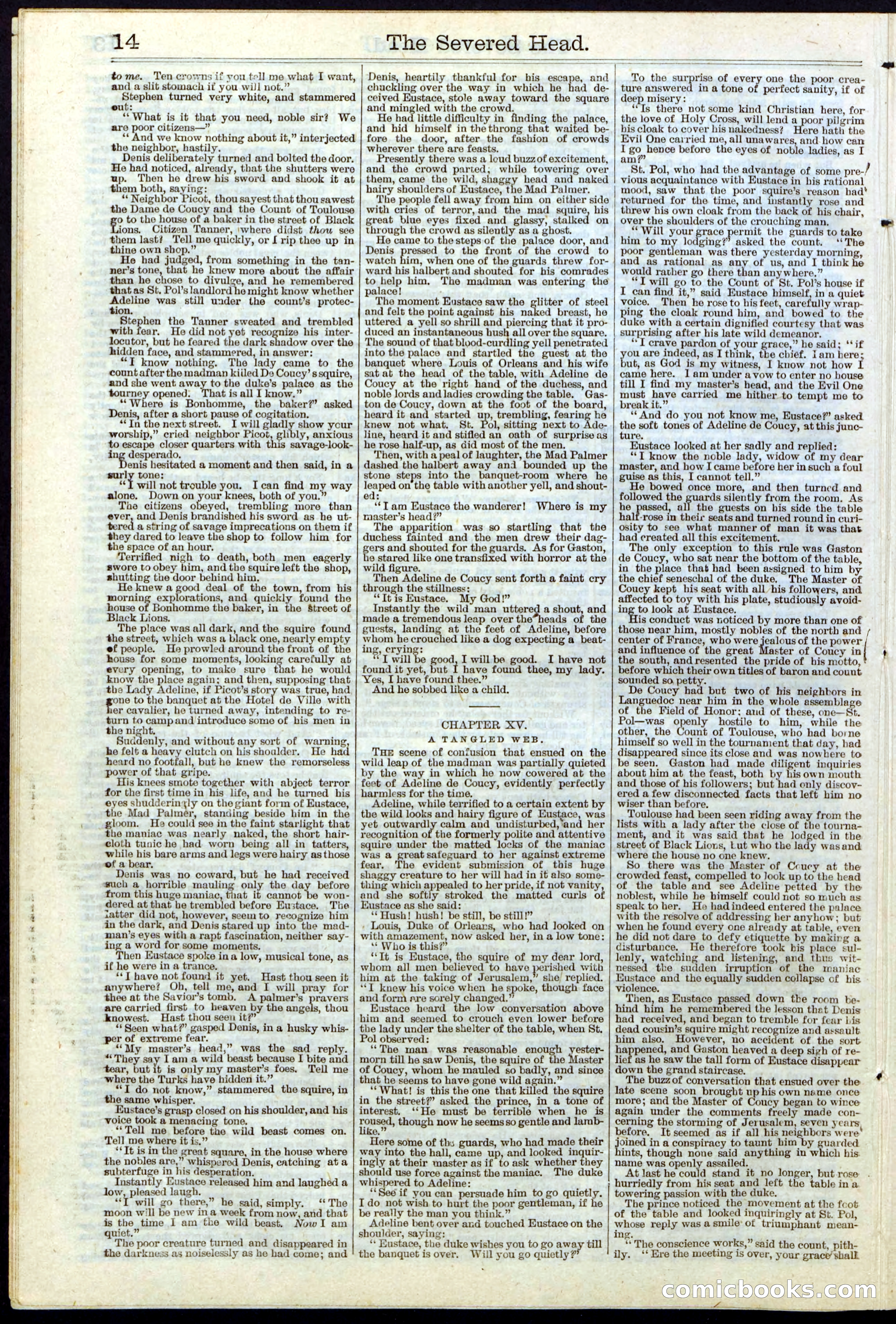
A restored page from Pulp Fiction, 1881. Page through the whole issue in the reader above.
📄 Transcribed text from this page (OCR, searchable)
Machine-transcribed from the original scan — historical spelling and the odd misread are preserved.
: | | ——* = —— ' , ' ‘ ! > ink o- 14 on — -- - — —_ — tome. Ten crowns if you tell me what I want, and a slit stomach if you will not.” Stephen turned very white, and stammered out: ‘‘ What is it that you need, noble sir? We are poor citizens—” ** And we know nothing about it,” interjected the neighbor, hastily. Denis deliberately turned and bolted the door. He had noticed, already, that the shutters were Then he drew his sword and shook it at up. them both, saying: ** Neighbor Picot, thou sayest that thou sawest the Dame de Coucy and the Count of Toulouse o to the house of a baker in the street of Black ions. Citizen Tanner, where didst thou see them last? Tell me quickly, or [ rip thee up in thine own shop.” He had judged, from something in the tan- ner’s tone, that he knew more about the affair than he chose to divulge, and he remembered that as St. Pol’s landlord he might know whether Adeline was still under the count’s protec- tion. Stephen the Tanner sweated and trembled with fear. He did not yet recognize his inter- locutor, but he feared the dark shadow over the hidden face, and stammered, in answer: “I know nothing. The lady came to the count after the madman killed De Coucy’ s squire, and she went away to the duke’s palace as the tourney opened. That is all I know.” “Where is Bonhomme, the baker?’ asked Denis, after a short pause of cogitation. “In the next street. I will g nf show your worship,” cried neighbor Picot, glibly, anxious to escape closer quarters with t ing’ desperado, enis hesitated a moment and then said, in a marly tone: **T will not trouble you. Ican find my way alone. Down on your knees, both of you.” The citizens obeyed, trembling more than ever, and Denis brandished his sword as he ut- tered a string of savage imprecations on them if they dared to leave the shop to follow him for the space of an hour. Terrified nigh to death, both men eagerly swore to obey him, and the squire left the shop, shutting the door behind him, He knew a good deal of the town, from his morning explorations, and quickly found the house of Bonhomme the baker, in the Street of Black Lions. The place was all dark, and the squire found the street, which was a black one, nearly empty ef people. He prowled around the front of the house for some moments, looking carefully at every opening, to make sure that he would know the place again; and then, supposing that the Lady Adeline, if Picot’s story was true, had gene to the banquet at the Hotel de Ville with er cavalier, he turned away, intending to re- turn fo campand introduce some of his men in the night. Suddenly, and without any sort of warning he felt a heavy clutch on his shoalder. He ha heard no footfall, but he knew the remorseless power of that gripe. His knees smote together with abject terror for the first time in his life, and he turned his eyes shudderingly on the giant form of Eustace, the Mad Palmer, standing beside him in the loom. He could see in the faint starlight that he maniac was nearly naked, the short hair- cloth tunic he had worn being all in tatters, while his bare arms and legs were hairy as those of a bear. Denis was no coward, but he had received such a horrible mauling only the day before trom this huge maniac, that it cannot won- dered at that he trembled before Eustace. The iatter did not, however, seem to recognize him in the dark, and Denis stared up into the mad- man’s eyes with a rapt fascination, neither say- ing a word for some moments. Then Eustace spoke ina low, musical tone, as if he were in a trance. ‘*T have not found it yet. Hast thou seen it anywhere? Oh, tell me, and I will pray for thee at the Savior’s tomb. A palmer’s pravers are carried first to heaven by the angels, thou knowest. Hast thou seen it?” ‘Seen what?” gasped Denis, in a husky whis- per of extreme fear. “‘My master’s head,” was the sad reply. “They say I am a wild beast because I bite and tear, but it is only my master’s foes. Tell me where the Turks have hidden it.” “IT do not know,” stammered the squire, in the same whisper. Eustace’s grasp closed on his shoulder, and his voice took a menacing tone. ‘“‘Tell me before the wild beast comes on. Tell me where it is.” ‘* Tt is in the great square, in the house where the nobles are,” whispered Denis, catching at a subterfuge in his desperation. Instantly Eustace released him and laughed a low, pleased laugh. “T will go there,” he said, simply. ‘‘ The moon will be new ina week from now, and that is the time I am the wild beast. Now I am quiet.” The poor creature turned and disappeared in the darkness as noiselessly as he had come; and savage-look- The Severed Flead. Denis, heartily thankful for his escape, and chuckling over the way in which he had de- ceived Eustace, stole away toward the square and mingled with the crowd. He had little difficulty in finding the palace, and hid himself in the throng that waited be- fore the door, after the fashion of crowds wherever there are feasts. Presently there was a leud buzzof excitement, and the crowd parted; while towering over them, came the wild, shaggy head and naked hairy shoulders of Eustace, the Mad Palmer. The people fell away from him on either side with cries of terror,and the mad squire, his great blue eyes fixed and glassy, stalked on through the crowd as silently as a ghost. He came to the steps of the palace door, and Denis pressed to the front of the crowd to watch him, when one of the guards threw for- ward his halbert and shouted for his comrades to help him, The madman was entering the palace! The moment Eustace saw the glitter of steel and felt the point against his naked breast, he uttered a yell so shrill and piercing that it pro- duced an instantaneous ae all over the square. The sound of that blood-curdling yell penetrated into the palace and startled the guest at the banquet where Louis of Orleans and his wife sat at the head of the table, with Adeline de Coucy at the right hand of the duchess, and noble lords and ladies crowding the table. Gas- ton de Coucy, down at the foot of the board, heard it and started up, trembling, fearing he knew not what. St. Pol, sitting next to Ade- line, heard it and stifled an oath of surprise as he rose half-up, as did most of the men. Then, with a peal of laughter, the Mad Palmer dashed the halbert away and bounded up the stone steps into the banquet-room where he nore on the table with another yell, and shout- ed: ‘‘Tam Eustace the wanderer! Where is my master’s head?” The apparition was so startling that the duchess fainted and the men drew their dag- ers and shouted for the guards. As for Gaston, 6 stared like one transfixed with horror at the wild figure. Then Adeline de Coucy sent forth a faint cry through the stillness: “It is Eustace. My God!” Instantly the wild man By aa shout, and made a tremendous leap over the*heads of the guests, landing at the feet of Adeline, before whom he crouched like a dog expecting a _beat- ing, cree ‘I will be good, I will be good. I have not found it yet, but I have found thee, my lady. Yes, I have found thee.” And he sobbed like a child. CHAPTER XV. A TANGLED WEB, THE scene of confusion that ensued on the wild leap of the madman was partially quieted by the way in which he now cowered at the feet of Adeline de Coucy, evidently perfectly harmless for the time. Adeline, while terrified to a certain extent by the wild looks and hairy figure of Eustace, was yet outwardly calm and undisturbed, ‘and her recognition of the formerly polite and attentive squire under the matted locks of the maniac was a greatsafeguard to her against extreme fear. The evident submission of this huge shaggy creature to her will had in it also some- thing which appealed to her pride, if not vanity, and she softly stroked the matted curls of Eustace as she said: ‘* Hush! hush! be still, be still!” ' Louis, Duke of Orleans, who had looked on with amazement, now asked her, in a low tone: ‘* Who is this?” *‘Tt is Eustace, the squire of my dear lord, whom all men believed to have perished with him at the taking of Jerusalem,” she) replied. ‘“T knew his voice when he spoke, though face and form are sorely changed.” Eustace heard the low conversation above him and seemed to crouch even lower before the lady under the shelter of the table, when St, Pol observed: “The man was reasonable enough yester- morn till he saw Denis, the squire of the Master of Coucy, whom he mauled so badly, and since that he seems to have gone wild again.” ‘** What! is this the one that killed the squire in the street?” asked the prince, in a tone of interest. ‘‘He must be terrible when he is Tone though now he seems so gentle and lamb- e, Here some of ths guards, who had made their way into the hall, came up, and looked inquir- ingly at their master as if to ask whether they should use force against the maniac. The duke whispered to Adeline: : ‘‘Seé if you can persuade him to go quietly. I do not wish to burt the poor gentleman, if he be really the man you think.” Adeline bent over and touched Eustace on the shoulder, saying: ** Eustace, the duke wishes you to go away till the banquet is over. Will you go quietly? re — Ae eee To the surprise of every one the poor crea- ture answered in a tone of perfect sanity, if of deep misery : ‘Is there not some kind Christian here, for the love of Holy Cross, will lend a poor pilgrim his cloak to cover his nakedness? Here hath the Evil One carried me, all unawares, and how can I go, hence before the eyes of noble ladies, as I am St. Pol, who had the advantage of some pre-/ vious acquaintance with Eustace in bis rational mood, saw that the poor squire’s reason had’ returned for the time, and instantly rose and threw his own cloak from the back of his chair, over the shoulders of the crouching man, “Will your grace permit the guards to take him to my lodging?” asked the count. ‘‘The poor gentleman was there yesterday morning, and as rational as any of us, and I think he would rather go there than any where.” “T will go to the Count of St. Pol’s house if I can find it,” said Eustace himself, in a quiet voice. Then he rose to his feet, carefully wrap- ping the cloak round him, and bowed to the uke with a certain dignified courtesy that was surprising after his late wild demeanor. ‘I crave pardon of your grace,” he said; ‘if ou are indeed, as I think, the chief. Iam here; ut, as God is my witness, I know not how L came here. I am under a vow to enter no house till I find my master’s head, and the Evil One must have carried me hither to tempt me to break it.” ‘“And do you not know me, Eustace?” asked the soft tones of Adeline de Coucy, at this junc- ture. Eustace looked at her sadly and replied: “*I know the noble lady, widow of my dear master, and how I came before her in such a foul guise as this, I cannot tell.” He bowed once more, and then turned and followed the guards silently from the room. As he , all the guests on bis side the table half-rose in their seats and turned round in curi- osity to see what manner of man it was that had created all this excitement. The only exception to this rule was Gaston de Coucy, who sat near the bottom of the table, in the place that had been assigned to him by the chief seneschal of the duke. The Master of Coucy kept his seat with all his followers, and affected to toy with his plate, studiously avoid- ing to look at Eustace. is conduct was noticed by more than one of those near him, mostly nobles of the north and ; center of France, who were jealous of the power and influence of the great Master of Coucy in| t the south, andresented the pride of bis motto, before which their own titles of baron and count sounded so. petty. De Coucy had but two of his neighbors in Languedoc near him in the whole assemblage of the Field of Honor; aud of these, one—St. Pol—was openly hostile to him, while the other, the Count of Toulouse, who had borne himself so well in the tournament that day, had disappeared since its close and was nowhere to seen. Gaston had made diligent inquiries about him at the feast, both by his own mouth and those of his followers; but had only discoy- ered a few disconnected facts that left him no wiser than before. . Toulouse had been seen riding away from the lists with a lady after the close of the tourna- ment, and it was said that he lodged in the street of Black Lions, Lut who the lady was and where the house no one knew. So there was the Master of Ccoucy at the crowded feast, compelled to Jook up to the head of the table and see Adeline petted by the noblest, while he himself could not so much as speak to her. He hadindeed entered the palace with the resolve of addressing her anyhow; but when he found every one already at table, even he did not dare to defy etiquette by making a disturbance. He therefore took bis place sul- lenly, watching and listening, and thus wit- nessed the sudden irruption of the maniac Eustace and the equally sudden collapse of his violence. Then, as Eustace passed down the room be- hind him he remembered the lesson thet Denis had received, and began to tremble for fear Lis dead cousin’s squire might recognize and assault him also. However, no accident of the sort happened, and Gaston heaved a deep sigh of re- lief as he saw the tall form of Eustace disappear down the grand staircase. 4 The buzz of conversation that ensued over the late scene soon brought up his own neme once more; and the Master of Coucy began to wince again under the comments freely made con- cerning the storming of Jerusalem, seven years before. It seemed as if all his ag al were yonen in a conspiracy to taunt him by guarded ints, though none said anything in which his. name was openly assailed. At last he could stand it no longer, but rose . hurriedly from his seat and left the table ina towering passion with the duke. The prince noticed the movement at the fcot of the table and looked inquiringly at St. Pol, whose reply was a smile’ ot triumphant mean- ing. ‘The conscience works,” said the count, pith- ily. ‘‘ Ere the meeting is over, your grace’ shall. com Eomicbooks oe 4 : -— — ——$———_— OO ———