
Pulp Fiction, 1880 · page 28 of 32
Beadle's Dime Library No. 111 — page 28: what you’re looking at
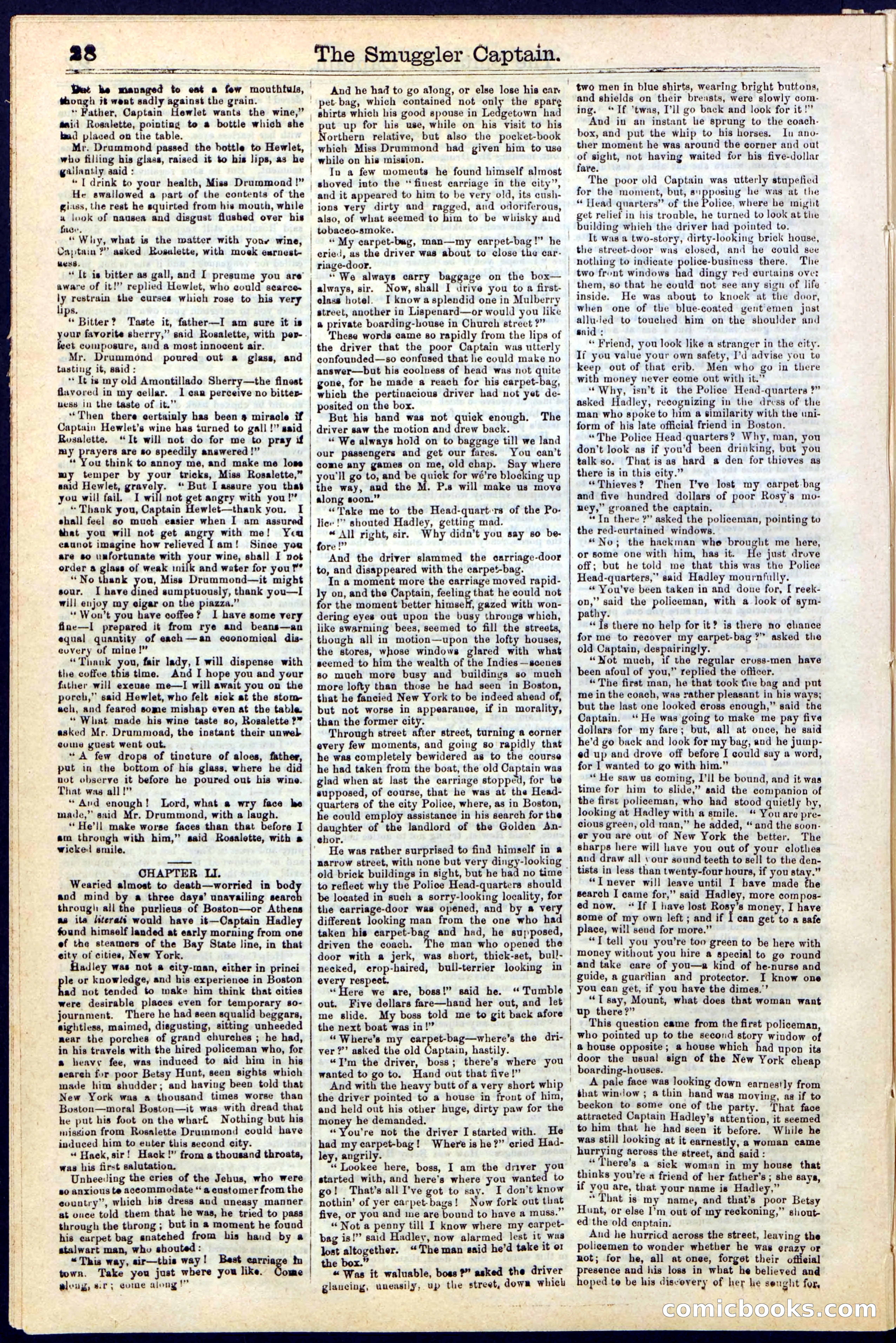
A restored page from Pulp Fiction, 1880. Page through the whole issue in the reader above.
📄 Transcribed text from this page (OCR, searchable)
Machine-transcribed from the original scan — historical spelling and the odd misread are preserved.
—<—————— . though jt went sadly against the grain. * Father, Captain Hewlet wants the wine,” amid Rosalette, pointing to a bottle which she ta] placed on the table. Mr. Drummond passed the bottle to Hewlet, who filling his glass, raised it to his lips, as he guiantly aaid : “ [| drink to your health, Miss Drummond !” He swallowed a part of the contents of the giiss, the rest he squirted from his mouth, while The Smuggler Captain. a ged to ent a few mouthtuls, u look of nausea and disgust flushed over his — fnew. “Why, what is the matter with yous wine, Unptain ?” asked Rosulette, with moek eurnest- wexs. “ [t is bitter as gall, and [ presume you are’ | aware of it!” replied Hewlet, who could searce M restrain the curses which rose to his very ips. ‘ Bitter? Taste it, father—I am gure it is your favorite yeatte said Rosalette, with pep- feet composure, and a most innocent air. Mr. Drummond poured out a glass, and tasting it, said : It is my old Amontillado Sherry—the finest flavored in my cellar. 1 cam perceive no bitter uess in the taste of it.” “Then there certainly has been 4 miracle if Captain Hewlet’s wine has turned to gall!’ said Rusalette. “It will not do for me to pray if my prayers are so speedily answered !” “ You think to annoy me, and make me lose my temper by your tricks, Miss Rosalette,” said Hewlet, gravely. “ But I assure you that you will fail. I will not get angry with you !” * Thank you, Captain Hewlet—thank you. shall feel so much easier when I am assured that you will not get angry with me! caunot imagine how relieved [am! Since you are so unfortunate with your wine, shall I not order 4 glass of weak iilk and water for you? “No thank you, Miss Drummond—it might sour. I have te sumptuously, thank you—I will enjoy my eigar on the piazza.” ‘‘Won’t you have coffee? I have some very fine—I prepared it from rye and beans—an equal quantity of each—an economical dis- evvery of mine!” “Thank you, fair lady, I will dispense with the coffee this time. And I hope you and your futher will exeuse me—I will await you on the porch,” said Hewlet, who felt sick at the stom ach, and feared some mishap even at the table ** What made his wine taste so, Rosalette ?” asked Mr. Drummoad, the instant their unweb come guest went out. ‘ “A few drops of tincture of aloes, father, put in the bottom of his glass, where he did not observe it before he poured out his wine. That was all!” “And enough! Lord, what a wry face he made,” anid Mr. Drummond, with a laugh. ‘He'll make worse faces than that before I ain through with him,” said Rosalette, with s wicked! smile. CHAPTER LI. Wearied almost to death—worried in bod aod mind by a three days’ unavailing searc throug): all the purlieus of Boston—or Athens as its isterats would have it—Captain Hadley found himself landed at early morning from one ef the steamers of the Bay State line, in that eity of cities, New York. Hadley was not @ city-man, either in princi le or knowledge, and his experience in Boston Pad not tended to make him think that cities were desirable places even for temporary s8o- journment. There he had seen squalid beggars, sightless, maimed, disgusting, sitting unheeded near the porches of grand churehes ; he had, in his travels with the hired policeman who, for a heavy fee, was induced to aid him in his seareh fur poor Betsy Hunt, seen sights which made him shudder; and having been told that New York was a thousand times worse than Boston—moral Boston—it was with dread that he put his foot on the wharf Nothing but his mission from Rosalette Drummond could have induced him to euter this second city. “ Hack, sir! Hack!” from a thousand throats, was his first salutation. Unheeding the cries of the Jebus, who were so anxious te accommodate “ a eustomer from the country”, which bis dress and uneasy manner at once told them that he was, he tried to pass through the throng ; but in a moment he found his eurpet bag snatehed from his hand by a stalwart man, who shouted : “This way, sir—this way! Best “Sb tu town. Take you just where you like. me @leug, er; come along 1" You | ae - e ee And he had to go along, or else lose his car pet- bag, which contained not only the spare shirts which his good spouse in Ledgetown had ut up for his use, while on his visit to his Northerd relative, but also the pocket-book which Miss Drummond had given him to use while on his mission. In a few momeuts he found himself almost shoved into the “finest carriage in the city”, and it appeared to him to be very old, its eush- ions very dirty and ragged, and odoriferous, also, of what seemed to him to be whisky and tobaceo-smoke. “My carpet-bag, man—my carpet-bag!” he eried, as the driver was about to close the car- riuge-door. * We always carry baggage on the box— always, sir. Now, shall I urive you to a first- olass hotel. I know asplendid one in Mulberry street, another in Lispenard—or would you like a private boarding-Louse in Church street ?” These words came so rapidly from the lips of the driver that the poor Captain was utterly - eonfounded—so confused that he could make no | | | mm answer—but his coolness of head was not quite gone, for he made a reach for his carpet-bag, which the pertinacious driver had not yet de- posited on the box. But his hand was not quick enough. The driver saw the motion and drew back. “ We always hold on to baggage till we land our passengers and get our fares. You can’t come any games on me, old chap. Say where you'll go to, and be quick for wé’re blocking up the way, and the M. P.s will make us move along soon.” “Take me to the Head-quart-rs of the Po- lice! shouted Hadley, getting mad. “All right, sir. Why didn’t you say so be- fore!” And the driver slammed the carriage-door to, and disappeared with the carpet-bag. In a moment more the carriage moved rapid- ly on, and the Captain, feeling that he could not or the moment better himself, gazed with won- dering eyes out upon the busy througs which, like swarming bees, seemed to fill the streets, though all in motion—upon the lofty houses, the stores, whose windows glared with what seemed to him the wealth of the Indies —scenes so much more busy and buildings so much more lofty than those he had seen in Boston, that he fancied New York to be indeed ahead of, but not worse in appearanee, if in morality, than the former city. Through street after street, turning a corner every few moments, and going so rapidly that he was completely bewidered as to the course he had taken from the boat, the old Captain was glad when at last the carriage stopped, for he supposed, of course, that he was at the Head- quarters of the city Police, where, as in Boston, he could employ assistance in his search for the daughter of the landlord of the Golden An- ehor. He was rather surprised to find himself in a narrow street, with none but very SS lve old brick buildings in sight, but he had no time to reflect why the Police Head-quarters should be located in such a sorry-looking locality, for the carriage-door was opened, and by a very different looking man from the one who had taken his earpet-bag and had, he su;posed, driven the coach. door with a jerk, was short, thick-set, bull- necked, erop-haired, bull-terrier looking im every respect, “Here we are, boss!” said he. “Tumble out. Five dellars fare—hand her out, and let me slide. My boss told me to git back afore the next boat was in!” “ Where’s my carpet-bag—where’s the dri- ver ?”’ asked the old Captain, hastily. “T’m the driver, boss; there’s where you wanted to go to. Hand out that five!” he man who opened the | inside. | | boarding-houses. And with the heavy butt of a very short whip | the driver pointed to a house in front of him, and held out his other huge, dirty paw for the money he demanded. “fs Yate not the driver I started with. He had my carpet-bag! Where is he?” cried Had- ley, angrily. “ Lookee here, boss, I am the driver you started with, and here’s where you wanted to go! That’s all I’ve got to say. I don’t know nothin’ of yer carpet-bags! Now fork out that five, or you and me are bound to have a muss.’ “Not a penny till I know where my carpet- bag is!” said Hadley, now alarmed lest 1t wus lost altogether. “The man said he’d take it o1 the box.” « Was it waluable, boss?’ asked the driver glaucing, uneasily, up the street, dows whieh | @ house opposite; a house which two men in blue shirts, wearing bright buttons, and shields on their breasts, were slowly com- ing. “If ‘twas, I'll go back and look for it!" And iu an instant le sprung to the coach- box, and put the whip to his horses. Iu ano- ther moment he was around the corner and out of sight, not having waited for his five-dollar fare. The poor old Captain was utterly stupefied for the moment, but, supposing he was at the * Hlead quarters” of the Police, where be migiit get reliet in his troable, he turned to look at the building which the driver had pointed to. It was a two-story, dirty-looking brick house, the street-door was elused, and he could see nothing to indicate police-business there. The two front windows had dingy red curtains over them, 80 that he eould not see any sign of life He was about to knock at the door, when one of the blue-coated yentemen just alluied to touched him on the shoulder and | gnid : “ Friend, you look like a stranger in the city. If you value your own safety, I'd advise you te | keep out of that crib. Men who go in there with money never come out with it.” “Why, isn’t it the Police Head-quarters ?” asked Hadley, recognizing in the dress of the man who spoke to him a similarity with the uni- form of his late official friend in Boston. “The Police Head quarters? Why, man, you don’t look as if you'd been drinking, bat you talk so. That is as hard a den for thieves as there is in this city.” “Thieves? Then I’ve lost my carpet bag and five hundred dollars of poor Rosy’s mo- ney,” groaned the captain. “In there ?” asked the policeman, pointing to the red-curtained windows. “No; the hackman whe brought me here, or some one with him, has it. Efe just drove off; but he told me that this was the Police Head-quarters,” said Hadley mournfully. “ You've been taken in and done for, [ reek- on,” said the policeman, with a look of sym- athy. 4 ‘ there no help for it? is there no chance for me to recover my carpet-bag ?” asked the old Captain, despairingly. “Wot much, if the regular cruss-men have been afoul of you,” replied the officer. “The first man, he that took tue bag and put me in the coach, was rather pleasant in his ways; but the last one looked cross enough,” said the Captain. “He was going to make me pay five dollars for my fare; but, all at once, he said he'd go back and look for my bag, and he jump- ed up and drove off before I could say a word, for I wanted to go with him.” ‘“* He saw us coming, I'll be bound, and it was time for him to slide,” said the companion of the first policeman, who had stood quietly by, looking at Hadley with a smile. “ You are pre- cious green, old man,” he added, “ and the soon- er you are out of New York the better. The sharps here will have you out of your clothes and draw all vour sound teeth to sell to the den- ‘| tists in less than twenty-four hours, if you stay.” “T never will leave until I bave made search I came for,’’ said Hadley, ed now. “If I have lost Ros some of my own left ; and if place, will send for more.” “I tell you you're too green to be here with money without you hire a special to go round and take care of you—a kind of he-nurse and guide, a guardian and protector. I know one you can get, if you have the dimes.’ “T say, Mount, what does that woman want up there?” This question came from the first policeman, who pointed up to the second story window of ad upon its door the usual sign of the New York cheap he more compos- 8 money, I have can get to a safe A pale face was looking down earnestly from shat window ; 8 thin hand was moving, aa if to beckon to some one of the party. ‘That face attracted Captain Hadley’s attention, it seemed to him that he had seen it before. While he was still looking at it earnestly, a woman came hurr ing across the street, and said : “'There’s a sick woman in my house that thinks you're « friend of her father’s ; she says, if you are, that your name ie Hadley,” “That is my name, and that’s poor Betsy Hunt, or else I’m out of my reckoning,” shout- ed the old captain. And he hurricd across the street, leaving the policemen to wonder whether he was a or ial not; for he, all at onee, forget their o press and his loss in what he believed and oped te be his diseovery of her he sought for, - en ee ome — (e(o) comilcbooks oA