
Pulp Fiction, 1880 · page 25 of 32
Beadle's Dime Library No. 111 — page 25: what you’re looking at
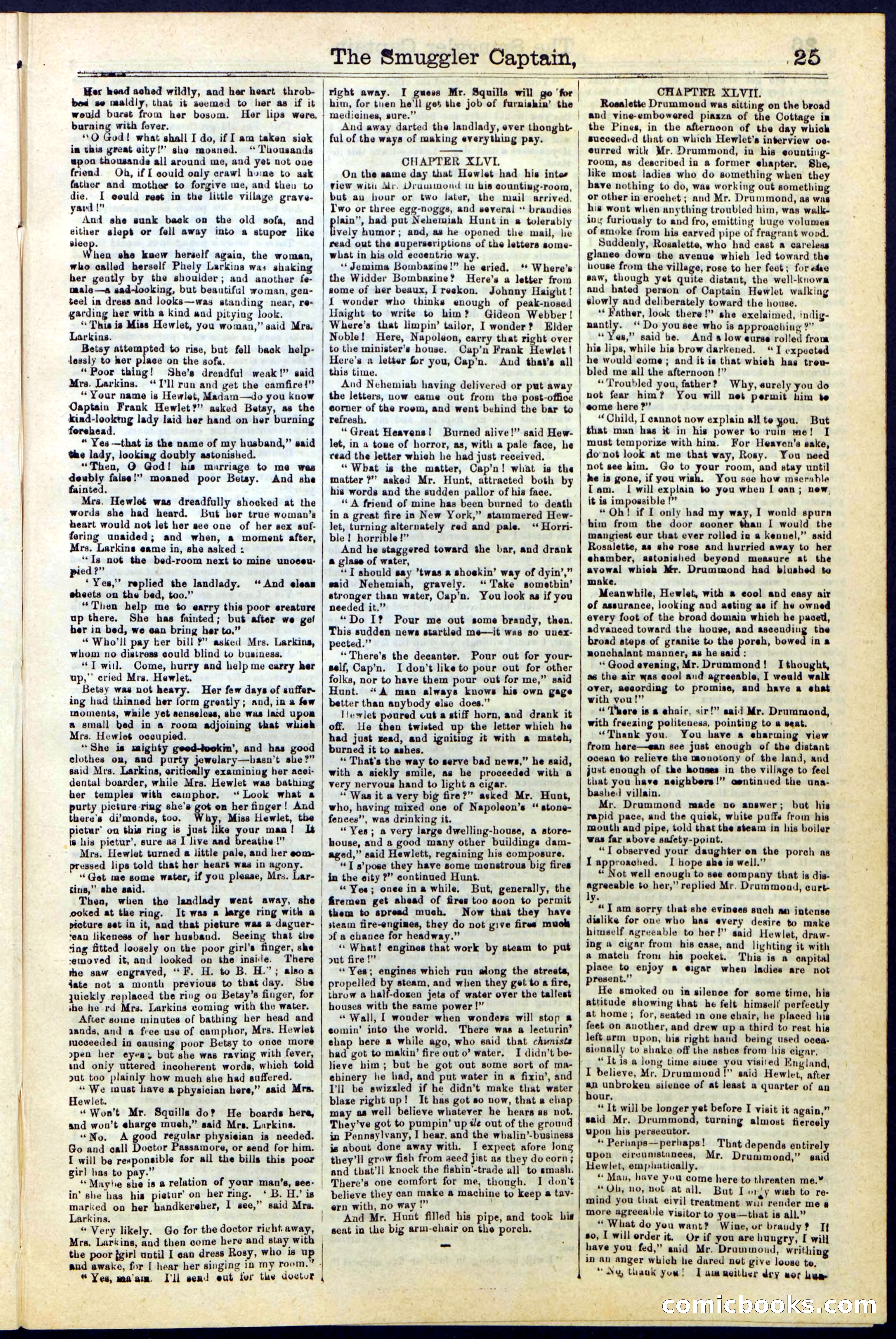
A restored page from Pulp Fiction, 1880. Page through the whole issue in the reader above.
📄 Transcribed text from this page (OCR, searchable)
Machine-transcribed from the original scan — historical spelling and the odd misread are preserved.
Mec head ached wildly, and her heart throb- bed se maldiy, that it seemed to her as if it would burst from her bosom. Her lips were. burning with fever. ‘‘O God! what shall I do, if I am taken sick im vhis great city!” sue moaned. “ Thousands apon thousands all around me, and yet not ove friend = Oh, if I could oaly crawl home to ask father and mother to forgive me, and then to die. [ oould rest in the little village grave- yard |" And she sunk back on the old sofa, and either slept or fell away into a stupor like bleep. When she koew herself again, the woman, who called herself Phely Larkins was shaking her geatly by the shoulder; and another fe- male—a sad-looking, but beautiful woman, gen- teel in dress and looks—was standing near, re- garding her with a kind and pitying look. “This is Miss Hewlet, you woman,” said Mra. Larkins. Betsy oa ea to rise, but fell back help- leasly to ker place on the sofa. “Poor thing! She’s dreadful weak!” said Mrs. Larkins. “I'll run and get the camfire!” “Your name is Hewlet, Madam—do you know Oaptain Frank Hewlet?” asked Betsy, as the kind-lookmg lady laid her hand on her burning forehead. “ Yes —that is the name of my husband,” said the lady, looking doubly astonished. “Then, @ God! his murriage to me was deubly false!” moaned poor Betsy. And she fainted. Mrs. Hewlet was dreadfully shocked at the words she had heard. But her true woman’s heart would not let her see one of her sex suf- fering unaided; and when, a moment after, Mrs. Larkins eame in, she asked : ‘Is not the bed-room next to mine unoceu- pied?” ‘Yes,’ replied the landlady. sheets on the bed, too.” “Then help me to earry this poor ereature up there. She has fainted; but after we gef her in bed, we ean bring her to.” “Who'll pay ker bill ?” asked Mrs. Larkins, whom no distress could blind to business. “I wil. Come, hurry and help me carry her up,’ cried Mrs. Hewlet. Betsy was not heavy. Her few days of suffer- ing had thinned her form greatly; and, in a few moments, while yet senseless, she was latd upoa a small bed in a room adjoining that whieh Mrs. Hewlet occupied. ‘She is mighty geed-tookim’, and has good clothes on, and purty jewelary—basn’t she?” ssid Mrs. Larkins, eritically examining her acei- dental boarder, while Mrs. Hewlet was bathing ber temples with cainphor. “ Look what a “And eleas purty picture ring she's got on her finger! And | bh _ fences”, was drinking it. there's di’monds, too. y: Miss Hewlet, the pictur’ on this ring is just lik @ your man! Ik \# his pietur’, sure as I live and breathe !” Mrs. Hewlet turned a little pale, and her eom- pressed lips told that her heart was in agony. “Get me some water, if you please, Mrs. Lar- tins,”’ she said. Then, when the landlady went away, she ooked at the ring. It was a large ring with a picture set in it, and that picture was a daguer- ‘ean likeness of her husband. Seeing that tlre ting fitted loosely on the poor girl's finger, she -ewoved it, and looked on the insile. There the saw engraved, “ F. H. to B. H.”; alsoa date not a month previous to that day. She yuickly replaced the ring on Betsy’s finger, for ihe he rd Mrs. Larkins coming with the water. Afier some minutes of bathing her head and aands, and a free use of camphor, Mrs. Hewlet succeeded in causing poor Betsy to once more »pen her eyes, but she was raving with fever, und only uttered incoherent words, which told out too plainly how much she had suffered. “We imust have a physician here,” said Mra. Hewlet. “Won't Mr. Squills do? He boards here, and won’t eharge mueh,” said Mrs. Larkins. “No. A good regular physieian is needed. Go and call Doctor Passamore, or send for him. I will be responsible for all the bills this poor girl has to pay.” ; ‘““Mayhe she is a relation of your man’s, see- in’ she has his pietur’ on herring. ‘ B. H.’ is ‘The Smuggler Captain, marked on her bandkereher, I see,” said Mra. Larkins. “Very likely. Go for the doctor richf away, Mra. Larkins, and then come here and stay with the poor {girl until I ean dress Rosy, who is up and awake, for [ hear her singing 1p my room. “Yes, ma'am. I'll send eut ior the doctor ‘ | right away. I guess Mr. Squills will ‘for ‘i for fie he'll ges the joe of farmiahin’ the medicines, sure.” And away darted the landlady, ever thonght- ful of the ways of making everything pay. CHAPTER XLVI. On the same day that Hewlet had his inter view with Mir. Urummond in bis countiug-room, but au hour or two later, the mail arrived. Iwo or three egg-noggs, and several * brandies lain”, had put Nehemiah Hunt in a tolerably Lively humor; and, as he opened the mail, he read out the superseriptions of the letters some- what in his old eccentric way. ‘* Jemima Bombazine!” he eried. ‘ Where’s the Widder Bombazine? Here’s a letter from aome of her beaux, lreekon. Johnny Haight! { wonder who thinks enough of peak-nosed Haight to write to him? Gideon Webber! Where’s that limpin’ tailor, I wonder? Elder Noble! Here, Napoleon, carry that right over to the minister's house. Cap’n Frank Hewlet! Here's a letter for you, Cap'n. And that’s all this time. And Nehemiah having delivered or put away the letters, uow came out from the post-office corner of the roem, and went behind the bar to refresh. “Great Heavens! Burned alive!” said Hew- let, in a tone of horror, as, with a pale face, he read the letter whieh he had just received. “What is the matter, Cap’n! what is the matter ?” asked Mr. Hunt, attracted both by his words and the sudden pallor of his face. ‘A friend of mine has been burned to death in a great fire in New York,” stammered Hew- let, turning alternately red and pale. ‘“ Horri- ble! home blp 1” And he staggered toward the bar, and drank a glase of water, “T should say ’twas a shoekin’ way of dyin’,” said Nehemiah, gravely. “Take somethin’ stronger than water, Cap’n. You look as if you needed it.” “Do I? Pour me out some brandy, then. This sudden news startled me—it was so unex- pected.” “There's the deeanter. Pour out for your- self, Cap'n. I don’t like to pour out for other folks, nor to have them pour out for me,” said Hunt. “A man always knows his own gage better than anybody else does.” l!evlet poured cut a stiff horn, and drank it off. He then twisted up the letter which he had just read, and igniting it with a mateh, burned it to ashes. ‘“‘ That's the way to serve bad news,” he said, with a sickly smile, as he proceeded with a very nervous hand to light a cigar. ‘‘ Was it a very big fire?” asked Mr. Hunt, who, having mixed one of Napoleon’s “ stone- “Yes; a very large dwelling-house, a store- house, and a good many other buildings dam- aged,” said Hewlett, regaining his mila Sie “TI s’pose they have some menstrous big fires in the sity ?”’ continued Hunt. “Yes; onee ina while. But, generally, the firemen get shead of fires too soon to permit them to spread much. Now that they have steam fire-engimes, they do not give fires muols of a chance for headway.” ‘What! engines that work by steam to put rut fire!” ‘Yes; engines which run along the streets, propelled by steam, and when they get to a fire, throw @ half-dozen jets of water over the tallest houses with the same power!” “ Wall, I wonder when wonders will stop a eomin’ into the world. There was a Jecturin’ ehap bere a while ago, who said that chumists had got to makin’ fire out o’ water. I didn’t be- lieve bim; but he got out some sort of ma- ehinery he had, and put water in a fixin’, and I'll be swizsled if he didn’t make that water blaze right up! It has got so now, that a clap may as well believe whatever he hears as not. They've got to pumpin’ up #e out of the ground in Pennsylvany, J hear, and the whalin’-business is about done away with. I expect afore Jong they'll grow fish from seed jist as they docorn; and tbat’}| knock the fishin’-trade all to smash. There’s one comfort for me, though. I don't believe they can make & machine to keep a tav- ern with, no way !” And Mr. Hunt filled his pipe, and took bis seat in the big arm-chair on the porch. | | 25 ee ee a ee ee Oe ou * CHAPTER XLVITI. Rosalette Drummond was sittin on the broad _ and vine-embowered piazza of the Cottage ia > — — : Se ae sss Sess sss ssf the Pines, in the afternoon of the day which succeeded that on which Hewlet's interview oe- curred with Mr. Drummond, in his eountinug- room, as described in a former ehapter. She, like most ladies who do something when they have nothing to do, was working out something or other in erochet ; and Mr. Drummond, as was his wont when anything troubled him, was walk- ivy furiously to and fro, emitting buge volunoes of smoke from his earved pipe of fragrant wood. Suddenly, Rosalette, who had east a careless glanee down the avenue whieh led toward the house from the village, rose to her feet; for efee saw, though yet quite distant, the well-knowa and hated 4 We of Captain Hewlet walking slowly and deliberately toward the house. ‘* Father, look there!” she exclaimed, indig- ee ** Do you see who is approaching ?” “Yes,” said be. And a low eurse rolled from his lips, while his brow darkened. “I expected he would eome; and it is that whieh has trew bled me all the afternoon !” “Troubled you, father? Why, surely you do not fear him? You will net permit him te e@ome here ?” “Child, I cannot now explain all te you. But that mun has it in his power to ruin me! I must temporize with him. For Heaven's sake, do'not look at me that way, Rosy. You need not see him. Go to your room, and stay until he is gone, if you wiek. You see how maernble Tam. I| will explain to you when | oan; new, it is impossible !”” “Oh! if I only had my way, I would spurn him from the door saoner than I would the mangiest ¢ur that ever rolled in a kennel,” said Rosalette, as she rose and hurried away to her ehamber, astonished beyond measure at the avowal whieh Mr. Drummond had blushed to make. Meanwhile, Hewlet, with a eoo! and easy air of assurance, looking and acting as if he owned every foot of the broad domain which he paced, advanced toward the houwe, and ascending the broad steps of granite to the J porwet bowed ina monchalant manner, as he sai * Good evening, Mr. Drummond! I thought, as the air was cool and agreeable, I would walk over, according to promise, and have a ehat with you!” “There is a ehair, sir!” said Mr. Drummond, with freezing politeness, pointing to a seat. “Thank you. You have a eharming view from here—ean see just enough of the distant ocean to relieve the monotony of the land, and just enough of the houses in the village to feel that you have neighbers!” aentinued the una- bashed villain. Mr. Drummond made no answer; but his rapid pace, and the quiek, white puffs from his mouth and pipe, told that the steam in his boiler was far above safety-point. “I observed your daughter on the porch as L approached, I hope she is well.” “ Not well enough to see company that is dis- eC to her,” replied Mr. Drummond, curt y “Tam sorry that she evinees such an intense dislike for one who has every desire to make himself agreeable to her!” said Hewlet, draw- ing « cigar from his ease, and lighting it with a match from his pocket. This is a capital place to enjoy eigar when ladies are not present.” — He smoked on in silence for some time, his attitude showing that he felt himself perfectly at home ; for, seated in one ebair, he placed his feet on another, and drew up a third to rest his left urm upon, bis right hand being used ocea- sionally to shake off the ashes from his cigar, “It is a long time sinee you visited England, I believe, Mr. Drummond!” said Hewlet, after an unbroken silence of at least a quarter of an hour. “It will be sangptizat before I visit it again,” said Mr. Drummond, turning almost fiercely upon his persecutor. * Perhaps—perhaps! That depends entirely upon circumstances, Mr. Drummond,” said Hewlet, emphatically, * Mau, have you come here to threaten me.” “Oh, no, bot atall, Bat [ory wigh to re- mind you that civil treatment wi render me @ more agreeable visitor to you—that is all.” * What do you want? Wine, ur braudy? Tf so, I will order it. Or if you are huugry, [ will have you fed,” said Mr. Drammoud, writhin in an anger which he dared net give louse te, “ay, thank you! I ammeither dry wor lee JIOOKS EGomic = EO