
Pulp Fiction, 1880 · page 14 of 32
Beadle's Dime Library No. 111 — page 14: what you’re looking at
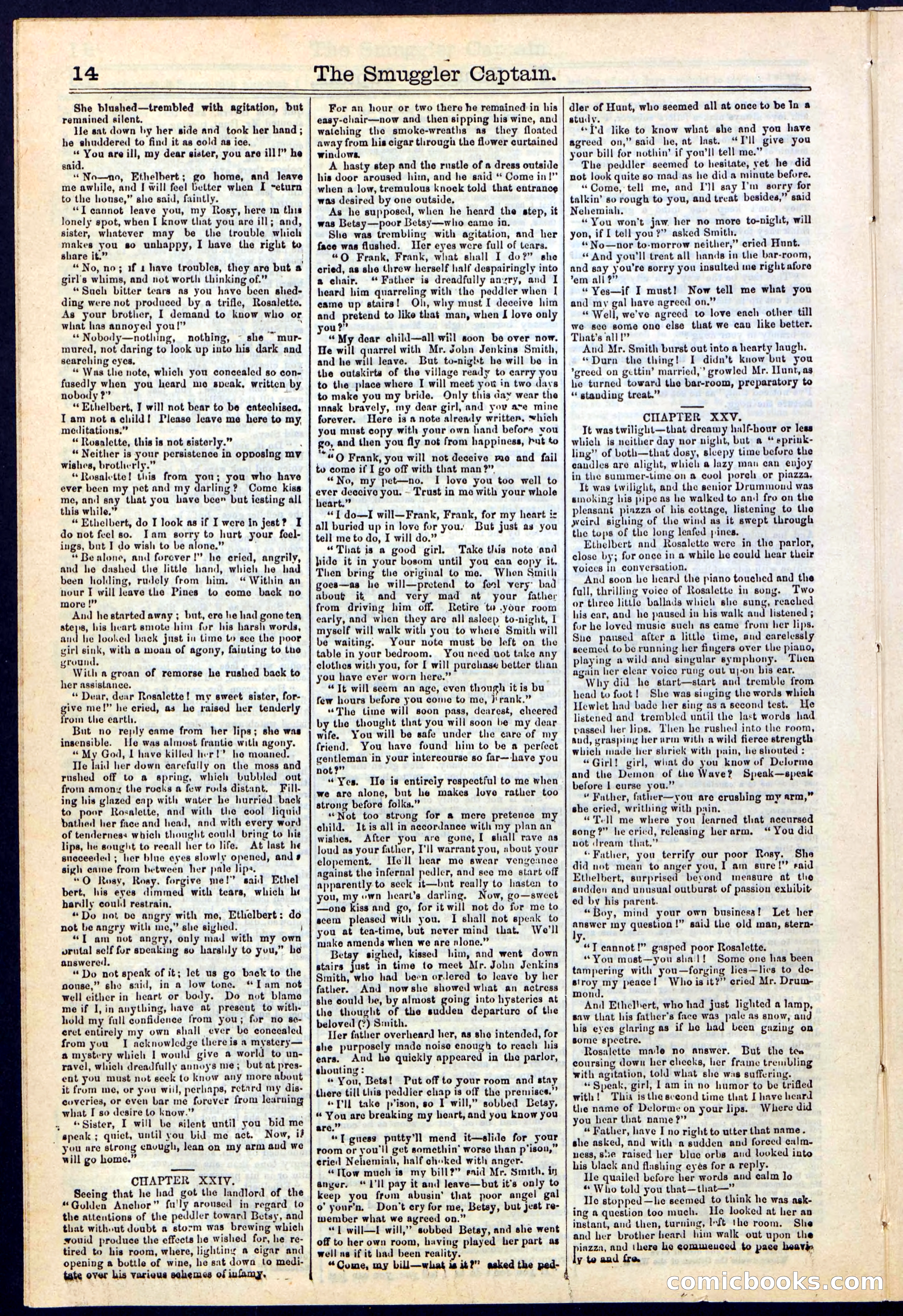
A restored page from Pulp Fiction, 1880. Page through the whole issue in the reader above.
📄 Transcribed text from this page (OCR, searchable)
Machine-transcribed from the original scan — historical spelling and the odd misread are preserved.
Om ee es i 5 ae 14 She blushed—trembled with agitation, but remained silent. le sat. down by her side and took her hand ; he shuddered to find it as cold as ice, : You are ill, my dear sister, you are ill!” he said. “ No—no, Ethelbert; go home, and leave me awhile, and | will feel better when I ~eturn to the house,” she said, faintly. “T cannot leave you my Rosy, here in this lonely spot, when [ know that you are ill; and, sister, whatever may be the trouble which makes you so unhappy, I have the right to share it.” “No, no; if 1 have troubles, they are but a girl's whims, and not worth thinking of.” “Such bitter tears as you have been shed- ding were not produced by a trifle, Rosalette. As your brother, I demand to know who or what has annoyed you!” 7 . “‘Nobody—nothing, nothing, ~ she ~ mur- mured, not daring to look up into his dark and searching eyes, ““ Was the note, which you concealed so con- pete when you heard mo speak, written by nobody ?” “Ethelbert, I will not bear to be entechisea. Tam not achild! Please leave me here to my, meditations,” “ Nosalette, this is not sisterly.” ' “ Neither is your persistence in opposing my wishes, brotherly.” * Rosalette! this from you; you who have ever been my pet and my darling? Come kiss me, and say that you have bee» but iesting all this while.” “ Ethelbert, do I look as if I were in jest? I do not feel so. Iam sorry to hurt your feel- ings, but I do wish to be alone.” ; * Be alone, and forever!” he cried, angrily, and he dashed the little hand, whieh he had been holding, rudely from him. “ Within an nour I will leave the Pines to come back no more |" Aud he started away ; but, ere he had gone ten steps, his heart amote him for his harsh words, and he looked back just in time to see the poor girl sink, with a moan of agony, faiuting to tne ground, With n groan of remorse he rushed back to her assistance. * Dear, dear Rosalette! my sweet sister, for- give me!” he cried, as he raised her tenderly from the earth. But no reply came from her lips; she was insensible. He was almost frantic with agony. “My God, | have killed her!” he moaned. Te laid her down carefully on the moss and rushed off to a spring, which bubbled out from amony the rocks a few rods distant. Fill- ing his glazed eap with water he hurried back to poor Rosalette, and with the cool liquid bathed her face and head, and with every word of tenderness which thought could bring to hie lips, he sought to reeall her to life. At Inst he sneceeded ; her blue eyes slowly opened, ands sigh eaine from between her pale lips. “O Rosy, Rosy, forgive me!” said Ethel bert, his eyes dimmed with tears, which he hardly could restrain. “Do not be angry with me, Ethelbert: do not be angry with me,” she sighed. “T am not angry, only mad with my own wrutal self fur speaking so harslily to you,” be answered. “Do not speak of it; Iet us go back to the oouse,” she said, in a low tone. “Iam not well either in heart or body. Do not blame me if I, in anything, have at present to with. hold my fall confidence from you; for no se- eret entirely my own shall ever be concealed from you I acknowledge there is a mystery— a mystery which I would give a world to un- ravel, which dreadfully annoys me; but at pres- ent you must not seck to know any more about it from me, or you wiil, perhaps, retard my dis- evveries, or even bar me forever from learning what I so desire to know.” « Sister, I will be silent until you bid me apeak ; quiet, until you bid me act. Now, i? ~ you are strong cnuugh, lean on my arm aud we will go home.” CHAPTER XXIV. Seeing that he had got the landlord of the “Golden Anchor” fu'ly aroused in regard to the attentions of the peddler toward Betsy, and that without doubt a storm was brewing which souid produce the effects he wished for, he re- tired to his room, where, lighting a cigar and opening a bottle of wine, he sat dowa to medi- tate over his various echemes of infamy, _ * The Smuggler Captain. For an hour or two there he remained in his easy-chair—now and then sipping his wine, and watching the smoke-wreaths as they floated away from his cigar througi: the flower curtained windows. A hasty step and the rustle of a dress outside his door aroused him, and he said * Come in!” when a low, tremulous knock told that entrance was desired by one outside, As he supposed, when he heard the step, it was Betsy—poor Betsy—who came in. She was trembling with agitation, and her face was flushed. Iler eyes were full of tears. “O Frank, Frank, what shall I do?” she cried, as she threw herself half despairingly into a chair. “ Father is dreadfully anzry, and I heard him quarreling with the peddler when | came up stairs! Oh, why must [ deceive him and pretend to like that man, when I love only you?” “My dear child—all wiil soon be over now. He will quarrel with Mr. Joln Jenkins Smith, and he will leave. But to-night be will be in the outskirts of the village ready to carry you to the place where I will meet you in two days to make you my bride. Only this day wear the inask bravely, my dear girl, and you are mine forever. Here is 1 note already written, which you must copy with your own hand before you go, and then you fly not from happiness, hut to “«o Frank, you will not deceive mo and fail to come if I go off with that man?” “No, my pet—no. I love you too well to ever deccive you. ~ Trust in me with your whole heart.” “T do—I will—Frank, Frank, for my heart is all buried up in love for yous But just as you tell me to do, I will do.” “That is a good girl. Take this note and hide it in your bosom until you can copy it. Then bring the original to me. When Smith goes—as he will—pretend to feol very: bad ubout it and very mad at your father from driving him off. Retire tu .your room early, and when they are all asleep to-night, I myself will walk with you to where Smith will be waiting. Your note must be left on the table in your bedroom. You need vot take any clothes with you, for [ will purchas« better than you have ever worn here.” , “Tt will seem an age, even though it is bu few hours before you come to me, }' rank.” “The time will soon pass, dearest, cheered by the thought that you will soon be my dear wife. You will be safe under the care of my friend. You have found him to be a perfect gentleman in your intercourse so far— have you not?” “Yes. Ile is entirciy respectful to me when we are alone, but he makes love rather too strong before folks.” “Not too strong for a mere pretence my child. Itis all in accordance with my plan an wishes, After you are gone, I shall rave as loud as your father, I'll warrant you, sbout your elopement. Iell hear me swear venge:nce against the infernal edler, and see me start off apparently to seck it—but cea to hasten to you, my own heart’s darling. Now, go—sweet —one kiss and go, for it will not do fur me to scem pleased with you. I shall not speak to you at tea-time, but never mind that. We'll make amends when we are alone.” Betsy sighed, kissed him, and went down stairs just in time to meet Mr. John Jenkins Smith, who had been ordered to leave by her father. And nowshe showed what an actress she could be, by almost going into hysterics at the thought of the sudden departure of the beloved (?) Smith. Iler father overheard her, as she intended, for she purposely made noise enough to reach his ears. And he quickly appeared in the parlor, shouting: “ You, Bets! Put off to your room and stay there till this peddier chap is off the premises.” “Tl take p'ison, so I will,” sobbed Betsy, “ You are breaking my heart, and you know you arc.” “T guess putty'll mend it—slide for your room or you'll get somethin’ worse than p‘ison,” erie] Nehemiah, half choked with anger. “Tlow much is my bill?” enid Mr. Smith, in anger. “ 1'll pay it and leave—but it’s only to keep you frum abusin' that poor angel gal o’ your’n, Don't ery for me, Betsy, but jest re- wember what we agreed on.” “1 will—I will,” sobbed Betsy, and she went off to her own room, having played her part as well ne if it had been reality. “Come, my bili—what is it?” asked the ped- dler of Hunt, who seemed all at once to be In a study. “I'd like to know what she and you have agreed on,” said he, at last. “I'll give you your bill for nothin’ if you'll tell me.” , The peddler seemed to hesitate, yet he did not look quite so mad as he did a minute before. “Come, tell me, and I'}l say I'm _ sorry for talkin’ so rough to you, and treat besides,” said Nehemiah. “You won't jaw her no more to-night, will yon, if [ tell you?” asked Smith. ‘‘ No—nor to-morrow neither,” cried Hunt. “And you'll treat all hands in the bar-room, and say you're sorry you insulted me right afore em all ?” “ Yes—if I must! Now tell me what you and my gal have agreed on,” “Well, we've agreed to love ench other till we see some one else that we cau like better. That’s all!” And Mr. Smith burst out into a hearty Jaugh. “Durn the thing! I didn’t know but you ‘greed on gettin’ married,’ growled Mr. Iunt, as he turned toward the bar-room, preparatory to “ standing treat.” CIIAPTER XXV. It was twilight—that dreamy half-hour or less which is neither day nor night, but a * eprink- ling” of both—that dosy, sleepy time before the candles are alight, which a lazy man can enjoy in the summer-time on & cvol porel or piazza, It was twilight, and the senior Drummoud was smoking his pipe as he walked to an fro on the pleasant piazza of his cottage, listening to the weird sighing of the wind as it swept through the tops of the long leafed j ines. Ethelbert and Rosalette were in the parlor, close by; fur once in a while he could hear their voices in conversation. And goon he heard the piano touched and the full, thrilling voice of Rosalette in song. Two or three little ballads which she sung, reached his ear, and he paused in bis walk aud listened ; for he loved music such as came from her lips. Sue pansed after a little time, and carelessly scemed to be running her fingers over the piano, playing a wild and singular symphony. Then again her elear voice rung out uj-on bis ear. Why did he start—start and tremble from head to foot! She was singing the words which Hewlet had bade her sing as a second test. He listened and trembled until the last words had passed her lips. Then be rushed into the room, aud, grasping her arm with a wild fierce strength which made her shriek with pain, he shouted : “Girl! girl, what do you know of Delorme and the Demon of the Wave? Speak—speak before | curse you.” “ Father, father—you are crushing my arm,” she cried, writhing with pain. “Tell me where you learned that accursed song?” he cricd, releasing herarm. “ You did not dream thiat,” «Father, you terrify our poor Rosy. She did not mean to anger you, I am sure!” raid Ethelbert, surprised beyond mensure at the sudden and unusual outburst of passion exhibit ed by his parent. “Boy, mind your own business! Let her answer mny question!” said the old man, stern- “T eannot!” gasped poor Rosalette. “You most—you sliail! Some one has been tampering with you—forging lies—lics to de- siroy my peace! Who is it?” cried Mr. Drum mond. Ani Ethelbert, who had just lighted a lamp, saw that his father’s face was pale as snow, and his eves glaring as if he had been gazing on some spectre, Rosalette made no answer. But the tes coursing down her cheeks, her frame trembling with agitation, told what she was suffering. “Speak, girl, lam in no humor to be trifled with! Thia isthe second time that I have heard the name of Delorme on your lips. Where did you hear that name ?” “Father, have I no right to utter that name. she asked, and with a sudden and foreed calm- ness, 8¢ raised her blue orbs and looked into his black and flashing eyés for a reply. Ile quailed before her words and calm Jo “ Who told you that—that—” | Ie stopped—lie seemed to think he was ask- ing a question too much. Le looked at her an instant, and then, turning, lft the room. She and her brother heard him walk out upon the inzza, and there he commenced to pace heavin. y te and fre, ! 2 JOO <S (E(e) EOmic t 1m