
Pulp Fiction, 1880 · page 12 of 32
Beadle's Dime Library No. 111 — page 12: what you’re looking at
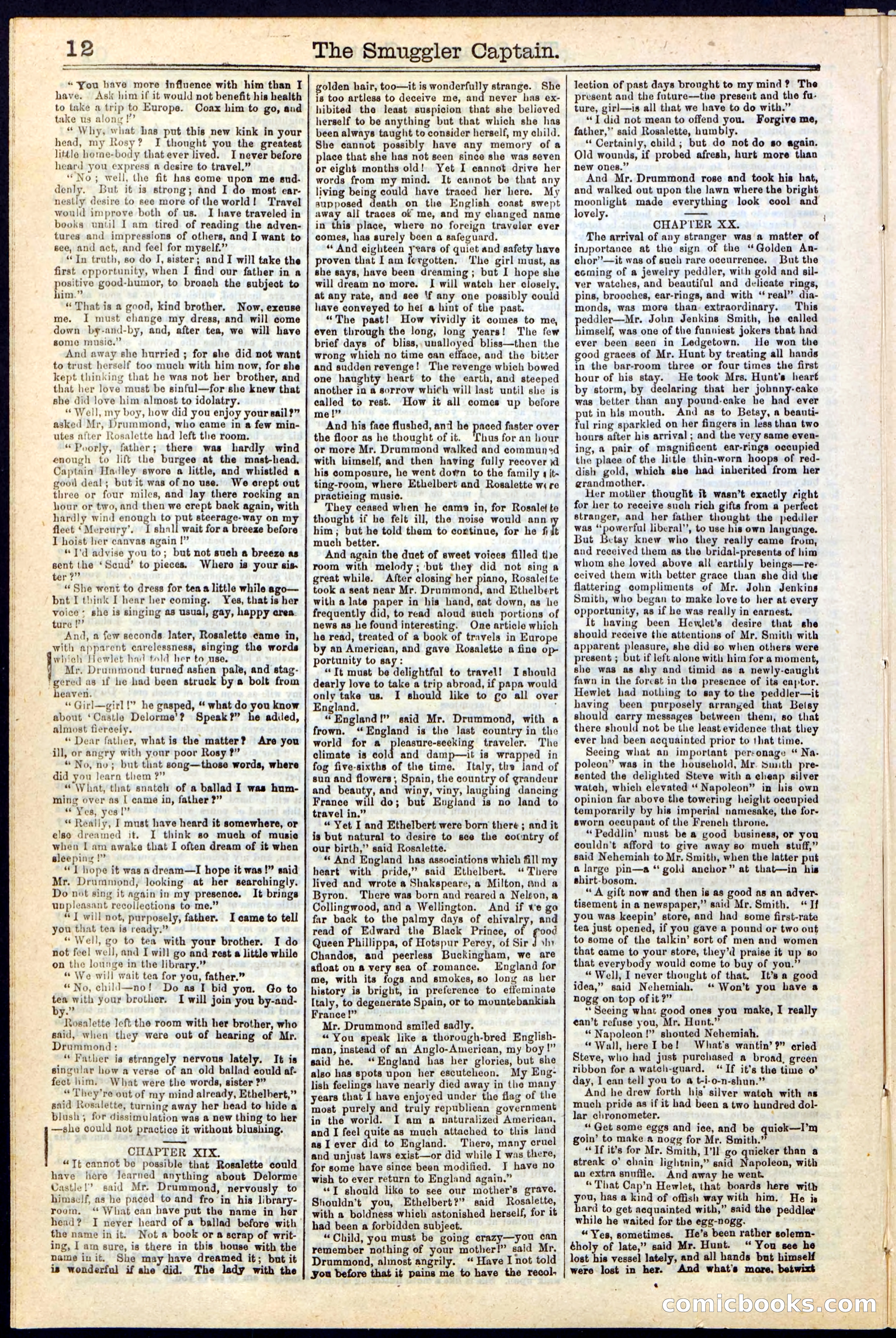
A restored page from Pulp Fiction, 1880. Page through the whole issue in the reader above.
📄 Transcribed text from this page (OCR, searchable)
Machine-transcribed from the original scan — historical spelling and the odd misread are preserved.
12 | VeVe—e—a00“**T=]=[@ra]nanr[V353”e === eee “You bave more influence with him than I have. Asi him if it would not benefit his health to take a trip to Europe. Coax him to go, and take us along!” “ Why, what has put this new kink in your head, my Kosy? I thought you the greatest little horne-body that ever lived. I never before heard you express a desire to travel.” ‘No; well, the fit has come upon me sud- denly. But it is strong; and I do most ear- nestly desire to see more of the world! Travel would improve both of us. I have traveled in books until I am tired of reading the adven- tures and impressions of others, and I want to see, and act, and feel for myself.” ‘‘ In truth, so do I, sister; and I will take the first opportunity, when I find our father in a positive good-humor, to broach the subject to him.” “ That is a good, kind brother. Now, excuse me. I must change my dress, and will come down by-and-by, and, after tea, we will have some music.” And away she hurried ; for she did not want to trust herself too much with him now, for she kept thinking that he was not her brother, and that her love must be sinful—for she knew that she did love him almost to idolatry. “ Well, my boy, how did you enjoy your sail?” asked Mr, Drummond, who came in a few min- utes after Rosalette had left the room. “Poorly, father; there was hardly wind enough to lift the burgee at the mast-head, Captain Hadley swore a little, and whistled a gootl deal; but it was of no use. We crept out three or four miles, and Jay there rocking an hour or two, and then we crept back again, with _ hardly wind enough to put steerage-way on my fleet ‘Mereury’. I shall wait fora breeze before I hoist hier canvas again !” “]'d advise you to; but not sueh a breeze as sent the ‘Send? to pieces. Whero is your gis. ter ?”’ “She went to dress for teaa little while ago— bnt I think I hear her coming. Yes, that is her voice: she is singing as usual, gay, happy crea. ture !”’ And, a few seconds Jater, Rosalette came in, with apparent carelessness, singing the words whieh Hewlet had fold her to use. Mr. Drummond turned ashen pan and stag- ‘gered as if le had been struck bya bolt from heaven. “ Girl—girl!” he gasped, “ what do you know about ‘Castle Delorme’? Speak?” he added, almost fiereely. ‘ *“ Dear father, what is the matter? Are you ill, or angry with your poor Rosy ?” “ No, nu; but that song—those words, where did you learn them ?” “What, that snateh of a ballad I was hum- ming over as | came in, father ?” “Yes, yes |” * Really, I must have heard it somewhere, or elso dreamed it. I think so much of musie when lL am awake that I often dream of it when sleeping !” “I hope it was a dream—I hope it was!” said Mr. Drummond, looking at her searchingly. Do not sing it again in my presence. It brings unpleasant recollections to me.” “I will not, purposely, father. I came to tell you that tea is ready.” “ Well, go to tea with your brother. I do not fee! well, and I will go and rest a little while on the lounge in the library.” “ We will wait tea for you, father.” “ No, chill—no! Do as I bid you. Go to = with your brother. I will join you by-and- ” z tosalette left the room with her brother, who said, when they were out of hearing of Mr. Drummond: ‘Father is strangely nervous lately. It is singular how a verse of an old ballad eould af- fect him. What were the words, sister ?” “ They're out of my mind already, Ethelbert,” said Rosalette, turning away her head to hide a blush; for dissimulation was a new thing to her —she could not practice it without blushing. CHAPTER XTX. “Tt cannot be possible that Rosalette could have here learned anything about Delorme Uastle!’ said Mr. Drummond, nervously to himse!f, as he paced to and fro in his library- room. ‘“ What can bave put the name in her head? I never heard of a ballad before with’ the name in it. Not a book ora scrap of writ- ing, I am sure, is there in this house with the nae init. She may have dreamed it; but it is wonderful if she did. The lady with the The Smuggler Captain. olden hair, too—it is wonderfully strange. She 1s too artless to deceive me, ind never has ex- hibited the least suspicion that she believed herself to be anything but that which she has been always taught to consider herself, my ebild. She cannot possibly have any memory of a place that she has not seen since she was seven or eight months old! Yet I cannot drive her words from my mind. It cannot be that any living being could have traced her here. My aupposed death on the English coast swept away all traces of me, and my changed name in this place, where no foreign trayeler ever comes, has surely been a safeguard. “ And eighteen years of quiet and safety have proven that Iam fergotten, The girl must, as she says, have been dreaming; but I hope she will dream no more. [ will watch her closely, at any rate, and see ‘f any one possibly could have conveyed to hei a hint of the past. “The past! How vividly it comes to me, even through the long, long years! The few brief days of bliss, unalloyed bliss—then the wrong which no time can efface, and the bitter and sudden revenge! The revenge which bowed one haughty heart to the earth, and steeped another in a sorrow which will last until she is called to rest. How it all comes up before me !” And his face flushed, and he paced faster over the floor as he thought of it. ‘Thus for an hour or more Mr. Drummond walked and communed with himself, and then having fully recover 3d his composure, he went down to the family 4 It- ting-room, where Ethelbert and Rosalette wi re practicing music. They ceased when he came in, for Rosale( te thought if he felt ill, the noise would ann him; but he told them to continue, for he file much better. And again the duet of sweet voices filled tlie room with melody; ‘but they did not sing a great while. After closing her piano, Rosalet te took a seat near Mr. Drummond, and Ethelbert with a late paper in his hand, sat down, as le frequently did, to read aloud such portions of news as he found interesting. One article which he read, treated of a book of travels in Europe by an American, and gave Rosalette a fine op- portunity to say: “Tt must be delightful to travel! I should dearly love to take a trip abroad, if papa would only take us. I should like to go all over England. “England!” gaid Mr. Drummond, with a frown. “England is the last country in the world for a pleasure-seeking traveler. The climate is aid and damp—it is wrapped in fog five-sixths of the time. Italy, the land of sun and flowers; Spain, the country of grandeur and beauty, and winy, viny, laughing dancing France will do; but England is no land to travel in.” “ Yet I and Ethelbert were born theré ; and it is but natural to desire to see the cotntry of our birth,” said Rosalette. “ And England has associations which fill my heart with pride,” said Ethelbert. “There lived and wrote a Shakspeare, a Milton, and a Byron. There was born and reared a Nelton, a Collingwood, and a Wellington. And if We go far back to the palmy days of chivalry, and read of Edward the Black Prince, of ood Queen Phillippa, of Hotspur Perey, of Sir J shy Chandos, and peerless Buckingham, we are afloat on a very sea of romance. England for me, with its fogs and smokes, so long as her history is bright, in preference to effeminate [taly, to degenerate Spain, or to mountebankish France!” Mr. Drummond smiled sadly. “You speak like a thorough-bred English- man, instead of an Anglo-American, my boy!” said he. “England has her glories, but she also has spots upon her escutcheon. My Eng- lish feelings have nearly died away in the many years that I have enjoyed under the flag of the most purely and truly republican government in the world. I am a naturalized American, and I feel quite as much attached to this land as I ever did to England. There, many eruel and unjust laws exist—or did while I was there, for some have since been modified. J have no wish to ever return to England again.” *“*T should like to see our mother’s grave. Shouldn't you, Ethelbert?” said Rosalette, with a boldness which astonished herself, for it had been a forbidden subject. “Child, you must be going crazy—you can remember nothing of your mother!” said Mr. Drummond, almost angrily. ‘“ Have I not told you before that it pains me to have the recol- lection of past days brought to my mind? The present and the future—the present and the fu- ture, girl—is all that we have to do with.” “I did not mean to offend you. Forgive me, father,” said Rosalette, humbly. “ Certainly, child; but do not do so again. Old wounds, if probed afresh, hurt more than new ones.” And Mr. Drummond rose and took his hat, and walked out upon the lawn where the bright moonlight made everything look cool and lovely. CHAPTER XX. The arrival of any stranger was a matter of insportance at the sign of the “Golden An- chor’’—it was of such rare occurrence, But the ecming of a jewelry peddler, with gold and sil- ver watches, and beautiful and delicate rings, pins, brooches, ear-rings, and with “real” dia- monds, was more than extraordinary. This peddler—Mr. John Jenkins Smith, he called himself, was one of the funniest jokers that had ever been seen in Ledgetown. He won the ood graces of Mr. Hunt by treating all hands in the bar-room three or four times the first hour of bis stay. He took Mrs. Hunt's heart by storm, by declaring that her johnny-cake was better than any pound-eake he had ever ut in his mouth. And as to Betsy, a beauti- ful ring sparkled on her fingers in less than two hours after his arrival ; and the very same even- ing, a pair of magnificent ear-rings occupied the place of the liltle thin-worn hoops of red- dish gold, which she had inherited from her grandmother. Her mother thought it wasn’t exactly right for her to receive such rich gifts from a perfect stranger, and her father thought the peddler was “powerful liberal’’, to use his own language. But Betsy knew who they really came from, and received them as the bridal-presents of him whom she loved above all earthly beings—re- ecived them with better grace than she did the flattering compliments of Mr. John Jenkins Smith, who began to make love to her at every opportunity, as if he was really in earnest. It having been Hewlet’s desire that she should receive the attentions of Mr. Smith with apparent peel, she did so when others were present ; but if left alone with him for a moment, she was as shy and timid as a newly-caught fawn in the forest in the presence of its captor. Hewlet had nothing to say to the peddler—it hare been purposely arranged that Betsy should carry messages between them, so that there should not be the least evidence that they ever had been acquainted prior to that time. Seeing what an important personage “ Na. poleon” was in the household, Mr. Smith pre- sented the delighted Steve with a eheap silver wateh, which elevated ‘‘ Napoleon” in his own opinion far above the towering height oceupied temporarily by his imperial namesake, the for- sworn oecupant of the French throne, “Peddlin’ must be a good business, or you couldn't afford to give away so much stuff,” said Nehemiah to Mr. Smith, when the latter put a large pin—a “ gold anchor” at that—in his shirt-bosom. “A gift now and then is as good as an adver- tisement in a newspaper,” said Mr. Smith. “ If you was keepin’ store, and had some first-rate tea just opened, if you gave a pound or two out to some of the talkin’ sort of men and women that came to your store, they’d praise it up 80 that everybody would come to buy of you.” “Well, I never thought of that. It’s a good idea,” said Nehemiah. ‘ Won't you have a nogg on top of it ?” “Seeing what good ones you make, I really ¢an’t refuse you, Mr. Hunt.” “‘ Napoleon !” shouted Nehemiah. “Wall, here I be! What's wantin’ 2” cried Steve, who had just purchased a broad, green ribbon for a watch-guard. “If it's the time o’ day, I ean tell you to a t-i-o-n-shun.” And he drew forth his silver wateh with os much pride as if it had been a two hundred dol- lar chronometer. : * Get some eggs and ice, and be quick—I'm goin’ to make a nogg for Mr. Smith.’ “Tf it’s for Mr. Smith, I'll go quicker than a streak o’ chain lightnin,” said Napoleon, with an extra snuffle. And away he went. “That Cap’n Hewlet, that boards here with pon has a kind of offish way with him. He is ard to get acquainted with,” said the peddler while he waited for the egg-nogg. ? “Yes, sometimes. He’s been rather solemn- tholy of late,” said Mr. Hunt. “ You see he lost his vessel lately, and all hands but himself were lost in her. And what's mare, betwixt « amliceleveve) (¢ cS eo (E(@)