
Pulp Fiction, 1880 · page 6 of 24
Beadle's Dime Library No. 109 — page 6: what you’re looking at
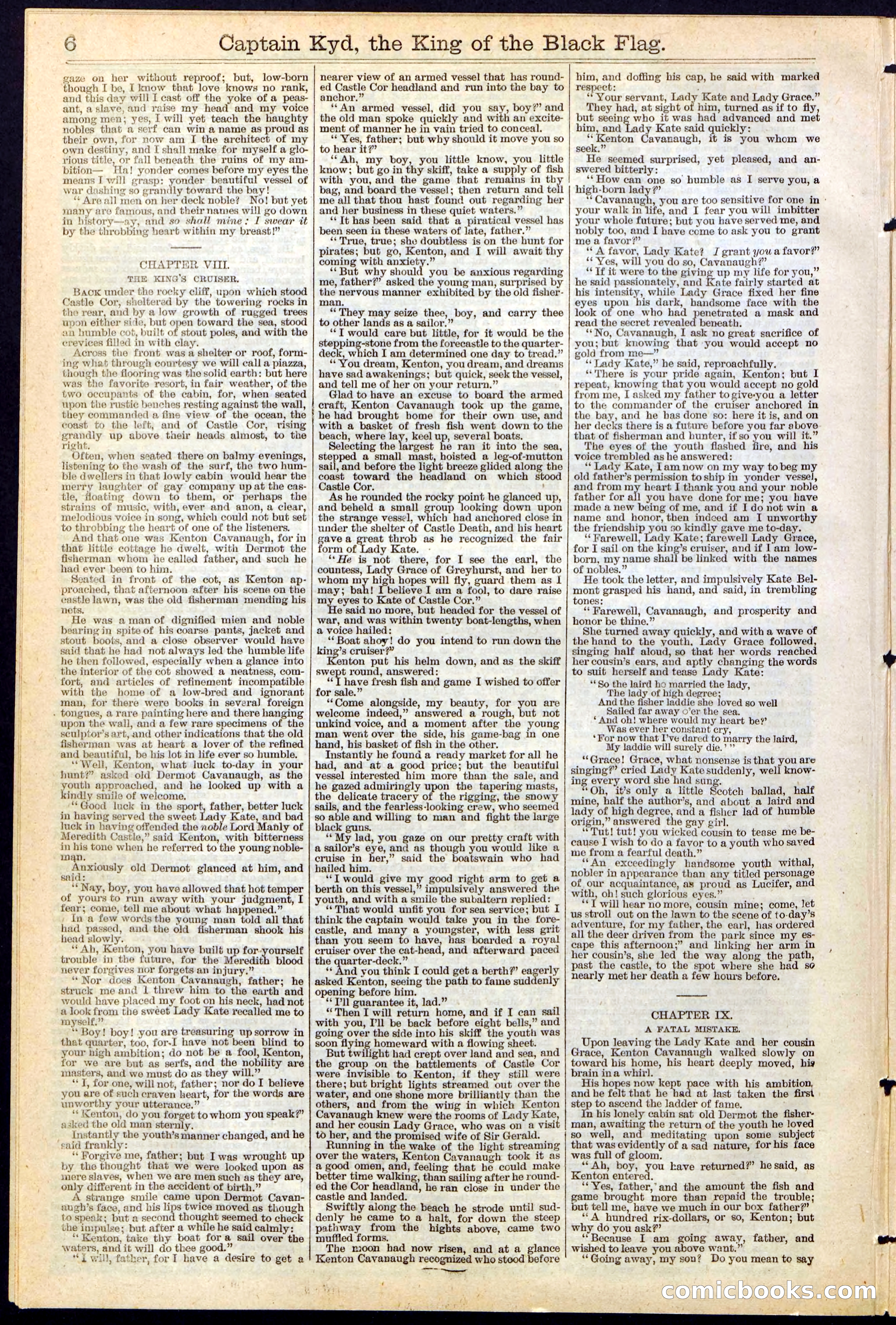
A restored page from Pulp Fiction, 1880. Page through the whole issue in the reader above.
📄 Transcribed text from this page (OCR, searchable)
Machine-transcribed from the original scan — historical spelling and the odd misread are preserved.
} eee a ee - => Ra CO RTT a oat gaze on her without reproof; but, low-born though I be, I know that love knows no rank, and this day will I cast off the yoke of a peas- ant, a slave, and raise my head and my voice among men; yes, I will yet teach the haughty nobles that a serf can win a name as proud as their own, for now am I the architect of my own destiny, and f shall make for myself a glo- rious title, or fall beneath the ruins of my am- bition— Ha! yonder comes before my eyes the means I will grasp: yonder beautiful vessel of war dashing so grandly toward the bay! ‘** Are all men on her deck noble? No! but yet many are famous, and their names will go down in history—ay, and so shall mine: I swear it by the throbbing heart within my breast!” CHAPTER VIII. THE KING'S CRUISER. Back under the rocky cliff, upon which stood Castle Cor, sheltered by the towering rocks in the rear, and by alow growth of rugged trees upon either side, but open toward the sea, stood an humble cot, built of stout poles, and with the crevices filled in with clay. Across the front was a shelter or roof, form- ing what through courtesy we will call a piazza, though the flooring was the solid earth: but here was the favorite resort, in fair weather, of the two occupants of the cabin, for, when seated upon the rustic benches resting against the wall, they commanded a fine view of the ocean, the coast to the left, and of Castle Cor, rising rrandly up above their heads almost, to the right. Often, when seated there on balmy evenings, listening to the wash of the surf, the two hum- ble dwellers in that lowly cabin would hear the merry laughter of gay company up at the cas- tle, floating down to them, or perhaps the strains of music, with, ever and anon, a clear, melodious voice in song, which could not but set to throbbing the heart of one of the listeners. And that one was Kenton Cavanaugh, for in that little cottage he dwelt, with Dermot the fisherman whom he called father, and such he had ever been to him. Seated in front of the cot, as Kenton ap- proached, that afternoon after his scene on the castle lawn, was the old fisherman mending his nets. He was amanof dignified mien and noble bearing in spite of his coarse pants, jacket and stout boots, and a close observer would have said that he had not always led the humble life he then followed, especially when a glance into the interior of the cot showed a neatness, com- fort, and articles of refinement incompatible with the home of a low-bred and ignorant man, for there were books in severa) foreign . tongues, a rare painting here and there hanging upon the wall, and a few rare specimens of the sculptor’s art, and other indications that the old fisherman was at heart a lover of the refined and beautiful, be his lot in life ever so bumble. ‘Well, Kenton, what luck to-day in your hunt?’ asked old Dermot Cavanaugh, as the youth approached, and he looked up with a indly smile of welcome. “Good luck in the sport, father, better luck in having served the sweet Lady Kate, and bad luck in having offended the noble Lord Manly of Meredith Castle,” said Kenton, with bitterness in his tone when he referred to the young noble- man. eealy old Dermot glanced at him, and said: ‘Nay, boy, you have allowed that hot temper of yours to run away with your judgment, I fear; come, tell me about what happened.” / In a few words the young man told all that had passed, and the old fisherman shook his head slowly. “Ah, Kenton, you have built up for-yourself trouble in the future, for the Meredith blood never forgives nor forgets an injury.” “ Nor does Kenton Cavanaugh, father; he struck meand | threw him to the earth and would have placed my foot on his neck, had not a look from the sweet Lady Kate recalled me to myself.” “Boy! boy! you are treasuring up sorrow in that quarter, too, for-I have not been blind to your high ambition; do not be a fool, Kenton, for we are but as serfs, and the nobility are masters, and we must do as they will.” ‘J, for one, will not, father; nor do I believe you are of such craven heart, for the words are unworthy your utterance.” ‘“Xenton, do you forget towhom you speak?” asked the old man sternly. _ Instantly the youth’s manner changed, and he said frankly: “ Forgive me, father; but Iwas wrought up by the thought that we were looked upon as mere slaves, when we are men such as they are, only different in the accident of birth.” A strange smile came upon Dermot Cavan- angh’s face, and his lips twice moved as though to speak; but a second thought seemed to check the impulse; but after a while he said calmly: “Kenton, take thy boat fora sail over the waters, and it will do thee good.” “i will, father, for I have a desire to get a SSS a 6 ! Captain Kyd, the King of the Black Flag. A ee ee er nearer view of an armed vessel that has round- ed Castle Cor headland and run into the bay to anchor.” ‘‘An armed vessel, did you say, boy?’ and the old man spoke quickly and with an excite- ment of manner he in vain tried to conceal. ‘Yes, father; but why should it move you so to hear it?” ‘‘Ah, my boy, you little know, you little know; but go in thy skiff, take a supply of fish with you, and the game that remains in thy bag, and board the vessel; then return and tell me all that thou hast found out regarding her and her business in these quiet waters.” ‘* It has been said that a piratical vessel has been seen in these waters of late, father.” ‘* True, true; she doubtless is on the hunt for pirates; but go, Kenton, and I will await thy coming with anxiety.” ‘‘But why should you be anxious regarding me, father?” asked the young man, surprised by the nervous manner exhibited by the old fisher- man. “They may seize thee, boy, and carry thee to other lands as a sailor.” “*T would care but little, for it would be the stepping-stone from the forecastle to the quarter- deck, which I am determined one day to tread.” “You dream, Kenton, you dream, and dreams have sad awakenings; but quick, seek the vessel, and tell me of her on your return,” Glad to have an excuse to board the armed ' craft, Kenton Cavanaugh took up the game 'he had brought bome for their own use, anc with a basket of fresh fish went down to the beach, where lay, keel up, several boats. Selecting the largest he ran it into the sea, stepped a small mast, hoisted a leg-of-mutton sail, and before the light breeze glided along the coast toward the headland on which stood Castle Cor. ' As he rounded the rocky Sere he glanced up, and beheld a small group looking down upon the strange vessel, which had anchored close in under the shelter of Castle Death, and his heart gave a great throb as he recognized the fair form of Lady Kate. ‘*He is not there, for I see the earl, the countess, Lady Grace of Greyhurst, and her to whom my high hopes will fly, guard them as | may; bah! I believe I am a fool, to dare raise my coe to Kate of Castle Cor.” e said no more, but headed for the vessel of war, and was within twenty boat-lengths, when a voice hailed: ‘** Boat ahoy! do you intend to run down the say cruiser?” enton put his helm down, and as the skiff swept round, answered: “T have fresh fish and game I wished to offer for sale.” “Come alongside, my beauty, for welcome indeed,” answered a rough, but not unkind voice, and a moment after the young man wernt over the side, his game-bag in one hand, his basket of fish in the other. Instantly he found a ready market for all he had, and at a good price; but the beautiful vessel interested him more than the sale, and he gazed admiringly a gn the tapering masts, the delicate tracery of the rigging, the snowy sails, and the fearless-looking crew, who seemed so able and willing to man and fight the large black guns. ** My lad, you gaze on our pretty craft with a sailor’s eye, and as though you would like a cruise in her,” said the boatswain who had hailed him. “*T would give my good right arm to get a berth on this vessel,” impulsively answered the youth, and with a smile the subaltern replied: “That would unfit you for sea service; but i think the captain would take you in the fore- castle, and many a youngster, with less grit than you seem to have, has boarded a royal cruiser over the cat-head, and afterward paced the quarter-deck.” ‘* And you think I could get a berth?’ eagerly asked Kenton, seeing the path to fame suddenly opening before him. Tl] guarantee it, lad.” ; “Then I will return home, and if I can sail with you, Pll be back before eight bells,” and going over the side into his skiff the youth was soon flying homeward with a flowing sheet. But twilight had crept over land and sea, and the group on the battlements of Castle Cor were invisible to Kenton, if they still were there; but bright lights streamed out over the water, and one shone more brilliantly than the others, and from the wing in which Kenton Cavanaugh knew were the rooms of Lady Kate, and her cousin Lady Grace, who was on a Visit to her, and the promised wife of Sir Gerald. _ Running in the wake of the light streaming over the waters, Kenton Cavanaugh took it as a good omen, and, feeling that he could make better time walking, than sailing after he round- ed the Cor headland, he ran close in under the castle and landed. Swiftly along the beach he strode until sud- denly he came to a halt, for down the steep pathway from the hights above, came two muffled forms. The moon had now risen, and at a glance Kenton Cavanaugh recognized who stood before “weet ou are > ‘ LF a ee | ’ é' ~ : . af iF 7 . fe r SY ae pe ne a + cree him, and doffing his cap, he said with marked respect: ! ‘** Your servant, Lady Kate and Lady Grace.” They had, at sight of him, turned as if to fly but seeing who it was had advanced and met him, and Lady Kate said quickly: * Kenton Cavanaugh, it is you whom we seek.” He seemed surprised, yet pleased, and an- swered bitterly: ‘* How can one so humble as I serve you, a high-born lady?’ ‘Cavanaugh, you are too sensitive for one in ° your walk in life, and I fear you will imbitter your whole future; but you have served me, and nobly too, and I have come to ask you to grant me a favor?’ “A favor, Lady Kate? J grant youa favor?” ‘Yes, will you do so, Cavanaugh?’ ** Tf it were to the giving up my life for you,” he said passionately, and Kate fairly started at his intensity, while Lady Grace fixed her fine eyes upon his dark, handsome face with the look of one who had penetrated a mask and read the secret revealed beneath. ‘*No, Cavanaugh, I ask no great sacrifice of you; but knowing that you would accept no gold from me—” ‘Lady Kate,” he said, reproachfully. ‘There is your pride again, Kenton; but I repeat, knowing that you would accept no gold from me, | asked my father to give-you a letter to the commander of the cruiser anchored in the bay, and he bas done so: here it is, and on her decks there is a future before you far above that of fisherman and hunter, if'so you will it.” The eyes of the youth flashed fire, and his voice trembled as he answered: ** Lady Kate, [am now on my way to beg my old father’s permission toship in yonder vessel, and from my heart I thank you and your noble father for all you have done for me; you have made a new being of me, and if Ido not win a name and honor, then indeed am I unworthy the friendship you so kindly gave me to-day. ‘‘ Warewell, Lady Kate; farewell Lady Grace, for I sail on the king’s cruiser, and if lam low- born, my name shall be linked with the names of nobles.” He took the letter, and impulsively Kate Bel- mont grasped his hand, and said, in trembling tones: ‘* Farewell, Cavanaugh, and prosperity and honor be thine.” She turned away quickly, and with a wave of the hand to the youth, Lady Grace followed, singing half aloud, so that her words reached her cousin’s ears, and aptly changing the words to suit herself and tease Lady Kate: **So the laird ho married the lady, The lady of high degree; And the fisher laddie she loved so well Sailed far away o’er the sea. ‘And oh! where would my heart be?” Was ever her constant cry, ‘For now that I’ve dared to marry the laird, My laddie will surely die.’ ”’ “Grace! Grace, what nonsense is that you are singing?’ cried Lady Kate suddenly, well know- ing every word she had sung. “Oh, it’s only a little Scotch ballad, h mine, half the author’s, and about a laird and lady of high degree, and a fisher lad of humble origin,” answered the gay girl, “Tut! tut! you wicked cousin to tease me be- cause I wish to do a favor to a youth who saved me from a fearful death.” ‘““An exceedingly handsome youth withal, nobler in appearance than any titled personage of our acquaintance, as proud as Lucifer, and with, oh! such glorious eyes.” ‘*{ will hear no more, cousin mine; come, Jet us stroll out on the lawn to the scene of to-day’s adventure, for my father, the earl, has ordered all the deer driven from the park since my es- cape this afternoon;” and linking her arm in her cousin’s, she led the way along the path, past the castle, to the spot where she had so nearly met her death a few hours before. CHAPTER IX, A FATAL MISTAKE. Upon leaving the Lady Kate and her cousin Grace, Kenton Cavanaugh walked slowly on toward his home, his heart deeply moved, hig brain ina whirl. His hopes now kept and he felt that he ha pe to ascend the ladder of fame. n his lonely cabin sat old Dermot the fisher- man, awaiting the return of the youth he loved so well, and meditating upon some subject that was evidently of a sad nature, for his face was full of gloom. ““Ah, boy, Fhe kave returned?” he said, as Kenton entered. ‘““'Yes, father,’and the amount the fish and game brought more than repaid the trouble; but tell me, have we much in our box father?” ‘‘A hundred rix-dollars, or so, Kenton; but why do you ask?’ ‘Because I am going away, father, and wished to leave you above want.” “Going away, my son? Do you mean to say ce with his ambition, at last taken the first. IOOKS Gomic t% “# od poet