
Pulp Fiction, 1880 · page 20 of 24
Beadle's Dime Library No. 109 — page 20: what you’re looking at
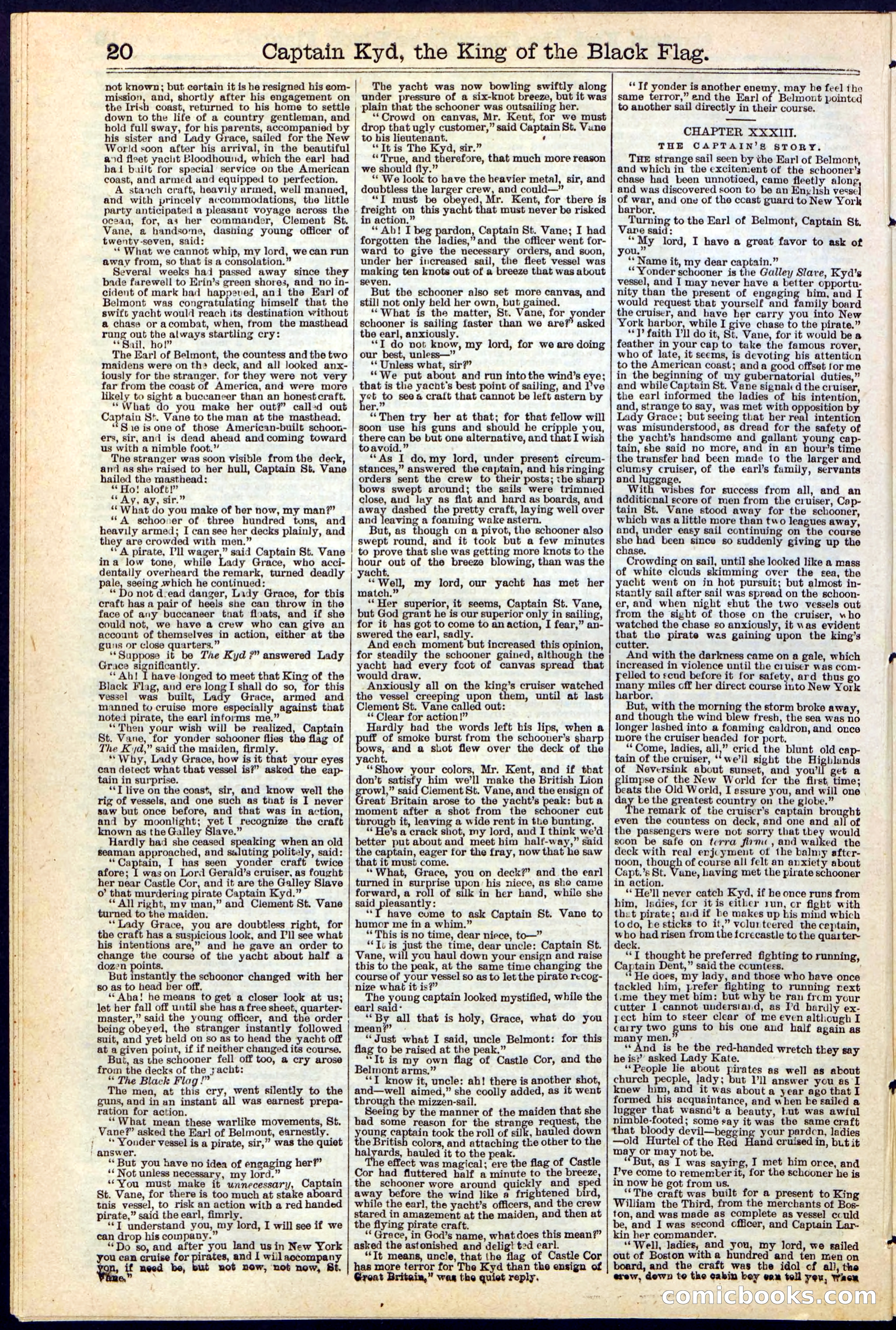
A restored page from Pulp Fiction, 1880. Page through the whole issue in the reader above.
📄 Transcribed text from this page (OCR, searchable)
Machine-transcribed from the original scan — historical spelling and the odd misread are preserved.
| ~ —————— = en een oe + et a Os i Se —— 20 —- Captain Kyd, the King of the Black Flag. samy not known; but certain it is he resigned his eom- mission, and, shortly after his engagement on the Irish coast, returned to his home to settle down to the life of a country gentleman, and hold full sway, for steed heen accompanied by his sister and Lady Grace, sailed for the New World soon after his arrival, in the beautiful and fleet yachit Bloodhound, which the earl had hai built for special service on the American coast, and armed and we ae to perfection. A stanch craft, heavily armed, well manned, and with princely accommodations, the little party anticipated a pleasant voyage across the ocean, for, as her commander, Clement St. Vane, a handsome, dashing young officer of twenty-seven, said: ‘What we cannot whip, my lord, we can run away from, so that is a consolation.” Several weeks had passed away since they bade farewell to Erin’s green shores, and no in- cident of mark bad happeved, ani the Earl of Belmont was congratulatia himself that the swift yacht would reach its destination without a chase or acombat, when, from the masthead rung out the always startling cry: ** Sail, ho!” The Earl of Belmont, the countess and the two maidens were on ths deck, and all looked anx- iously for the stranger, for they were not very far from the coast of America, and were more likely to sight a buccaneer than an honestcraft. “What do you make her out?” called out Captain St. Vane to the man at the masthead. “Sie is one of those American-built schoon- ers, sir, and is dead ahead andcoming toward us with a nimble foot.” The stranger was soon visible from the deck, and as she raised to her hull, Captain St. Vane hailed the masthead: “ Ho! aloft!” “* Ay, ay, sir.” ** What do you make of her now, my man?” **A schooner of three hundred tons, and heavily armed; I can see her decks plainly, and they are crowded with men.” ‘‘ A pirate, Pll wager,” said Captain St. Vane ina low tone, while Lady Grace, who acci- dentally overheard the remark, turned deadly pale, seeing which he continued: “Do not d-ead danger, Lady Grace, for tbis craft has a pair of heels she can throw in the face of any buccaneer that floats, and if she could not, we have a crew who can give an account of themselves in action, either at the guns or close quarters.” ‘*Sup it be The Kyd ?” answered Lady Grace significantly. ‘*Ah! I have longed to meet that King of the Black Flag, and ere longI shall do so, for this vessel was built, Lady Grace, armed and manned to cruise more especially against that noted pirate, the earl informs me.” *“Then your wish will be realized, Captain St. Vane, for yonder schooner flies the flag of The Kd,” said the maiden, firmly. **Why, Lady Grace, how is it that your eyes can detect what that vessel is?” asked the eap- tain in surprise. ‘*T live on the coast, sir, and know well the rig of vessels, and one such as that is I never saw but once before, and that was in action, and by moonlight; yet [ recognize the craft known as the Galley Slave.” Hardly had she ceased aking when an old seaman approached, and saluting politely, said: “Captain, I has seen yonder craft twice afore; yi was on Lord Gerald’s cruiser, as fought her near Castle Cor, and it are the Galley Slave o’ that murdering pirate Captain Kyd.” “All right, mv man,” and Clement St. Vane turned to the maiden. ‘*Lady Grace, you are doubtless right, for the craft has a suspicious look, and [ll see what his intentions are,” and he gave an order to change the course of the yacht about half a dozen points. But instantly the schooner changed with her so as to head ber off, ‘‘ Aba! he means to get a closer look at us; let ber fall off until she has a free sheet, quarter- master,” said the young officer, and the order being obeyed, the stranger instantly followed suit, and yet held on so as to head the yacht off at a given point, if if neither changed its course. But, as the schooner fell off too, a cry arose from the decks of the ;acht: * The Black Flag !” The men, at this cry, went silently to the guns, and in an instant all was earnest prepa- ration for action. ‘““What mean these warlike movements, St. Vane?” asked the Earl of Belmont, earnestly. ** Yonder vessel is a pirate, sir,” was the quiet ' answer. ‘“*But you have no idea of engaging her?” ‘* Not unless necessary, my lord.” “You must make it unnecessary, Captain St. Vane, for there is too much at stake aboard tnis vessel, to risk an action witb a red handed pirate,” said the earl, fimrly. ‘‘T understand you, my lord, I will see if we can drop his company.” “Do so, and after you land usin New York ou can cruise for pirates, and I will accompany ya if need be, but not now, not now, Bt. & 2 sess ernment esse The yacht was now bowling swiftly along under pressure of a six-knot breeze, but it was plain that the schooner was outsailing her. ‘“*Crowd on canvas, Mr. Kent, for we must drop that ugly customer,” said Captain St. Vune to bis lieutenant. ‘ “It is The Kyd, sir.” “True, and therefore, that much more reason we should fly.” ** We look to have the heavier meta] doubtless the larger crew, and could— “IT must be obeyed, Mr. Kent, for there is freight on this yacht that must never be risked in action.” ** Ab! I beg pardon, Captain St. Vane; I had forgotten the ladies,” and the officer went for- ward to give the necessary orders, and soon, under her increased sail, the fleet vessel was making ten knots out of a breeze that was about seven. But the schooner also set more canvas, and still not only held her own, but gained, ‘““What is the matter, St. Vane, for yonder schooner is sailing faster than we are?’ asked the earl, anxiously. **I do not know, my lord, for we are doing our best, unless—” ‘* Unless what, sir?’ **We put about and run into the wind’s eye; that is the yacht’s best point of sailing, and I’ve et to see & cralt that cannot be left astern by er. “Then try her at that; for that fellow will soon use his guns and should he cripple you, there can be but one alternative, and that I wish toavoid.” ‘““As I do,my lord, under present circum- stances,” answered the captain, and his ringing orders sent the crew to their posts; the sharp bows swept around; the sails were trimnied close, and Juy as flat and hard as boards, and tel dashed the pretty craft, laying well over and leaving a foaming wake astern. But, as though on a pivot, the schooner also swept round, and it took but a few minutes to prove that she was getting more knots to the hour out of the breeze blowing, than was the yacht. “Well, my lord, our yacht has met her match.” ‘*Her superior, it seems, Captain St. Vane, but God grant he is our superior only in sailing, for it has got to come to an action, I fear,” an- swered the earl], sadly. And each moment but increased this opinion, for steadily the schooner gained, although the yacht had every foot of canvas spread that would draw. Anxiously all on the king’s cruiser watched the vessel creeping upon them, until at last Clement St. Vane called out: ‘Clear for action!” Hardly had tbe words left bis lips, when a uff of smoke burst from the schooner’s sharp ws, and a shot flew over the deck of the yacht. “Show your colors, Mr. Kent, and if that don’t satisfy him we’ll make the British Lion wl,” said Clement St. Vane, and the ensign of rreat Britain arose to the yacht’s peak: buta moment after a shot from the schooner cut through it, leaving a wide rent in the bunting. ‘“* He’s a crack shot, my lord, and I think we’d better put about and meet him half-way,” said the captain, eager for the fray, now that he saw that it must come. “What, Grace, you on deck?” and the earl turned in ee upon his niece, as she came forward, a roll of silk in her hand, while she said Bremen “T have come to ask Captain St. Vane to humor me in a whim.” “This is no time, dear niece, to—” “Tv is just the time, dear uncle: Captain St. Vane, will you haul down your ensign and raise this to the peak, at the same time changing the course of your vessel so as to let the pirate recog- nize what it is?” The young captain looked mystified, while the ear! said- eur all that is holy, Grace, what do you mean?’ | “‘ Just what I said, uncle Belmont: for this flag to be raised at the ” “It is my own flag of Castle Cor, and the Belmont arms.” “I know it, uncle: ah! there is another shot, and—well aimed,” she coolly added, as it went through the mizzen-sail. Seeing by the manner of the maiden that she had some reason for the strange request, the young captain took the roll of silk, hauled down the British colors, and attaching the other to the halyards, hauled it to the peak. e effect was magical; ere the flag of Castle Cor had fluttered half a minute to the breeze, the schooner wore around quickly and sped away before the wind like a frightened bird, while the earl, the yacht’s officers, and the crew stared in amazement at the maiden, and then at the flying pirate craft. ; ‘Grace, in God’s name, what does this mean?” asked the astonished and deligt ted earl. “It means, uncle, that the flag of Castle Cor has ws terror for The Kyd than the ensign of ;, Sir, and " waa the quist reply. ‘If yonder is another enemy, may he feel the same terror,” end the Earl of Belmont pointed to another sail directly in their course. CHAPTER XXXIITI. THE CAPTAIN’S STORY. THE strange sail seen by the Earl of Belmont, and which in the excitement of the schooner’s chase had been unnoticed, came fleetly along, and was discovered soon to be an English vesse of war, and one of the ccast guard to New York harbor, Turning to the Earl of Belmont, Captain St. Vane said: ‘““My lord, I have a great favor to ask of you.” ‘* Name it, my dear captain.” “Yonder schooner is the Galley Slave, Kyd’s vessel, and I may never have a better opportu- nity than the present of engaging bim, and I would request that yourself and family board the cruiser, and have her carry you into New York harbor, while I give chase to the pirate.” ‘*]’ faith Dll do it, St. Vane, for it would be a feather in your cap to take the famous rover, who of late, it seems, is devoting his attention to the American coast; and a good offset tor me in the beginning of my gubernatorial duties,” and while Captain St. Vane signak d the cruiser, the earl informed the ladies of his intention, and, strange to say, was met with opposition by Lady Grace; but seeing that her real intention was misunderstood, as dread for the safety of the yacht’s handsome and gallant young cap- tain, she said no more, and in an hour’s time the transfer had been made to the larger and clumsy cruiser, of the earl’s family, servants and luggage. With wisbes for success from all, and an additional score of men from the cruiser, Cap- tain St. Vane stood away for the schooner, which was a little more than two leagues away, and, under easy sail continuing on the course oo had been since so suddenly giving up the chase. Crowding on sail, until she looked like a mass of white clouds skimming over the gea, the yacht went on in hot pursuit; but almost in- stantly sail after sail was spread on the schoon- er, and when night shut the two vessels out from the sight of those on the cruiser, who watched the chase so anxiously, it was evident that the pirate was gaining upon the king’s cutter. _ And with the darkness came on a gale, which increased in violence until the ci uiser was com- felled to seud before it for safety, ard thus go many miles off her direct course into New York harbor. But, with the morning the storm broke away, and though the wind blew fresh, the sea was no longer lashed into a foaming caldron, and once wore the cruiser headed for port. ‘* Come, ladies, all,” cricd the blunt old ca tain of the cruiser, ‘‘ we'll sight the Highlands of Neversink about sunset, and you'll get a oe of the New World fer the first, time; ats the Old World, I essure you, and will one day ke the greatest country on the globe.” he remark of tbe cruiser’s captain brought even the countess on deck, and one and all of the passengers were not sorry that they would soon be safe on terra firnu , and walked the deck with real enjcymeut of the balmy after- noon, i, of course all felt an anxiety about Capt.’s St. Vane, having met the pirate schooner in action. ‘** He’ll never catch Kyd, if he once runs from him, Isdies, for itis either 1un, cr fight with thet pirate; ard if be makes up his mind which todo, be sticks to it,” volurtcered the ceptain, who had risen from the fcrecastle to the quarter- eck. ‘“‘T thought he preferred fighting to running, Captain Dent,” said the countess. ‘** He does, my lady, and thore who have once tackled him, prefer fighting to running next t:me they met bim: but why be ran frcm your cutter 1 cannot undersiaid, as I’d hardly ex- yect him to steer clear of me even although I carry two guns to his one and half again as nt And We tee tbe. reashatided wretch th * An -handed wretch the he is’ asked Lady Kate. fred ‘People lie about pirates as well as about church people, Jady; but 1’l] answer you as I knew him, and it was about a year ago that I formed his acquaintance, and when he sailed a lugger that wasnd’t a beauty, but was awiul on aera : eye thes it was the Sone a y devil— ing your parden, ladies —old Hurtel of the Red Hand cruised in, but it may or may not be, F “But, as I was sayirg, I met him orce, and Pve come to remember it, for the schooner he is in now he got from us. ‘The craft was built for a present to King William the Third, from the merchants of Bos- ton, and was made as complete as vessel eculd be, and I was second officer, and Captain Lar- kin her commander, ‘Well, ladies, and you, my lord, we sailed out of Boston with a hun and ten men on board, and the craft was the idol of all, the exew, down to the cabin bey eau toll yeu, Waon — — » —- a 2 = COMIEDOOKS.COM CY a .