
Pulp Fiction, 1880 · page 13 of 24
Beadle's Dime Library No. 109 — page 13: what you’re looking at
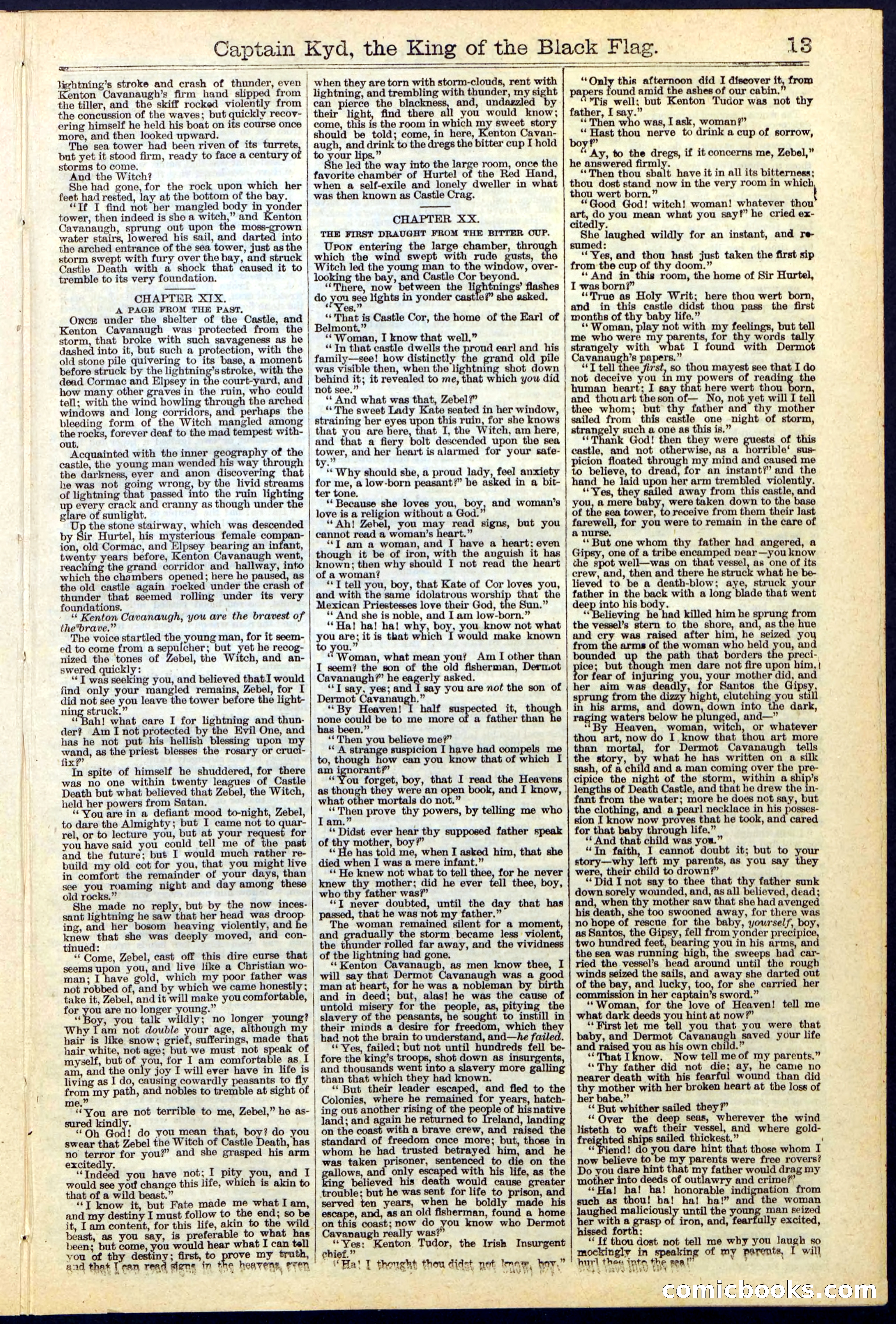
A restored page from Pulp Fiction, 1880. Page through the whole issue in the reader above.
📄 Transcribed text from this page (OCR, searchable)
Machine-transcribed from the original scan — historical spelling and the odd misread are preserved.
» ns me ee go eee lightning’s stroke and crash of thunder, even Kenton Cavanaugh’s firm hand slipped from the tiller, and the skiff rocked violently from the concussion of the waves; but quickly recov- ering himself he held his boat on its course once more, and then looked upward. The sea tower had been riven of its turrets but yet it stood firm, ready to face a century of storms to come. And the Witch? She had gone, for the rock upon which her feet had rested, lay at the bottom of the bay. “Te TI find not ber mangled body in yonder tower, then indeed is she a witch,” and Kenton Cavanaugh, sprung out upon the wal py water stairs, lowered his sail, and d d into the arched entrance of the sea tower, just as the storm swept with fury over the bay, and struck Castle Death with a shock that caused it to tremble to its very foundation. CHAPTER XIX. A PAGE FROM THE PAST. Once under the shelter of the Castle, and Kenton Cavanaugh was protected from the storm, that broke with such savageness as he dashed into it, but such a protection, with the old stone pile quivering to its base, a moment before struck by the lightning’s stroke, with the dead Cormac and Elpsey in the court-yard, and how many other graves in the ruin, who could tell; with the wind howling through the arched windows and long corridors, and perhaps the bleeding form of the Witch mangled among the rocks, forever deaf to the mad tempest with- out. Acquainted with the inner geography of the castle, the young man wended his way through the darkness, ever and anon discovering that he was not going wrong, by the livid streams of lightning that passed into the ruin lighting up every crack and cranny as though under the glare of sunlight. Up the stone stairway, which was descended by Sir Hurtel, his mysterious female Se! io ion, old Cormac, and Elpsey bearing an infant, twenty years before, Kenton Cavanaugh went, reaching the grand corridor and hallway, into which the chambers opened; here he paused, as the old castle again rocked under the crash of thunder that seemed rolling under its very foundations. “ Kenton Cavanaugh, you are the bravest of the*brave.” The voice startled the young man, for it seem- ed to come from a sepulcher; but yet he recog- nized the tones of Zebel, the Witch, and an- swered quickly: ‘“‘T was seeking you, and believed that.I would find only your mangled remains, Zebel, for I did not see you leave the tower before the light- ning struck.” ‘Bah! what care I for lightning and thun- der? Am I not protected by the Evil One, and has he not put his hellish blessing upon m fe a as the priest blesses the rosary or cruci- fix In spite of himself he shuddered, for there was no one within twenty leagues of Castle Death but what believed that Zebel, the Witch, held her powers from Satan. ‘You are in a defiant mood to-night, Zebel, to dare the Almighty; but I came not to quar- rel, or to lecture you, but at your uest for you have said you could tell me of the past and the future; but I would much rather re- build my old cot for you, that you might live in comfort the remainder of your days, than see you roaming night and day among these old rocks.” ; She made no reply, but by the now inces- sant lightning he saw that her head was droo ing, and her bosom heaving violently, and he knew that she was deeply moved, and con- tinued: ‘Come, Zebel, cast off this dire curse that seems upon you, and live like a Christian wo- man; I have gold, which my poor father was not robbed of, and by which we came honestly ; take it, Zebel, and it will make you comfortable, for you are no longer young.” “ : you talk wildly; no longer young? Why Iam not double your age, although my hair is like snow; grief, sufferings, made that hair white, not age; but we must not speak of myself, but of = ets for I am comfortable as I | fore the king’s troo and the only joy I will ever have in life is living as I do, causing cowardly peasants to fly from my path, and nobles to tremble at sight of » e. “You are not terrible to me, Zebel,” he as- sured kindly. * Oh Goal do you mean that, boy? do you swear that Zebel the Witch of Castle th, has no terror for you?” and she grasped his arm excitedly. : ‘“‘Indéed you have not; I pity you, and I would see yort change this life, which is akin to that of a wild beast.” ‘‘T know it, but Fate made me what I am, and my destiny I must follow to the end; so be it, I am content, for this beast, as you say, is preferable to what has been; but come, you would hear what I can tell vou of thy destiny; first, to ve my truth, aad thet [ean read gens in the heavens, eren ee I ; | life, akin to the wild. nT co Captain Kyd, the King of the Black Flag. when they are torn with storm-clouds, rent with lightning, and trembling with thunder, my sight can pierce the blackn and, undagzled by their light, find there you would know; come, this is the room in which my sweet story should be told; come, in here, Kenton Cavan- augh, and drink to the dregs the bitter cup I hold to your lips.” he led the way into the large room, once the favorite chamber of Hurtel of the Red Hand, when a self-exile and lonely dweller in what was then known as Castile Crag. CHAPTER XX. THE FIRST DRAUGHT FROM THE BITTER OUP. Upon entering the large chamber, through which the wind swept with rude gusts, the Witch led the Nie man to the window, over- looking the bay, and Castle Cor beyond. “There, now between the 1 pee od flashes do a see lights in yonder castle?’ she asked, es ‘‘' That is Castle Cor, the home of the Earl of Belmont.” ‘‘- Woman, I know that well.” “In that castle dwells the proud earl and his family—see! how distinctly the nd old pile was visible then, when the lightning shot down behind it; it revealed to me, that which you did not see.” ‘** And what was that, Zebel?”’ “The sweet Lady Kate seated in her window, straining her eyes upon this ruin, for she knows that you are bere, that I, the Witch, am here, and that a fiery bolt descended upon the sea tower, and her heart is alarmed for your safe- ‘*Why should she, a proud lady, feel anxiety for me, a low-born peasant?” be asked in a bit- ter tone. ‘* Because she loves you, boy, and woman’s love is a religion without a God.’ ‘*Ah! Zebel, you may read signs, but you cannot read a woman’s heart.” ‘“‘T am a woman, and I have a heart: even though it be of iron, with the anguish it has known; then why should I not read the heart of a woman? ‘*T tell you, boy, that Kate of Cor loves you, and with the same idolatrous worship that the Mexican Priestesses love their God, the Sun.” ** And she is noble, and I am low-born.” “Ha! ha! ha! why, boy, you know not what a are; it is that which I would make known ou.’ Woman, what mean you’ Am I other than I seem? the son of the old fisherman, Dermot Cavanaugh?” he eagerly asked. “T say, yes; and I say you are not the son of Dermot thc pe a ‘“By Heaven! I half suspected it, ang none could be to me more of a father than he has been.” ‘‘Then you believe me?” ig eb suspicion I have had compels me to, though how can you know that of which I am ignorant?’ “You forget, boy, that I read the Heavens as though they were an open book, and I know, what other mortals do not.” ‘ - Then prove thy powers, by telling me who am. ‘*‘ Didst ever hear thy supposed father speak of thy mother, boy?’ ‘‘ He has told me, when I asked him, that she died when I was a mere infant.” ‘* He knew not what to tell thee, for he never knew thy mother; did he ever tell thee, boy, who thy father was?’ “‘T never doubted, until the day that has passed, that he was not my father.” The woman remained silent for a moment, and dually the storm became less violent, the thunder rolled far away, and the vividness of the lightning had gone. ‘‘Kenton Cavanaugh, as men know thee, I will say that Dermot Cavanaugh was a man at heart, for he was a nobleman by and in deed; but, alas! he was the cause of untold misery for the ple, as, pitying the slavery of the peasants, he sought to instill in their minds a desire for freedom, which they had not the brain to understand, and—he failed. ‘Yes, failed; but not until hundreds fell be- shot down as insurgents, and thousands went into a slavery more galling than that which they had known. ‘‘ But their leader escaped, and fled to the Colonies, where he remained for years, hatch- ing out another rising of the le of hisnative land; and again he returned eland, landing on the coast with a brave crew, and raised the standard of freedom once more; but, those in whom he had trusted betrayed him, and he was taken pecs gpl sentenced to die on the patows, and only escaped with his life, as the g believed his death would cause greater trouble; but he was sent for life to prison, and served ten years, when he boldly made his py and, as an old fisherman, found a home on this coast; now do you know who Dermot Cavanaugh really was ‘Yes: Kenton Tudor, the Irish Insurgent chief.” ; “Hat I thought thou didst net tryqy, hoy,” 13 ee this afternoon did I discover it, from papers ound amid the ashes of our cabin. “Tis well: but Kenton Tudor was not thy father, I say.” “Then who was, I ask, woman?” me ane thou nerve to drink a cup of sorrow, if Ay, to the dregs, if it concerns me, Zebel,” he answered gm “Then thou sbalt have it in all its bitterness; thou dost stand now in the very room in which thou wert born.” “Good God! witch! woman! whatever thou pe you mean what you say?” he cried ex- citedly. She laughed wildly for an instant, and re- sumed: ‘Yes, and thou hast just taken the first sip from the cup of thy doom.” ‘‘And in this room, the home of Sir Hurtel, I was born?” “True as Holy Writ; here thou wert born, and in this castle didst thou pass the first months of thy baby life.” ‘* Woman, play not with my feelings, but tell me who were my pee for thy words tally strangely with what I found with Dermot Cavanaugh’s papers.” “T tell thee jirst, so thou mayest see that I do not deceive you in my powers of reading the human heart; I say that here wert thou born, and thouart theson of— No, not yet will I tell thee whom; but thy father and thy mother sailed from this castle one night of storm, strangely such a one as this is,” ‘‘Thank God! then they were guests of this castle, and not otherwise, as a horrible‘ sus- picion floated through my mind and caused me to believe, to dread, for an instant?’ and the hand he laid upon her arm trembled violently. ‘Yes, they sailed away from this castle, and you, a mere baby, were taken down to the base of the sea tower, to receive from them their last farewell, for you were to remain in the care of a nurse. ‘*But one whom thy father had angered, a Gipsy, one of a tribe encamped near—you know the spot well—was on that vessel, as one of its crew, and, then and there he struck what he be- lieved to be a death-blow; aye, struck your father in the back with a long blade that went ge his body. ‘Believing he had killed him he sprung from the vessel’s stern to the shore, and, as the hue and cry was raised after him, he seized you from the arms of the woman who held you, an bounded up the path that borders the preci- — but though men dare not fire upon him, | or fear of injuring you, your mother did, and her aim was deadly, for Santos the Gipsy sprung from the dizzy hight, clutching you still in his arms, and down, down into the dark, g waters below he plunged, and—” ‘By Heav woman, tch, or whatever thou art, now do I know that thou art more than mortal, for Dermot Cavanaugh tells the story, by what he has written on a silk sash, of a child and a man coming over the pre- cipice the night of the storm, within a ship’s lengths of Death Castile, and that he drew the in- fant from the water; more he does not say, but the clothing, and a pearl necklace in his posses- sion I know now proves that he took, and cared for that baby through life.” ‘* And that child was you.” dae a eS cannot Sonne it; but to pa story—why my parents, as you sa were, their child to drown?’ nated “ Did I not say to thee that thy father sunk down sorely wounded, and, as all believed, dead; and, when thy mother saw that she had avenged his death, she too swooned away, for there was no hope of rescue for the baby, yoursel/, boy, as Santos, the Gipsy, fell from yonder precipi two hundred feet, bearing you in his arms, ad the sea was running high, the sweeps had car- ried the vessel’s head around until the rough winds seized the sails, and away she darted out of the bay, and lucky, too, for she carried her commission in her captain’s sword.” ‘*Woman, for the love of Heaven! tell me what dark deeds you hint at now?” ‘First let me tell you that you were that baby, and Dermot Cavanaugh saved your life and raised you as his own child.” “That I w. Now tell meof my parents,” “Thy father did not die; ay, he came no nearer death with his fearful wound than did thy mother with her broken heart at the loss of her babe.”’ ‘But whither sailed they?” ‘Over the deep seas, wherever the wind listeth to waft their vessel, and where gold- freighted ships sailed thickest,” ' “Biend! do you dare hint that those whom I now believe to be my parents were free rovers? Do you dare hint that et faa would drag my mother into deeds of outlawry and crime?” ‘‘Ha! ha! ha! honorable indignation from wee thou! ma ae ya and the rome ug maliciously until the young man se her eg a =§ iron, and, vearfally excited, orth: “cas ee ~~ eee val) a8 why you ee in mockingly spea m ren wi mint thea tn teereate "i 2 %ey 1S miicbioo €O (C SiG