
Pulp Fiction, 1881 · page 22 of 107
The Wrong Man — page 22: what you’re looking at
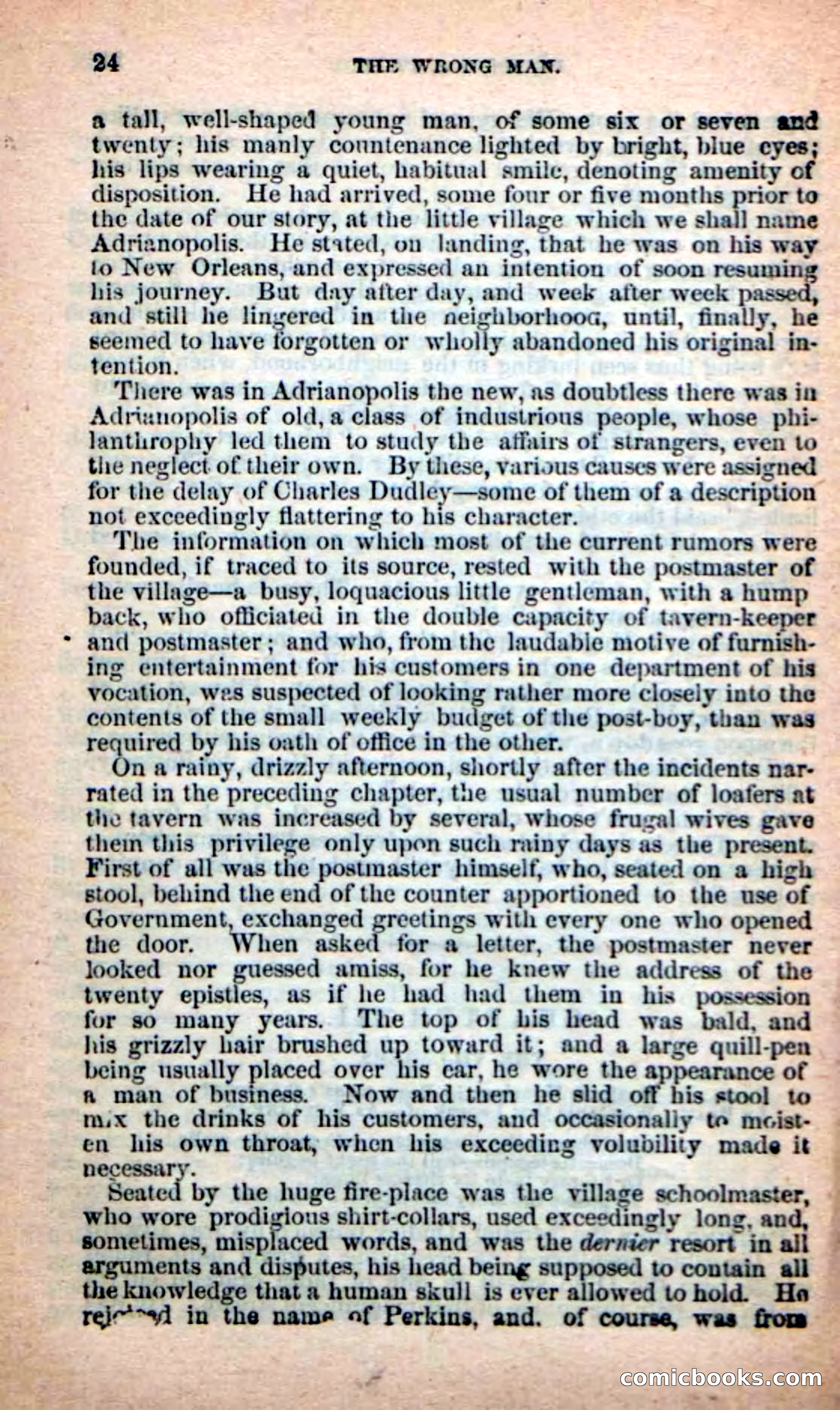
A restored page from Pulp Fiction, 1881. Page through the whole issue in the reader above.
📄 Transcribed text from this page (OCR, searchable)
Machine-transcribed from the original scan — historical spelling and the odd misread are preserved.
24 THE WRONG MAN. a tall, well-shaped young man, of some six or seven and twenty; his manly conntenance lighted by bright, blue eyes; his lips wearing a quiet, habitual smile, denoting amenity disposition. He had arrived, some four or five months prior to the date of our story, at the little village which we shall name Adrianopolis. He stated, on landing, that he was on his way to New Orleans, and expressed an intention of soon i his journey. But day atter day, and week after week and still he lingered in the neighborhooa, until, finally, he seemed to have forgotten or wholly abandoned his original in- tention. There was in Adrianopolis the new, as doubtless there was in Adrixnopolis of old,a class of industrious people, whose phi- lanthrophy led them to study the affairs of strangers, even to the neglect of their own. By these, various causes were assigned for the delay of Charles Dudley—some of them of a description | not exceedingly flattering to his character. The information on which most of the current rumors were founded, if traced to its source, rested with the postmaster of the village—a busy, loquacious little gentleman, with a hump — back, who officiated in the double capacity of tavern-k * and postmaster; and who, from the laudable motive of furnish- ing entertainment for his customers in one department of his vocation, wes suspected of looking rather more closely into the contents of the small weekly budget of the post-boy, than was required by his oath of office in the other. “On a rainy, drizzly afternoon, shortly after the incidents nar- rated in the preceding chapter, the usual number of loafers at the tavern was increased by several, whose frugal wives gave them this privilege only upon such rainy days as the present. First of all was the postmaster himself, who, seated on a high stool, behind the _ ood the counter apportioned to the use of Government, exc tings with every one who opened the door. When oiked ten a letter, the postmaster nares looked nor guessed np, te ro gprioed the address of the twenty epistles, as if he ad them in his possession — for = many years. The top of his head was bald, and his grizzly hair brushed up toward it; and a large quill-pen being usually ae over his ear, he wore the appearance of a man of business. Now and then he slid his stool to mix the drinks of his customers, and occasionally te moist- — en his own throat, when his exceeding volubility made it tented by the huge fire-place was the village schoolmaster, who wore ea shirt-collars, used exceedingly long, and, A ee os, So Seat wae tho desi rent ae the knowledge that a human skull is ever rej*~ai in the name of Perkins, and. :