
Pulp Fiction, 1877 · page 7 of 16
Beadle's Half Dime Library, Vol. 1, No. 2 — page 7: what you’re looking at
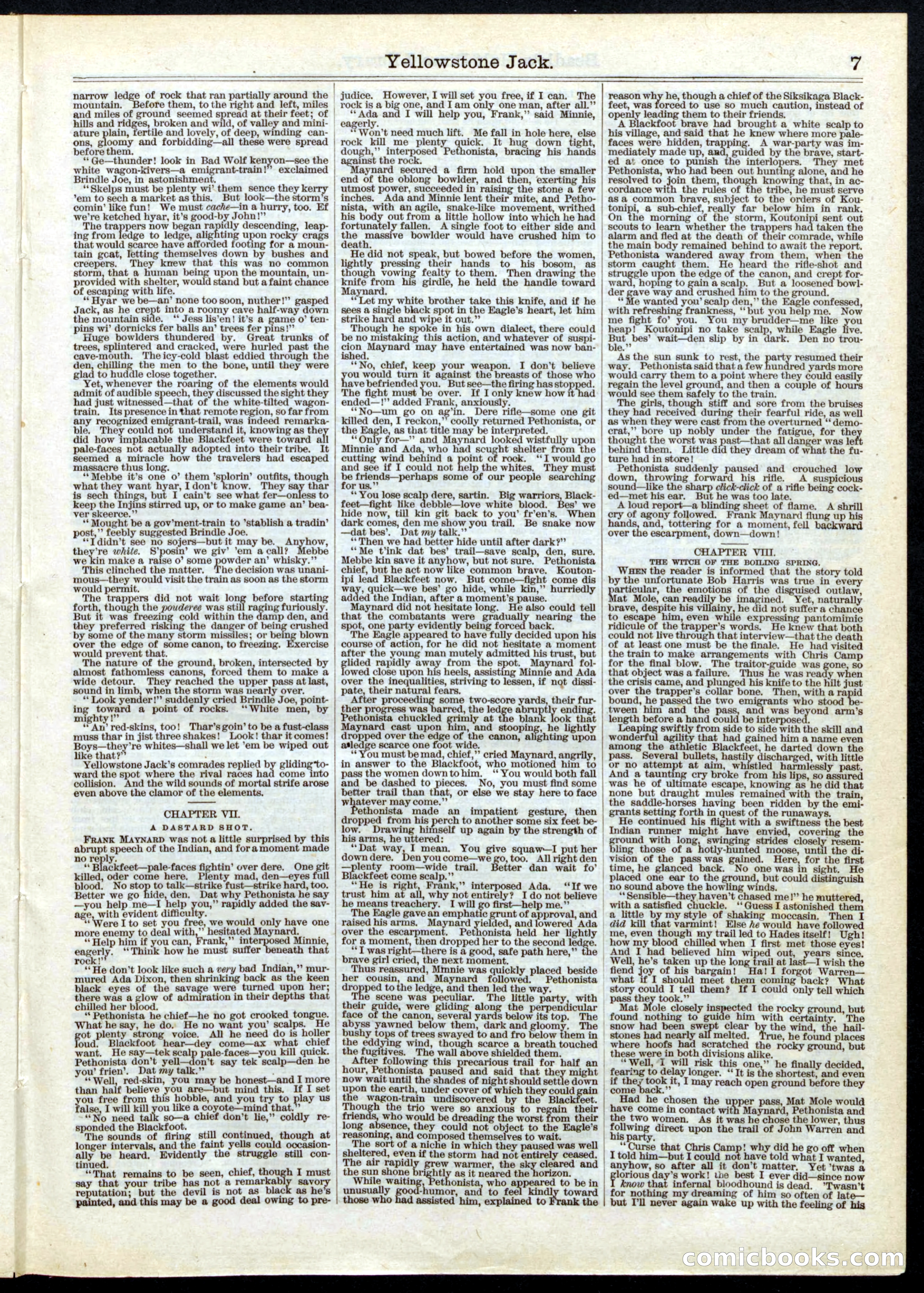
A restored page from Pulp Fiction, 1877. Page through the whole issue in the reader above.
📄 Transcribed text from this page (OCR, searchable)
Machine-transcribed from the original scan — historical spelling and the odd misread are preserved.
—_———— $$ ———e narrow | mountain. fore them, to the right and left, miles and miles of ground seemed spread at their feet; of hills and ridges, broken and wild, of valley and mini- ature plain, fertile and lovely, of deep, winding can- ons, gloomy and forbidding—all these were spread before them. ‘*Ge—thunder! look in Bad Wolf kenyon—see the white wagon-kivers—a emigrant-train!”’ exclaimed Brindle Joe, in astonishment, ‘*Skelps must be plenty wi’ them sence they kerry ‘em to sech a market as this. But look—the storm’s comin’ like fun! We must cache—in a hurry, too. Ef we're ketched hyar, it’s good-by John!” The trappers now began “he ged descending, leap- ing from ledge to ledge, alighting upon rocky crags that would scarce have afforded footing for a moun- tain goat, letting themselves down by bushes and creepers. They knew that this was no common storm, that a human — upon the mountain, un- provided with shelter, would stand but a faint chance of escaping with life. ‘*Hyar we be—an’ none too soon, nuther!”’ gasped Jack, as he crept into a roomy cave half-way down the mountain side. ** Jess lis’en! it’s a game o’ ten- pins wi’ dornicks fer balls an’ trees fer pins!” Huge bowlders thundered by. Great trunks of trees, splintered and cracked, were hurled past the cave-mouth. Theicy-cold blast eddied through the den, chilling the men to the bone, until they were glad to huddle close together. Yet, whenever the roaring of the elements would admit of audible speech, they discussed the sight they had just witnessed—that of the white-tilted wagon- train. Its presence in that remote region, so far from any recognized emigrant-trail, was indeed remarka- ble. They could not understand it, knowing as ae did how implacable the Blackfeet were toward all pale-faces not actually adopted into their tribe. It seemed a miracle how the travelers had escaped massacre thus long. ‘*Mebbe it’s one o’ them ’splorin’ outfits, though what they want hyar, Idon’t know. They say thar is sech things, but I cain’t see what fer—onless to keep the Injins stirred up, or to make game an’ bea- ver skeerce.”’ ‘* Mought be a gov’ment-train to ’stablish a tradin’ post,’’ feebly suggested Brindle Joe. ‘‘T didn’t see no sojers—but it may be. Anyhow, they’re while. wt ae A we giv’ ‘em acall? Mebbe we kin make a raise 0’ some powder an’ whisky.” This clinched the matter. The decision was unani- mous—they would visit the train as soon as the storm would permit. The trappers did not wait long before starting forth, though the pouderee was still raging furiously. But it was freezing cold within the damp den, and they preferred risking the danger of being crushed by some of the many storm missiles; or being blown over the edge of some canon, to freezing. Exercise would prevent that. The nature of the ground, broken, intersected by almost fathomless canons, forced them to make a wide detour. They reached the upper pass at last, sound in limb, when the storm was nearly over. ** Look yender!”” suddenly cried Brindle Joe, point- ing toward a point of rocks. ‘White men, by might }’? " ‘Ane red-skins, too! Thar’s goin’ to be a fust-class muss thar in jist three shakes! Look! thar it comes! Boys—they’re whites—shall we let ‘em be wiped out like that?’ Yellowstone Jack’s comrades replied by gliding*to- ward the spot where the rival races had come collision. And the wild sounds of mortal strife arose even above the clamor of the elements. CHAPTER VII. A DASTARD SHOT. MAYNARD was not a little surprised by this abrupt speech of the Indian, and fora moment made no reply. Pe Blackfect—~pale-faces fightin’ over dere. One git killed, oder come here. Plenty mad, den—eyes full blood. No stop to talk—strike fust—strike hard, too. Better we go hide, den. Dat why Pethonista he say —you help me—I help — rapidly added the sav- age, with evident difficulty. ‘Were I to set you free, we would only have one more enemy to deal with,”’ hesitated Maynard. “Help him if you can, Frank,’’ interposed Minnie, eagerly. “Think how he must suffer beneath that rock!’ ‘He don’t look like such a very bad Indian,” mur- mured Ada Dixon, then shrinking back as the keen black eyes of the savage were turned upon her; there was a glow of ad tion in their depths that chilled her blood. **Pethonista he chief—he no got crooked tongue. What he say, he do. He no want you’ scalps. He ot plenty strong voice. All he need do is holler foud. Blackfoot hear—dey come—ax what chief want. He say—tek scalp pale-faces—you kill quick. Pethonista don’t yell—don't say tek scalp—den he you’ frien’. Dat my talk.” ‘* Well, red-skin, you may be honest—and I more than half believe you are—but mind this. If I set ou free from this hobble, and you try to play us alse. I will kill you like a coyote—mind that.” “No need talk so—a chief don’t lie,” coldly re- sponded the Blackfoot. The sounds of firing still continued, though at longer intervals, and the faint yells could occasion- ally be heard, Evidently the struggle still con- eo remains to be seen, chief, though I must say that your tribe has not a remarkably savo reputations but the devil is not as black as he’s peinted, end this may be a good deal owing to pre- e of rock that ran partially around the | | | jj}=:°=}=}° =r 01 nnn nnn ee Uae Una an | ' | | Yellowstone Jack. judice. However, I will set you free, if I can. The rock is a big one, and Iam only one man, after all.’’ fie and I will help you, Frank,’’ said Minnie, eagerly. **Won’t need much lift. Me fall in hole here, else rock kill me plenty wen It hug down tight, dough,”’ interposed Pethonista, bracing his hands against the rock. Maynard secured a firm hold upon the smaller end of the oblong bowlder, and then, exerting his utmost power, succeeded in raising the stone a few inches. Ada and Minnie lent their mite, and Petho- nista, with an agile, snake-like movement, writhed his body out from a little hollow into which he had fortunately fallen. A single foot to either side and ve bowlder would have crushed him to He did not speak, but bowed before the women, lightly pressing their hands to his bosom, as though vowing fealty to them. Then drawing the sie — his girdle, he held the handle toward aynard. ‘**Let my white brother take this knife, and if he sees a single black spot in the Eagle’s heart, let him strike hard and wipe it out.” Though he spoke in his own dialect, there could be no mistaking this action, and whatever of suspi- eel Maynard may have entertained was now ban- ‘*No, chief, keep your weapon. I don’t believe tt would turn it against the breasts of those who ave befriended you. But see—the firing has ey er The fight must over. If I only knew how it ended—!”’ added Frank, anxiously. **No—um go on ag’in. Dere rifle—some one git killed den, I reckon,”’ coolly returned Pethonista, or the Eagle, as that title may be interpreted. **Only for—” and Maynard looked wistfully upon Minnie and Ada, who had scught shelter from the cutting wind behind a point of rock. ‘I would go and see if I could not help the whites. They must be friends—perhaps some of our people searching for us.”’ ** You lose —— dere, sartin. Big warriors, Black- feet—fight like debble—love white blood. Bes’ we hide now, till kin git back to you’ fr’en’s. When dark comes, den me show you trail. Be snake now —dat bes’. Dat my talk.” ‘*Then we had better hide until after dark?” ‘*Me t’ink dat bes’ trail—save scalp, den, sure. Mebbe kin save it anyhow, but not sure. Pethonista chief, but he act now like common brave. Kouton- ipi lead Blackfeet now. But come—fight come dis way, quick—we bes’ go hide, while kin,’’ hurriedly added the Indian, after a moment’s pause. Maynard did not hesitate long. He also could tell that the combatants were peo | nearing the spot, one party evidently being forced back. The Eagle appeared to have fully decided upon his course of action, for he did not hesitate a moment after the young man mutely admitted his trust, but met rapidly away from the spot. Maynard fol- owed close upon his heels, enaiatiner Minnie and Ada over the inequalities, striving to lessen, if not dissi- pate, their natural fears. After proceeding some two-score yards, their fur- ther p was barred, the +} abruptl ending. Petho chuckled grimly at the b ook that Maynard cast upon , and stooping, he lightly dropped over the edge of the canon, alighting upon atledge scarce one foot wide. ‘You must be mad, chief,’ cried Maynard, angrily, in answer to the Blackfoot, who motioned him to pass the women downtohim. ‘ You would both fall and be dashed to came No, you must find some better trail than that, or else we stay here to face whatever may come.”’ ethonista made an impatient gesture, then dh got —— ~ Fee to Set ~ bee feet. ~ ow. ra up again e stre re) his arms, he aieaved: : * mes “Dat way, I mean. You give squaw—I put her down dere. Den you come—we go, too. Allright den = gry J room—wide trail. tter dan wait fo’ Blackfeet come scalp.” “He is ht, Frank,” interposed Ada. “If we trust him at all, why not entirely? I do not believe rae ap one I neh? eM me. “ i e Eagle gave an emphatic grunt of approval, an raised his arms. Maynard ielded, and ieated Ada over the oo . Pethonista held her lightly for a moment, then dropped her to the second ledge. ‘I was right—there is a good, safe path here,” the brave girl cried, the next moment. Thus reassured, Mmnie was quickly placed beside her cousin, and Maynard followed. Pethonista dropped to the ledge, and then led the way. eé scene was peculiar. The little party, with their de, were gliding along the perpendicular face of the canon, several yards below its top. The byss yawned below them, dark and ee The | em in a bushy tops of trees swayed to and fro below the eddying wind, though scarce a breath touched the fugitives. The wall above shielded them. After following this precarious trail for half an hour, Pethonista pa and said that they might now wait until the shades of night should settle down upon the earth, under cover of which they could gain the wagon-train undiscovered by the B eet. Though the trio were so anxious to een their friends, who would be dreading the worst from their long absence, they could not object to the Eagle’s reaso , and composed the ves to wait. The sort of a niche in which they paused was well sheltered, even if the storm had not entirely ceased. The air rapidl w warmer, the cleared and the sun shone bi on as it neared the horizon. While wait thonista, who eaveeres to be in unusually -humor, and to feel kin toward those who assisted him, explained to the 7 $$ $s reason why he, though a chief of the Siksikaga Black- wre Bow vadioe aan = = fo nee —s instead of ope them eir friends. A Blackfoot brave had brought a white scalp to his village, and said that he knew where more pale- faces were hidden, ee A war-party was im- mediately made up, ard, guided by the brave, start- ed at once to punish the interlopers. They met Pethonista, who had been out hunting alone, and he resolved to join them, though knowing that, in ac- cordance with the rules of the tribe, he must serve as a common brave, subject to the orders of Kou- tonipi, a sub-chief, really far below him in rank. On the morning of the storm, Koutonipi sent out scouts to learn whether the trappers had taken the alarm and fled at the death of their comrade, while the main body remained behind to await the report. Pethonista wandered away from them, when the storm caught them. He heard the rifle-shot and struggle upon the edge of the canon, and crept for- ward, hoping to _ ascalp. But a loosened bowl- der ae way and crushed him to the ground. ‘**Me wanted you’ scalp den,” the Eagle confessed, with refreshing frankness, ‘“‘ but you help me. Now me fight fo’ you. You my brudder—me like you heap! Koutonipi no take scalp, while Eagle live. — bes’ wait—den slip by in dark. Den no trou- e,”’ As the sun sunk to rest, the party resumed their way. Pethonista said that a few hun yards more would eo them to a point where they could easily regain the level ground, and then a couple of hours would see them safely to the train. The girls, though stiff and sore from the bruises they had received during their fearful ride, as well as when they were cast from the overturned ‘ demo- crat,’’ bore up nobly under the fatigue, for the thought the worst was past—that all danger was le behind them. Little did they dream of what the fu- ture had in store! Pethonista suddenly paused and crouched low down, throwing forward his rifle. A suspicious sound—like the sharp click-click of a rifle being cock- ed—met his ear. But he was too late. A loud report—a blinding sheet of flame. A shrill cry of agony followed. Frank Maynard flung up his hands, and, tottering for a moment, fell backward over the escarpment, down—down! CHAPTER VIII. THE WITCH OF THE BOILING SPRING. WHEN the reader is informed that the story told by the unfortunate Bob Harris was true in every articular, the emotions of the disguised outlaw, at Mole, can eaey be imagined. Yet, naturally brave, despite his villainy, he did not suffer a chance to escape him, even while expressing pantomimic ridicule of the trapper’s words. He knew that both | could not live through that interview—that the death | of at least one must be the finale. He had visited the train to make arrangements with Chris Camp _for the final blow. The traitor-guide was gone, so _ that object was a failure. Thus he was ready when | the crisis came, and plunged his knife to the hilt just _ over the trapper’s collar bone. Then, with a rapid tween him and the pass, and was beyond arm’s uld be interposed. oo EEE —— eee... bound, he passed the two em ts who stood length before a hand co rposed, ae swiftly from side to side with the skill and wond agility that had gained him a name even among the athletic Blackfeet, he darted down the pass. Several bullets, ney ceoheneed, with little or no attempt at aim, whistled harmlessly past. And a taunting cry broke from his lips, so assured was he of ultimate escape, knowing as he did that none but draught mules remained with the train, the saddle-horses having been ridden by the emi- grants setting forth in quest of the runaways. He continued his flight with a swiftness the best Indian runner might have envied, covering the ground with long, swin -resem- bling those of a hotly-hun moose, until the di- vision of the pass was gained. Here, for the first time, he ee No o was in sight. He placed one ear e ground, but could distinguish no sound above the how winds. ‘* Sensible—they haven't chased me!” he muttered, _ with a satisfied chuckle. ‘‘Guess I astonished them a little by my style of shaking moccasin. Then I did kill t varmint! Else he would have followed me, even though my trail led to Hades itself! Ugh! how my blood chilled when I first met those eyes! And I had believed him wi out, years since, _ Well, he’s taken up the long trail at it —1 wish the fiend joy of his bargain! a! 1 forgot Warren— what if I should meet them coming back? What story could I tell them? If I could only tell which pass ~—_ took.” Mat Mole closely the rocky ground, but found nothing to e him with certainty. The snow had been swept clear by the wind, the hail- where: hots Had scratched the thaby cane on where hoo sc e und, but vrs a en a alike. ~e ' is one,” he finally decided, fearing to delay longer. “ It is the shortest: ond even if they took it, I may reach open ground before they come : Had he chosen the upper pass, Mat Mole would have come in contact wit Maynard, Pethonista and | the two women. As it was he chose the lower, thus Sota J direct upon the trail of John Warren and ‘Curse that Chris Camp! why did he go off when I told him—but I could net have told wins I wanted, _ anyhow, so after all it don’t matter. Yet twas a gy day’s work! tbe best I ever did—since now know that infernal bloodhound is dead. °*Twasn’t for nothing my dreaming of him so often of late~ but I'll never again wake up with the feeling of his des close cS (EOIN MUCE OOK e) (E(e)