
Pulp Fiction, 1896 · page 13 of 16
Beadle's Half Dime Library No. 991 — page 13: what you’re looking at
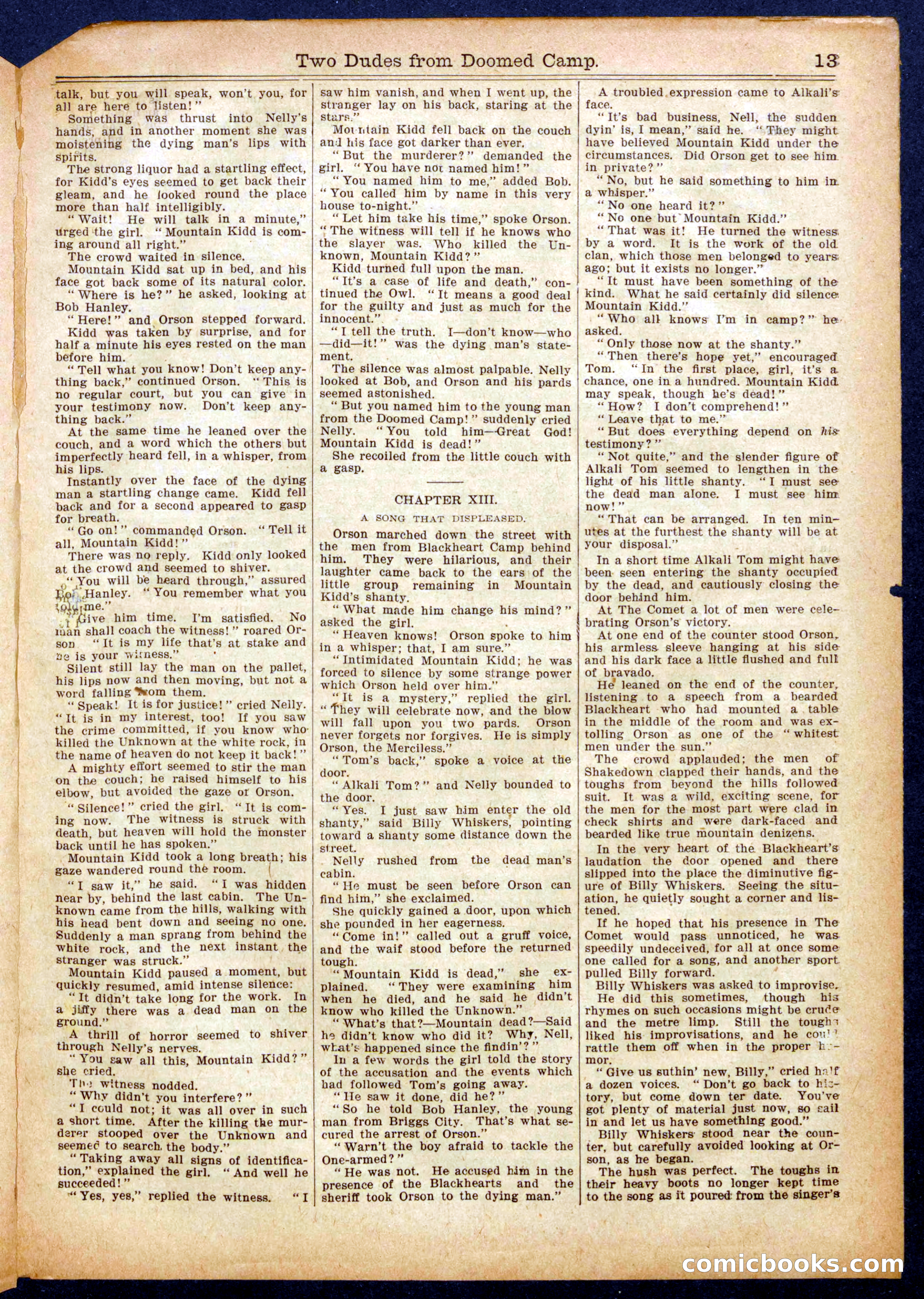
A restored page from Pulp Fiction, 1896. Page through the whole issue in the reader above.
📄 Transcribed text from this page (OCR, searchable)
Machine-transcribed from the original scan — historical spelling and the odd misread are preserved.
_— a. ey ~<~s See} , but you will speak, won’t you, for | | are here to listen! ” - Something | was thrust into Nelly’s hands, and in another moment she was moistening the dying man’s lips with spirits. The strong liquor had a startling effect, for Kidd’s eyes seemed to get back their gleam, and he fooked round the place more than half intelligibly. “Wait! He will talk in a minute,” urged the girl. ‘‘ Mountain Kidd is com- ing around all right.” The crowd waited in silence. Mountain Kidd sat up in bed, and his face got back some of its natural color. “Where is he?” he asked, looking at Bob Hanley. “ Here!” and Orson stepped forward. Kidd was taken by surprise, and for half a minute his eyes rested on the man before him. “Tell what you know! Don’t keep any- thing back,’ continued Orson. “ This is no regular court, but you can give in your testimony now. Don’t keep any- thing back.” At the same time he leaned over the couch, and a word which the others but imperfectly heard fell, in a whisper, from his lips. Instantly over the face of the dying man a startling change came. Kidd fell back and for a second appeared to gasp for breath. “Go on!” commanded Orson. all, Mountain Kidd!” There was no reply. Kidd only looked at the crowd and seemed to shiver. 6 you will be heard through,” assured ; , Hanley. “You remember what you ‘ive him time. I’m satisfied. No wan shall coach the witness!” roared Or- son. “It is my life that’s at stake and ne ig your witness,’ Silent still lay the man on the pallet, his lips now and then moving, but not a word falling wom them. “Speak! It is for justice!’ cried Nelly. “Tt is in my interest, too! If you saw “Tell it the crime committed, if you know who: killed the Unknown at the white rock, in the name of heaven do not keep it back!”’ A mighty effort seemed to stir the man on the couch; he raised himself to his elbow, but avoided the gaze or Orson. “ Silence!” cried the girl. “It is com- ing now. The witness is struck with death, but heaven will hold the monster back until he has spoken.” Mountain Kidd took a long breath; his gaze wandered round the room. “T saw it,” he said. “I was hidden near by, behind the last cabin. The Un- known came from the hills, walking with his head bent down and seeing no one. Suddenly a man sprang from behind the white rock, and the next instant , the Stranger was struck.” Mountain Kidd paused a moment, but quickly resumed, amid intense silence: “It didn’t take long for the work. In a jiffy there was a dead man on the ground,” A thrill of horror seemed to shiver through Nelly’s nerves. “You saw all this, Mountain Kidd?” she cried. The witness nodded. “Why didn’t you interfere?” “T could not; it was all over in such a short time. After the killing the mur- derer stooped over the Unknown and seemec to search. the body.” “Taking away all signs of identifica- tion,” explained the girl. ‘ And well he succeeded! ‘i “* Yes, yes,” replied the witness. “I “A og « (sp et tad - Aj a : ve ; a " w "has . Wis ¥ is p ~~ . ; ia? a3 « sla 40-59 Rae ee SS. 2 = saw him vanish, and when I went up, the stranger lay on his back, staring at the stars,” Motntain Kidd fell back on the couch an:l his face got darker than ever. “But the murderer?’ demanded the girl. “ You have not named him!” “You named him to me,” added Bob. “You called him by name in this very house to-night.”’ “Let him take his time,’”’ spoke Orson. “The witness will tell if he knows who the slayer was. Who killed the Un- known, Mountain Kidd?” Kidd turned full upon the man. “It’s a case of life and death,” con- tinued the Owl. “It means a good deal for the guilty and just as much for the innocent.”’. “T tell the truth. I—don’t know—who —did—it!”’ was the dying man’s state- ment. The silence was almost palpable. Nelly looked at Bob, and Orson and his pards seemed astonished. “ But you named him to the young man from the Doomed Camp!” suddenly cried Nelly. “You told him—-Great God! Mountain Kidd is dead!” She recoiled from the little couch with a gasp. CHAPTER XIII. A SONG THAT DISPLEASED. Orson marched down the street with the men from Blackheart Camp behind him. They were hilarious, and their laughter came back to the ears of the little group remaining in Mountain Kidd’s shanty. “What made him change his mind?” asked the girl. “Heaven knows! Orson spoke to him in a whisper; that, I am sure.” “Intimidated Mountain Kidd; he was forced to silence by some strange power which Orson held over him.” “It is a mystery,” replied the girl. “They will celebrate now, and the blow will fall upon you two pards. Orson never forgets nor forgives. He is simply Orson, the Merciless.”’ “Tom’s back,’ spoke a voice at the door. “ Alkali Tom?” and Nelly bounded to the door. “Yes. I just saw him enter the old shanty,” said Billy Whiskers, pointing toward a shanty some distance down the street. _ Nelly rushed from the dead man’s cabin. “He must be seen before Orson can find him,” she exclaimed. She quickly gained a door, upon which she pounded in her eagerness. “Come in!” called out a gruff voice, and the waif stood before the returned tough. “Mountain Kidd is dead,’ she ex- plained. ‘* They were examining him when he died, and he said he didn’t know who killed the Unknown.” “ What’s that?—Mountain dead?—Said he didn’t know who did it? Why, Nell, wkat’s happened since the findin’? ” In a few words the girl told the story of the accusation and the events which had followed Tom’s going away. “Tie saw it done, did he?”’ “So he told Bob Hanley, the young man from Briggs City. That’s what se- cured the arrest of Orson.” ‘“Warn’t the boy afraid to tackle the One-armed? ” “He was not. He accused him in the presence of the Blackhearts and _ the sheriff took Orson to the dying 1 man. = ro { ‘ ¥ “ : * . ‘ « 4 Saat ; ; 4 . “ : Poy a +e i. treet TATE ee ~~ “9 "I ar « s ** a ‘ ee A Ses 3 © Lae ’ * ae eh ES Two Dudes from Doomed Camp. — ce Pa ee ee Ee OU a dozen voices. 13 A troubled.expression came to Alkali’s: face. “It’s bad business, Nell, the sudden dyin’ is, I mean,” said he. “ Fhey might have believed Mountain Kidd under the circumstances. Did Orson get to see him in private? ’”’ “No, but he said something to him im a whisper.”’ “No one heard it?” “No one but Mountain Kidd.” “That was it! He turned the witness. by a word. It is the work of the old clan, which those men belonged to years: ago; but it exists no longer.” “It must have been something of the kind. What he said certainly did silence Mountain Kidd.” “Who all knows I’m in camp?” he: asked. “Only those now at the shanty.” “Then there’s hope yet,” encouraged Tom. “In the first place, girl, it’s a chance, one in a hundred. Mountain Kidd may speak, though he’s dead!” “How? I don’t comprehend!” “Leave that to me.” “But does everything depend on his testimony? ”’ “Not quite,” and the slender figure of Alkali Tom seemed to lengthen in the light of his little shanty. “I must see the dead man alone. I must see him now!” “That can be arranged. In ten min- utes at the furthest the shanty will be at your disposal.” In a short time Alkali Tom might have been. seen entering the shanty occupied by the dead, and cautiously closing the door behind him. At The Comet a lot of men were cele- brating Orson’s victory. At one end of the counter stood Orson, his armless sleeve hanging at his side and his dark face a little flushed and full of bravado. He leaned on the end of the counter, listening to a speech from a_ bearded Blackheart who had mounted a. table in the middle of the room and was ex- tolling Orson as one of the “ whitest men under the sun.’ The crowd applauded; the men of Shakedown clapped their hands, and the toughs from beyond the hills followed suit. It was a wild, exciting scene, for the men for the most part were clad in check shirts and were dark-faced and — bearded like true mountain denizens. In the very heart of the Blackheart’s laudation the door opened and there slipped into the place the diminutive fig- ure of Billy Whiskers. Seeing the situ- ation, he quietly sought a corner and lis- tened. If he hoped that his presence in The Comet would pass unnoticed, he was speedily undeceived, for all at once some one called for a song, and another sport pulled Billy forward. Billy Whiskers was asked to improvise. He did this sometimes, rhymes on such occasions might be cruce and the metre limp. Still the toughs liked his improvisations, and he cou!’ rattle them off when in the proper h-- mor, “ Give us suthin’ new, Billy,” cried ha!f “Don’t go back to his- tory, but come down ter date. got plenty of material just now, so cail in and let us have something good. % Billy Whiskers stood near the coun- ter, but carefully avoided looking at Or- — son, as he began. The hush was perfect. The toughs in their heavy boots no longer kept time to the song as it poured from the singer's _ though his You've |