
Pulp Fiction, 1896 · page 9 of 16
Beadle's Half Dime Library No. 971 — page 9: what you’re looking at
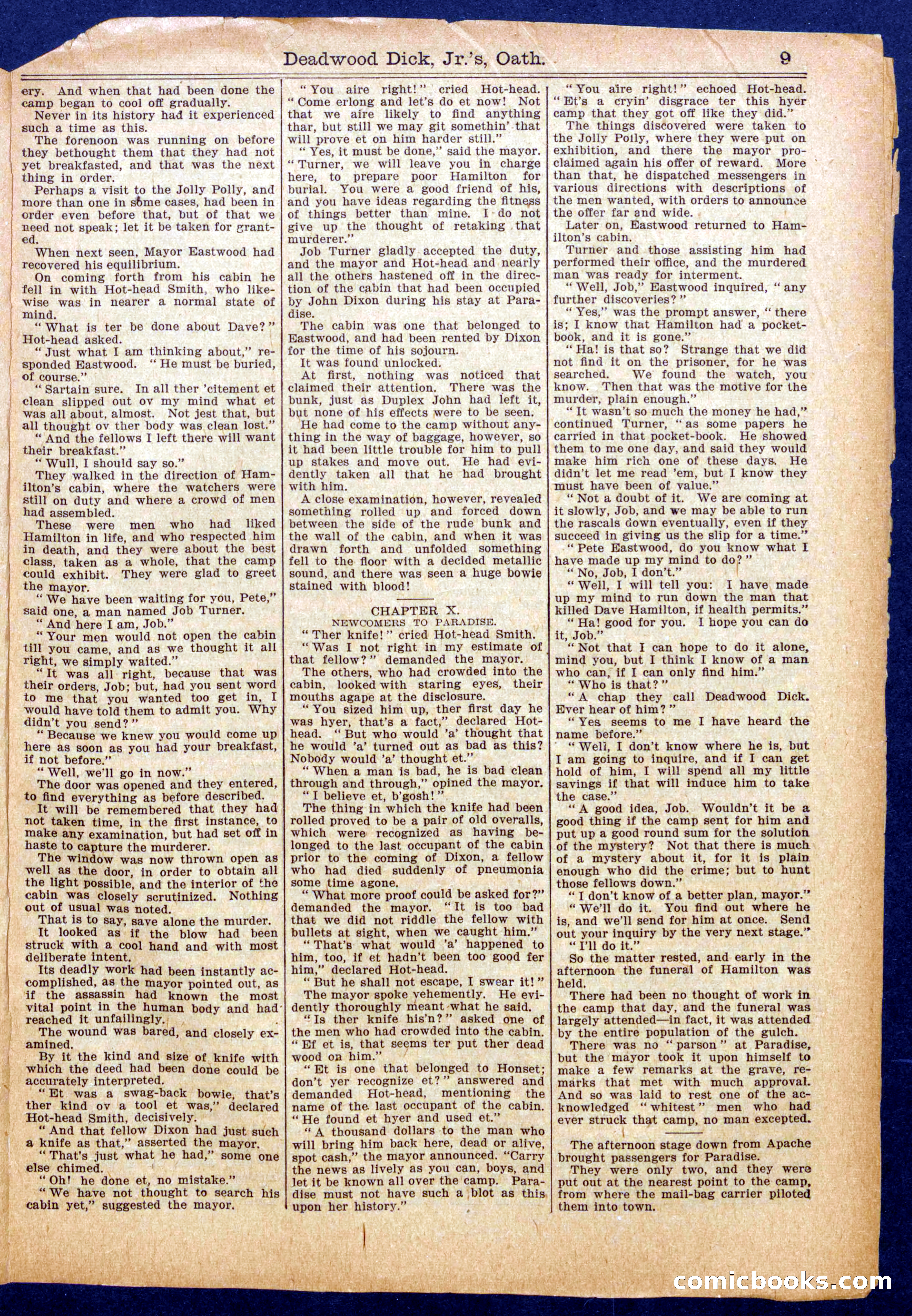
A restored page from Pulp Fiction, 1896. Page through the whole issue in the reader above.
📄 Transcribed text from this page (OCR, searchable)
Machine-transcribed from the original scan — historical spelling and the odd misread are preserved.
ery. And when that had been done the camp began to cool off gradually. Never in its history had it experienced such a time as this. The forenoon was running on before they bethought them that they had not yet breakfasted, and that was the next thing in order. Perhaps a visit to the Jolly Polly, and more than one in s6me cases, had been in order even before that, but of that we need not speak; let it be taken for frant- ed. When next seen, Mayor Eastwood had recovered his equilibrium. On coming forth from his cabin he fell in with Hot-head Smith, who like- wise was in nearer a normal state of mind. “What is ter be done about Dave?” -Hot-head asked. “ Just what I am thinking about,” re- sponded Eastwood. ‘“‘ He must be buried, of course.” “Sartain sure. In all ther ’citement et clean slipped out ov my mind what et Was all about, almost. Not jest that, but all thought ov ther body was clean lost.” “ And the fellows I left there will want their breakfast.” *“Wull, I should say so.” They walked in the direction of Ham- ilton’s cabin, where the watchers were still on duty and where a crowd of men had assembled. _ These were men who had liked Hamilton in life, and who respected him in death, and they were about the best Class, taken as a whole, that the camp could exhibit. They were glad to greet the mayor. “We have been waiting for you, Pete,” Said one, a man named Job Turner. “ And here I am, Job.” “Your men would not open the cabin | till you came, and as we thought it all _ right, we simply waited.” “It was all right, because that was to me that you wanted too get in, I would have told them to admit you. Why didn’t you send?” _ “ Because we knew you would come up | here as soon as you had your breakfast, if not before.” “Well, we'll go in now.’ | The door was opened ha they entered, _ to find everything as before described. It will be remembered that they had . not taken time, in the first instance, to haste to capture the murderer. The window was now thrown open as well as the door, in order to obtain all the light possible, and the interior of the | cabin was closely scrutinized. Nothing out of usual was noted. That is to say, save alone the murder. It looked as if the blow had been t Siruclt with a cool hand and with most deliberate intent, Its deadly work had been instantly ac- - complished, as the mayor pointed out, as ‘if the assassin had known the most 1\ reached it unfailingly. . aves Ab aia was bared, and closely ex- “py tt the kind and size of knife with j : ae the deed had been done could be a accurately interpreted, — “Et was a swag-back orte, that’s ther kind ov a tool et was,” declared _ Hot-head Smith, decisively. ~ . “ And that fellow Dixon had just such ae fig knife as that,” asserted the mayor, “That's just what he Basia Some ope q else chimed. | | “Oh! he done et, no ciietalee a rls A a ‘We have not thought to search his cabin rare | Migeemted the mayor, ~~ a . yig 4 . ‘a= 4 ar Deadwood Dick, Jr.’s, Oath. ; _ their orders, Job; but, had you sent word | “You. aire right!” head. * We Ze @ +, - a . " cried Hot-head. “ Come erlong and let’s do et now! Not that we aire likely to find anything thar, but still we may git somethin’ that will prove et on him harder still.” “ Yes, it must be done,” said the mayor. “Turner, we will leave you in charge here, to prepare poor Hamilton for burial. You were a good friend of his, and you have ideas regarding the fitness of things better than mine. I-do not give up the thought of retaking that murderer.” Job Turner gladly accepted the duty, and the mayor and Hot-head and nearly all the others hastened off in the direc- tion of the cabin that had been occupied by John Dixon during his stay at Para- dise. The cabin was one that belonged to Eastwood, and had been rented by Dixon for the time of his sojourn. It was found unlocked. At first, nothing was noticed that claimed their attention. There was the bunk, just as Duplex John had left it, but none of his effects were to be seen, He had come to the camp without any- thing in the way of baggage, however, so it had been little trouble for him to pull up stakes and move out. He had evi- dently taken all that he had brought with him. A close examination, however, revealed something rolled up and forced down between the side of the rude bunk and the wall of the cabin, and when it was drawn forth and unfolded something fell to the floor with a decided metallic sound, and there was seen a huge bowie stained with blood! | CHAPTER X. NEWCOMERS TO PARADISE. “Ther knife!” cried Hot-head Smith. “Was I not right in my estimate of that fellow?” demanded the mayor. The others, who had crowded into the cabin, looked with staring eyes, their mouths agape at the disclosure. “You sized him up, ther first day he was hyer, that’s a fact,’ declared Hot- " But who would ’a’ thought that he would ’a’ turned out as bad as this? | Nobody would ’a’ thought et.” make any examination, but had set off in | | vital point in the human body and had: “When a man is bad, he is bad clean through and through,” opined the mayor, “TI believe et, b’gosh!”’ The thing in ‘which the knife had been rolled proved to be a pair of old overalls, which were recognized as having be- longed to the Jast occupant of the cabin prior to the coming of Dixon, a fellow who had died suddenly of pneumonia some time agone, “What more proof could be asked tor?” demanded the mayor. “It is too bad that we did not riddle the fellow with bullets at sight, when we caught him,” “ That’s him,” declared Hot-head. “ But he shall not escape, I swear it! ” The mayor spoke vehemently. He eyi- dently thoroughly meant what he said. “Ts ther knife his’n?”’ asked one of the men who had crowded into the cabin. “Pf et is, that seems ter put ther dead wood on him.” “Bt is one that belonged to Honset: don’t yer recognize et?” answered and demanded MHot-head, mentioning the name of the last occupant of the cabin, “He found et hyer and used et.” ‘A thousand dollars to the man who ‘| will bring him back here, dead or alive, A inte cash,” the mayor announced. “Carry t e news as lively as you can, boys, and let it be known all over the camp. Para-. dise must not have such a blot as this, bas. math her history.” ; Ne se A 4 as se ¥ a, vate ee yen " | ever struck that camp, no man exceptec "S3 : E o* “You aire right!” echoed Hot-head. “BEt’s a cryin’ disgrace ter this hyer camp that they got off like they did.” The things discovered were taken to the Jolly Potly, where they were put on exhibition, and there the mayor pro- claimed again his offer of reward. More ° than that, he dispatched messengers in various directions with descriptions of the men wanted, with orders to announce the offer far and wide. . Later on, Eastwood returned to Ham- ilton’s cabin. Turner and those assisting him had performed their office, and the murdered man was ready for interment. “Well, Job,” Eastwood inquired, “ any further discoveries? ”’ * Yes,” was the prompt answer, “‘ there is; I know that Hamilton had a pocket- book, and it is gone.” “Ha! is that so? Strange that we did not find it on the prisoner, for he was searched, know. ‘Then that was the motive for the murder, plain enough.” “It wasn’t so much the money he had,” continued Turner, “as some papers he carried in that pocket-book. He showed them to me one day, and said they would make him rich one of these days. He didn’t let me read ’em, but I know they must have been of value.” “Not a doubt of it. We are coming at it slowly, Job, and we may be able to run the rascals Gown eventually, even if they succeed in giving us the slip for a time.” .“ Pete Eastwood, do you know what IL have made up my mind to do?” “No, Job, I don’t.” | * Well, I will tell you: I have made up my mind to run down the man that killed Dave Hamilton, if health permits.” “Ha! good for you. I hope you can do it, Job.” “Not that I can hope to do it alone, mind you, but I think I know of a man who can, if I can only find him.” “ Who is that?” “A chap they call Deadwood Dick. Ever hear of him?” “Yes seems to me I have heard the name before.” “ Well, I don’t know where he is, but I am going to inquire, and if I can get hold of him, I will spend all my little savings if that will induce him to take the case.’ ““A good idea, Job. Wouldn’t it be a good thing if the camp sent for him and put up a good round sum for the solution of the mystery? those fellows down.” “T don’t know of a better plan, mayor. % “We'll do it. You find out where he is, and we’ll send for him at once. Send | out your inquiry by the very next stage.” what would ’a’ happened to. him, too, if et hadn’t been too good fer “T’ll do it.” So the matter rested, and early in the afternoon the funeral of Hamilton was held, by the entire population of the gulch. There was no “parson” at Paradise, — but the mayor took it upon himself to | make a few remarks at the grave, re- | marks that met with much approval. | And so was laid to rest one of the had 43 knowledged ‘“ whitest” men who. enone The afternoon stage down from Apache brought passengers for Paradise. They were only two, and they were put out at the nearest point to the camp, from where the re erase ee i ; them: into town. ~ ye We found the watch, you - Not that there is much of a mystery about it, for it is plain enough who did the crime; but to hunt; There had been no thought of work in the camp that day, and the funeral was largely attended—in fact, it was attended — . > . » 3 yr e” . x = oh - ee sat, ten G = A +2 ‘ 4 Pp, ‘ _ ’ Py b. ° ree } Pe? ye: beat > "4 {aan Dad 7 + = * ~ : « 7 : = eats pet fe ae ———_ xt 4 * ", Son OO TS + Oh ey rs ae ’ 7+ : ' ~ ‘ + ta. 7 . 7 ra” tee s Se . , > he ce me 5 : id - . ™ > > =m - e ‘ oaeS * P ? - =e 41 ~ > > aa f y _ a. + Sant - » M = | R< “ b > co ~via. 7 * - ‘> gy —_ af ae ae a ” a We - en . S ae *- a "3 1s . Sed iy cot Bear >, a! » ne ¥ * : + . “~@ RY PS eS Aes TE - ve ~ oF . en to. (ar 7" “3 25. hoi gy ° . > ue - wes ba Yo “3 ~ To ae — * se 7 - 2 a "ee oN ens * ie p 43 © 5° : a - - and : “ - - > we ay $< ‘ Po tin is 2 .. : ¢ ~ . _ i ‘ Tone fn? . * ** * reid a 4 gy) e oe a ole 4 z ° os - — Hemet yh EP gaps ee ee ng ee AP ie a . ie . "* - ~ a . 23 ee “a i e fe * ; -* AP) nd oe ye: 7. = “We Tee, Aue e5 ¢ en ee <a ~~ 7) TS ' ~~