
Pulp Fiction, 1896 · page 6 of 16
Beadle's Half Dime Library No. 971 — page 6: what you’re looking at
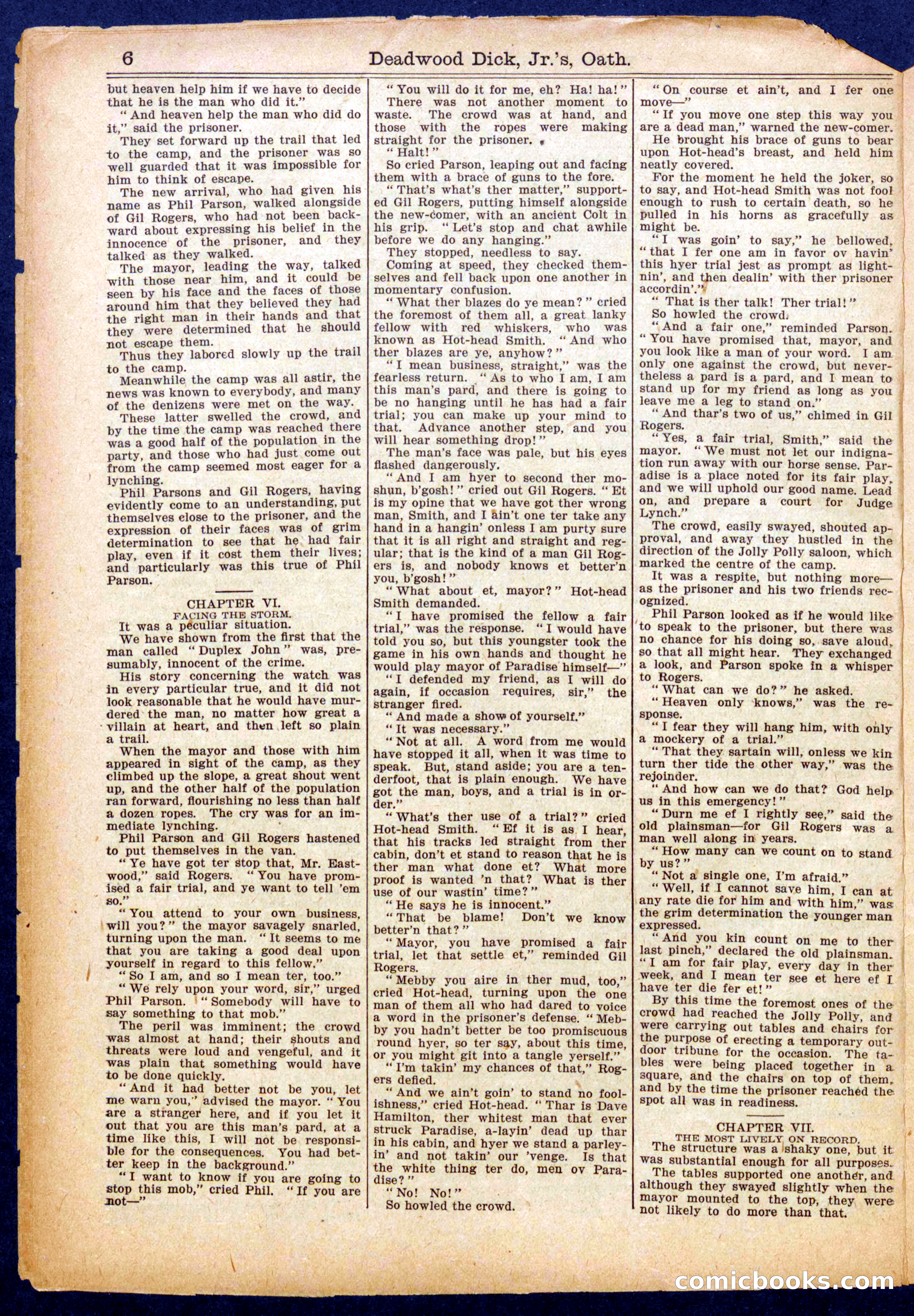
A restored page from Pulp Fiction, 1896. Page through the whole issue in the reader above.
📄 Transcribed text from this page (OCR, searchable)
Machine-transcribed from the original scan — historical spelling and the odd misread are preserved.
—— eae | ieee ag a 6 Deadwood Dick, Jr.’s, Oath. 2 , crs ~ ~ . ch ad #5 é Se en nay tO eb Lome = ty az * _ . ae ul + ye > Tee % ’ - aoe Es ‘ rg £f ee . . “ . > St Bs pr < f a : ay che _—, ~ Fe - a0 ’ a an a4 > See *. al *, ? — ta | 7 th by Ps . _—" j r Sa Jaa J = eat, pee WK ' . : ee = - .* ~ BEF * 4 * ¥ at ¢ : \ ~., ie “ y - q.™- os ’ ez ’ * ti 4s - pee ‘ ’ i i ee ot ens % “ on. - . i * ~~) ais | . , ° : =; &. -_ nat wea? Se aS * 7 a ~~ eae > ane or -- > a” ee ; * gat’ he * - q a > ? | ter keep in the background.” -. -jmot—” but heaven help him if we have to decide that he is the man who did it.” “And heaven help the man who did do it,” said the prisoner. They set forward up the trail that led to the camp, and the prisoner was so well guarded that it was impossible for him to think of escape. The new arrival, who had given his name as Phil Parson, walked alongside of Gil Rogers, who had not been back- ward about expressing his belief in the innocence of the prisoner, and they talked as they walked. The mayor, leading the way, talked with those near him, and it could be seen by his face and the faces of those around him that they believed they had the right man in their hands and that they were determined that he should not escape them. Thus they labored slowly up the trail to the camp. Meanwhile the camp was all astir, the news was known to everybody, and many of the denizens were met on the way. These latter swelled the crowd, and by the time the camp was reached there was a good half of the population in the party, and those who had just come out from the camp seemed most eager for a lynching. Phil Parsons and Gil Rogers, having evidently come to an understanding, put themselves elose to the prisoner, and the expression of their faces was of grim determination to see that he. had fair play, even if it cost them their lives; and particularly was this true of Phil Parson. | CHAPTER VI. FACING THE STORM. Tt was a péculiar situation. We have shown from the first that the man called “Duplex John” was, pre- sumably, innocent of the crime. His story concerning the watch was in every particular true, and it did not look reasonable that he would have mur- dered’ the man, no matter how great a ‘villain at heart, and then left so plain a trail. | When the mayor and those with him appeared in sight of the camp, as they climbed up the slope, a great shout went up, and the other half of the population ran forward, flourishing no less than half a dozen ropes. The cry was for an im- mediate lynching. , Phil Parson and Gil Rogers hastened to put themselves in the van. “Ye have got ter stop that, Mr. Hast- wood,” said Rogers. “‘ You have prom- _ ised a fair trial, and ye want to tell ’em “You attend to your own business, ‘will you?” the mayor savagely snarled, turning upon the man. that you are taking a good deal upon yourself in regard to this fellow.” “So I am, and so I mean ter, too.” “We rely apes your word, sir,” urged Phil Parson. |‘ ‘‘ Somebody will have to say something to that mob.” The peril was imminent; the crowd was almost at hand; their shouts and threats were loud and vengeful, and it was plain that something would have to be done quickly. “And it had better not be you, let me warn you,” advised the mayor. “ You are a stranger here, and if you let it out that you are this man’s pard, at a time like this, I will not be responsi- ble for the consequences. You had bet- “TI want to know if you are going to stop this mob,” cried Phil. “If you are “It seems to me | “You will do it for me, eh? Ha! ha!” There was not another moment to waste. The crowd was at hand, and those with the ropes were making straight for the prisoner. -» “* Halt! ” So cried Parson, leaping out and facing them with a brace of guns to the fore. “That’s what’s ther matter,’ support- ed Gil Rogers, putting himself alongside the new-comer, with an ancient Colt in his grip. “ Let’s stop and chat awhile before we do any hanging.” They stopped, needless to say. Coming at speed, they checked them- selves and fell back upon one another in momentary confusion. “What ther blazes do ye mean?” cried the foremost of them all, a great lanky fellow with red whiskers, who was known as Hot-head Smith. ‘‘ And who ther blazes are ye, anyhow?” “T mean business, straight,’’ was the fearless return. ‘“‘ As to who I am, I am this man’s pard, and there is going to be no hanging until he has had a fair trial; you can make up your mind to that. Advance another step, and you will hear something drop!” The man’s face was pale, but his eyes flashed dangerously. “And I am hyer to second ther mo- shun, b’gosh!”’ cried out Gil Rogers. “ Et is my opine that we have got ther wrong man, Smith, and I ain’t one ter take any hand in a hangin’ onless I am purty sure that it is all right and straight and reg- ular; that is the kind of a man Gil Rog- ers is, and nobody knows et better’n you, b’gosh!”’ “What about et, mayor?” Hot-head Smith demanded. | “TIT have promised the fellow a fair trial,” was the response. “I would have told you so, but this youngster took the game in his own hands and thought he would play mayor of Paradise himself—” ‘““I defended my friend, as I will do again, if occasion requires, sir,” the stranger fired. “And made a show of yourself,” “It was necessary.” | “Not at all. A word from me would have stopped it all, when it was time to speak. But, stand aside; you are a ten- derfoot, that is plain enough. We have got the man, boys, and a trial is in or- der,” “What’s ther use of a trial?” cried Hot-head Smith. “Ef it is as I hear, that his tracks led straight from ther cabin, don’t et stand to reason that he is ther man what done et? What more proof is wanted ’n that? What is ther use of our wastin’ time?” “He says he is innocent.” “That be blame! Don’t we know better’n that?” “Mayor, you have promised a fair trial, let that settle et,’ reminded Gil Rogers. ““Mebby you aire in ther mud, too,” cried Hot-head, turning upon the one man of them all who had dared to voice a word in the prisoner’s defense. ‘‘ Meb- by you hadn’t better be too promiscuous round hyer, so ter say, about this time, or you might git into a tangle yerself.” “I’m takin’ my chances of that,” Rog- ers defied. | . “And we ain’t goin’ to stand no fool- ishness,” cried Hot-head. “ Thar is Dave Hamilton, ther whitest man that ever struck Paradise, a-layin’ dead up thar in his cabin, and hyer we stand a parley- in’ and not takin’ our ’venge. Is that the white thing ter do, men ov Para- dise? ” ‘No! No!” So howled the crowd. | : Be* - ar ee See 0 ys § Wiese . tae 2 = * . Py ~ ra! p co » F oy . Te 4 . ' : ‘ bd - : ? 7 of a 4 ret re 2 ay — — f. d ¥ & : PPA we ; « hat ; / | a \/ ¥ 4 ¥ . - ts ” a 2 9 * \ e| es | \ \ a: ‘ Ae PEARLS fa o_o ee ee a) - “On course et ain’t, and I fer one move—” a “If you move one step this way you — are a dead man,” warned the new-comer. — He brought his brace of guns to bear upon Hot-head’s breast, and held him © neatly covered. 4 For the moment he held the joker, so to say, and Hot-head Smith was not fool enough to rush to certain death, so he pulled in his horns as gracefully as might be. “I was goin’ to say,” he bellowed, “that I fer one am in favor ov havin’ this hyer trial jest as prompt as light- nin’, and then dealin’ with ther prisoner accordin’.’¥ “ That is ther talk! Ther trial!” So howled the crowd: | “And a fair one,” reminded Parson. “You have promised that, mayor, and — you look like a man of your word. I am only one against the crowd, but never- theless a pard is a pard, and I mean to > stand up for my friend as long as you leave me a leg to stand on.” ‘And thar’s two of us,” chimed in Gil Rogers. “Yes, a fair trial, Smith,” said the mayor. ‘‘ We must not let our indigna-— tion run away with our horse sense. Par-_ adise is a place noted for its fair play, | and we will uphold our good name, Lead on, and prepare a court for Judge Lynch.” The crowd, easily swayed, shouted ap- proval, and away they hustled in the direction of the Jolly Polly saloon, which marked the centre of the camp. It was a respite, but nothing more— as the prisoner and his two friends rec- ognized. Phil Parson looked as if he would like ‘to speak to the prisoner, but there was _ no chance for his doing so, save aloud, so that all might hear. They exchanged a look, and Parson spoke in a whisper to Rogers. “What can we do?” he asked. “Heaven only ‘knows,’ was the re- sponse. “T fear they will hang him, with only a mockery of a trial.” “That they sartain will, onless we kin > turn ther tide the other way,” was the rejoinder, “And how can we do that? God help: us in this emergency!” “Durn me ef I rightly see,” said the | old plainsman—for Gil Rogers was a man well along in years. “How many can we count on to stand by us?” “Not a single one, I’m afraid.” : “Well, if I cannot save him, I ean at | -any rate die for him and with him,” was the grim determination the expressed. “And you kin count on me to ther last pinch,” declared the old plainsman. “IT am for fair play, every day in ther younger man — week, and I mean ter see et here ef [ have ter die fer et!” By this time the foremost ones of the crowd had reached the Jolly Polly, and a were carrying out tables and chairs for | the purpose of erecting a temporary out-_ door tribune for the occasion. The ta- bles were being placed together in a | square, and the chairs on top of them, | and by the time the prisoner reached the © spot all was in readiness. CHAPTER VII. . THE MOST LIVELY, ON RECORD. | The structure was a/shaky one, but it was substantial enough for all purposes. The tables supported one another, and although they swayed slightly when the _ mayor mounted to the top, they, were _ not likely to do more than that. / ,. 16; a ; , Te ad ed ,