
Pulp Fiction, 1896 · page 11 of 16
Beadle's Half Dime Library, No. 963 — page 11: what you’re looking at
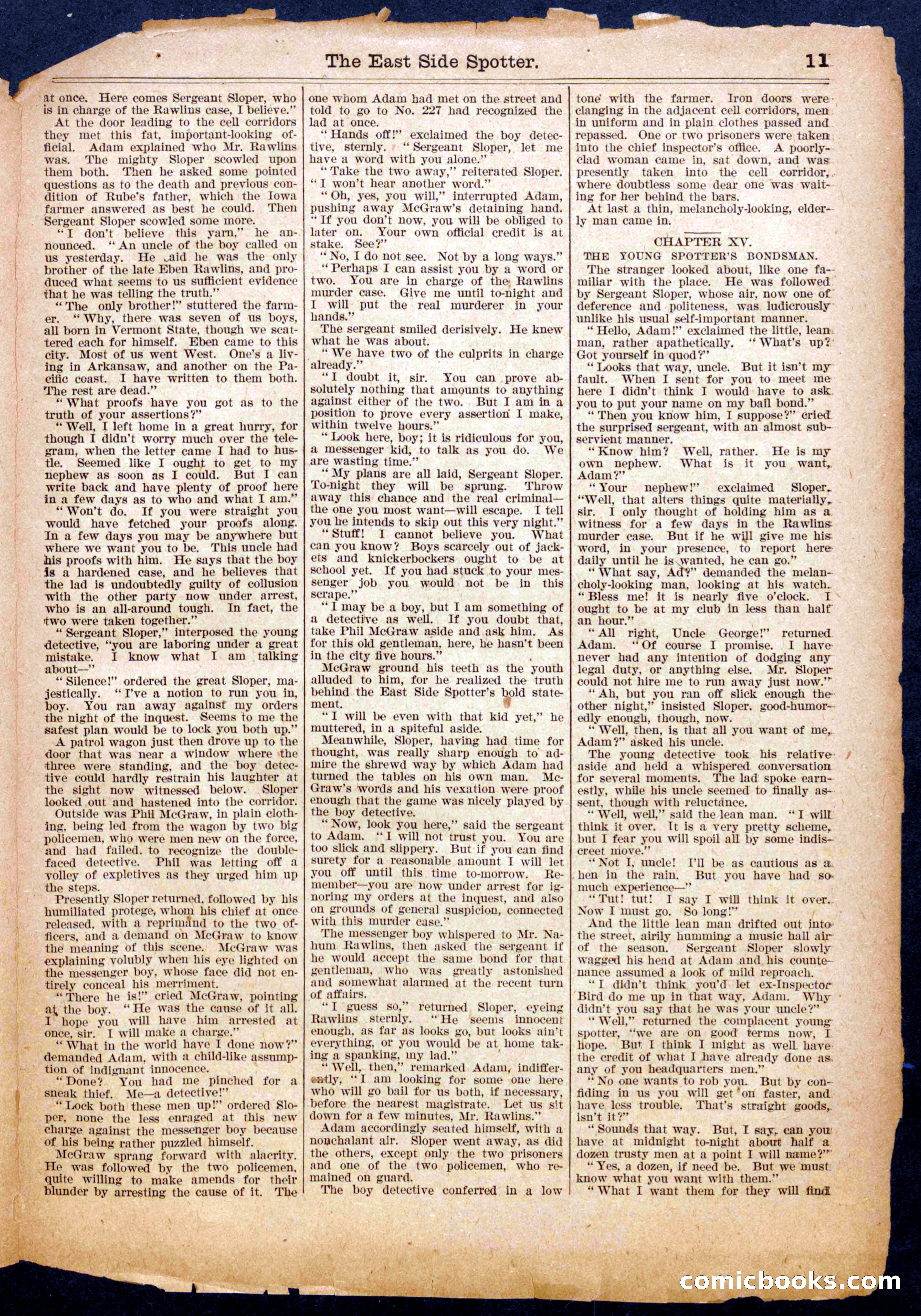
A restored page from Pulp Fiction, 1896. Page through the whole issue in the reader above.
📄 Transcribed text from this page (OCR, searchable)
Machine-transcribed from the original scan — historical spelling and the odd misread are preserved.
a ol #05 at once, Here comes Sergeant Sloper, who _ is in charge of the Rawlins case, I believe.” ot At the door leading to the cell corridors pee they met this fat, important-looking of- ficial. Adam explained who Mr. Rawlins ; was. The mighty Sloper scowled upon them both. Then he asked some pointed iN questions as to the death and previous con- - dition of Rube'’s father, which the Iowa farmer answered as best he could. Then Sergeant Sloper scowled some more. “YT don’t believe this yarn,” he an- “An uncle of the boy called on He aid he was the only ! nounced. us yesterday. brother of the late Eben Rawlins, and pro- i duced what seems to us sufficient evidence | that he was telling the truth.’ . “The only brother!” stuttered the farm- er. “Why, there was seven of us boys, all born in Vermont State, though we scat- tered each for himself. Eben came to this city. Most of us went West. One’s a liv- ing in Arkansaw, and another on the Pa- eific coast. I have written to them both. The rest are dead.” “What proofs have you got as to the | truth of your assertions?” “ Well, I left home in a great hurry, for though I didn’t worry much over the tele- | gram, when the letter came I had to hus- } tle. Seemed like I ought to get to my ; nephew as soon as I could. But I can write back and have plenty of proof here , in a few days as to who and what I am.’ “Won't do. If you were straight you -. would have fetched your proofs along. In a few days you may be anywhere but ‘ where we want you to be. This uncle had his proofs with him. He says that the boy 4s a hardened case, and he believes that | the lad is undoubtedly guilty of collusion with the other party now under arrest, ' who is an all-around tough. In fact, the | two were taken together.” it “ Sergeant Sloper,” interposed the young detective, ‘you are laboring under a great mistake. I know what I am_ talking i ~ about—’”’ . ‘** Silence!” ordered the great Sloper, ma- *“T’ve a notion to run you in, - jestically. : boy. You ran away against my orders the night of the inquest. Seems to me the : safest plan would be to lock you both up.” : A patrol wagon just then drove up to the door that was near a window where ‘the ithree were standing, and the boy detec- tive could hardly restrain his laughter at 3). the sight now witnessed below. Sloper ; looked out and hastened into the corridor. Outside was Phil McGraw, in plain cloth- ing, being led from the wagon by two big '. policemen, who were men new on the force, | 4 and had failed. to recognize the double- _ faced detective. Phil was letting off a yolley of expletives as they urged him up the steps. Presently Sloper returned, followed by his humiliated protege, whom his chief at once released, with a reprimdnd to the two of- ficers, and a demand on McGraw to know the meaning of this scene. McGraw was oN oy explaining yolubly when his eye lighted on the messenger boy, whose face did not en- tirely conceal his merriment. “There he is!” cried McGraw, pointing the boy. “He was the cause of it all. fe I hope you will have him arrested at foo once, sir. I will make a charge.” | ee eer i" What in the world have I done now?” othe ae ‘demanded Adam, with a child-like assump- 0 iw tion of indignant innocence. oy % eek gaa thief. Me—a detective!” “Lock both these men up!” ordered Slo- - per, hone the less enraged at this new , charge against the messenger boy because is being rather puzzled himself. __MeGraw sprang forward with alacrity. Te was followed by the two policemen, : uite sch to make amends for their Pad * ay A re yy ea at Ags” é. + 4 ’ | Fe Oe : a" tan) FS . 7 PY y" a “ee P . >t i § * + «.” . . SPAY CP UR oh ‘ < oO ap ee ri} \ ice. “Done? You had me pinched for a ee eer) one whom Adam had met on the street and told to go to No. 227 had recognized the lad at once. ‘Hands off!’ exclaimed the boy detec- tive, sternly. - ‘Sergeant Sloper, let me have a word with you alone.” “Take the two away,” reiterated Sloper. ‘‘T won’t hear another word.” “Oh, yes, you will,” interrupted Adam, pushing away McGraw’s detaining hand. ‘If you don’t now, you will be obliged to later on. Your own official credit is at stake. See?’ ‘*No, I do not see. Not by a long ways.’ “Perhaps I can assist you by a word or two. You are in charge of the Rawlins murder case. Give me until to-night and I will put the real murderer in your hands.” The sergeant smiled derisively. He knew what he was about. “We have two of the culprits in charge already.” “I doubt it, sir. You can prove ab- solutely nothing that amounts to anything against either of the two. But I am in a position to prove every assertion I make, within twelve hours.” ‘Look here, boy; it is ridiculous for you, a messenger kid, to talk as you do. We are wasting time.” ‘*My plans are all laid, Sergeant Sloper. To-night they will be sprung. Throw away this chance and the real criminal— the one you most want—will escape. I tell you he intends to skip out this very night.” “Stuff! I cannot believe you. What can you know? Boys scarcely out of jack- ets and knickerbockers ought to be at school yet. senger scrape.”’ “IT may be a boy, but I am something of a detective as well. If you doubt that, take Phil MeGraw aside and ask him, As for this old gentleman, here, he hasn’t been in the city five hours.” McGraw ground his teeth as the youth alluded to him, for he realized the truth behind the East Side Spotter’s ae state- ment, “I will be even with that kid yet,” he muttered, in a spiteful aside. Meanw hile, Sloper, having had time for thought, Was really sharp enough to ad- mire the shrewd way by which Adam had turned the tables on his own man. Mce- Graw’s words and his vexation were proof enough that the game was nicely played by the boy detective. ‘ Now, look you here,” said the sergeant to Adam, “I will not trust you. You are too slick and slippery. But if you can find surety for a reasonable amount I will let you off until this time to-morrow. Re- member—you are how under arrest for ig- noring my orders at the inquest, and also on grounds of general suspicion, connected with this murder Gase.”’ The messenger boy whispered to Mr. Na- hum Rawlins, then asked the sergeant if he would accept the same bond for that gentleman, who was greatly astonished and somewhat alarmed at the recent turn of affairs. If you had stuck to your mes- job you would not be in this “T guess so,” returned Sloper, eyeing Rawlins sternly. “He seems innocent enough, as far as looks go, but looks ain’t everything, or you would be at home tak- ing a spanking, my lad.”’ “ Well, then, " remarked. Adam, indiffer- ently, “ T am looking for some one here who will go bail for us both, if necessary, before the nearest magistrate. Let us sit down for a few minutes, Mr. Rawlins.” Adam accordingly seated himself, with a nonchalant air. Sloper went away, as did the others, except only the two prisoners and one of the two policemen, who re- mained on guard. The boy detective conferred in a low ay \o¥ ay at > Sap Alt SO ch AE: ire at , ie. Fe =i ‘ ie Pestle oh oa app ae oe ty ‘hen in the rain. ‘Bird do me up in that way, Adam. YF ke tone with the farmer. clanging in the adjacent cell corridors, men. in uniform and in plain clothes passed and. repassed. One or two prisoners were taken. into the chief inspector’s office. A poorly- Clad woman came in, sat down, and was presently taken into the cell corridor,. where doubtless some dear one was wait-. ing for her behind the bars. At last a thin, melancholy-looking, elder- ly man came in, CHAPTER XV. THE YOUNG SPOTTER’S BONDSMAN, The stranger looked about, like one fa-- miliar with the place. He was followed. by Sergeant Sloper, whose air, now one of deference and. politeness, was ludicrously” unlike his usual self-important manner. * Hello, Adam!” exclaimed the little, lean. man, rather apathetically. Got yourself in quod?’ “Looks that w ay, uncle. But it isn’t my fault. When I sent for you to meet me here I didn’t think I would have to ask. you to put your name on my bail bond.” “Then you know him, I suppose?” cried the surprised sergeant, with an almost sub- servient manner, “Know him? Well, rather. He is my own nephew. What is it you want, Adam ?”’ “Your nephew!’ exclaimed Sloper, “Well, that alters things quite materially, sir. I only thought of holding him as a witness for a few days in the Rawlins murder case. But if he will give me his word, in your presence, to report here daily until he is.wanted, he can go.” “ What say, Ad?” demanded the melan-- choly-looking man, looking at his watch. * Bless me! it is nearly five o’clock. IL ought to be at my club in less than half an hour.” ) “All right, Uncle George!” returned Adam. “Of course I promise. I have never had any intention of dodging any legal duty, or anything else. Mr. Sloper could not hire me to run away just now.’ “Ah, but you ran off slick enough the other night,” insisted Sloper. good-humor-- edly enough, though, now. * Well, then, is that all you want of me, Adam?” asked his uncle. The young detective took his relative: aside and held a whispered conversation for several moments. The lad spoke earn- estly, while his uncle seemed to finally as-. sent, though with reluctance, | ‘Well, well,” said the lean man. “TI will think it over. It is a very pretty scheme, Iron doors were- ‘“What’s up?’ but I fear you will spoil all by some indis— creet move.’ “Not I, uncle! I'll be as cautious as @. But you have had so much experience—’ * Tut! tut! Tsay I will think it over. Now I must go. So long!” And the little lean man drifted out into the street, airily humming a music hall air of the season. Sergeant Sloper slowly wagged his head at Adam and his counte- nance assumed a look of mild reproach. “| didn’t think you'd let ex-Inspector didn’t you say that he was your uncle?” “ Well,” returned the complacent young spotter, “‘we are on good terms now, I hope. But I think I might as well. have: the credit of what I have already done as. any of you headquarters men.” ‘No one wants to rob you. But by con- fiding in us you will get ‘on faster, and. have less trouble, That’ Ss straight goods,. isn’t it?” “Sounds that way. But, I say, ean you. have at midnight to-night about half a dozen trusty men at a point I will name?” — “Yes, a dozen, if need be. But we rates know what you want with them.” “What I want them for i will f Why ° ey 4 i A RS " ton ‘ ok 2p Bis: =k ie a a * 4 ve y ait , on ey