
Pulp Fiction, 1895 · page 15 of 16
Beadle's Half Dime Library No. 959 — page 15: what you’re looking at
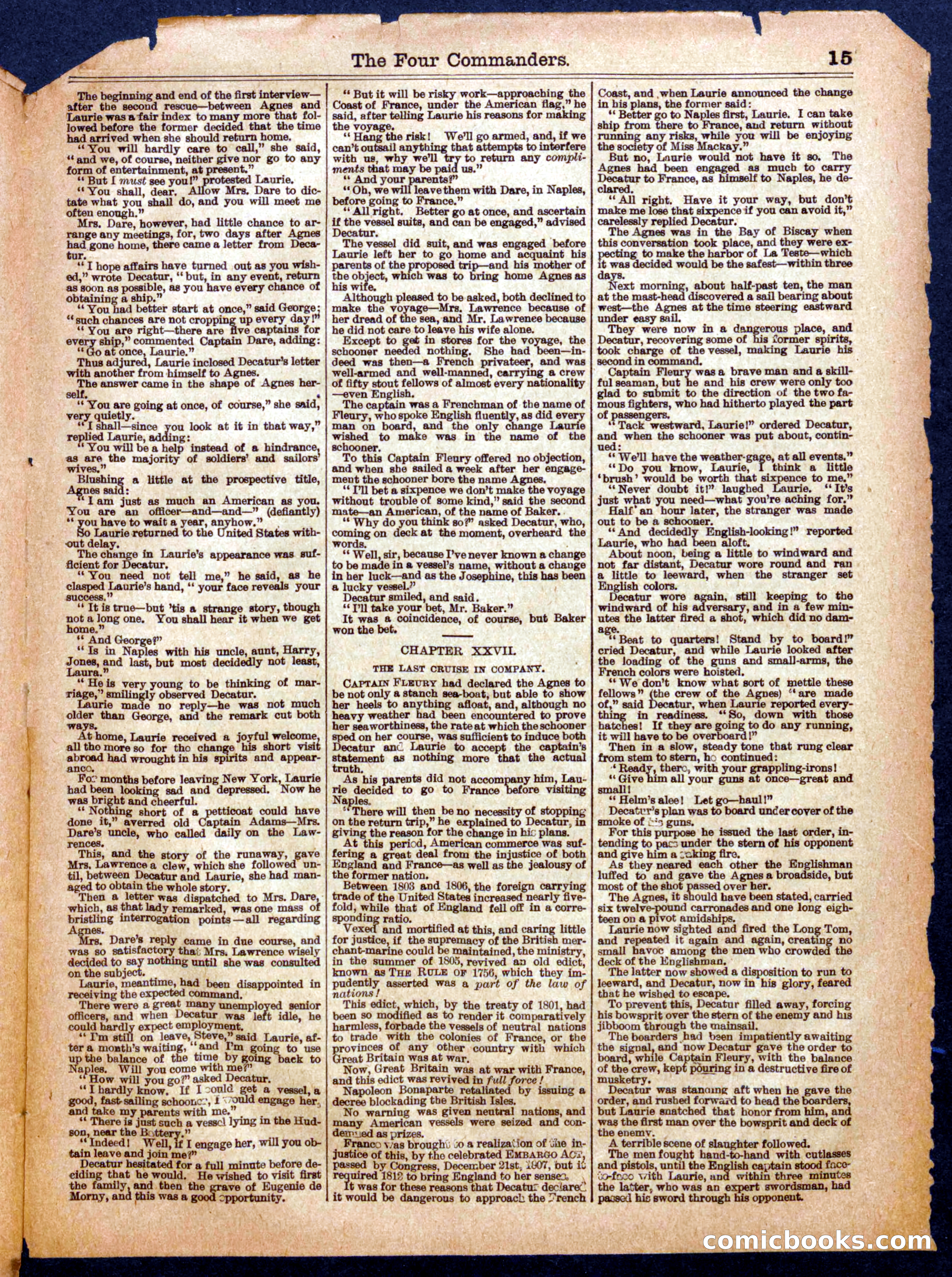
A restored page from Pulp Fiction, 1895. Page through the whole issue in the reader above.
📄 Transcribed text from this page (OCR, searchable)
Machine-transcribed from the original scan — historical spelling and the odd misread are preserved.
The g and end of the first interview— after the second rescue—between Agnes and Laurie was a fair index to many more that fol- lowed before the former decided that the time had arrived when she should return home. ““You will hardly care to call,” she said, ** and we, of course, neither give nor go to any form of entertainment, at present.” “* But [ must see you!” protested Laurie. **'You shall, dear, ow Mrs. Dare to dic- tate what you shall do, and you will meet me often enough.” Mrs. Dare, however, had little chance to ar- range any meetings, for, two days after Agnes had gone home, there came a letter from Deca- tur. ‘“*T hope affairs have turned out as you wish- ed,” wrote Decatur, ‘‘ but, in any event, return as s0on.as possible, as you have every chance of obtaining a ship.” * You better start at once,” said George F “such chances are not cropping up every day! “‘ You are right—there are five captains for if 2 * Are a commented Captain Dare, adding: ** Go at once, Laurie.” Thus adj , Laurie inclosed Decatur’s letter with another from himself to Agnes. The answer came in the shape of Agnes her- lf. . ‘* You are going at once, of course,” she said, very quietly. ‘** T shall—since replied Laurie, ad * You will be a help instead of a hindrance, as are the majority of soldiers’ and sailors wives.” nape a little at the prospective title, es said: “Lam just as much an American as you. —and—and—” (defiantly) you look at it in that way,” g: You are an officer x Ate have to wait a year, anyhow.” . Laurie returned to the United States with- ie eon in Laurie’ suf e change urie’s appearance was - ficient for Decatur, ’ “You need not tell me,” he said, as he clasped Laurie’s hand, “‘ your face reveals your ccess, ‘* It is true—but ‘tis a strange story, though not along one. You shall hear it when we get home.” ** And George?” “Ts in Naples with his uncle, aunt, Harry, pepe and last, but most decidedly not least, ura ““Heis very young to be thinking of mar- riage,” smili ngly observed Decatur. Laurie made no reply—he was not much older than George, and the remark cut both wa ‘At home, Laurie received a jo welcome tho more so for tho chan short visit abroad had wrought in his spirits and appear- anco. Fo° months before leaving New York, Laurie had been 1 sad and depressed. Now he was bright and cheerful. ** Not short of a petticoat could have done it,” averred old Captain Adams—Mrs. Dare’s uncle, who called daily on the Law- rences. This, and the story of the runaway, gave Mrs, Lawrence a clew, which she followed un- til, between Decatur and Laurie, she had man- aged to obtain the whole story. Then a letter was dispatched to Mrs. Dare, which, as that lady remarked, was one mass of bristling interrogation points—all regarding A . Mrs, Dare’s reply came in due course, and was so satisfactory thai; Mrs, Lawrence wisely decided to ses nothing until she was consulted cecil se ae urie, meantime, n disappointed in receiving the expected command, cs There were a great Many unemployed senior officers, and when Decatur was ieft idle, he could hardly expect employment, “Tm still on leave, Steve,” said Laurie, af- ter & month’s waiting, ‘and Pm going to use up the balance of the time by going back to aples. Will you come with me?” ‘“* How will you go?” asked Decatur, ““T hardly know, If I could get a vessel,a good, fast-sailing schoonc’, 1 d engage her, and take my parents with me.” “‘ There is just such a vessc! lying in the Hud- ’ gry a Ww ll, it her, will b- e age her, you o tain leave and join’mer” i Decatur hesitated for a full minute before de- eiding that he would. He wished to visit first the mage bs then the ve of Eugenie de Morny, an this was a seed Spoorbonity. | The Four Commanders. ** But it will be risky work—approaching the Coast of France, under the American flag,” he said, after telling Laurie his reasons for making the voyage. ‘‘ Hang the risk! We'll go armed, and, if we can’t outsail anything that attempts to interfere with us, why we'll to return any compli- ments that may be paid us.” * And igen peer ‘Oh, we leavethem with Dare, in Naples, before going to France.” “Allright. Better go at once, and ascertain if the vessel suits, and can be engaged,” advised Decatur. The vessel did suit, and was engaged before Laurie left her to go home and acquaint his parents of the proposed trip—and his mother of ae object, which was to bring home Agnes as is wife, Although pleased to be asked, both declined to make the voyage—Mrs. Lawrence because of her dread of the sea, and Mr, Lawrenee because he did not care to leave his wife alone. Except to in stores for the voyage, the schooner needed nothing. She had been—in- deed was then—a French privateer, and was well-armed and well-manned, carrying a crew of fifty stout fellows of almost every nationality —even English. ae captain bee . oe nee of ooo — of eury, whospoke Engli uentily, as ev man on board, and the only anes tenets wished to make was in the name of the schooner. To this Captain Fleury offered no objection, and when she sailed a week after her engage- ment the schooner bore the name Agnes. ‘**T’ll bet a sixpence we don’t make the voyage without trouble of some kind,” said the second mate—an American, of the name of Baker. ** Why do you think go?” asked Decatur, who, a on deck at the moment, overheard the words. ** Well, sir, because I’ve never known a change to be made in @ veasel’s name, without a change in her luck—and as the Josephine, this has been a lucky vessel.” Decatur smiled, and said. **T’ll take your bet, Mr. Baker.” It was a coincidence, of course, but Baker won the bet, CHAPTER XXVIL THE LAST CRUISE IN COMPANY. CAPTAIN FLEURY had declared the Agnes to be not only a stanch sea-boat, but able to show her heels to anything afloat, and, although no heavy weather had been encountered to prove her sea worthiness, the rate at which the schooner — on her course, was sufficient to induce both ecatur anc Laurie to accept the captain’s a as nothing more that the actual th. As his ts did not accompany him, Lau- rie decided to go to France before visiting N. ap! es. There will then be no necessity of stopping on the return trip,” he explained to Desa, giving the reason for the change in hic plans. At this period, American commerce was suf- fering a great deal from the injustice of both England and France—as well as the jealousy of the former nation. Between 1803 and 1806, the foreign carrying trade of the United States increased nearly five- fold, while that of England fell off in a corre- sponding ratio. Vexed and mortified at this, and caring little for justice, if the supremacy of the British mer- chant-marine could be maintained, the ministry, in the summer of 1805, revived an old edict, known as THm RULE OF 1756, which they im- pudently asserted was a part of the law of nations ! This edict, which, by the treaty of 1801, had been so modified as to render it comparatively harmless, forbade the vessels of neutral nations to trade with the colonies of France, or the rovinces Of any Other country with which Giens Britain was at war, Now, Great Britain was at war with France, and this edict was revived in full force ! Napoleon Bonaparte retaliated by issuing a decree blockading the British Isles. No warning was given neutral nations, and many American vessels were seized and con- Franco vas broughi Jo 4 realization of Jie in- justice of this, by the celebrated EMBARGO AC2, by Congress, December 21st, 1907, but it uired 1812 to bring England to her senseo. t was for these reasons that Decatur declare’ it would be dangerous to approach the 7rench 15 Coast, and .when Laurie announced the change in his plans, the former said: ‘* Better go to Naples first, Laurie. I can take ship from there to France, and return without ——s any risks, while you will be enjoying the society of Miss Mackay.” But no, Laurie would not have it so, The Agnes had been engaged as much to carry Decatur to France, as himself to Naples, he de- Cc . ‘‘ All right. Have it your way, but don’t make me lose that sixpence if you can avoid it,” carelessly replied Decatur. The Agnes was in the Bay of Biscay when this conversation took place, and they were ex- pecting to make the harbor of La Teste—which it was decided would be the safest—within three days. Next morning, about half-past ten, the man at the mast-head discovered a sail bearing about west—the Agnes at the time steering eastward under easy sail. They were now in a cangeeras place, and Decatur, recovering some of his former spirits, took charge of the vessel, making Laurie his second in co : Captain Fleury wasa brave man and a skill- ful seaman, but he and his crew were only too glad to submit to the direction of the two fa- mous fighters, who had hitherto played the part of passengers. ‘Tack westward, Laurie!” ordered Decatur, and when the schooner was put about, contin- ued: ‘‘ We'll have the weather-gage, at all events.” ‘Do you know, Laurie, think a little ‘brush’ would be worth that ce to me,” ‘“*Never doubt it!” laughed urie. ‘It’s just what you need—what you're aching for.” Half’ an hour later, the stranger was made out to be a ooner. ““And decidedly English-looking!” reported Laurie, who had n aloft. About noon, being a little to windward and not far t, Decatur wore round and ran a little to leeward, when the stranger set English colors. Decatur wore in, still keeping to the windward of his adversary, and in a few min- utes the latter fired a shot, which did no dam- age. ‘*Beat to quarters! Stand by to board!” cried Decatur, and while Laurie looked after the loading of the guns and smalJ-arms, the French colors were hoisted. ** We don’t know what sort of mettle these fellows” (the crew of the Agnes) “‘are made of,” said tur, when Laurie reported every- Sat Pir gat oe ay sa atches! they are any runni it will have to be overboard )” : Then in a slow, steady tone that rung clear from stem aoe a continued: a , thero, with your grappling-irons ai Give him all your guns at once—great and smali ‘* Helm’s alee! Let go—haul!” Decatvr’s plan was to board uncer cover of the smoke of °*5 guns, For this purpose he issued the last order, in- tending to pacs under the stern of his opponent and give him a ccking fire. As they neared each other the Englishman luffed to and gave the Agnesa b de, but most of the shot passed over her. The Agnes, it should have been stated, carried six twelve- d carronades and one long eigh- teen on a pivot amidships. Laurie now sighted and fired the Long Tom, and repeated it again and again, creating no small havoc among the men who crowded the deck of the Englishman, The latter now showed a disposition to run to leeward, and Decatur, now in his glory, feared that he wished to escape. To prevent this, Decatur filled away, forcing his bowsprit over the stern of the enemy and his jibboom through the mainsail. The boarders had been impatiently awaiting the signal, and now Decatur gave the order to board, while Captain Fleury, with the balance of the crew, kept pouring in a destructive fire of musketry. Decatur was stanaing aft when he gave the order, and rushed forward to head the boarders, but Laurie snatched that honor from him, and was the first man over the bowsprit and deck of the enemy. | A terrible scene of slaughter followed. The men fought hand-to-hand with cutlasses and pistols, until the En captain stood face- “o-faco with Laurie, and within three minutes the latter, who was an expert swordsman, bad passed his sword through his opponent. 900 ¢c com S