
Pulp Fiction, 1895 · page 13 of 16
Beadle's Half Dime Library No. 959 — page 13: what you’re looking at
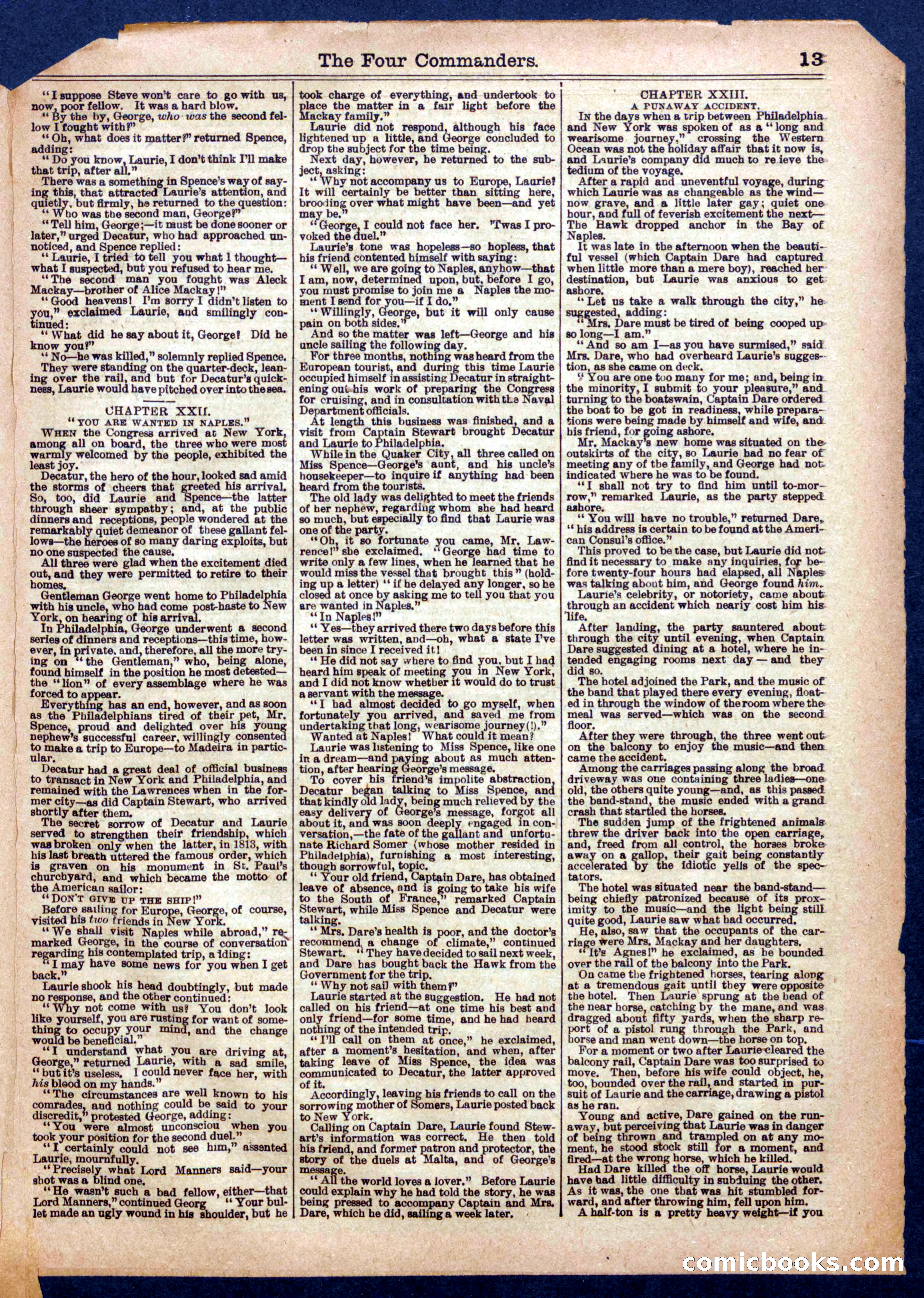
A restored page from Pulp Fiction, 1895. Page through the whole issue in the reader above.
📄 Transcribed text from this page (OCR, searchable)
Machine-transcribed from the original scan — historical spelling and the odd misread are preserved.
‘‘T suppose Steve won't care to go with us, now, poor fellow. It was a hard blow, xe By the by, George, who was the second fel- low I fought with?” ** Oh, what does it matter?” returned Spence, adding: ** Do you know, Laurie, I don’t think I'll make that trip, after all,” There was a something in Spence’s way of say- ing this, that attracted Laurie’s attention, and quietly, but firmly, he returned to the question: Wr ‘* W ho was the second man, George?” “Tell him, George ;—it naust be done sooner or later,” urged Decatur, who had approached un- noticed, and Spence replied: ‘“* Laurie, I tried to tell you what | thought— what I but you refused to hear me. “‘The second man you fought was Aleck Mackay—brother of Alice Mackay!” **Good heavens! I’m sorry I didn’t listen to Too, exclaimed Laurie, and smilingly con- ued: ‘*What did he say about it, George? Did he know you?” ‘** No—he was killed,” solemnly replied Spence. They were standing on the quarter-deck, lean- ing over the rail, and but for Decatur’s quick- ness, Laurie would have pitched over into the sea. CHAPTER XXII. ‘*YOU ARE WANTED IN NAPLES.” WHEN the Congress arrived at New York, among all on board, the three who were most warmly welcomed by the people, exhibited the least joy. Decatur, the hero of the hour, looked sad amid the storms of cheers that his arrival, So, too, did Laurie and Spence—the latter through sheer sympathy; and, at the public dinners and receptions, people wondered at the remarkably quiet demeanor of these gallant fel- lows—the heroes of so many daring exploits, but no one suspected the cause, All three were glad when the excitement died out, and they were permitted to retire to their homes, Gentleman George went home to Philadelphia with his uncle, who had come * apcsatn to New York, on hearing of his arrival. In Philadelphia, George underwent a second series of dinners and receptions—this time, how- ever, in private. and, therefore, all the more try- ing on “the Gentleman,” who, being alone, found himself in the position he most detested— the “lion” of every assemblage where he was forced to appear. Everyt has an end, however, and as 800n as the Philadelphians tired of their pet, Mr. Spence, proud and delighted over his youn nephew’s successful career, willingly consen — make a trip to Europe—to Madeira in partic- ular, Decatur had a great deal of official business to transact in New York and Philadelphia, and remained with the Lawrences when in the for- mer city—as did Captain Stewart, who arrived shortly after them. ® secret sorrow of Decatur and Laurie served to strengthen their friendship, which was broken only when the latter, in 1813, with his last breath uttered the famous order, which is graven on his monument in St. Paul’s churchyard, and which became the motto of the American sailor: ‘DON'T GIVE UP THE SHIP!” Before “peers for Europe, George, of course, visited his two friends in New York. “We shall visit Naples while abroad,” re- marked George, in the course of conversation r ding his contemplated trip, aiding: ‘I may have some news for you when I get back,” Laurie shook his head doubtingly, but made no response, and the other continued: “Why not come with us? You don’t look like yourself, you are rusting for want of some- thing to occupy your mind, and the change would be beneficial. “YT understand what you are driving at, George,” returned Laurie, with a sad smile, ‘‘butit’s useless, 1 could never face her, with his bleod on my hands.” “The circumstances are well known to his comrades, and nothing could be said to your discredit,” protested George, adding: ‘You were almost unconsciou when you took your position for the second duel.” “I certainly could not see him,” assented Laurie, mournfully, ‘Precisely what Lord Manners said—your shot was a blind one, ‘*He wasn’t such a bad fellow, either—that Lord Manners,” continued ‘* Your bul- let made an ugly wound in his shoulder, but he The Four Commanders. took charge of everything, and undertook to lace the matter in a fair light before the ackay family.” Laurie did not respond, although his face lightened up a little, and George concluded to drop the subject for the time being. Next day, however, he returned to the sub- ject, asking: “4 Why not accompany us to Europe, Laurie? It will certainly be better than sitting here, brooding over what might have been—and yet may be,” ‘“‘George, I could not face her. "I'was I pro- voked the duel,” Laurie’s tone was hopeless—so hopless, that his friend contented himself with saying: ** Well, we are going to Naples, anyhow—that I am, now, determined upon, but, before I go, you must promise to join me a Naples the mo- ment I send for you—if I do,” ‘* Willingly, rge, but it will only cause pain on both sides,’ And so the matter was left—George and his uncle sailing the ong bites | day. For three months, nothing was heard from the European tourist, and during this time Laurie occupied himself in assisting Decatur in straight- ening out-his work of preparing the Con for cruising, and in consultation with tke Naval Department officials. At length this business was finished, and a visit from Captain Stewart brought Decatur and Laurie to Philadelphia. Whilein the Quaker City, all three called on Miss Spence—George’s aunt, and his uncle’s housekeeper—to inquire if anything had been heard from the tourists. The old lady was delighted to meet the friends of her nephew, regarding whom she had h so much, but especially to find that Laurie was one of the party. vs Oh, it so fortunate you came, Mr, Law- rence!” she exclaimed. ‘‘George had time to write only a few lines, when he learned that he would miss the vessel that brought this” (hold- ing UP a letter) ‘‘ if he delayed any longer, so he closed at once Ry asking me to tell you that you are wanted in Naples,” ““In Naples!” ** Yes—they arrived there two days before this letter was written, and—oh, what a state I’ve been in since I received it! ‘* He did not say where to find you, but I had heard him speak of meeting you in New York, and I did not know whetber it would do to trust a servant with the message. ‘*‘T bad almost decided to go myself, when fortunately you arrived, and saved me from undertaking that long, wearisome journey (!).” Wanted at Naples! What could it mean? Laurie was listening to Miss Spence, like one in a dream—and paying about as much atten- tion, after hearing George’s message. To cover his friend’s impolite abstraction Decatur began talking to Miss Spence, and that kindly old lady, being much relieved by the easy delivery of rge’s message, forgot all about it, and was soon deeply engaged in con- versation,—the fate of the gallant and unfortu- nate Richard Somer (whose mother resided in Philadetphia), furnishing a most interesting, though sorrowful, topic, ** Your old friend, Captain Dare, has obtained leave of absence, and is going to take his wife to the South of France,” remarked Captain pac easly while Miss Spence and Decatur were ‘** Mrs, Dare’s health is r, and the doctor's recommend, a change of climate,’’ continued Stewart. ‘They have decided to sail next week, and Dare has bought back the Hawk from the Government for the trip, ‘* Why not sai) with them?” Laurie started at the suggestion. He had not called on his friend—at one time his best and only friend—for some time, and he had heard nothing of the intended trip, “Tl call on them at once,” he exclaimed, after a moment’s hesitation, and when, after taking leave of Miss Spence, the idea was communicated to Decatur, the latter approved of it. Accordingly eave friends to call on the mother of Somers, Laurie posted back ork. Calling on Captain Dare, Laurie found Stew- art’s information was correct, He then told his friend, and former patron and protector, the story of the duels at Malta, and of George's message, > All the world loves a lover.” Before Laurie could explain why he had told the story, he was being pressed to accompany Captain and Mrs, Dare, which he did, a week later, 13 CHAPTER XXIII. A PUNAWAY ACCIDENT. In the days when a trip between Philadelphia and New York was spoken of as a “long and wearisome journey,” crossing the Western Ocean was not the holiday affair that it now is, and Laurie’s company did much to re.ieve the tedium of the voyage, After a rapid and uneventful voyage, during which Laurie was as changeable as the wind— now grave, and a little later gay; quiet one hour, and full of feverish excitement the next— The Hawk dropped anchor in the Bay of Naples. It was late in the afternoon when the beauti- ful vessel (which Captain Dare had captured when little more than a mere boy), reached her destination, but Laurie was anxious to get ashore, ‘* Let us take a walk through the city,” he suggested, adding: ‘* Mrs, Dare must be tired of being cooped up so long—I am,” **And so am I—as you have surmised,” said Mrs. Dare, who had overheard Laurie’s sugges-- tion, as she came on deck. ** You are one too many for me; and, being in the mings ys I submit to your pleasure,” and turning to the boatswain, Captain Dare ordered the boat to be got in readiness, while prepara- tions were being made by himself and wife, and bis friend, for going ashore, Mr. Mackay’s new home was situated on the outskirts of the city,so Laurie had no fear of meeting any of the family, and George had not indicated where he was to be found, **T shall not try to find him until to-mor- row,” remarked Laurie, as the party stepped ashore, ‘* You will have no trouble,” returned Dare, ‘* his address is certain to be found at the Ameri- can Consul’s office.” This proved to be the case, but Laurie did not find it necessary to make any inquiries, tor be- fore twenty-four hours had elapsed, all Naples was talking about him, and George found him. Laurie’s celebrity, or notoriety, came about Rep an accident which neariy cost him his: e, After landing, the party sauntered about through the city until evening, when Captain Dare suggested dining at a hotel, where he in- get engaging rooms next day—and they id so. The hotel adjoined the Park, and the music of the band that played there every evening, float- ed in through the window of theroom where the: Me was served—which was on the second oor. After they were through, the three went out on the balcony to enjoy the music—and then came the accident, , Among the carriages passing along the broad driveway was one containing three ladies—one old, the others quite young—and, as this the band-stand, the music ended with a grand crash that startled the horses. The sudden jump of the frightened animals threw the driver back into the ig carria Re, and, freed from all control, the horses broke away on a gallop, their gait being constantly accelerated Sy the idiotic yells of the spec- tators, The hotel was situated near the band-stand— being chiefly patronized because of its prox- imity to the music—and the light being still quite good, Laurie saw what had occurred, He, also, saw that the occupants of the car- riage were Mrs, Mackay and her daughters, “It’s Agnes!” he exclaimed, as he bounded over the rail of the balcony into the Park, On came the frightened horses, tearing along at a tremendous gait until they were opposite the hotel. Then Laurie sprung at the bead of the near horse, catching by the mane, and was dragged about fifty yards, when the sharp re- port of a pistol ay through the Park, and borse and man went down—the horse on top, For a moment or two after Lauriecleared the balcony rail, Captain Dare was too surprised to move, Then, before his wife could object, he, too, bounded over the rail, and started in pur- suit of Laurie and the carriage, drawing a pistol as he ran. Young and active, Dare gained on the run- away, but perotiving, thes Laurie was in danger of being thrown an asus on at any mo- ment, he stood stock still for a moment, and fired—at the wrong horse, which he killed. Had Dare killed the off horse, Laurie would have had little difficulty in subduing the other. As it was, the one that was hit stumbled for- ward, and after throwing him, fell upon him. A half-ton is a pretty heavy weight—if you comicboo (e “Ss..cO