
Pulp Fiction, 1895 · page 2 of 16
Beadle's Half Dime Library No. 958 — page 2: what you’re looking at
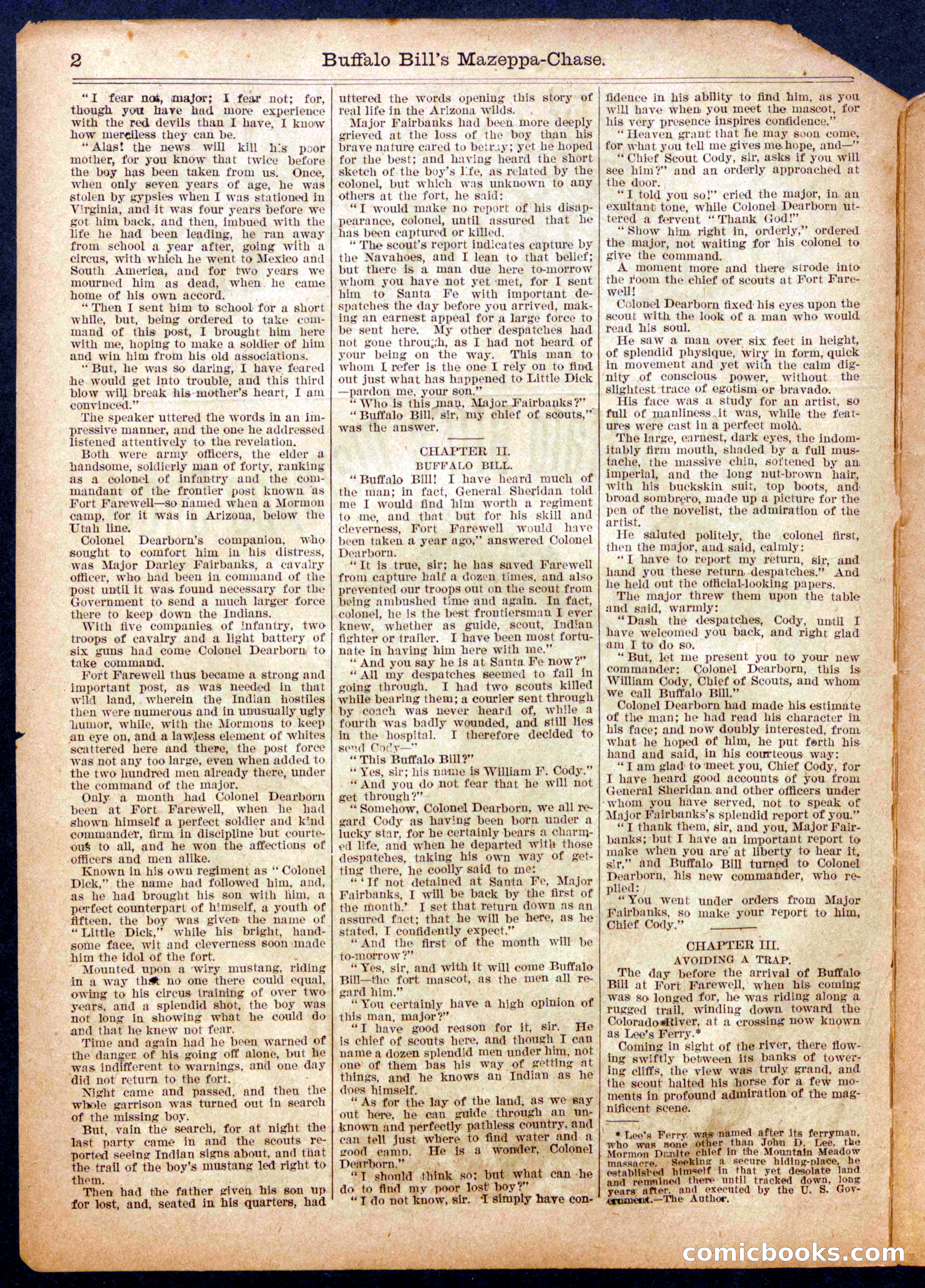
A restored page from Pulp Fiction, 1895. Page through the whole issue in the reader above.
📄 Transcribed text from this page (OCR, searchable)
Machine-transcribed from the original scan — historical spelling and the odd misread are preserved.
* « re - a - . ‘ oP, = e a “oS tae = >” tere Ss a ‘ a ye — ~~ Y “I fear not, major; I fear not; for, though you have had more experience with the red devils than I have, I know how mere¢iless they can be. “Alas! the news will kill h‘s poor mother, for you know that twice before the boy has been taken from us. Once, When only seven years of age, he was stolen by gypsies when I was stationed in Virginia, and it was four years before we got him back, and then, imbued with the life he had been leading, he ran away from school a year after, going with a circus, with which he went to Mexico and South America, and for two years we mourned him as dead, when he came home of his own accord. “Then I sent him to school for a short while, but, being ordered to take com- mand of this post, I brought him here with me, hoping to make a soldier of him and win him from his old associations. *“ But, he was so daring, I have feared he would get into trouble, and this third blow will break his-mother’s heart, I am convinced.” The speaker uttered the words in an im- pressive manner, and the one he addressed listened attentively to the revelation, Both were army officers, the elder a handsome, soldierly man of forty, ranking as a colonel of infantry and the com- mandant of the frontier post known as Fort Farewell—so named when a Mormon camp, for it was in Arizona, below the Utah line. Colonel Dearborn’s companion, who sought to comfort him in his distress, was Major Darley Fairbanks, a cavalry officer, who had been in command of the post until it was found necessary for the Government to send a much larger force there to keep down the Indians, With five companies of infantry, two troops of cavalry and a light battery of six guns had come Colonel Dearborn to take command. Fort Farewell thus became a strong and -important post, as was heeded in that wild land, wherein the Indian hostiles then were numerous and in unusually ugly luumor, while, with the Mormons to keep an eye on, and a lawless element of whites scattered here and there, the post force Was not any too large, even when added to the two hundred men already there, under the command of the major, Only a month had Colonel Dearborn been at Fort Farewell, when he had ~ shown himself a perfect soldier and k‘nd commander, firm in discipline but courte- ous to all, and he won the affections of officers and men alike. Known in his own regiment as “ Colonel. Dick,” the name had followed him, and, as he had brought his son with him, a perfect counterpart of himself, a youth of fifteen, the boy was givem the name of “Little Dick,” while his bright, hand- some face, wit and cleverness soon made him the idol of the fort. . * Mounted upon a ‘wiry mustang, riding in a way th# no one there could equal, owing to his circus training of over two years, and a splendid shot, the boy was not long in showing what he could do and that he knew not fear. Time and again had he been warned of. the danger of his going off alone, but he was indifferent to warnings, and one day ‘did not return to the fort. Night came and passed, and then the whole garrison was turned out in search of the missing boy. - But, vain the search, for at night the. last party came in and the scouts re- ported seeing Indian signs about, and that the trail of the boy’s mustang led right to them. 3 Then had the father given his son up | for lost, and, seated in his quarters, had. Buffalo Bill’s Mazep Se gh a | uttered the words opening this story of real life in the Arizona wilds. Major Fairbanks had been more deeply grieved at the loss of the boy than his brave nature cared to betray; yet he hoped for the best; and having heard the short sketch of the boy’s life, as related by the colonel, but which was unknown to any others at the fort, he snid: *T would make no report of his disap- pearance, colonel, until assured that he has been captured or killed. “ The scout’s report indicates capture by the Navahoes, and I lean to that belief; but there is a man due here to-morrow whom you have not yet met, for I sent him to Santa Fe with important de- spatches the day before you arrived, mak- ing an earnest appeal for a large force to be sent here. My other despatches had not gone throuyh, as I had not heard of your being on the way. This man to whom I refer is the one I rely on to find out just what has happened to Little Dick —pardon me, your son,” “Who is this man, Major Fairbanks?” “Buffalo Bill, sir, my chief of scouts,” was the answer. CHAPTER II. BUFFALO BILL. “Buffalo Bill! I have heard much of the man; in fact, General Sheridan told me I would find him worth a regiment to me, and that but for his skill and cleverness, Fort Farewell would have been taken a year ago,’ answered Colonel Dearborn. “It is true, sir; he has saved Farewell from capture half a dozen times, and also prevented our troops out on the scout from being ambushed time and again. In fact, colonel, he is the best frontiersman I ever knew, whether as guide, scout, Indian fighter or trailer. I have been most fortu- nate in having him here with me,” “And you say he is at Santa Fe now?” ‘“ All my despatches seemed to fail in going through. I had two scouts killed while bearing them; a courier sent through by coach was never heard of, while 4a fourth was badly wounded, and still lies in the hospital. I therefore decided to send Cocy—” “This Buffalo Bill?” IS “Yes, sir; his name is William IF’. Cody.” “And you do not fear that he will not get through?” ‘Somehow, Colonel Dearborn, we all re- gard Cody as having been born under ; lucky star, for he certainly bears a charm- ed life, and when he departed with those despatches, taking his own way of get- ting there, he coolly said to me: “Tf not detained at Santa Fe, Major Fairbanks, I will be back by the first of the month” J set that return down as an assured fact; that he will be here, as he stated, I confidently expect.” “And the first of the month will be to-morrow ?” “Yes, sir, and with it will come Buffalo Bill—the fort mascot, as the men all re- gard him.” “You certainly have a high opinion of this Man, major?” “T have good reason for it, sir. He is chief of scouts here, and though T can name a dozen splendid men under him, not one of them has his way of getting at things, and he knows an Indian as he does himself. 7 Pas “As for the lay of the land, as we say out here, he ean guide through an un- known and perfectly pathless country, and can tell just where to find good eamp. He is a Wor DesPhorn, oso) Spake ee do to find my /poor jost * “T do not know, sir. — pa-Chase. fidence in his ability to find him, as you an ari will have when you meet the mascot, for his very presence inspires confidence.” “Heaven grant that he may svon come, for what you tell me gives me hope, and—’” ‘Chief Seout Cody, sir, asks if you will see him?’ and an orderly approached at the door. “T told you so!” cried the major, in, an exultant tone, while Colonel Dearborn ut- tered a fervent “Thank God!” “Show him right in, orderly,’ ordered the major, not waiting for his colonel to give the command. A moment more and there strode into the room the chief of scouts at Fort Fare- well! | Colonel Dearborn fixed his eyes upon the scout with the look of a man who would read his soul. He saw a man over six feet in height, of splendid physique, wiry in form, quick in movement and yet with the calm dig- nity of conscious power, without the slightest trace of egotism or bravado. His face was a study for an artist, 80 full of manliness it was, while the feat- ures were cast in a perfect mold. The large, earnest, dark eyes, the indom- itably firm mouth, shaded by a full mus- tache, the massive chin, softened by an imperial, and the long nut-brown hair, with his buckskin suit, top boots, and: broad sombrero, made up a picture for the pen of the novelist, the admiration of the artist. He saluted politely, the colonel first, then the major, and said, calmly: ‘*T have to report my return, sir, and hand you these return, despatches.” And he held out the official-looking papers. The major threw them upon the table and said, warmly: “Dash the despatches, Cody, until I have weleomed you back, and right glad am I to do so. * But, let me present you to your new commander: William Cody, we @all Buffalo Bill.” Colonel Dearborn had made his estimate of the man; he had read his character in his face; and now doubly interested, from what he hoped of him, he put forth his hand and said, in his courteous way: “T am glad to meet you, Chief Cody, for I have heard good accounts of you from General Sheridan and other officers under ‘whom you have served, not to speak of Major Fairbanks’s splendid report of you.” “7 thank them, sir, and you, Major Fair- banks; but I have an important report to make when you are at liberty to hear it, sir,’ and Buffalo Bill turned to Colonel epi his new commander, who re- plied: , , “You went under orders from Major Fairbanks, so make your report to him, Chief Cody.” : CHAPTER III, AVOIDING A TRAP. “~- The day before the arrival of Buffalo Bill at Fort Farewell, when his coming was so longed for, he was riding along a rugged trail, winding down toward the Coloradokiver, at a crossing DOW known. rs as Lee’s Ferry.* Coming in sight of the river, there flow- ing swiftly between its banks of tower- ing cliffs, the view was truly grand, and the scout halted his horse for a fe nificent scene. * iw ay ss - vag named. after its ferryman, ther than John D. , the nite cl in pe Mg a Syme =o To » Seeking a secure ing-place, he plished mself in that yet desolate jana Te there until tracked down, long . WA PNeCc 7% | * tae The Author, + fi a? oJonel Dearborn, this is. hief of Scouts, and whom mo-- | ments in profound admiration of the mag- and executed by the U. 8. Gov- |