
Pulp Fiction, 1895 · page 11 of 16
Beadle's Half Dime Library No. 958 — page 11: what you’re looking at
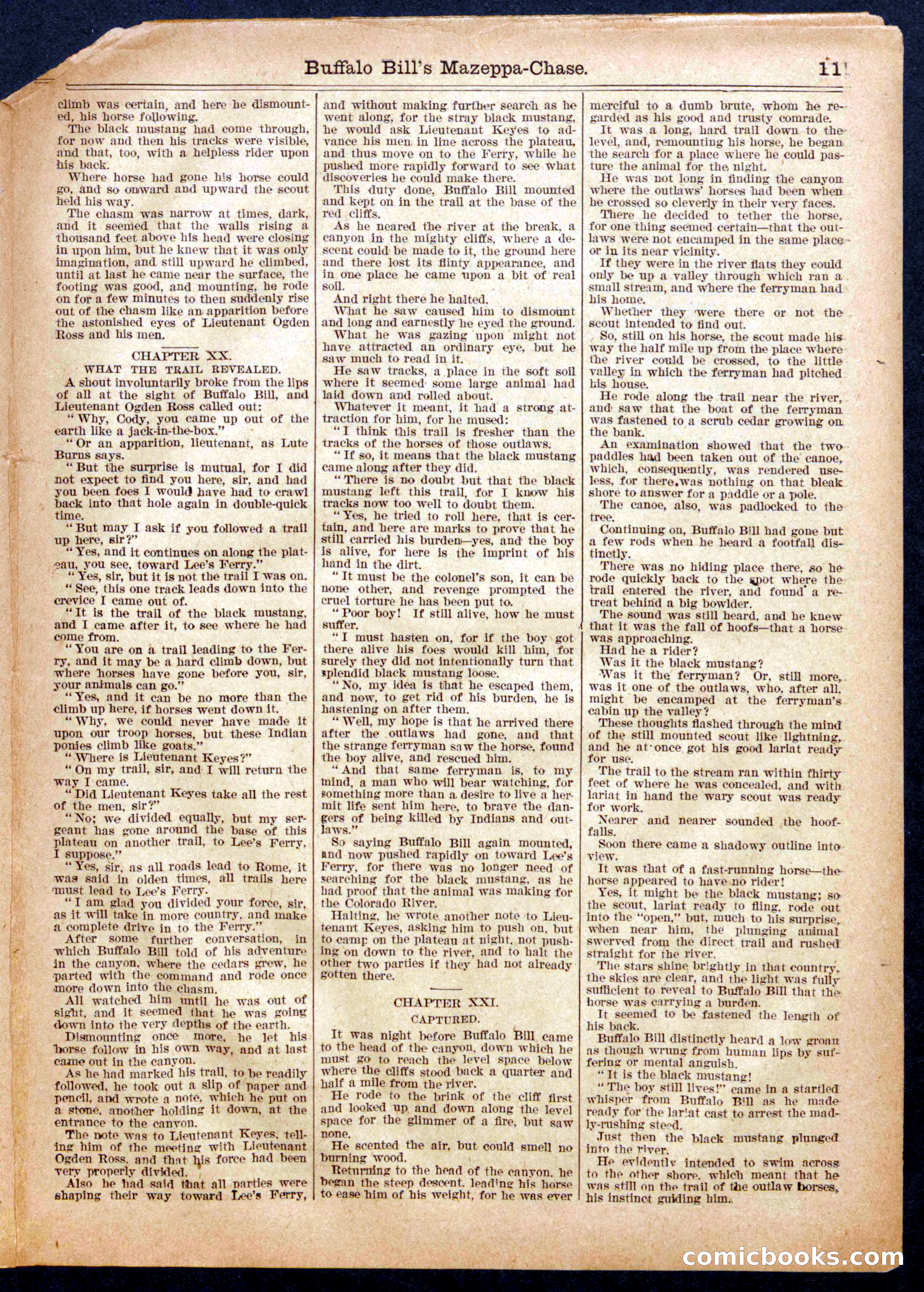
A restored page from Pulp Fiction, 1895. Page through the whole issue in the reader above.
📄 Transcribed text from this page (OCR, searchable)
Machine-transcribed from the original scan — historical spelling and the odd misread are preserved.
Vall ' i” - + @ ‘ Le *, A Bag | | ooh ® F ‘ge 7 ‘a> ae te ‘ » s'hG ey, : a , - i avg . * ° - . 4 ; vn te : Satie « ~ ow ies ty 2X 5.7 4 : Ba > ae {, 7 Sed c ie . » '? >t , We. - o fe , Ye > , ‘di uss P 8 b ’ y < p . im € oe fy et a - ~~ -Y -> A ee ef 7 wh we. t * - climb was eertain, and here he dismount- ed, his horse following. ‘The black mustang had come through, for now and then his tracks were visible, and that, too, with a helpless rider upon his back. Where horse had gone his horse could go, and so onward and upward the scout held his way. The chasm was narrow at times, dark, and it seemed that the walls rising a thousand feet above his head were closing in upon him, but he knew that it was only imagination, and still upward he climbed, until at last he came near the surface, the footing was good, and mounting, he rode on for a few minutes to then suddenly rise out of the chasm like an apparition before the astonished eyes of Lieutenant Ogden Ross and his men. CHAPTER XX. WHAT THE TRAIL REVEALED. A shout involuntarily broke from the lips of all at the sight of Buffalo Bill, and Lieutenant Ogden Ross called out: “Why, Cody, you came up out of the earth like a jack-in-the-box.” ; “Or an apparition, lieutenant, as Lute Burns says. “But the surprise is mutual, for I did not expect to find you here, sir, and had you been foes I would have had to crawl back into that hole again in double-quick time, “But may I ask if you followed a trail up here, sir?’ “Yes, and it continues on along the plat- eau, you see, toward Lee’s Ferry.” “ Yes, sir, but it is not the trail I was on. “See, this one track leads down into the crevice I came out of. “It is the trail of the black mustang, and I came after it, to see where he had come from, “You are on a trail leading to the Fer- ry, and it may be a hard climb down, but where horses have gone before you, sir, your animals can go.” “Yes, and it can be no more than the climb up here, if horses went down it. “Why, we could never have made it upon our troop horses, but these Indian ponies climb like goats.” “Where is Lieutenant Keyes?” “On my trail, sir, and I will return the way I came. “Did Lieutenant of the men, sir?” “No; we divided equally, but my ser- geant has gone around the base of this plateau on another trail, to Lee’s Ferry, I suppose.” “Yes, sir, as all roads lead to Rome, it was said in olden times, all trails here Keyes take all the rest ' ‘must lead to Lee’s Ferry. “T am glad you divided your force, sir, as it will take in more country, and make a complete drive in to the Ferry.” After some further conversation, in which Buffalo Bill told of his adventure in the canyon, where the cedars grew, he parted with the command and rode once more down into the ¢hasm. All watched him until he was out of sight, and it seemed that he was going down into the very depths of the earth. Dismounting once More, he let his horse follow in his own way, and at last came out in the canyon. len ) As he had marked his trail, to be readily followed, he took out a slip of paper and pencil, and wrote a note, which he put on a stone, another holding it down, at the entrance to the canyon. The note was to Lieutenant Keyes, tell- ing him of the meeting with Lieutenant Ogden Ross. and that his force had been very properly divided. | Also he had said that all parties were _ shaping their way toward Lee’s Ferry, t “ oe we yrs x — a 7 - 7 L Padi a *. ra oe = * Buftalo Bill’s = — and without making further search as he went along, for the stray black mustang, he would ask Lieutenant Keyes to ad- vance his men in line across the plateau, and thus move on to the Ferry, while he pushed more rapidly forward to see what discoveries he could make there. This duty done, Buffalo Bill mounted and kept on in the trail at the base of the red cliffs. As he neared the river at the break, a canyon in the mighty cliffs, where a de- scent could be made to it, the ground here and there lost its flinty appearance, and in one place he came upon a bit of real soil. And right there he halted. What he saw caused him to dismount and long and earnestly he eyed the ground. What he was gazing upon might not have attracted an ordinary eye, but he saw much to read in it. He saw tracks, a place in the soft soil where it seemed some large animal had laid down and rolled about. Whatever it meant, it had a strong at- traction for him, for he mused: “T think this trail is fresher than the tracks of the horses of those outlaws: “ If so, it means that the black mustang came along after they did. “There is no doubt but that the black mustang left this trail, for I know his tracks now too well to doubt them. “Yes, he tried to roll here, that is cer- tain, and here are marks to prove that he still carried his burden—yes, and the boy is alive, for here is the imprint of his hand in the dirt. “It must be the colonel’s son, it can be none other, and revenge prompted the cruel torture he has been put to. “Poor boy! If still alive, how he must suffer, “I must hasten on, for if the boy got there alive his foes would kill him, for surely they did not intentionally turn that splendid black mustang loose. “No, my idea is that he escaped them, and now, to get rid of his burden, he is hastening on after them. *“ Well, my hope is that he arrived there after the outlaws had gone, and that the strange ferryman saw the horse, found the boy alive, and rescued him. “And that same ferryman is, to my mind, a man who will bear watching, for something more than a desire to live a her- mit life sent him here, to brave the dan- — of being killed by Indians and out- aws.” So saying Buffalo Bill again mounted, and now pushed rapidly on toward Lee’s Ferry, for there was no longer need of searching for the black mustang, as he had proof that the animal was Making for the Colorado River. Halting, he wrote another note to Lieu- tenant Keyes, asking him to push on, but to camry on the plateau at night, not push- ing on down to the river, and to halt the other two parties if they had not already gotten there. | —___—_— CHAPTER XXI. CAPTURED. It was night before Buffalo Bill came to the head of the canyon, down which he must go to reach the level space below where the Gliffs stood back a quarter and half a mile from the river. He rode to the brink of the cliff first and looked up and down along the level space for the glimmer of a fire, but saw none, | | _ He scented the air, but could smell no burning wood. ieee to the head of the eanyon. he began the steep descent, leading his horse to ease him of his weight, for he was ever Mazeppa-Chase. ee —_ —- -—— -—— - = _ .* (a*. a, wets . merciful to a dumb brute, whom he re-- garded as his good and trusty comrade. It was a long, hard trail down to the level, and, remounting his horse, he began: the search for a place where he could pas- ture the animal for the night. | He was not long in finding the canyon where the outlaws’ horses had been when he crossed so cleverly in their very faces. There he decided to tether the horse, for one thing seemed certain—that the out- laws were not encamped in the same place» or in its near vicinity. If they were in the river flats they eould only be up a valley through which ran a. small stream, and where the ferryman had his home, Whether they ‘were there or not the Scout intended to find out. So, still on his horse, the scout made his. way the half mile up from the place where: the river could be crossed, to the little valley in which the ferryman had pitched his house. He rode along the trail near the river, and saw that the boat of the ferryman was fastened to a scrub cedar growing on. the bank. An examination showed that the two. paddles had been taken out of the canoe, which, consequently, was rendered use- less, for there,was nothing on that bleak shore to answer for a paddle or a pole. The canoe, also, was padlocked to the tree, Continuing on, Buffalo Bill had gone but a few rods when he heard a footfall dis- tinetly. There was no hiding place there, so he rode quickly back to the gpot where the trail entered the river, and found’ a re- treat behind a big bowlder. The sound was still heard, and he knew that it was the fall of hoofs—that a horse was approaching. Had he a rider? Was it the black mustang? Was it the ferryman? was it one of the outlaws, who, after all, might be encamped at the ferryman’s. cabin up the valley? These thoughts flashed through the mind of the still mounted scout like lightning, and he at‘once got his good lariat ready for use. The trail to the stream ran within thirty feet of where he was concealed, and with lariat in hand the wary scout was ready for work. Nearer and nearer sounded falls. Soon there came a shadowy outline into. view. the hoof- It was that of a fast-running horse—the horse appeared to have no rider! Yes, it might be the black mustang; so- the scout, lariat ready to fling, rode out into the “open,” but, much to his surprise, when near him, the plunging animal swerved from the direct trail and rushed straight for the river. The stars shine brightly in that country, the skies are clear, and the light was fully sufficient to reveal to Buffalo Bill that the horse was carrying a burden. It seemed to be fastened the length of his back. Buffalo Bill distinetly heard a low groan as though wrung from human lips by suf- fering or mental anguish. “It is the black mustang! “ The boy still lives!” came in a startled whisper from Buffalo Bill as he made ready for the lartat cast to arrest the mad- ly-rushing steod, Just then the black mustang plunged into the river, He evidently intended to swim across. to the other shore. which meant that he was still on the trail of the outlaw borses, — his instinct guiding him. > a) pw 1? ee ~ aoe e r ‘ a Ke ‘e * LM “ Lh p ws ‘ ° | ~ ws 2 wm od »! ie Oe Areas? BU LO” i 7 cy Or, still more,. at mf «=~ @ he Pr, ame