
Pulp Fiction, 1895 · page 2 of 16
Beadle's Half Dime Library No. 939 — page 2: what you’re looking at
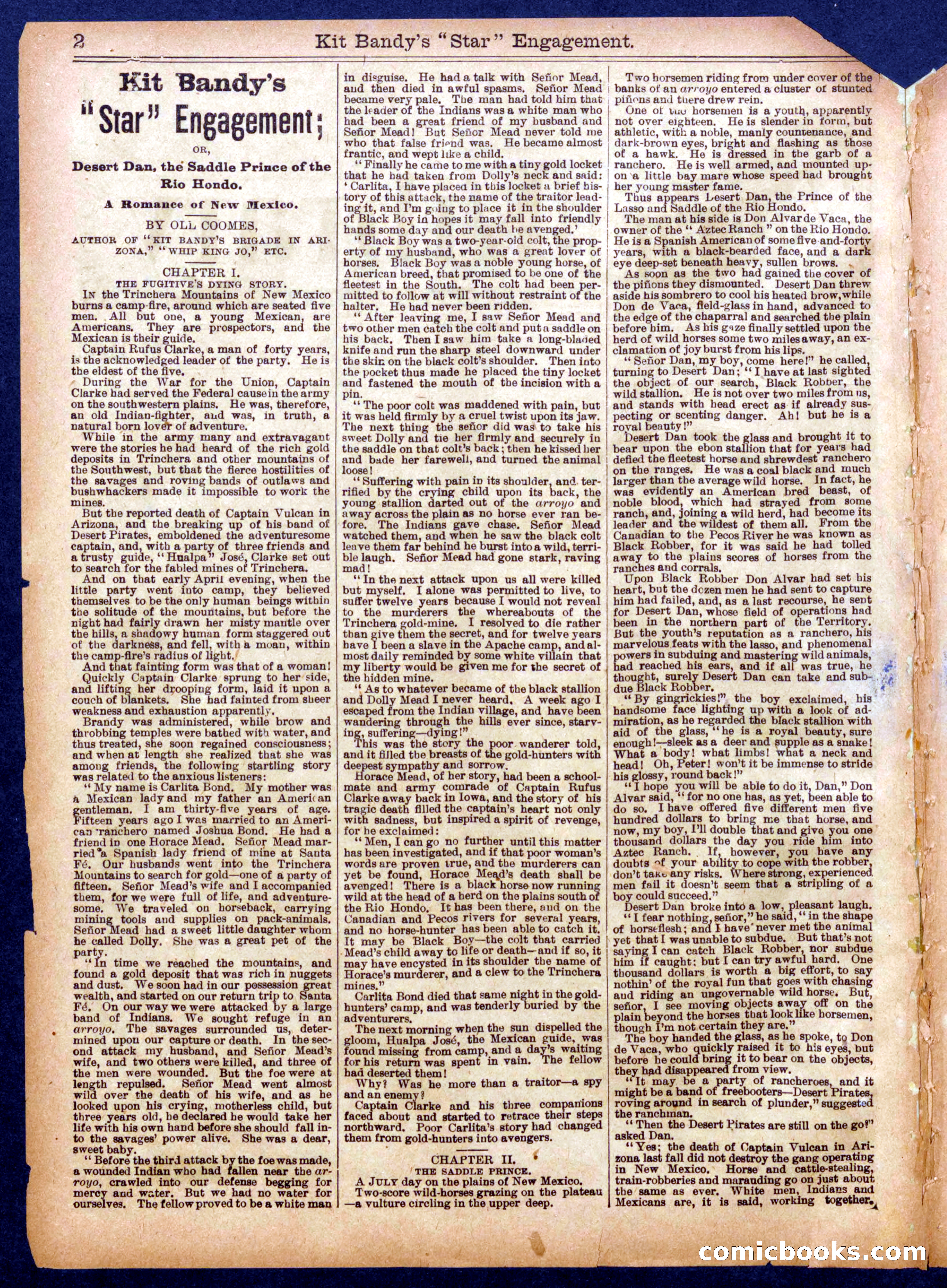
A restored page from Pulp Fiction, 1895. Page through the whole issue in the reader above.
📄 Transcribed text from this page (OCR, searchable)
Machine-transcribed from the original scan — historical spelling and the odd misread are preserved.
_ Kit Bandy’s “Star” Engagement: Desert Dan, the Saddle Prince of the Rio Hondo. A Romance of New Mexico. BY OLiL COOMES, AUTHOR OF ‘KIT BANDY’S BRIGADE IN ARI- ZONA,” *‘ WHIP KING JO,” ETC, CHAPTER I. THE FUGITIVE’S DYING STORY. In the Trinchera Mountains of New Mexico burns a camp-fire, around which are seated five men. All but one, a young Mexican, are Americans, They are prospectors, and the Mexican is their guide. Captain Rufus Clarke, a man of forty years, is the acknowledged leader of the party. Heis the eldest of the five, During the War for the Union, Captain Clarke had served the Federal] causein the army on the southwestern plains. He was, therefore, an old Indian-fighter, aud was, in truth, a natural born lover of adventure. While in the army many and extravagant were the stories he had heard of the rich gold deposits in Trinchera and other mountains of the Southwest, but that the fierce hostilities of the savages and roving bands of outlaws and bushwhackers made it impossible to work the mines. But the reported death of Captain Vulcan in Arizona, and the breaking up of his band of Desert Pirates, emboldened the adventuresome captain, and, with a party of three friends and atrusty guide, ‘‘Hualpa” José, Clarke set out to search for the fabled mines of Trinchera, And on that early April evening, when the little party went into camp, they believed themselves to be the only human beings within the solitude of the mountains, but before the night had fairly drawn her misty mantle over the hills, a shadowy human form staggered out of the darkness, and fell, with a moan, within the camp-fire’s radius of light, And that fainting form was that of a woman! Quickly Captain Clarke sprung to her side, and lifting her drooping form, laid it npon a couch of blankets, She had fainted from sheer weakness and exhaustion apparently. Brandy was administered, while brow and throbbing ge were bathed with water, and thus treated, she soon regained consciousness ; and when at length she reajized that she was among friends, the following startling story was related to the anxious listeners: ‘* My name is Carlita Bond. My mother was i Mexican ladyand my father an American entleman, I am thirty-five years of age. ifteen years ago lI was married to an Ameri- can “ranchero named Joshua Bond. He had a friend in one Horace Mead. Sefior Mead mar- ried a Spanish lady friend of mine at Santa Fé, Our husbands went into the Trinchera Mountains to search for gold—one of a party of fifteen. Sefior Mead’s wife and I accompanied them, for we were full of life, and adventure- some, We traveled on horseback, carrying Sheen acs ey aud supplies on pack-animals, Sefior Mead had a sweet little daughter whom he called Dolly. She was a great pet of the rty. pe n time we reached the mountains, and found a gold deposit that was rich in nuggets and dust. Wesoon had in our possession great wealth, and started on our return trip to Santa Fé, On our way we were attacked by a large band of Indians. We sought refuge in an arroyo. The savages surrounded us, deter- mined upon our capture or death. In the sec- ond attack my husband, and Sefior Mead’s wife, and two others were killed, and three of the men were wounded. But the foe were at length repulsed. Sefior Mead went almost wild over the death of his wife, and as he looked upon his crying, motherless child, but three years old, be declared he would take her life with his own hand before she should fall in- to the savages’ power alive. She was a dear, sweet baby. ** Before the third attack by the foe was made, a wounded Indian who had en near the ar- royo, crawled into our defense g for mercy aud water. But we had no water for ourselves, The fellow proved to be a white man in disguise. He hadatalk with Sefior Mead, aud then died in awful spasms, became very pale. The man had told him that the leader of the Indians was a white man who | Kit Bandy’s “Star” Engagement. | Senior Mead | had been a great friend of my busband and | But Sefor Mead never told me He became almost Sefior Mead! who that false friend was. frantic, and wept like a child. that he bad taken from Dolly’s neck and said: Two horsemen riding from under cover of the © banks of an arroyo entered a cluster of stunted pinons and there drew rein. One of wie horsemen is a youth, apparently not over eighteen. Heis slender in form, but athletic, with a noble, manly countenance, and dark-brown eyes, bright and flashing as those of a hawk. He is dressed in the garb of a ‘* Finally he came to me witha tiny gold locket | ‘ Carlita, | have placea in this locket a brief bis- | tory of this attack, the name of the traitor lead- | ing it, and ’'m going to place it in the shoulder of Black Boy in hopes it may fall into friendly hands some day and our death he avenged,’ ‘* Black Boy was a two-year-old colt, the prop- | | years, with a black-bearded face, and a dar erty of my husband, who was a great lover of borses, American breed, that promised to be one of the fleetest in the South, The colt had been per- mitted to follow at will without restraint of the halter. He had never been ridden. Black Boy was a noble young horse, of | | ranchero. Heis well armed, and mounted up- ona little bay mare whose speed had brought her young master fame. : Thus appears Lesert Dan, the Prince of the Lasso and Saddle of the Rio Hondo. The man at his side is Don Alvarde Vaca, the owner of the ‘* Aztec Ranch ” on the Rio Hondo. He is a Spanish American of some five and-forty eye deep-set beneath heavy, sullen brows. , As soon as the two had gained the cover of the pifions they dismounted. Desert Dan threw aside his sombrero to cool his heated brow, while Don de Vaca, fleld-glass in hand, advanced to ‘* After leaving me, I saw Sefior Mead and | the edge of the chaparral and searched the plain to other men catch the colt and puta saddle on his back, ThenI saw him take a long-bladed knife and run the sharp steel downward under the skin on the black colt’s shoulder. Then into the pocket thus made he placed the tiny locket and fastened the mouth of the incision with a pin. ‘* The poor colt was maddened with pain, but it was held firmly by a cruel twist upon its jaw. | The next thing the sehor did was to take his sweet Dolly and tie her firmly and securely in i | [ , | ' ' | before bim. As his g4ze finally settled upon the herd of wild horses some two milesaway, an ex- clamation of joy burst from his lips. ‘‘ Sefior Dan, my boy, come here!” he called, turning to Desert Dan; ‘‘I have at last sighted the object of our search, Black Robber, the wild stallion. He is not over two miles from ns, and stands with head erect as if already sus- pecting or scenting danger. Ah! but he isa roval beauty !” Desert Dan took the glass and brought it to the saddle on that colt’s back; then he kissed her | bear upon the ebon stallion that for years had and bade her farewell, and turned the animal | defied the fleetest horse and shrewdest ranchero loose | ‘‘ Suffering with pain in its shoulder, and. ter- rified by the crying child upon its back, the young stallion darted out of the arroyo and away across the plain as no horse ever ran be- | fore. The Indians gave chase. Sefior Mead | leader and the wildest of them all. watched them, and when he saw the black colt leave them far behind he burst into a wild, terri- ade Sefior Mead had gone stark, raving mad! ‘*In the next attack upon us all were killed | on the ranges, | He was a coal black and much larger than the average wild horse. In fact, he was evidently an American bred beast, of noble blood, which had strayed from some ranch, and, joining a wild herd, had become its From the Canadian to the Pecos River he was known as Black Robber, for it was said he had tolled away to the plains scores of horses from the ranches and corrals, Upon Black Robber Don Alvar had set bis but myself, I alone was permitted to live, to | heart, but the dozen men he had sent to capture because I would not reveal suffer twelve years whereabouts of the to the murderers the him had failed, and, as a last recourse, he sent for Desert Dan, whose field of operations had Trinchera gold-mine. I resolved to die rather | been in the northern part of the Territory. than give them the secret, and for twelve years | But the youth’s reputation as a ranchero, his bave | been a slave in the Apache camp, and al- most daily reminded by some white villain that my liberty would be given me for the secret of the hidden mine. ‘* As to whatever became of the black stallion and Dolly Mead I never heard, A week ago I escaped from the Indian village, and have been wandering through the hills ever since, starv- ing. suffering—dying!” This was the story the r wanderer told, and it filled the breasts of the gold-hunters with deepest sympathy and sorrow. orace Mead, of her story, had been a school- mate and army comrade of Captain Rufus Clarke away back in lowa, and the story of his tragic death filled the captain’s heart not only with sadness, but inspired a spirit of revenge, for he exclaimed: ‘* Men, I can go no further until this matter has been investigated, and if that poor woman’s words are proven true, and the murderers can yet be found, Horace Mead’s death shall be avenged! There is a black horse now runnin wild at the head of a herd on the plains south o the Rio Hondo, It has been there, and on the Canadian and Pecos rivers for several years, and no horse-hunter has been able to catch it, It may be Black Boy—the colt that carried -Mead’s child away to life or death—and if so, it sted in its shoulder the name of h Cc acihne’s tens erer, and a clew to the Trinchera Horace’s mur mines,” Carlita Bond died that same iy 3 in the gold- hunters’ camp, and was tenderly buried by the adventurers, The next morning when the sun dispelled the gloom, Hualpa José, the Mexican guide, was found missing from camp, and a re waiting for his return was spent in vain. The fellow had deserted them! Why? Was he more than a traitor—a spy and an enemy? : Captain Clarke and his three companions faced about and started to retrace their steps northward, Poor Carlita’s story had changed them from gold-hunters into avengers. CHAPTER II, °* ‘THE SADDLE PRINCE. A JULY day on the plains of New Mexico, Two-score wild-horses grazing on the plateau —a vulture circling in the upper deep. marvelous feats with the lasso, and phenomenal wers in subduing and mastering wild animals, reached his ears, and if all was true, he thought, surel due Black Robber, “By gingrickies!”. the boy exclaimed, his handsome face lighting up with a look of ad- miration, as he regarded the black stallion with aid of the glass, ‘‘he is a royal beauty, sure enough!—sleek asa deer and supple as a snake! What a body! what limbs! what a neck and head! Oh, Peter! won’t it be immense to stride his glossy, round back!” ‘*] hope you will be able to do it, Dan,” Don Alvar said, ‘‘ for no one has, as yet, been able to do so. I have offered five different men five hundred dollars to bring me that horse, and now, my boy, I'll double that and give you one thousand dollars the day you ride him into Aztec Ranch. If, however, you have any doubts of your ability to cope with the robber don’t take any risks, Where strong, experienced, men fail it doesn’t seem that a stripling of a boy could succeed.” Desert Dan broke into a low, gyre laugh, ‘*T fear nothing, sefior,” he said, “‘ in the shape of horseflesh ; and | have’ never met the animal yet that [ was unable to subdue, But that’s not saying I can catch Black Robber, nor subdue him if caught; but I can try awful hard. One thousand dollars is worth a big effort, to say nothin’ of the royal fun that goes with chasing aud riding an ungovernable wild horse, But, sefior, I see moving objects rer off on the plain be ond the horses that look e horsemen, though I’m not certain they are.’ The boy handed the glass, as he spoke, tg Don de Vaca, who Sy eerad raised it to his eyes, but before he could bring it to bear on the objects, they had disappeared from view. ‘Tt may be a ty of rancheroes, and it might be a band of freebooters—Desert ‘Pirates roving aroynd in search of plunder,” suggested the ranchman. ‘‘ Then the Desert Pirates are still on the go?” asked Dan, ‘‘ Yes; the death of Captain Vulcan in Ari- zona last fall did not destroy the gang operating in New Mexico, Horse and cattle- ing, train-robberies and marauding go on just about the same as ever. White men, Indians and Mexicans are, it is said, working together, co Desert Dan can take and sub-. ; s A, ; “4 > 4 oy MOLD % | I. co 4 } |. ss “ ’ iF