
Pulp Fiction, 1895 · page 2 of 16
Beadle's Half Dime Library, No. 938 — page 2: what you’re looking at
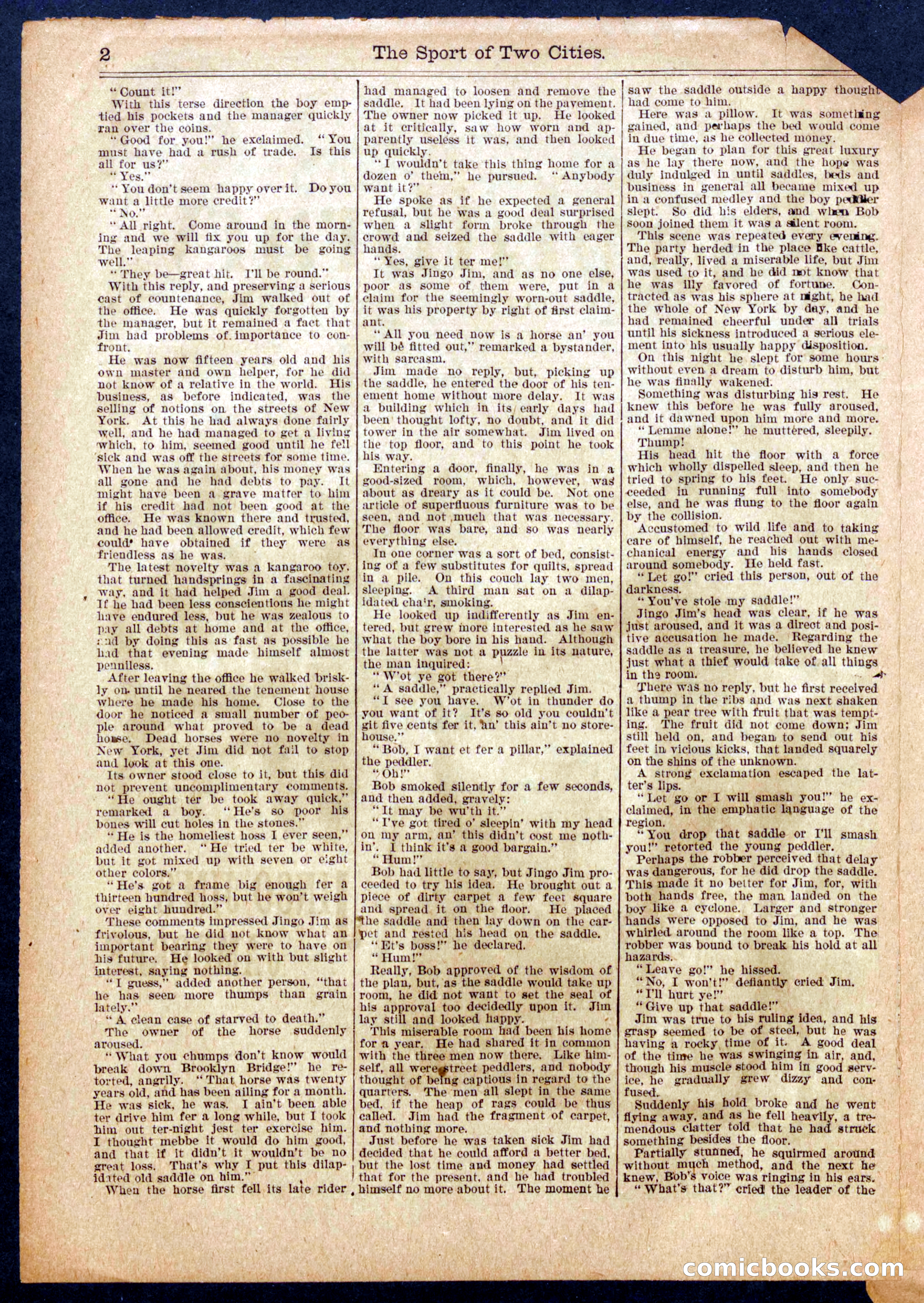
A restored page from Pulp Fiction, 1895. Page through the whole issue in the reader above.
📄 Transcribed text from this page (OCR, searchable)
Machine-transcribed from the original scan — historical spelling and the odd misread are preserved.
2 “Count it!’ With this terse direction the boy emp- tied his pockets and the manager quickly ran over the coins. “Good for you!” he exelaimed. must have had a rush of trade, all for us?” 7 Les." * You don’t seem happy over it. want a little more credit?” ** No.’’ “ All right. Come around in the morn- ing and we will fix you up for the day. The leaping kangaroos must be going well,”’ “ They be—great hit. I'll be round.” With this reply, and preserving a serious cast of countenance, Jim walked out of the office. He was quickly forgotten by let the manager, but it remained a fact that 3 Jim had problems of.importance to con- ES front. . He was now fifteen years old and his own master and own helper, for he did not know of a relative in the world. His business, as before indicated, was the selling of notions on the streets of New York. At this he had always done fairly well, and he had managed to get a living ‘which, to him, seemed good until he fell ‘sick and was off the streets for some time. When he was again about, his money was all gone and he had debts to pay. It ., might have been a grave matfer to him By if his credit had not been good at the oh office. He was Known there and trusted, and he had been allowed credit, which few could’ have obtained if they were as friendless as he was. The latest novelty was a kangaroo toy, that turned handsprings in a fascinating way, and it had helped Jim a good deal. If he had been less conscientious he might lave endured less, but he was zealous to pay all debts at home and at the office, “i :ud by doing this as fast as possible he had that evening made himself almost | | penniless. cs After leaving the office he walked brisk- ; | ly om until he neared the tenement house , where he made his home. Close to the door he noticed a small number of peo- ple around what proved to be a dead home. Dead horses were no novelty in New York, yet Jim did not fail to stop and luok at this one. | Its owner stood close to it, but this did not prevent uncomplimentary comments. “He ought ter be took away quick,” remarked a boy. ‘He’s so poor his bones will cut holes in the stones.”’ * He is the homeliest hoss I ever seen,” } added another. ‘“ He tried ter be white, piv? but it got mixed up with seven or eight other colors.” | “He's got a frame big enough fer a “iia thirteen hundred hoss, but he won’t weigh if over eight hundred.” - ‘These comments impressed Jingo Jim as * frivolous, but he did not know what an if ' jmportant bearing they were to have on an his future. He looked on with but slight Peet 8 Fh interest, saying nothing. . ahs | “T guess,’ added another person, “‘that he has seem more thumps than grain lately.” “A clean case of starved to death.” The owner of the horse suddenly aroused. “What you chumps don’t know would break down Brooklyn Bridge!’ he re- torted, angrily. ‘That horse was twenty years old, and has been ailing for a month. He was sick, he was. I ain’t been able is ty | ter drive him fer a long while, but I took es it him out ter-night jest ter exercise him. ae I thought mebbe it would do him good, a and that if it didn’t it wouldn’t be no ie great loss. That’s why I put this dilap- ei idated old saddle on him.” “You Is this Do you | When the horse first fell its late rider , ee ee eee eC The Sport of Two Cities. had managed to loosen and remove the saddle. It had been lying on the payement. The owner now picked it up. He looked at it critically, saw how worn and ap- parently useless it was, and then looked up quickly. 1 wouldn’t take this thing home for a dozen o’ them,” he pursued. ‘“ Anybody want it?” He spoke as if he expected a general refusal, but he was a good deal surprised when a Slight form broke through the crowd and seized the saddle with eager hands. ‘Yes, give it ter me!” It was Jingo Jim, and as no one else, poor as some of them were, put in a claim for the seemingly worn-out saddle, it was his property by right of first claim- ant, * All you need now is a horse an’ you will bé fitted out,’ remarked a bystander, With sarcasm, Jim made no reply, but, picking up the saddle, he entered the door of his ten- ement home without more delay. It was a building which in its; early days had been’ thought lofty, no doubt, and it did tower in the air somewhat. Jim lived on the top floor, and to this point he took his way. Entering a door, finally, he was in a good-sized room, which, however, was about as dreary as it could be. Not one article of superfluous furniture was to be seen, and not much that was necessary. The floor was bare, and so was nearly everything else. In one corner was a sort of bed, consist- ing of a few substitutes for quilts, spread in a pile. On this couch lay two men, sleeping. A third man sat on a dilap- idated chair, smoking. He looked up indifferently as Jim en- | tered, but grew more interested as he saw What the boy bore in his hand. Although the latter was not a puzzle in its nature, the man inquired: | * W’ot ye got there?’ * A saddle,” practically replied Jim. “Il see you have. W’ot in thunder do you want of it? It’s so old you couldn't git five cents fer it, ‘hn’ this ain’t no store- house.”’ * Bob, I want et fer a pillar,” explained the peddler, se Oh a Bob smoked silently for a few seconds, and then added, gravely: “It may be wu’th it.” T’ye got tired o’ sleepin’ with my head ou my arm, an’ this didn’t cost me noth- in’. I think it’s a good bargain.”’ Bom)" es Bob had little to say, but Jingo Jim pro- ceeded to try his idea. He brought out a piece of dirty carpet a few feet square and spread. it on the floor. He placed he saddle and then lay down on the ear- ‘pet and rested his head on the saddle. * Et’s boss!” he “Hum aoe hs Really, Bob approved of the wisdom of the plan, but, as the saddle would take up room, he did not want to set the seal of declared. eee ee his approval too decidedly upon it. Jim | lay still and looked happy. = — ~ This miserable room had been his home for a year. . had shared it in common with the three men now there, Like him- self, all weregtreet peddlers, and nobody thought of being captious in regard to the quarters. The men all slept in the same bed, if the heap of rags could be thus called. Jim had the fragment of carpet, and nothing more. Just before he was taken sick Jim had decided that he could afford a better bed, but the lost time and money had settled that for the present, and he had troubled himself no more about it. The moment he - a oo = saw the saddle outside a happy though) had come to him. Here was a pillow. It was something gained, and perhaps the bed would come in due time, as he collected money. He began to plan for this great luxury as he lay there now, and the hope was duly indulged in until saddles, beds and business in general all became mixed up in a confused medley and the boy pediler slept. So did his elders, and when Bob soon joined them it was a silent room. This scene was repeated every evening. The party herded in the place Uke cattle, and, really, lived a miserable life, but Jim was used to it, and he did mot know that he was illy favored of fortune. Con- tracted as was his sphere at might, he had the whole of New York by day, and he had remained cheerful under all trials until his sickness introduced a serious ele- ment into his usually happy disposition. On this night he slept for some hours: without even a dream to disturb him, but he was finally wakened. Something was disturbing his rest. He knew this before he was fully aroused, and it dawned upon him more and more. “Lemme alone!’ he muttéred, sleepily. Thump! His head hit the floor with a force which wholly dispelled sleep, and then he tried to spring to his feet. He only suc- ceeded in running full into somebody else, and he was flung to the floor again by the collision. Accustomed to wild life and to taking eare of himself, he reached out with me- chanical energy around somebody. He held fast. “Let go!” cried this person, out of the darkness. “You've stole my saddle!” Jingo Jim’s head was clear, if he was just aroused, and it was a direct and posi- tive accusation he made. Regarding the saddle as a treasure, he believed he knew just what a thief would take of. all things in ths room. re There was no reply, but he first received a thump in the ribs and was next shaken like a pear tree with fruit that was tempt- ing. The fruit did not come down; Jim still held on, and begam to send out his feet in vicious kicks, that landed squarely on the shins of the unknown. A strong exclamation escaped the lat- ter’s lips. vee “Let go or I will smash you!” he ex- claimed, tne the emphatic language of the regiony 45004. “You drop that saddle or I'll smash you!” retorted the young peddler. Perhaps the robber perceived that delay was dangerous, for he did drop the saddle. This made it no better for Jim, for, with both hands free, the man landed on the boy like a cyclone. Larger and stronger hands were opposed to Jim, and he was whirled around the room like a top. The robber was bound to break his hold at all hazards.. | ‘i on eave go!” he hissed. “No, I won't!” defiantly cried Jim. “Tl hurt ye!” Fishy e at : “Give up that saddle!” Jim was true to his ruling idea, and his grasp seemed to be of steel, but he was having a rocky, time of it. A good deal | of the tinre he was swinging in air, and, - though his muscle stood him in good serv- dee, he gradually grew dizzy and con- ed. ie ‘Suddenly his hold broke and he went flying away, and as he fell heavily, a tre- mendous clatter told that he had struck _ something besides the floor. isi Partially stufined, he squirmed around without much method, and the next he — voice was ringing in his ears. — knew, Bob's voi “ What's that?” cried the leader of the i> and his hands closed 11Icbooks:<« et? Sees * Rar eisai ora 4 a —_ a ae -