
Pulp Fiction, 1877 · page 3 of 16
Beadle's Half Dime Library, No. 9 — page 3: what you’re looking at
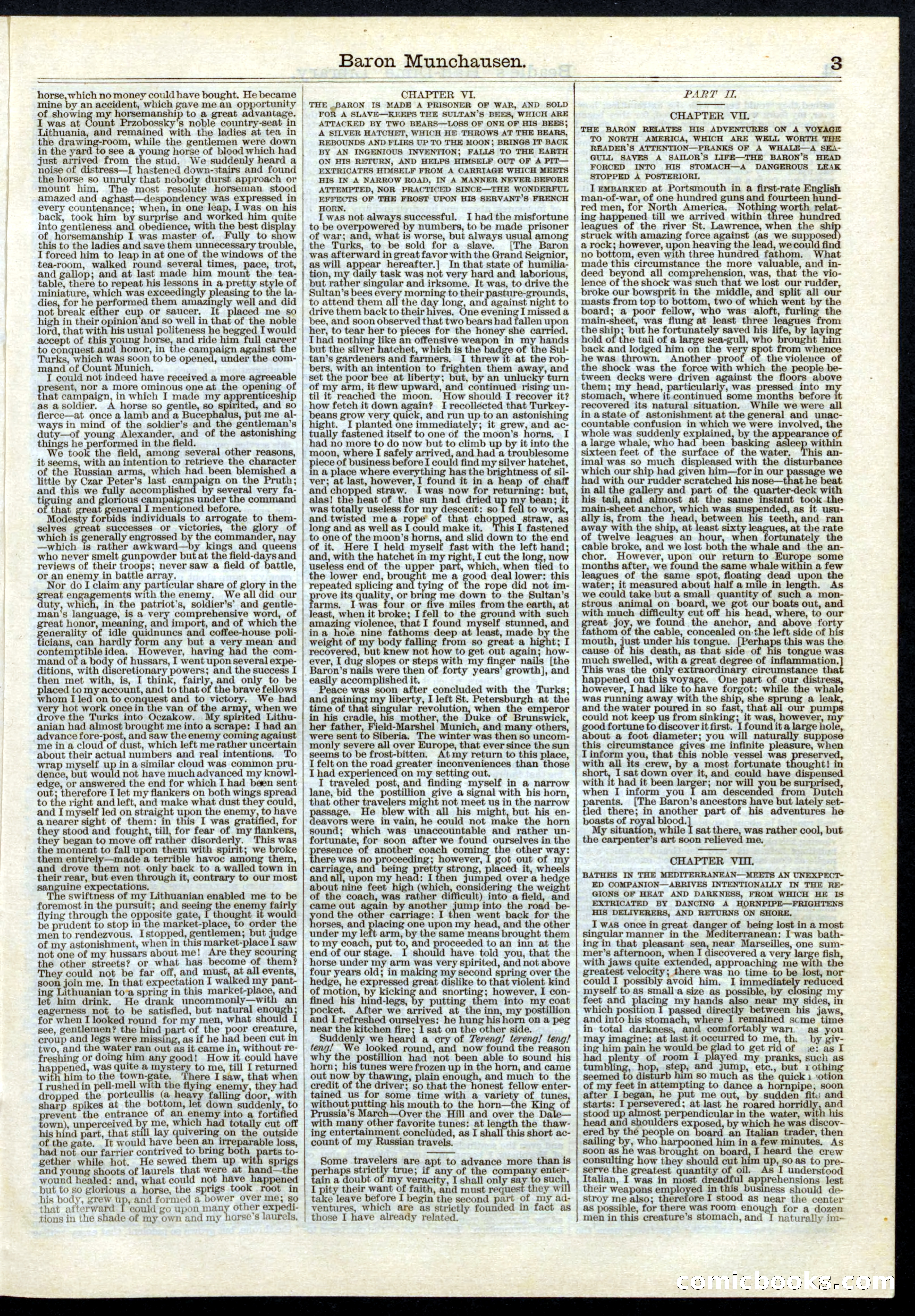
A restored page from Pulp Fiction, 1877. Page through the whole issue in the reader above.
📄 Transcribed text from this page (OCR, searchable)
Machine-transcribed from the original scan — historical spelling and the odd misread are preserved.
~ horse, which no money could have bought. He became mine by an accident, which gave me an opportunity of showing my horsemanship to a great advantage. I was at Count Przobossky’s noble country-seat in Lithuania, and remained with the ladies at tea in the drawing-room, while the gentlemen were down in the yard to see a tegen horse of blood which had just arrived from the stud. We suddenly heard a noise of distress—I hastened down-stairs and found the horse so unruly that nobody durst approach or mount him. The most resolute horseman stood amazed and aghast—despondency was expressed in every countenance; when, in one leap, I was on his back, took him by surprise and worked him quite into gentleness and obedience, with the best page of horsemanship I was master of, Fully to show this to the ladies and save them unnecessary trouble, I forced him to leap in at one of the windows of the tea-room, walked round several times, e, trot, and gallop; and at last made him mount the tea- table, there to repeat his lessons in a pretty ae of miniature, which was Senee ary presting to the la- dies, for he performed them amazingly well and did not break either cup or saucer, It placed me so high in their opinion and so well in that of the noble lord, that with his usual politeness he begged I would accept of this young horse, and ride him full career to conquest and honor, in the campaign against the Turks, which was soon to be opened, under the com- mand of Count Munich. I could not indeed have received a more agreeable resent, nor a more ominous one at the opening of hat campaign, in which I made my apprenticeship as a soldier. A horse so gentle, so spirited, and so fierce—at once a lamb and a Bucephalus, put me al- ways in mind of the soldier’s and the gentleman’s duty—of young Alexander, and of the astonishing things he performed in the field. We took the field, among several other reasons, it seems, with an intention to retrieve the character of the Russian arms, which had been blemished a little by Czar Peter’s last campaign on the Pruth; and this we fully accomplished by several very fa- tiguing and glorious campaigns under the command of that great general I mentioned before. Modesty forbids individuals to arrogate to them- selves t successes or victories, the glory of which is generally engrossed by the commander, nay —which is rather awkward—by kings and queens who never smelt gunpowder but at the field-days and reviews of their troops; never saw a field of battle, or an enemy in battle array. Nor do I claim any particular share of glory in the eat engagements with the enemy. We all did our uty, which, in the patriot’s, soldier’s’ and gentle- man’s language, is a very comprehensive word, of great honor, meaning, and import, and of which the iatedege A of idle Le and coffee-house poli- icians, can hardly form any but a very mean and ee ae idea. However, having had the com- mand of a body of hussars, I went upon several expe- ditions, with discretionary powers; and the success I then met with, is, I think, fairly, and only to be placed to my account, and to that of the brave fellows whom I led on to conquest and to victory. We had very hot work once in the van of the , when we drove the Turks into Oezakow. My spirited Lithu- anian had almost brought me into a scrape: I had an advance fore-post, and saw the enemy coming against me in a cloud of dust, which left me rather uncertain about their actual numbers and real intentions. To wrap myself up in a similar cloud was common pru- dence, but would not have much advanced my know!- edge, or answered the end for which I had been sent out: therefore I let my flankers on both wings spread to the right and left, and make what dust they could, and I myself led on straight upon the enemy, to have a nearer sight of them: in this I was gratified, for they stood and fought, till, for fear of my flankers, they began to move off rather disorderly. This was the moment to fall upon them with spirit; we broke them entirely—made a terrible havoc among them, and drove them not only back to a walled town in their rear, but even through it, contrary to our most “om expectations. e swiftness of my Lithuanian enabled me to be foremost in the pursuit; and seeing the enemy fairly flying through the opposite gate, 1 thought it would be prudent to stop in the market-place, to order the men to rendezvous. Istopped, gentlemen; but judge of my astonishment, when in this market-place I saw not one of my hussars about me! Are they scouring the other streets? or what has become of them? They could not be far off, and must, at all events, soon join me. In that expectation I walked my pant- ing Lithuanian toa spring in this market-place, and let him drink. He drank uncommonly—with an eagerness not to be satisfied, but natural enough; for when I looked round for my men, what should I see, gentlemen? the hind part of the poor creature, croup and Jegs were missing, as if he had been cut in two, and the water ran out as it came in, without re- freshing or doing him any good! How it could have happened, was quite a ga! to me, till I returned wi ri to rs npc mee ae I saw, iat oe I rushedin peli-mel wi e flying enem ey dropped the portcullis (a weary falling *¢ oor, with sharp spikes at the bottom, let down suddenly, to revent the entrance of an enemy into a fortified wn), unperceived by me, which totally cut off his hind part, that still lay quivering on the outside of the gate. It would have been an irreparable loss, had not our farrier contrived to bring both parts to- gether while hot. He sewed them up with spri and young shoots of laurels that were at hand—the wound healed: and, what could not have happened but to so glorious a horse, the sprigs took root in his body, gZrew up, and formed a bower Over me; so that afterward I could go upon many other expedi- tions in the shade of my own and my horse’s laurels, eee ener errr eer ar LL LLL LLLLLLLL LL LLL LLL Baron Munchausen. $$ —— CHAPTER VI. THE .BARON IS MADE A PRISONER OF WAR, AND SOLD FOR A SLAVE—KEEPS TEE SULTAN’S BEES, WHICH ARE ATTACKED BY TWO BEARS—LOSS OF ONE OF HIS BEES, A SILVER HATCHET, WHICH HE THROWS AT THE BEARS, REBOUNDS AND FLIES UP TO THE MOON; BRINGS IT BACK BY AN INGENIOUS INVENTION, FALLS TO THE EARTH ON HIS RETURN, AND HELPS HIMSELF OUT OF A PIT— EXTRICATES HIMSELF FROM A CARRIAGE WHICH MEETS HIS IN A NARROW ROAD, IN A MANNER NEVER BEFORE ATTEMPTED, NOR PRACTICED SINCE—THE WONDERFUL EFFECTS OF THE FROST UPON HIS SERVANT’S FRENCH HORN. I was not always successful. I had the misfortune to be overpowered by numbers, to be made prisoner of war; and, what is worse, but always usual among the Turks, to be sold for a slave. [The Baron was afterward in great favor with the Grand Seignior, as will appear hereafter.|] In that state of humilia- tion, a daily task was not very hard and laborious, but rather singular and irksome. It was, to drive the Sultan’s bees Sven? morning to their pasture-grounds, to attend them all the day long, and against night to drive them back to their hives, One evening I missed a bee, and soon observed that two bears had fallen upon her, to tear her to pieces for the honey she carried. Thad nothing like an offensive weapon in my hands but the silver hatchet, which is the ge of the Sul- tan’s gardeners and farmers. I threw it at the rob- bers, with an intention to frighten them away, and set the poor bee at liberty; but, by an unlucky turn of my arm, it flew upward, and continued rising un- til it reached the moon. How should I recover it? how fetch it down again? I recollected that Turkey- beans grow very quick, and run up to an astonishing hight. I planted one immediately; it grew, and ac- tually fastened itself to one of the moon’s horns, I had no more to do now but to climb up by it into the moon, where I ony arrived, and had a troublesome iece of business before I could find my silver hatchet, in a place where everything has the brightness of sil- ver; at last, however, I found it in a heap of chaff and chop straw. I was now for returning: —_ alas! the heat of the sun had dried up mr bean; i was totally useless for my descent: so I fell to work, and twisted mea rope of that cho straw, as long and as well as I could make it. is I fastened to one of the moon’s horns, and slid down to the end of it. Here I held myself fast with the left hand; and, with the hatchet in my right, I cut the long, now useless end of the upper , which, when tied to the lower end, bro t me a good deal lower: this repeated splicing and tying of the rope did not im- prove its quality, or bring me down to the Sultan’s arms, I was four or five miles from the earth, at least, when it broke; I fell to the ground with such amazing violence, that I found oy wen stunned, and ina hoe nine fathoms deep at least, made by the weight of my body f from so great a hight; I recovered, but knew not how to get out again; how- ever, I dug slopes or steps with my finger nails [the Baron's nails were then of forty years’ growth], and easily accomplished it. sd anialnesing tunertge i iets Bis Devenabvargh.en ties an i my li , [left St. Peters at the tine of that dn ar suvalutio when ino dhapirer in his cradle mother, the Duke of Brunswick, her father, Field-Marshel Munich, and many others, were sent to Siberia. The winter was then so uncom- monly severe all over Europe, that ever since the sun seems to be frost-bitten. Atmy return to this place, I felt on the road greater inconveniences than those I had experien on my setting out. I traveled post, and finding myself in a narrow lane, bid the postillion give a signal with bis horn, that other travelers might not meet us in the narrow eeee. He blew with all his might, but his en- eavors were in vain, he could not make the horn sound; which was unaccountable and rather un- fortunate, for soon after we found ourselves in the —— of another coach Conaing. the other way: ere was no proceeding; however, I got out of my carriage, and being pretty strong, placed it, wheels and all, upon my head: I then jum over a hedge about nine feet high (which, considering the weight of the coach, was rather difficult) into a field, and came out a by another jump into the road be- ond the other carriage: I then went back for the orses, and oe one upon my head, and the other under my left arm, by the same means brought them to my coach, put to, and proceeded to an inn at the end of our stage. I should have told you, that the horse under my arm was very spirited, and not above four years old; in making my second spring over the hedge, he expressed great dislike to that violent kind of motion, by kicking and meet however, I con- fined his hind-legs, by putting them into my coat pocket. After we arrived at the inn, my postillion and I refreshed ourselves: he hung his horn on a peg near the kitchen fire; 1 sat on the other side. Suddenly we heard a cry of Tereng/ tereng! teng! feng! We looked round, and now found the reason why the postillion had not been able to sound his horn; his tunes were frozen up in the horn, and came out now by thawing, plain enough, and much to the credit of the driver; so that the honest fellow enter- tained us for some time with a variety of tunes without put his mouth to the horn—the King of Prussia’s March—Over the Hill and over the Da with many other favorite tunes: at length the thaw- ing entertainment conclided, as I shall this short ac- count of my Russian travels. Some travelers are apt to advance more than is perhaps strictly true; if any of the company énter- n a doubt of my veracity, I shall only sa such I pity their want of faith, and must request they will take leave before I begin the second part of my ad- ventures, which are as strictly founded in fact as those I have already related. PART I. CHAPTER VIL THE BARON RELATES HIS ADVENTURES ON A VOYAGE TO NORTH AMERICA, WHICH ARE WELL WORTH THE READER'S ATTENTION—PRANKS OF A WHALE—A SEA- GULL SAVES A SAILOR’S LIFE—THE BARON’S HEAD FORCED INTO HIS STOMACH—A DANGEROUS LEAK STOPPED A POSTERIORI. I EMBARKED at Portsmouth in a first-rate English man-of-war, of one hundred guns and fourteen hund- red men, for North America. Not worth relat- ing happened till we arrived within three hundred leagues of the river St. Lawrence, when the struck with amazing force against (as we sup a rock; however, upon heaving the lead, we could fin no bottom, even with three hundred fathom. What made this circumstance the more valuable, and in- deed beyond all comprehension, was, that the vio- lence of the shock was such that we lost our rudder, broke our bowsprit in the middle, and split all our masts from top to bottom, two of which went by the board; a poor fellow, who was aloft, furling the main-sheet, was flung at least three leagues from the ee but he fortunately saved his life, by laying hold of the tail of a large sea-gull, who brought him back and lodged him on the very spot from whence he was thrown. Another proof of the violence of the shock was the force with which the people be- tween decks were driven against the floors above them; my head, particularly, was pressed into my stomach, where it continued some months before it recovered its natural situation. While we were all in astate of astonishment at the general and unac- omens pater ei in erecneme = bi involved, ma whole was suddenly explain Vv eawncernes> a large whale, who had been basking eep within sixteen feet of the surface of the water. an- imal was so much displeased with the disturbance which our ship had given him—for in our we had with our rudder scratched his nose—that he beat in all the gallery and part of the quarter-deck with his tail, and almost at the same instant took the main-sheet anchor, which was suspended, as it usu- ally is, from the head, between his teeth, and ran away with the ship, at least “—— es, at the rate of twelve leagues an hour, when fortunately the cable broke, and we lost both the whale and the an- chor. However, upon our return to Europe some months after, we found the same whale within a few leagues of the same spot, floating dead upon the water; it measured about half a mile in length. As we could take but a small quantity of such a mon- strous animal on board, we got our boats out, and with much difficulty cut off his head, where, to our erent joy, we found the anchor, and above fort athom of the cable, concealed on-the left side of h mouth, just under his tongue. [Perhaps this was the cause of his death, as that side of his tongue was much swelled, with a great degree of inflammation. This was the only extraordinary circumstance tha happened on this voyage. One part of our distress, however, I had like to have forgot: while the whale was running away with the ship, she —rune a leak, and the water poured in so fast, that our pumps could not keep us from sinking; it was, however, my good fortune to discover it first. I found ita large hole, about a foot diameter; you will this circumstance hg: me infinite pleasure, when I inform you, that this noble vessel was preserved, with all its crew, by a most fortunate thought! in short, I sat down over it, and could have nsed with it had it been er; nor will bg be rised, when I inform you I am descended from Dutch parents. [The Baron’s ancestors have but lately set- tled there; in another part of his adventures he boasts of royal ore My si on, while I sat there, was rather cool, but the carpenter’s art soon relieved me, CHAPTER VIII. BATHES IN THE MEDITERRANEAN—MEETS AN UNEXPECT- ED COMPANION—ARRIVES INTENTIONALLY IN THE RE- GIONS OF HEAT AND DARENESS, FROM WHICH HE IS EXTRICATED BY DANCING A HORNPIPE—FRIGHTENS HIS DELIVERERS, AND RETURNS ON SHORE, _I was once in great canes of being lost in a most singular manner in the Mediterranean: Iwas bath- ing in that pleasant sea, near Marseilles, one sum- nat suppose mer’s afternoon, when I discovered a very large fish, with jaws quite extended, approaching me with the greatest velocity; there was no time to be lost, nor could I possibly avoid him. I imm reduced myself to as small a size as possible, by closing my feet and placing my hands also near my sides, in which tion I passed directly between his jaws, and into his stomach, where I remained scme time in total darkness, and comfortably warn. as you may imagine: at last it occurred to me, th — by giv- ing him pain he would be glad to get ridof .e: as I had plenty of room I played my pranks, such as tumbling, hop, step, and jump, etc., but rothing seemed disturb him so much as the quick i \otion of my feet in attempting to dance a hornpipe after I began, he put me out, by sudden fits and : ; at last he roared nossa and stood up almost perpendicular in the water, th his head and shoulders exposed, by which he was discov- ered by the people on an Italian trader, then sailing by, who harpooned him in a few minutes. As soon as he was brought on pong heard the crew consulting how they should cut up, so as to pre- serve the greatest quantity of oil. As I understood Italian, I was in most d apprehensions lest their weapons rine ps in this business should de- stroy me also; therefore I stood as near the center as possible, for there was room enough for a dozen men in this creature’s stomach, and I naturally im- , soon 0 )(0)) <eom SS (E (€©)