
Pulp Fiction, 1894 · page 2 of 16
Beadle's Half Dime Library, No. 899 — page 2: what you’re looking at
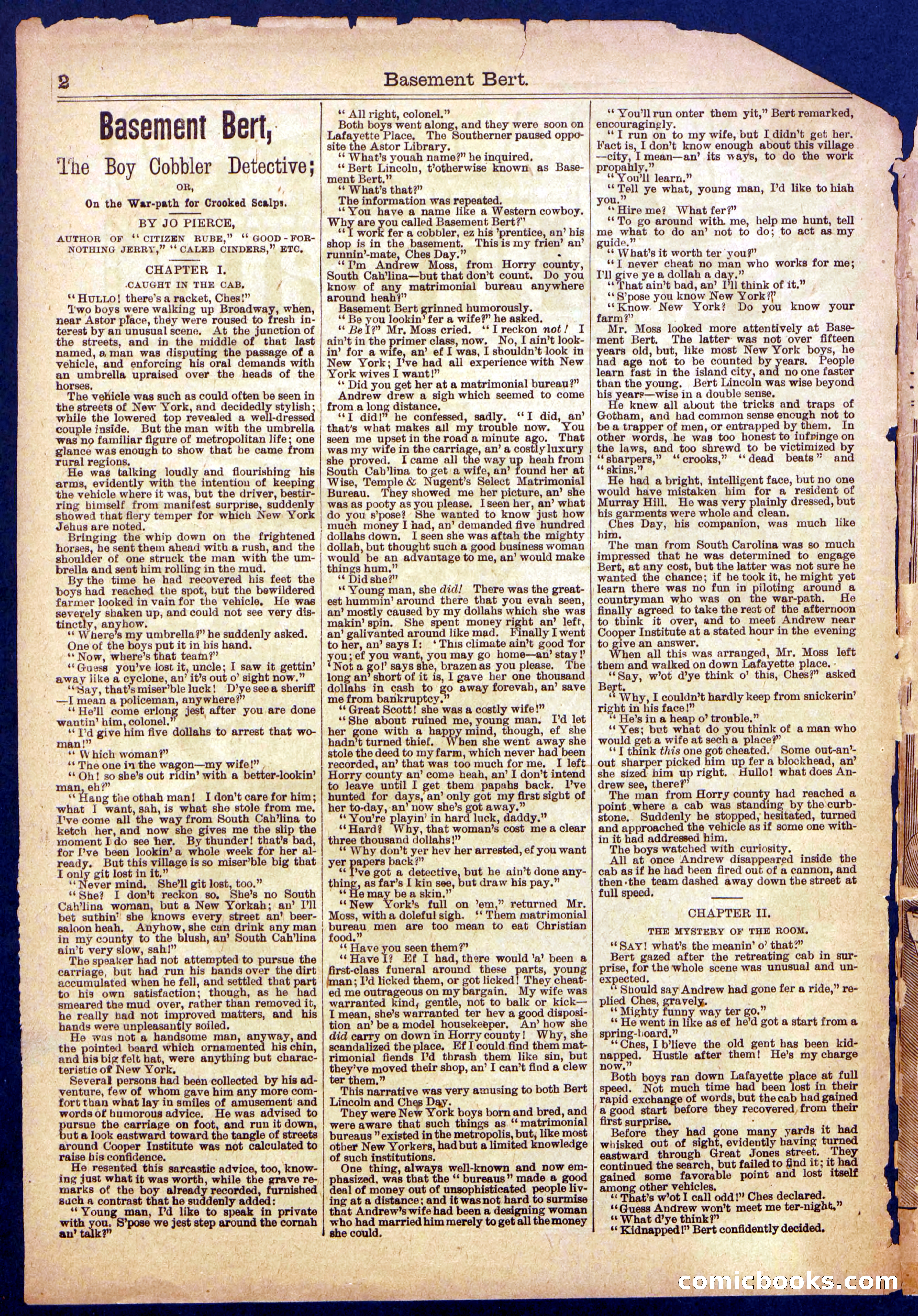
A restored page from Pulp Fiction, 1894. Page through the whole issue in the reader above.
📄 Transcribed text from this page (OCR, searchable)
Machine-transcribed from the original scan — historical spelling and the odd misread are preserved.
‘. ketch her, and now she gi » ynoment Ido see her, _ for ve been lookin’a whole week ready. But this village is so miser’ble big that | yer papers back?” __-with you, S’pose we jest step around the 2 ——— Basement Bert, ‘Lhe Boy Cobbler Detective; OR, / On the War-path for Crooked Scalps. BY JO PIERCE, AUTHOR OF ‘‘ CITIZEN RUBE,” ‘* GOOD - FOR- NOTHING JERRY,” ‘‘ CALEB CINDERS,” ETC, CHAPTER I. .CAUGHT IN THE CAB, / ‘* HULLO! there’s a racket, Ches!” ‘l'wo boys were walking up Broadway, when, near Astor place, they were roused to fresh in- terest by an unusual scene. At the junction of the streets, and in the middle of that last named, 9, man was disputing the passage of a vehicle, and enforcing his oral demands with an umbrella upraised over the heads of the horses, The vehicle was such as could often be seen in the streets of New York, and decidedly stylish ; while the lowered top revealed a well-dressed couple inside. But the man with the umbrella was no familiar figure of metropolitan life; one . glance was enough to show that he came from rural regions, He was talking loudly and flourishing his arms, evidently with the intention of keeping the vehicle where it was, but the driver, bestir- ring himself from manifest surprise, suddenly showed that flery temper for which New York Jehus are noted. | Bringing the whip down on the frightened horses, he sent them ahead with a rush, and the shoulder of one struck the man with the um- brella and sent him rolling in the mud, By the time he had recovered his feet the boys had reached the spot, but the bewildered farmer looked in vain for the vehicle, He was severely shaken up, and could not see very dis- tinctly, anyhow. ‘¢ W here’s my umbrella?” he suddenly asked. One of the boys put it in his hand. _** Now, where’s that team?” ‘‘Guess you've lost it, uncle; I saw it gettin’ ~ away like a cyclone, an’ it’s out o’ sight now.” ‘“Say, that’s miser’ble luck! D'ye see a sheriff —IJ mean a policeman, anywhere?’ ‘¢ He'll come erlong jest, after you are done wantin’ him, colonel.’ ; Id give him five dollahs to arrest that wo- n! ‘* W hich woman?” ‘‘ The one in the wagon—my wife!” ‘Oh! so she’s out ridin’ with a better-lookin’ man, eh?” rs Hang the othah man! I don’t care for him; what I want, sah, is what she stole from me, I've come all the way from South Cah’lina to ives me the slip the By thunder! that’s bad, for her al- I only git lost in it.” — ‘‘Never mind, She'll git lost, too.” ‘‘She? I don’t reckon so, She’s no South Cab’lina woman, but a New Yorkah; an’ [ll bet suthin’ she knows every street an’ beer- / Basement Bert. ** All right, colonel.” Both boys went along, and they were soon on Lafayette Place, The Southerner paused oppo- site the Astor Library. ‘* What’s youah name?” he inquired, ‘* Bert Lincoln, t’otherwise known, as Base- ment Bert,” ** What’s that?” The information was repeated. ‘*'You have a name like a Western cowboy. Mh are you called Basement Bert?” ‘*T work fer a cobbler, ez his ’prentice, an’ bis shop is in the basement. Thisis my frien’ an’ runnin’-mate, Ches Day.” . ‘‘1’m Andrew Moss, from. Horry county, South Cah’lina—but that don’t count. Do you know of any matrimonial bureau anywhere around heah?” Basement Bert grinned humorously. ‘¢ Be you lookin’ fer a wife?” he asked. ‘‘ Be I?’ Mr. Moss cried. ‘‘I reckon not/ I ain’t in the primer class, now. No, [ ain’t look- in’ for a wife, an’ ef I was, I shouldn’t look in New York; I’ve had all experience with New York wives I want!” ‘* Did you get her at a matrimonial bureau?” Andrew drew a sigh which seemed to come from a long distance. ‘‘T did!” he confessed, sadly. ‘‘I did, an’ that’s what makes all my trouble now. You seen me upset in the road a minute ago. That was my wife in the carriage, an’ a costly luxury she proved. Icame all the way up heah from South Cab’lina to get a wife, an’ found her at Wise, Temple & Nugent’s Select Matrimonial Bureau. They showed me her picture, an’ she was as pooty as you please, Iseen her, an’ what do you s’pose? She wanted to know just how much money I had, an’ demanded five hundred dollahs down, I seen she was aftah the mighty dollah, but thought such a good business woman would be an advantage to me, an’ would make things hum.” ** Did she?” ‘“'Young man, she did! There was the great- est hummin’ around there that you evah seen, an’ mostly caused by my dollahs which she was makin’ spin. She spent money ee an’ left, an’ galivanted around like mad. Finally I went to her, an’saysI: ‘This climate ain’t good for you, ef you want, you may go home—an’ stay!’ Nota go!’ says she, brazenas you please, The long an’ short of it is, 1 gave her one thousand dol in cash to go away forevah, an’ save me from bankruptcy.” ‘¢ Great Scott! she was a costly wife!” ‘‘She about ruined me, young man, I'd let her gone with a nappy mind, though, ef she hadn’t turned thief, hen she went away she stole the deed to my farm, which never had been recorded, an’ that was too much for me, I left Horry county an’ come heah, an’ I don’t intend to leave until I get them papahs back. I’ve hunted for days, an’ only got my first sight of her to-day, an’ now she’s got away.” ‘You're playin’ in hard luck, daddy.” ‘* Hard? hy, that woman’s cost me a clear three thousand dollahs!” ‘* Why don’t yer hev her arrested, ef you want 've got a detective, but he ain’t done any- thing, as far’s I kin see, but draw his pay.” ‘* He may be a skin.” ‘‘New York’s full on ’em,” returned Mr. Moss, witha doleful sigh. ‘‘ Them matrimonial saloon heah, Anyhow, she can drink any man | bureau. men are too mean to eat Christian in my county to the blush, an’ South Cah’lina ain’t very slow, sah!” J The speaker had not attempted to pursue the carriage, but had run his bands over the dirt accumulated when he fell, and settled that part to his own satisfaction; though, as he had smeared the mud over, rather than removed it, he really had not improved matters, and his hands were unpleasantly soiled. . He was not a handsome man, anyway; and the pointed beard which ornamen his chin, and his big felt hat, were anything but charac- teristic of New York, Several persons had been collected by his ad- venture, few of whom gave him any more com- fort than what lay in smiles of amusement and words of humorous advice. He was advised to Saige the carriage on foot, and run it down, ut a look eastward toward the t of streets Institute was not calculated to bis confidence. _ He resented this sarcastic advice, too, know- ing just what it was worth, while the grave re-. marks of the boy already rec such a contrast that he suddenly added: ‘* Young man, I'd like to speak in private around Cooper i ' ~-* . ~ = . a ‘ a ‘ * , 7 . ‘ 4 4 g - « : + ’ ~< -* i uf a. A : - ’ 474 ’ * “% ‘<a yo ' ; . >>» st j ‘ be : < a es Fe, Che. it a nee We — >. Fy —- - mS » + * : mat aT? % 4 Fa + esa ae pe . a Seay, TY .. * a . a yoy + : +2 f odie” ry “- , a 1, - Cw" ahd ial 6) iia ees - Nae orded, furnished | food.” ‘‘ Have you seen them?” ‘¢‘Have i? Ef I had, there would ’a’ been a rst-class funeral around these parts, young : I'd licked them, or got licked! They cheat- ed me outrageous on my bargain. My wife was warranted kind, gentle, not to balk or kick— I mean, she’s warranted ter hev a good disposi- tion an’ be a model housekeeper, An’ how she did carry on down in Horrycounty! Why, she scandalized the place. Ef I could find them mat- rimonial fiends I’d thrash them like sin, but they’ve moved their shop, an’ I can’t find a clew ter them.” This narrative was very amusing to both Bert Lincoln and Ches Day. : They were New York boys born and bred, and were aware that such things as. ‘“‘ matrimonial bureaus ” existed in the metropolis, but, like most other New Yorkers, had but a limited knowledge of such institutions. | One thing, always well-known and now em- phasized, was that the ‘‘ bureaus” ea deal of money out of unsophisticated people liv- ing at a distance; and it wasnot hard to surmise that Andrew’s wife D g woman ad who had married him merely to get all the money she could, learn there was no fun in pilot drew see, there?’ ‘* 'You'llrun onter them yit,” Bert remarked, encouragingly. ‘*T run on to my wife, but I didn’t get her. Fact is, 1 don’t know enough about this village . —city, Imean—an’ its ways, to do the work propahly,” ** You'll learn,” * Tell ye what, young man, Id like to hiah ou. ‘Hire me? What fer?” ‘*To go around with me, help me hunt, tell ° ps ig to do an’ not to do; to act as my uide. ‘¢ What’s it worth ter you?” ‘‘T never cheat no man who works for me; I'l) give ye a dollah a day.” ‘¢That ain’t bad, an’ I’ll think of it.” ‘*S’pose you know New York?) ‘‘Know. New York? Do you know your farm?” Mr. Moss looked more attentively at Base- ment Bert. The latter was not over fifteen years old, but, like most New York RORs he had age not to be counted by years. People learn fast in the island city, and no one faster than the young. Bert Lincoln was wise beyond bis years—wise in a double sense, e knew all about the tricks and traps of Gotham, and had common sense enough not to be a trapper of men, or entrapped by them. In other words, he was too honest to infringe on the laws, and too shrewd to be victimized by ‘‘sharpers,” ‘‘crooks,” ‘‘dead beats” and ‘* skins,” He had a bright, intelligent face, but no one would have mistaken him for a resident of Murray Hill. He was very py dressed, but his garments were whole and clean. nine Day, his companion, was much like im. The man from South Carolina was so much impressed that he was determined to engage Bert, at any cost, but the latter was not sure he wanted the chance; if he took it, he might yet ing around a countryman who was on the war-path. He finally agreed to take the rest of the afternoon to think it over, and to meet Andrew near Cooper Institute at a stated hour in the evening to give an answer, : , hen all this was arranged, Mr, Moss left them and walked on down Lafayette place. - “Say, wot d’ye think o’ this, Ches?” asked Bert. CWhy, I couldn’t hardly keep from snickerin’ right in his face!” ‘¢ He’s in a heap o’ trouble.” ‘‘VYes; but what do you think of aman who would get a wife at sech a place?” ‘‘T think this one got cheated. Some out-an’- out sharper picked him up fer a blockhead, an’ she sized him up right, . Hullo! what does An- The man from Horry county had reached a point where a cab was standing by the curb- stone. Suddenly he stopped, hesitated, turned and approached the vehicle as if some one with- in it had addressed him. , The boys watched witb curiosity. All at once Andrew disappeared inside the cab as if he had been fired out of a cannon, and then:-the team dashed away down the street at => full speed, CHAPTER II, THE MYSTERY OF THE ROOM, ‘Say! what’s the meanin'’o’ that?” Bert gazed after the retreating cab in sur- | prise, for the whole scene was unusual and un- — ‘* Should say Andrew had gone fer a ride,” re- — plied Ches, gravely. ‘* Mighty funny way ter go.” , ‘* He went in like as ef he’d got a start froma spring-loard,” ‘‘Ches, I b’lieve the old gent has been kid- - now,” Both boys ran down Lafayette Blac? at full 14 speed. Not much time had been lost in their — rapid exchange of words, but the cab had i a good start before they recovered, from | first surprise. Bey Before they had bs whisked out of sight, evidently having oe Aa, eastward through Great Jones street. — hex We: continued the search, but failed to find it; it 3 gained some favorable point and lost itself 4 among other vehicle “That's wot call odd!” Ches declared. = ‘Guess Andrew won't meet me ter-night,” ‘* What d’ye think?” | Matar sr htt o- ‘‘ Kidnapped!” Bert confidently decided, pas y & ‘ : ‘ 4 7 . - ~ a «, a i ie - one many yards it had ai