
Pulp Fiction, 1893 · page 5 of 16
Beadle's Half Dime Library, No. 841 — page 5: what you’re looking at
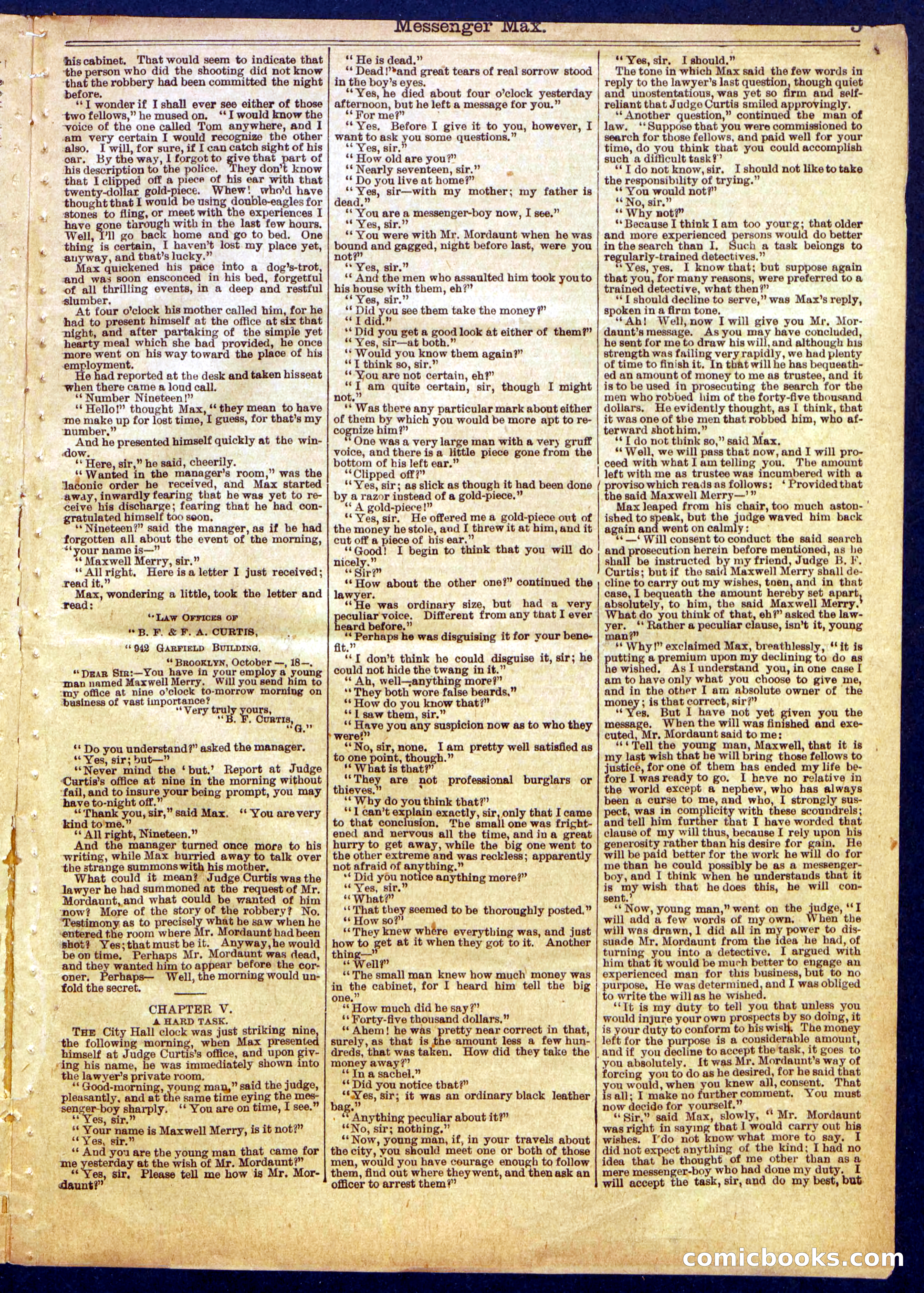
A restored page from Pulp Fiction, 1893. Page through the whole issue in the reader above.
📄 Transcribed text from this page (OCR, searchable)
Machine-transcribed from the original scan — historical spelling and the odd misread are preserved.
— ~- ie ase s ; re > F wy - ~" 4 Se _—— eee E > .) r ~ ? x. ai £- $5 é * sy -, » a mal | = ie i) Sr : ra at rt} 4 ry (pe . - ‘ i ‘me j - _. * And you are the young man. ty .- . - + ' ware det HE, this cabinet. That would seem to indicate that ‘the person who did the shooting did not know ‘that the robbery had been committed the night before. ‘¢T wonder if I shall ever see either of those two fellows,” he mused on, ‘‘I would know the ' -yoice of the one called Tom anywhere, and I am very certain I would recognize the other also, I will, for sure, if I can catch sight of his oar. By the way, Ll forgot to Hye that part of his description to the police. They don’t know that I clipped off a piece of his ear with that twenty-dollar gold-piece. Whew! who'd have thought that I would be using double-eagles for stones to fling, or meet with the experiences I have gone through with in the last few hours. Well, 1 go back home and go to bed. One thing is certain, I haven’t lost my place yet, auyway, and that’slucky.” | Max quickened his pace into a_ dog’s-trot, and was soon ensconced in his bed, forgetful of all thrilling events, in a deep and restful slumber, At four o’clock his mother called him, for he had to present himself at the office at six that night, and after partaking of the simple yet hearty meal which she had provided, he once more went on his way toward the place of his employment. e had reported at the desk and taken hisseat ~when there came a loud call. ‘* Number Nineteen!” ‘* Hello!” thought Max, ‘‘ they mean to have me make up for lost time, I guess, for that’s my “number,” : And he presented himself quickly at the win- dow. ‘‘ Here, sir,” he said, cheerily. ‘¢ Wanted in the manager’s room,” was the Yaéonic order he received, and Max started away, inwardly fearing that he was yet to re- ceive his discharge; fearing that he had con- gratulated himself too seon, ‘* Nineteen?” said the manager, as if he had forgotten all about the event of the morning, **vour name is—” ** Maxwell Merry, sir.” “Allright, Here isa letter I just received; read it,” Max, wondering a little, took the letter and Tead: to) of | Sakae Oxparanneey Om 7- © BOF & FA. CURTIS, ‘6942 GARFIELD BUILDING, ** BROOKLYN, October —, 18—. “Dear Str:—You have in your employ a young ‘man named Maxwell Merry. Will you send him to “my office at nine o’clock to-morrow mo ‘business of vast importance? ‘*Very truly yours, ; Ji “BB rigor e ‘* Do you understand?” asked the manager. _ Yes, sir; but—” ‘Never mind the ‘but.’ Report at Judge ‘Curtis’s office at nine in the morning without ‘fail, and to insure your being prompt, you may haveto-nightoff.” | “Thank you, sir,” said Max. ‘‘ You arevery “ All right, Nineteen.” Br And the manager turned once more to his writing, while Max hurried away to talk over ‘the strange summons with his mother, What could it mean? Judge Curtis was the lawyer he had summoned at the request of Mr. Mordaunt, and what could be wanted of him -# now? More of the story of the robbery? No, ‘Testimony as to precisely what he saw when he entered the Poona where r. Mordaunt had been ‘shot? Yes;that must be it. , be on the, Perhaps Mr, Mordaunt was dead, and they wanted him to appear before the cor- oner, Perhaps— Well, the morning would un- fold the secret. ; Aare CHAPTER V. SS BARD TASK. ad Oe ae Tue City Hall clock was just striking nine ‘the following morning, when Max presented himself at Judge Curtis's office, and upon giv- ving his name, he was immediately shown into the lawyer’s private room. pleasantly. e same time eying the ame is Maxwell Merry, is it not?” : ‘ se tell me how is Mr, Mor- ad : + . ’ ; ~4 Te > ee J ih. * os tee ok J o-tae 7, 2 7 . yt » ry At ‘ as b I ~ r . ae ‘ “5 SE ’ Palatic eens es Bede Fs ; * 5. te wet “A> wuss "a L ' “S zt “ ls io ,! o 4 aM on | Anyway,he would Good-morning, young man,” said the judge itl) and at the Metis mes- ir pf a ‘Anything peculiar about it?” — . ‘You are on time, I see.” came for vlessenger Max. ** He is dead,” ** Dead!’*and great tears of real sorrow stood in the boy’s eyes. **'Yes, he afternoon, but he left a message for you.” ‘* For me?” ** Yes, want to ask you some questions.” **'Yos, tir.” ** How old are you?” ‘* Nearly seventeen, sir.” ** Do you live at home?” ‘Yes, sir—with my mother; my father is dead,” ‘* You are a messenger-boy now, I see,” ** Yes, sir.” ‘‘ You were with Mr. Mordaunt when he was Birla and gagged, night before last, were you not ‘* Yes, sir.” ‘** And the men who assaulted him took you to his house with them, eh?” ‘* Yes, sir.” ‘** Did you see them take the money?” ce I di 7 ** Did you get a good look at either of them?” ** Yes, sir—at both.” ‘** Would you know them again?” ‘**T think so, sir.” ‘*-You are not certain, eh?” 4 I am quite certain, sir, though I might not. ‘* Was there any particular mark about either of them by which you would be more apt to re- cognize him?” **One was a very large man with a very gruff voice, and there is a little piece gone from the bottom of his left ear.” “Clipped off?” ied about four o’clock yesterday | and unostentatious, was yet so ! | reliant that Judge Curtis smiled approvingly. Before I give it to you, however, I | law. “Yes, sir, I should.” The tone in which Max said the few words in — reply to the lawyer’s last question, though quiet F firm and: salt ‘* Another question,” continued the man of ‘*Suppose that you were commissioned to search for those fellows, and paid well for your time, do you think that you could accomplish such a difficult task?’ ‘*T do not know, sir, I should not like to take the responsibility of trying.” *¢ You would not?” ** No, sir.” ‘* Why not?” ‘* Because I think Iam too yourg; that older and more experienced persons would do better in the search than I, Such a task belongs to regulariy-trained detectives.” Yes, yes. I know that; but suppose again that you, for many reasons, were preferred to a trained detective, what then?” ‘** If should decline to serve,’ was Max’s reply, spoken in a firm tone, ‘‘*Ah! Well, now I will give you Mr, Mor- daunt’s message. As you may have concluded, he sent for me to draw his will, and although his strength was er eh a we had plenty of time to finish it. In that will he has bequeath- ed an amount of money to me as trustee, and it is to be used in prosecuting the search for the men who robbed him of the forty-five thousand dollars. He evidently thought, as I think, that it was one of the men that robbed him, who af- terward shot him,” ‘ | ‘¢ fT do not think so,” said Max. ** Well, we will pass that now, and I will pro- ceed with what lam telling you. The amount left with me as trustee was incumbered with a ‘Yes, sir; as slick as though it had been done ( provisowhich readsas follows; ‘ Providedthat by a razor instead of a gold-piece, ** A gold-piece!” ; ‘Yes, sir. He offered mea gold-piece out of the money he stole, and [ threw it at him, and it cut off a piece of bis ear,” ‘‘Good! I begin to think that you will do nicely.” sé i Q ‘¢How about the other one?” continued the lawyer. ‘He was ordinary size, but had a_very eculiar voice. Different from any that I ever eard be ore,” r Perhaps he was disguising it for your bene- t ‘‘T don’t think he could disguise it, sir; he could not hide the twang in it.” ** Ah, well—anything more?” ‘*They both wore false beards,” ** How do you know that?” ‘* 1! saw them, sir.” | a Have you any suspicion now as to who they Ww ; ? **No, sir, none, Lam pretty well satisfied as to one point, though.” ‘* What is that?” ‘C They are not professional burglars or thieves.” Be | ‘* Why do you think that?” **1 can’t explain exactly, sir, only that I came to that conclusion, The small one was fright- i and nervous all the time, and ina great urry was reckless; apparentl not afraid of + al pete , thing.” ** Did you notice spe ehiod more?” ‘Yes, sir.” “What?” fs LS they seemed to be thoroughly posted.” ‘* How so?” ‘*'They knew whére everything was, and just how to get at it when they got toit. Another 6 Well?” “The small man knew how much money was . ‘in the cabinet, for I heard him tell the big _ * How much did he say?” ¥ -five thousand dollars,” ‘‘ Ahem! he was pretty near correct in that, surely, as that is dreds, that was take D186 nasa nel,” “Did you notice that?” a es, Sir; it was an ordinary black leather ow did they take the “No, sir; nothing.” ‘* Now, young man, if, in your travels about the city, you should meet one or both of those men, would you have courage enough to follow. them, find out where they went, and then ask an officer to arrest them?” — | ’ ' to get away, while the big one went to the other extreme and e amount less a few hun- 2h | forcing ; ’ Lj | will accept the task, -andif you decline to accept the ta he said Maxwell Merry—’” Max leaped from his chair, too much aston- ’ ished to speak, but the again and went on calm ‘+ _¢ Will consent to conduct the said search and prosecution herein before mentioned, as he shall be instructed by my friend, Judge B, F. Curtis; but if the said Maxwell Merry shall de- cline to carry out my wishes, toen, and in that case, I bequeath the amount hereby set apart, absolutely, to him, the said Maxwell Merry. What do you think of that, eh?” asked the law- yer. a Rather a peculiar clause, isn’t it, young né * ‘* Why!” exclaimed Max, breathlessly, ‘it is pan a premium upon my declining to do as e wished, AsI understand you, in one case I am to have only what you choose to give me, and in the other I am absolute owner of the money ; is that correct, sir?” ‘*Yes, But 1 have not yet given you the message, When the will was finished and exe- cuted, Mr, Mordaunt said to me; ‘** Tell the young man, Maxwell, that it is my last wish that he will bring those fellows to justice, for one of them has ended my life be- fore I was ready to go. I heve no relative in the world except a nephew, who has always been a curse to me, and who, I strongly sus- pect, was in ‘sae ia with these scoundrels; and tell him further that I have worded that clause of my will thus, because I rely upon h generosity rather than his desire for gain, He will be paid better for the work he will do for me than he could possibly be as a messenger- boy, and I think w is my wish that he does this, he will con- sent. ‘‘ Now, young man,” went on the judge, ‘I will add a few words of my own, When the will was drawn, 1 did all in my power to dis- suade Mr. Mordaunt from the idea he had, of turning you into a detective. I argued with him that it would be much better to engage an experienced man for this business, but to no judge waved him back y: purpose, He was determined, and I wasobliged _ tg that unless you _ 2 to write the willas he wished. ‘‘Tt is my duty to tell you | would injure your own prospects Hy is ty duty to conform to his wis left for the so doing, it ie ee f goes be ou absolutely. It was Mr. Mordaunt’s way 0 4 on to do as he desired, for he said eat ou would, when you knew all,consent, That sall; I make no further comment, You now decide for yourself.” bes St i Max, was right in sayin wishes. Ido ire iow What more to say, did not expect anything of the kind; I had idea that he thought of me mere messenger-boy who ha done my duty. I sir, and do my best, bu . : tau n he understands that it . f must an » a eS Niet | slowly, “‘ Mr. Mordaunt that | would carry out ba aie nO a Saye Wee Sheek 3 : mi! ° Affe . are ye a oo aa Themoney = urpose is a considerable amount, — LP i