
Pulp Fiction, 1893 · page 2 of 16
Beadle's Half Dime Library, No. 841 — page 2: what you’re looking at
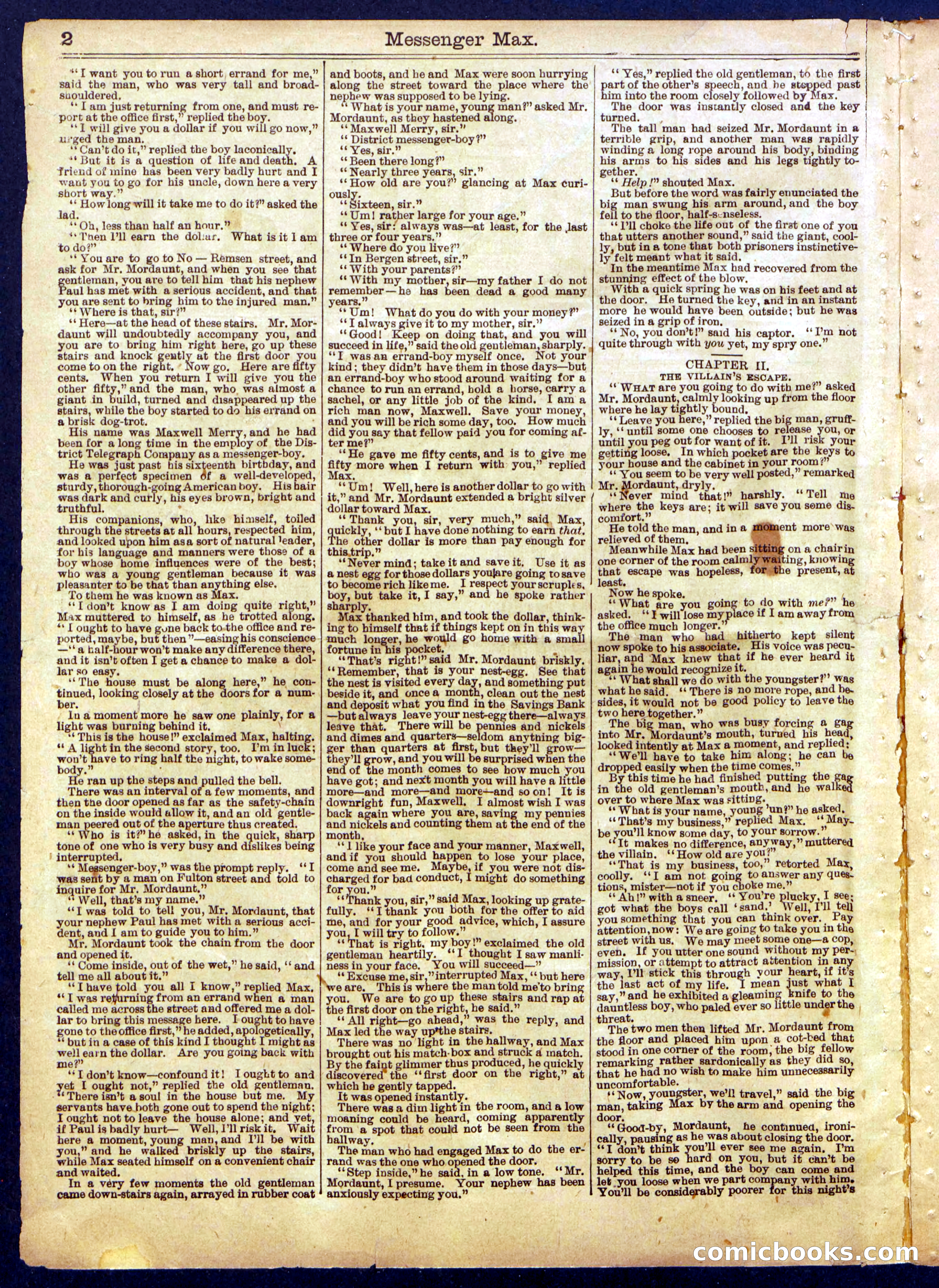
A restored page from Pulp Fiction, 1893. Page through the whole issue in the reader above.
📄 Transcribed text from this page (OCR, searchable)
Machine-transcribed from the original scan — historical spelling and the odd misread are preserved.
2 ———— = —— **T want you torun ashort, errand for me,” said the man, who was very tall and broad- suouldered, ‘*l am just returning from one, and must re- port at the office first,” replied the boy. ‘*T will give you a dollar if you will go now,” urged the man, ‘*Can’t doit,” replied the boy laconically, ** But it is a question of life and death. A Triend of mine has been very badly hurt and I waut you to go for his uncle, down here a very short way.” ‘* How long will it take me to do it?” asked the q ‘*Oh, less than half an hour,” — ‘*T‘nen ll earn the doliar. What is it 1 am to do?” | ‘*You are to go to No — Remsen street, and ask for Mr. Mordaunt, and when you see that agar papepte you are to tell him that his nephew aul has met with a serious accident, and that you are sent to bring him to the injured man.” ‘¢ Where is that, sir?” ** Here—at the head of these stairs. Mr, Mor- daunt will undoubtedly accompany you, and you are to bring him right here, go up these stairs and knock Ospie at the first door you come to on the right. Now go, Here are fifty cents, When you return I will give you the other fifty,” and the man, who was almost a giant in build, turned and disappeared up the stairs, while the boy started to do his errand on a brisk dog-trot. ' His name was Maxwell Merry, and he had been for along time in the employ of the Dis- trict Telegraph COMEDY as a messenger-boy. He was just past his sixteenth birtbday, and was a perfect specimen 6f a well-developed, sturdy, apes cr gs Americanboy. His hair was dark and curly, his eyes brown, bright and truthful. . His companions, who, hke himself, toiled through the streets at all hours, respected him, and looked upon him asa sort of natural leader, for his language and manners were those of a boy whose home influences were of the best; who was a young gentleman because it was pleasanter to be that than anything else. To them he was known as Max. | ‘TT don’t know as I am doing quite right,” Max muttered to himself, as he trotted along. ** [ ought to have gune back to.the office and re- —‘‘a half-hour won’t make any difference there, and it isn’t often I get a chance to make a dol- lar 80 easy. . ‘The house must be alon pada looking closely at the er. - Ina moment more he saw one plainly, for a light was burning behind it, ' ‘This is the house!” exclaimed Max, halting. ‘‘ A light in the second story, too. I’m in luck; Mei ht ve to ring half tke night, to wake some- ody. He ran up the steps and pulled the bell. There was an interval of a few moments, and then the door opened as far as the safety-chain on the inside would allow it, and an old gentle- man apeeree out of the aperture thus created. ‘‘ Who is it?’?he asked,in the quick, sharp tone of one who is very busy and dislikes being interrupted, oi qgeenger- poy, | was the promptreply. ‘‘I was serit b here,” he con- y a man on Fulton street and told to inquire for Mr. Mordaunt.” * Well, that’s my name.” “‘T was told to tell you, Mr, Mordaunt, that your nephew Paul has met with a serious acci- cent and [ am to guide you to him.” . Mordaunt took the chain from the door and opened it. ‘¢ Come inside, out of the wet,” he said, ‘‘ and tell me all about it.” | ‘‘T have told you all I know,” replied Max, ‘*T was returning from an errand when a man called me across the street and offered me a dol- lar to bring this message here. Lought to have gone to the office first,” he added, apologetically, ‘* but in a case of this kind I thought I might as well earn the dollar. Are you going back with ‘*T don’t know—confound it! Iougktto and yet [ ought not,” replied the old gentleman, -“*There isn’t a soul in the house but me. My servants have both gone out to spend the night; I ought not to leave the house alone; and yet, if Paulis badly burt— Well, l'llriskit, Wait here a moment, young man, and I'll be with you,” and he wa riskly up the stairs, while Max seated himself on a convenient chair In a véry few moments the old gentleman came down-stairs again yed in rubber |, arrayed coat ported, maybe, but then ”’—easing his conscience; much ]. oors for a num-. ‘discovere Messenger Max. and boots, and he and Max were soon hurrying | along the street toward the place where the | part of the other’s nephew was supposed to be lying. ‘* What is your name, young man?” asked Mr. Mordaunt, as they hastened along. ‘* Maxwell Merry, sir.” ‘* District messenger-boy?” ‘Yes, sir.” ‘** Been there long?” ‘‘ Nearly three years, sir.” ‘How old are you?” glancing at Max ¢uri- ously. .s Si xtaca sir.” “Um! rather large for your age.” “* Yes, sir: always was—at least, for the Jast three or four years,” ** Where do you live?” ‘*In Bergen street, sir.” ‘* With your parents?” ** With my mother, sir—my father I do not remember — he has been dead a good many ears. ‘*Um! What do you do with your money?” ‘*T always give it to my mother, sir.” ‘Good! Keep on doing that, and you will succeed in life,” said the old gentleman, sharply. ‘‘T was an errand-boy myself once, Not your kind; they didn’t have them in those days—but an errand-boy who stood around waiting for a chance to run an errand, bold a horse, carry a sachel, or any little job of the kind. [Tama rich man now, Maxwell. Save your money, and you will be rich some day, too. How much did you say that fellow paid you for coming af- ter me?” . ‘‘He gave me fifty cents, and is to give me aitty more when I return with you,” replied ax. ‘*Um! Well, here is another dollar to go with it,” and Mr. Mordaunt extended a bright silver dollar toward Max. , ‘‘Thank you, sir, very much,” said, Max, que ‘but I have done nothing to earn that, he other dollar is more than pay enough for this.trip.” ‘Never mind; take it and saveit, Use it as a nest egg for those dollars youfare going tosave to become rich like me. I respect yourscruples, boy, but take it, I say,” an sharply. Max t unked him, and took the dollar, think- ing to lf that if things kept on in pape hn nger, he would go home with a sm: fortune in his pocket, — = “That's right!” said Mr. Mordaunt briskly. ‘*Remember, that is your nest-egg. See that the nest is visited every day, and something put beside it, and once a month, clean out the nest and deposit what you find in the Savings Bank —butalways leave your nest-egg there—always leave that. There will be pennies and nickels and dimes and quarters—seldom anything big- ger than quarters at first, but they'll grow— they’ll grow, and you rised when the end of the month comes to see how much you have got; and next month you will have a little more—and more—and more+-and soon! It is downright fun, Maxwell, I almost wish I was back again where you are, sav my pennies and ne els and counting them at the end of the month, ‘*] like your face and your manner, Maxwell, and if you should happen to lose your place, come and seeme. Maybe, if you were not dis- charged for bad conduct, I might do something for Me e ‘Thank you, sir,” said Max, looking up grate- fully. ‘*I thank you both for the offer to aid me, and for your good advice, which, I assure you, I wiil try to follow. ‘That is right, my boy!” exclaimed the old gentleman heartily. ‘‘I thought I saw manii- ness in your face, You will succeed—” ‘Excuse me, sir,” interrupted Max, ‘‘ but here eare. This is where the man told me'to bring ou. We are to goup these stairs and rap at he first door on the right, he said.” All eigtite-e0 ahead,” was the reply, and Max led the way up’the stairs. There was no light in the hallway, and Max brought out his match-box and struck 4 match. By the faint glimmer thus produced, he quickly Fi the faree door on the right,” at which he gently tapped. It was opened instantly. There was a dim light in the room, and a low moaning could be heard, coming apparently om ‘a spot that could not be seen from the way. The nan who had engaged Max to do the er- rand was the one who opened the door. ‘Step inside,” he said, in a lowtone. ‘‘ Mr. he spoke rather Mordaunt, I presume. Your nephew has been anxiously expecting you.” = 7 what hesaid, ‘ There is no more rope, and let you loose when we part company with h ‘** Yes,” replied the old gentleman, to the first «me and he stepped past him into the room closely followed by Max. The door was instantly closed and the key | turned. ! The tall man had seized Mr. Mordaunt in a | terrible grip, and another man was rapidly | winding a long rope around his body, binding his arms to his sides and his legs tightly to- gether. ‘** Help !” shouted Max. But before the word was fairly enunciated the big man swung his arm around, and the boy fell to the floor, half-s-nseless. 7 ‘* 1°l] choke the life out of the firat one of you u that utters another sound,” said the giant, cool- | ly, but in a tone that both prisoners instinctive- ly felt meant what it said. RY In the meantime Max had recovered from the stunning effect of the blow, With a quick spring he was on his feet and at the door. He turned the key, and in an instant more he would have been outside; but he was seized in a grip of iron, ‘** No, you don’t!” said his captor. ‘‘I’m not quite through with you yet, my spry one.” CHAPTER II. THE VILLAIN’S ESCAPE. ‘© WHAT are you going to do with me?” asked | Mr. Mordaunt, calmly looking up from the floor : where he lay tightly bound, ts ‘¢ Leave you here,” replied the big man, gruff- | ly, ‘‘ until some one chooses to release you, or until you peg out for want of it. Vl risk your | getting loose, In which pocket are the keys to your house and the cabinet in your room q”? ome ‘You seem to be very well posted,” remarked Mr. aimee dryly. . ; ‘‘Never mind that!” harshly. ‘Tell me where the keys are; it will save you some dis- miort.” | He told the man, and in a relieved of them, Meanwhile Max had been one corner of the room calm that escape was hopeless, ae ee a4 ent more’ Was on a chairin ing, knowi e present, a 1g a k ow ' A ‘“ What a ‘you going to do with me?” he asked, ‘*¥ will lose my place if I am away from Ae the office much longer.’ The man who | liar, ad Max knew ’ Max kne again he would recogni . en What shall we do with the youngster?” wae cS sides, it would not be good policy to leave the two here together.” | The big man, who was busy forcing a ga into Mr. Mordaunt’s mouth, turned his head, . looked intently at Max a moment, and replied; scored have to aye rm afoug:; he can be Pp easily when the time Comes, oo Spm time he had finished putting the fee in the old gentleman’s mouth, and he wa over to where Max was sittiDg. | ‘What is your name, young 'un?” he asked, ‘‘That’s my business,” replied Max, ‘‘ May- be you'll know some day, to your sorrow.’ **It makes no difference, anyway,” muttered the villain. ‘‘ How old are you? “That is my business, too,” retorted Max, coolly. ‘‘I am not going to 40swer any (ués~ tions, mister—not if you choke me.” : ‘‘ Ah!” with asneer, ‘* You're plucky, I see; got what the boys call ‘sand.’ Well, I'll tel} you something that you can think over. Pay attention,now: Weare going to take you in the ’ street with us. We may meet some one—a Cop, even. If you utter one sound without my per-) mission, or attempt to attract attention in an way, lll stick this through your heart, if it's the last act of my life, I mean just what I say,” and he exhibited a gleaming knife to the dauntiless boy, who paled ever so little maeige the | The two men then lifted Mr. Mordaunt from the floor and placed him upon a cot-bed that stood in one corner of the room, the big fellow remarking rather sardonically as they did so, that he had no wish to make him unnecessarily uncomfortable. , ‘Now, youngever, we'll travel,” said the big | man, taking Max by thearm and opening the door. ‘‘Good-by, Mordaunt, hitherto kept silent pis voice was pecu- at if he ever heard it 7 he continued, ironi- g as he was about closing the door. oT Mont think youl ever see me again, [Tm sorry to be so hard on you, but it can’t be helped this time, and the . ~ Ss ae 4 , _=s ° , ‘* : . : a ‘ ’ . fst » 0 = < es; 2 wt ere a). eat ‘ ’ ms . * A a8 . y _ 4 ; | | _ y \ 1ICDOOKS.CONn Se , > fb wn : | ‘ , Ly \ a dan om