
Pulp Fiction, 1879 · page 3 of 16
Beadle's Half Dime Library, No. 81 — page 3: what you’re looking at
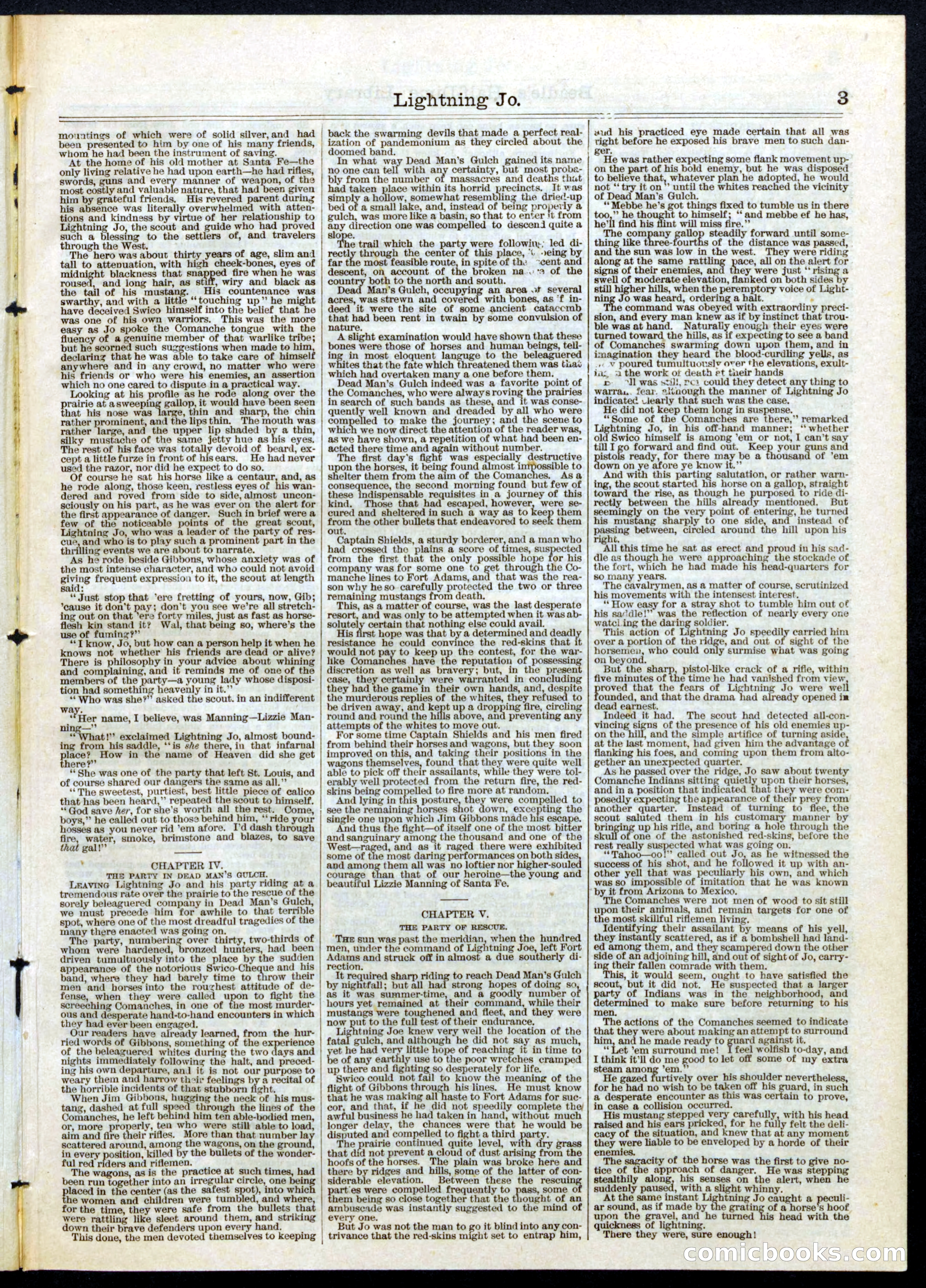
A restored page from Pulp Fiction, 1879. Page through the whole issue in the reader above.
📄 Transcribed text from this page (OCR, searchable)
Machine-transcribed from the original scan — historical spelling and the odd misread are preserved.
—— mountings of which were of solid silver,and had been presented to him by one of his many friends, whom he had been the instrument of saving. At the home of his old mother at Santa Fe—the only living relative he had upon earth—he had rifles, swords, guns and every manner of weapon, of the most costly and valuable nature, that had n given him by grateful friends. His revered parent during his absence was literally overwhelmed with atten- tions and kindness by virtue of her relationship to Lightning Jo, the scout and guide who had proved such a blessing to the settlers of, and travelers through the West. The hero was about thirty years of age, slim and tall to attenuation, with high cheek-bones, eyes of midnight blackness that snap fire when he was rou and long hair, as stiff, wiry and black as the tail of his mustang. His countenance was swarthy, and with a little “touching up” he might have deceived Swico himself into the belief that he was one of his own warriors. This was the more easy as Jo spoke the Comanche tongue with the fluency of a genuine member of that warlike tribe; but he scorned such pt Se teem when made to him declaring that he was able to take care of himself anywhere and in any crowd, no matter who were his friends or who were his enemies, an assertion which no one cared to dispute in a practical way. Looking at his profile as he rode along over the rairie at SEWeoDing EGROP, it would have been seen that his nose was , thin and sharp, the chin rather prominent, and the lips thin. The mouth was rather 1 and the upper lip shaded a: a thin, silky mustache of the same jetty hue as his eyes. The rest of his face was totally devoid of beard, ex- cept a little furze in front of hisears. He had never used the razor, nor did he expect to do so. Of course he sat his horse like a centaur, and, as he rode along, those keen, restless eyes of his wan- dered and roved from side to side, almost uncon- sciously on his part, as he was ever on the alert for the first appearance of danger. Such in brief were a few of the noticeable points of the great scout, Lightning Jo, who was a leader of the party of res- cue, and who is to play such a prominent part in the thrilling events we are about to narrate. As he rode beside Gibbons, whose anxiety was of the most intense character, and who could not avoid giving frequent expression to it, the scout at length sa . “ Just stop that ‘ere fretting of yours, now, Gib; ‘cause it don’t pay; don’t you see we're all stretch- ing out on that ‘ere forty miles, just as fast as horse- flesh kin stand it? Wal, that being so, where’s the use of fuming?” ““T know, Jo, but how can a person help it when he knows not whether his friends are dead or alive? There is philosophy in your advice about whining and complaining, and it reminds me of one of the members of the party—a young lady whose disposi- tion had something heavenly in it.” Py. ‘Who was she?’ asked the scout. in an indifferent way. my Her name, I believe, was Manning—Lizzie Man- ni “What!” exclaimed Lightning Jo, almost bound- ing from his saddle, ‘‘is she there, in that infarnal wee How in the name of Heaven did she get ere ‘*She was one of the party that left St. Louis, and of course shared our dangers the same as all.”’ ‘‘The sweetest, purtiest, best little piece of calico that has been heard,”’ repeated the scout to himself. ‘God save Her, for she’s worth all the rest. Come, boys,” he called out to those behind him, “ride your hosses as you never rid ’em afore. I'd dash through fire, water, smoke, brimstone and blazes, to save that gal!”’ . CHAPTER IV. THE PARTY IN DEAD MAN’S GULCH. Leaving Lightning Jo and his party riding at a tremendous rate over the prairie to the rescue of the sorely beleaguered company in Dead Man’s Gulch, we must precede him for awhile to that terrible spot, where one of the most dreadful tragedies of the many there enacted was going on. The party, numbering over thirty, two-thirds of whom were hardened, bronzed hunters, had been driven tumultuously into the place by the sudden appearance of the notorious Swico-Cheque and_ his band, where they had barely time to throw their men and horses into the rouchest attitude of de- fense, when they were called upon to fight the screeching Comanches, in one of the most murder- ous and desperate hand-to-hand encounters in which they had ever been engaged. Our readers have already learned, from the hur- ried words of Gibbons, something of the experience of the beleaguered whites during the two days and nights immediately following the halt, and preced- ing his own departure, and it is not our purpose to weary them and harrow their feelings by a recital of the horrible incidents of that stubborn fight. When Jim Gibbons, hugging the neck of his mus- tang, dashed at full s through the lines of the Comanches, he left behind him ten able-bodied men, or, more properly, ten who were still able to load, aim and fire their rifles. More than that number la scattered around, among the wagons, on the ground, in every position, killed by the bullets of the wonder- ful red riders and riflemen. The wagons, as is the practice at such times, had been run together into an irregular circle, one pase in the center (as the safest spot), into whic @ women and children were tumbled, and where, for the time, they were safe from the bullets that were ratt like sleet around them, and striking down their brave defenders upon every hand. This done, the men devoted themselves to keeping | trivance that the red-skins Lightning Jo. A = = 3 | back the swarming devils that made a perfect real- | wud his practiced eye made certain that all was | | | | ee EL LLL LL LLL LLL sss ization of pandemonium as they circled about the doomed band. In what way Dead Man’s Gulch gained its name no one can tell with any certainty, but most probe- bly from the number of massacres and deaths that had taken place within its horrid precincts. It was simply a hollow, somewhat resembling the driec-up bed of a small lake, and, instead of being properly a gulch, was more like a basin, so that to enter 't from any direction one was compelled to desceni quite a slope. the trail which the ty were followin;; led di- rectly through the center of this place, . »eing by far the most feasible route, in spite of the descent, on account of the broken na... ‘2 of the country both to the north and south. Dead Man’s Gulch, giao a an area of several acres, was strewn and cove with bones, as ‘f in- deed it were the site of some ancient cataccmb that had been rent in twain by some convulsion of nature. A slight examination would have shown that these bones were those of horses and human beings, tell- ing. in most eloquent languge to the beleaguered whites that the fate which threatened them was tia which had overtaken many a one before them. Dead Man’s Gulch indeed was a favorite point of the Comanches, who were always roving the prairies in search of such bands as these, and it was conse- quently well known and dreaded by all who were compelled to make the journey; and the scene to which we now direct the attention of the reader was, as we have shown, a repetition of what had been en- acted there time and again without number. The first day's fight was especially destructive upon the horses, it being found almost intpossible to shelter them from the aim of the Comanches. Asa consequence, the second morning found but few of these indispensable requisites in a journey of this kind. Those that had escaped, however, were se- cured and sheltered in such a way as to keep them from the other bullets that endeavored to seek them out. Captain Shields, a sturdy borderer, and a man who had crossed the plains a score of times, suspected from the first that the only possible hope for his company was for some one to get through the Co- manche lines to Fort Adams, and that was the rea- son why he so carefully protected the two or three remaining mustangs from death, This, as a matter of course, was the last desperate resort, and was only to be attempted when it was ab- solutely certain that nothing else could avail. His frat hope was that by a determined and dead] resistance he could convince the red-skins that it would not pay to keep up the contest, for the war- like Comanches have the reputation of possessi discretion as well as bravery; but, in the presen case, they certainly were warranted in concluding they had the game in their own hands, and, despite the murderous replies of the whites, they ref to be driven away, and kept up a dropping fire, circling round and round the above, and preventing any attempts of the whites to move out. For some time Captain Shields and his men fired from behind their horses and wagons, but they soon improved on this, and taking their positions in the wagons themselves, found that they were quite well able to pick off their assailants, while they were tol- erably well protected from the return fire, the red- skins being compelled to fire more at random. And lying in this posture, they were compelled to see the remaining horses shot down, exce ting the single one upon which Jim Gibbons made his escape. And thus the fight—of itself one of the most bitter and sanguinary among the thousand and one of the Sr att-engen and as it raged there were exhibited some of the most daring performances on both sides and among them all was no loftier nor higher-souled courage t that of our heroine—the young an beautiful Lizzie Manning of Santa Fe. CHAPTER V. THE PARTY OF RESCUE. ‘Tue sun was past the meridian, when the hundred men, under the command of Lightning Joe, left Fort a and struck off in almost a due southerly di- rection. It required sharp riding to reach Dead Man’s Gulch by nightfall; but all strong hopes of doing so as it was summer-time, and a goodly number o hours yet remained at their command, while their mustangs were Spgnenes and fleet, and they were now put to the full test of their endurance, Lig tning Joe knew very well the location of the fatal gulch, and although he did not say as much, ‘et he had very little hope of reaching it in time to of any eart y use to the poor wretches cramped up there and fighting so desperately for life. Swico could not fail to know the meaning of the flight of Gibbons through his lines. He must know that he was making all haste to Fort Adams for suc- cor, and that, if he did not speedily complete the awful business he had taken in hand, without much longer delay, the chances were that he would be disputed and compelled to fight a third pexty: The prairie continued quite level, with dry grass that did not prevent a cloud of dust arising from the hoofs of the horses. The plain was broke here and there by ridges and hills, some of the latter of con- siderable elevation. Between these the perkee were compelled frequently to , some oO hem being so close together that the thought of an ambuscade was instantly suggested to the mind of every one. But Jo was not the man to go it blind into any con- might set to entrap him, p some of right before he exposed his brave men to such dan- ger. He was rather expecting some flank movement up- on the part of his bold enemy, but he was disposed to believe that, whatever plan he adopted, he would not “ try it on’’ until the whites reached the vicinity of Dead Man’s Gulch. **Mebbe he’s got things fixed to tumble us in there too,” he thought to himself; “‘ and mebbe ef he has, he'll find his flint will miss fire.” The company ane: ype ge wl forward until some- thing like t -fourths of the distance was passed, and the sun was low in the west. along at the same ratt ace, all on the alert for signs of their enemies, and they were just “rising a swell of moderate elevation, flanked on both sides by still en hills, when the peremptory voice of Light- ca 3 o was heard, ordering a halt. > e command was obeyed with extraordiny preci- sion, and every man knew as if by instinct that trou- ble was at hand. Naturally enough their eyes were turned toward the hills, as if expecting to see a band of Comanches swarming down upon them, and in imagination they heard the blood-curdling yells, as . v poured tumultuouslv over the elevations, exult- jac, a the work of death et their hands pm Il was stil!, rc: could they detect any thing to walra... fear. sttnough the manner of Lightning Jo indicatec vlearly that such was the case. He did not keep them long in suspense. “Some of the Comanches are there,’ remarked ree Jo, in his off-hand manner; ‘“ whether old Swico himself is among ‘em or not, I can't say till I go forward and find out. Keep your s and pete ready, for there may be a thousand of ‘em own on ye afore ye know it.”’ They were riding And with this parting salutation, or rather warn- ing, the scout started his horse on a gallop, straight toward the rise, as though he purposed to ride di- rectly between the hills already mentioned. But seemingly on the very point of entering, he turned his mustang sharply to one side, and instead of passing between, circled around the hill upon his t All this time he sat as erect and proud in his sad- dle as though he were approaching the stockade of the fort, which he had made his head-quarters for so many years. The cavalrymen, as a matter of course, scrutinized his movements with the intensest interest. “How easy for a stray shot to tumble him out of his sacdle!’’ was the reflection of nearly every one watcl ing the daring soldier. This action of Lightning Jo speedily carried him over a portion of the ridge, and out of sight of the horsemen, who could only surmise what was going on beyond. But the pri: pistol-like crack of a rifle, within five minutes of the time he had vanished from view roved that the fears of Lightning Jo were well ounded, and that the drama had already opened in dead earnest. Indeed it had. The scout had detected all-con- vincing signs of the presence of his old enemies up- on the hill, and the simple artifice of turning aside at the last moment, had given him the advantage of flanking his foes, and coming upon them from alto- gether an unexpected quarter. As he ed over the ridge, Jo saw about twenty Comanche Indians sitting quietly upon their horses, and in a position that indicated that they were com- posedly expecting the appearance of their prey from another quarter. Instead of turning to flee, the scout saluted them in his customary manner by bb oe up his rifle, and boring a hole through the of one of the astonished red-skins, before the rest really s cted what was going on. ‘‘Tahoo—oo!” called out Jo, as he witnessed the success of his shot, and he followed it up with an- other yell that was peculiarly his own, and which was so impossible of imitation that he was known by it from Arizona to Mexico. The Comanches were not men of wood to sit still upon their animals, and remain targets for one of the most skillful riflemen living. Identifying their assailant by means of his yell, they instantly scattered, as if a bombshell had land- ed among them, and they scampered down the other side of an adjoining hill, and out of sight of Jo, carry- ing their fallen comrade with them. , it would seem, ought to have satisfied the scout, but it did not. He suspected that a larger y of Indians was in the neighborhood, and etermined to make sure before returning to his men. The actions of the Comanches seemed to indicate that they were about making an attempt to surround him, and he made ready to yay against it. “Let ’em surround me! I feel wolfish to-day, and I think it*ll do me good to let off some of my extra oo amo sine his ahould re e gazed ively over his shoulder nevertheless, for he had no wish to be taken off his rd, in such a desperate encounter as this was certain to prove, in case a collision occurred. His mustang stepped very carefully, with his head raised and his ears pricked, for he fully felt the deli- cacy of the situation, and knew that at any moment a liable to be enveloped by a horde of their enemies. The sagacity of the horse was the first to give no- tice of the approach of danger. He was stepping stealthily along, his senses on the alert, when he suddenly pa , With a slight whinny. At the same instant ma Seta, Jo caught a peculi- ar sound, as if made by the grating of a horse’s hoof upon the gravel, and he turned his head with the quickness of lightning. There they were, sure enough! com IOOKS (S