
Pulp Fiction, 1879 · page 10 of 16
Beadle's Half Dime Library, No. 81 — page 10: what you’re looking at
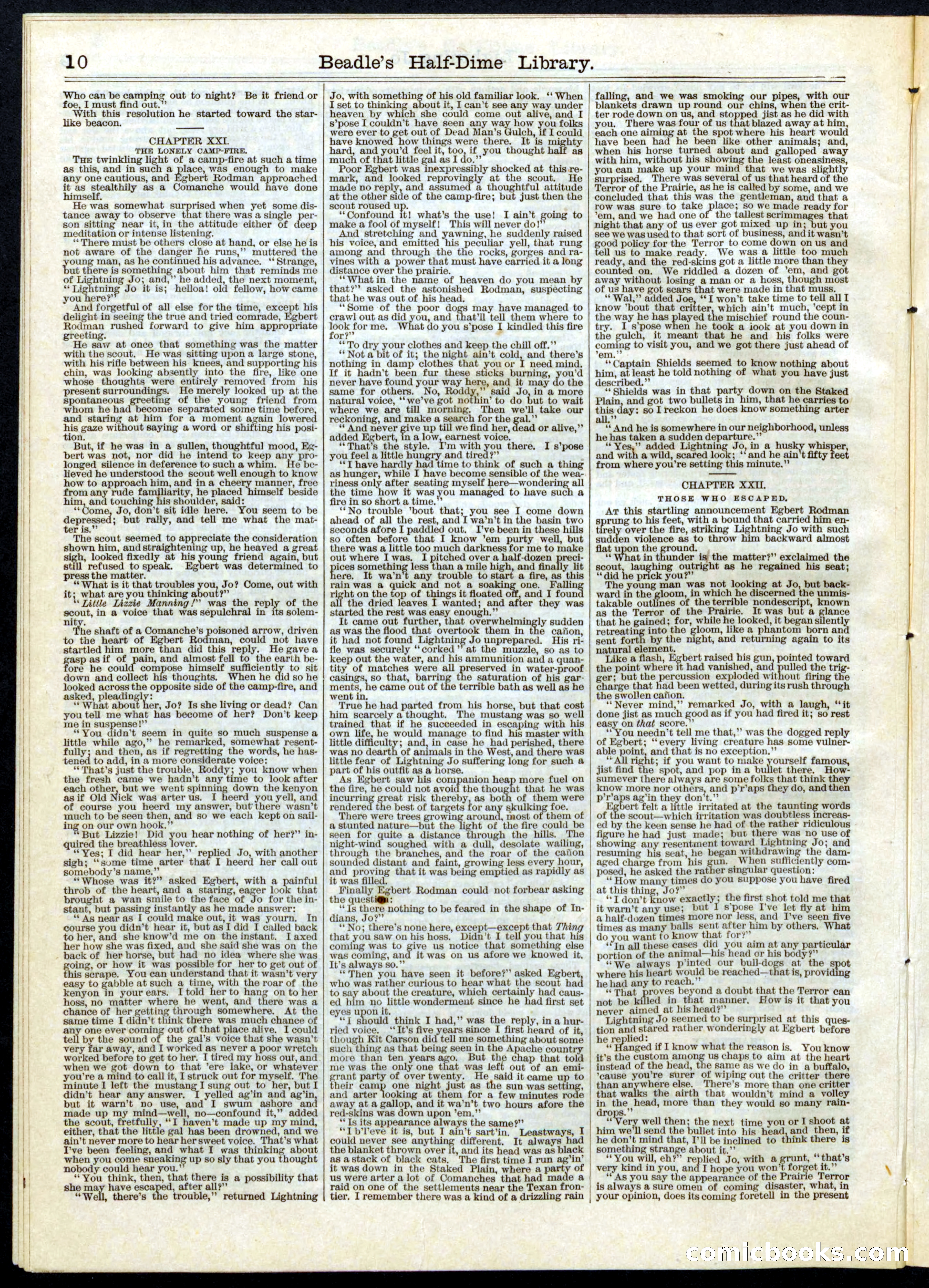
A restored page from Pulp Fiction, 1879. Page through the whole issue in the reader above.
📄 Transcribed text from this page (OCR, searchable)
Machine-transcribed from the original scan — historical spelling and the odd misread are preserved.
10 Who can be camping out to night? Be it friend or foe, I must find out.”’ With this resolution he started toward the star- like beacon. CHAPTER XX. THE LONELY CAMP-FIRE, Tue twinkling light of a camp-fire at such a time as this, and in such a Bsn was enough to make any one cautious, and Egbert Rodman approached it as stealthily as a Comanche would have done himself. He was somewhat aT abe when yet some dis- tance away to observe that there was a single per- son sitting near it, in the attitude either of deep meditation or intense listening. ‘There must be others close at hand, or else he is not aware of the danger he runs,”’ muttered the oung man, as he continued his advance. ‘ Strange, but there is something about him that reminds me of Lightning Jo; and,”’ he added, the next moment, * Li itning Jo it is; helloa! old fellow, how came you here?’ And forgetful of all else for the time, except his delight in seeing the true and tried comrade, Egbert Rodman rushed forward to give him appropriate greeting. He saw at once that something was the matter with the scout. He was sitting upon a large stone, with his rifle between his knees, and supporting his chin, was looking absently into the fire, like one whose thoughts were entirely removed from his present surroundings. He merely looked up at the spontaneous greeting of the young friend from whom he had become separated some time before, and staring at him for a moment again lowered a gaze without saying a word or shifting his posi- on. But, if he was in a sullen, thoughtful mood, Eg- bert was not, nor did he intend to keep any pro- longed silence in deference to such a whim. He be- lieved he understood the scout well enough to know how to approach him, and in a cheery manner, free from any rude familiarity, he placed self beside him, and touching shoulder, said: ‘‘Yome Jo, don’t sit idle here. You seem to be depressed; but rally, and tell me what the mat- +. a The scout seemed to appreciate the consideration shown him, and straightening up, he heaved a great sigh, looked fixedly at his young friend again, but still refused tospeak. Egbert was determined to press the matter. ‘What is it that troubles you, Jo? Come, out with of the it; what are you thinking a ut?” ‘Little Lizzie Manning /” was the repl scout, in a voice that was sepulchral in its solem- nity. The shaft of a Comanche’s poisoned arrow, driven to the heart of Egbert man, could not have startled him more than did this reply. He gavea asp asif of pain, and almost fell the earth be- ore he could compose himself sufficiently to sit down and collect thoughts. When he did so he looked across the opposite side of the camp-fire, and asked, eye en, gh ‘* What about her, Jo? Is she living or dead? Can you tell me what has become of her? Don’t keep me in suspense!” “You didn’t seem in quite so much suspense a little while ago,” he remarked, somewhat resent- fully; and then, as if regretting the words, he has- tened to add, in a more considerate voice: ‘*That’s just the trouble, Roddy; you know when the fresh came we hadn’t any time to look after each other, but we went oe down the kenyon as if Old Nick was arter us. I heerd you yell, and of course you heerd my answer, but there wasn’t much to be seen then, and so we each kept on sail- ing on our own hook.” ‘But Lizzie! Did you hear nothing of her?’ in- quired the breathless lover. “Yes; I did hear her,’ replied Jo, with another sigh; “some time arter that I heerd her call out somebody’s name,” “Whose was it?” asked Egbert, with a painful throb of the heart, and a staring, eager look that brought a wan smile to the face of Jo for the in- stant, but passing instantly as he made answer: ** As near as I could make out, it was yourn. In course you didn’t hear it, but as I did I called back to her, and she know’d me on the instant. I axed her how she was fixed, and she said she was on the . back of her horse, but had no idea where she was oing, or how it was possible for her to get out of is scrape. You can understand that it wasn’t very easy to gabble at such a time, with the roar of the kenyon in yourears. I told her to hang on to her hoss, no matter where he went, and there was a chance of her gotting through somewhere. At the same time I didn’t think there was much chance of ref one ever coming out of that place alive. I could tell by the sound o very far away, and I worked as never a poor wretch worked before to get to her. I tired my hoss out, and when we got down to that ere lake, or whatever you're a mind to call it, I struck out for myself. The minute I left the ab songs Me sung out to her, but I didn’t hear any answer. I yelled ag’in and ag’in but it warn’t po use, and I swum ashore an made up my mind—well, no—confound it,” added the scout, fretfully, “I haven’t made up my mind, either, that the little gal has been drowned, and we ain’t never more to hear her sweet voice. That’s what I've been feeling, and what I was thinking about when you come sneaking up so sly that you thought nobody could hear you.’ ‘You think, then, that pt e a possibility that she may have ig os after “Well, there’s the trouble,” returned Lightning the gal’s voice that she wasn't | Jo, with something of his old familiar look. ‘‘ When I set to thinking about it, I can’t see any way under heaven by which she could come out alive, and I s’pose I couldn’t have seen any a. how you folks were ever to get out of Dead Man’s Gulch, if I could have knowed how things were there. It is mighty hard, and you’d feel it, too, if you thought half as much of that little gal as I do.” Poor Egbert was inexpressibly shocked at this re- mark, and looked reprovingly at the scout. He made no reply, and assumed a thoughtful attitude at the other side of the camp-fire; but just then the scout roused up. ‘‘Confound it! what’s the use! I ain’t going to make a fool of myself! This will never do!’ And stretching and yawning, he suddenly raised his voice, and emitted his peculiar yell, that rung among and through the the rocks, gorges and ra- vines with a power that must have carried it a long distance over the prairie. **Whatin the name of heaven do you mean by that?” asked the astonished Rodman, suspecting that he was out of his head. ‘*Some of the poor dogs may have managed to crawl out as did you, and that’ll tell them where to a for me, at do you s’pose I kindled this fire or?”’ ‘To dry your clothes and keep the chill off.” ** Not a bit of it; the night ain’t cold, and there’s nothing in damp clothes that you or I need mind, If it hadn’t been fur these sticks burning, you'd never have found your way here, and it may do the same for others. No, ey. said Jo, in a more natural voice, ‘‘we’ve got nothin’ to do but to wait where we are till morning. Then we'll reckoning, and make a search for the gal.”’ ** And never give up till we find her, dead or alive,”’ added Egbert, n a low, earnest voice, ‘*That’s the style. I’m with you there. I s’pose you feel a little hungry and tired?” ‘*T have hardly had time to think of such a thing as hunger, while I have become sensible of the wea- riness only after seating myself here—wondering all the time how it was you managed to have such a fire in so short a time.” ‘*No trouble "bout that; you see I come down ahead of all the rest, and I wa’n’tin the basin two seconds afore I paddled out. I’ve been in these hills so often before that I know ’em purty well, but there was a little too much darkness for me to make out where I was. I pitched over a half-dozen preci- pow something less than a mile high, and ly lit ere. It wa’n'’t any trouble to start a fire, as this rain was a quick and not a ary one. _ | ht on the top of t s it floated off, and I foun the dried leaves I wanted; and after they was started the rest was easy enough.” It came out further, that overwh ly sudden as was the flood that overtook them in the caijion, it had not found Lightning Jo unprepared. His ri- fle was securely “corked ’’ at the muzzle, so as to keep out the water, and his ammunition and a quan- tity of matches were all preserved in water-proof casings, so that, Legis | the saturation of his gar- ee he came out of the terrible bath as well as he went in. True he had parted from his horse, but that cost him searcely a thought. The mustang was so well trained that if he succeeded in escaping with his own life, he would manage to find his master with little difficult ; and, in case he had perished, there was no dearth of animals in the West, and there was little fear of Lightning Jo suffering long for such a part of his outfit as a horse. As Egbert saw his ore YT hea the fire, he could not avoid the thought that he was incurrin oo risk thereby, as both of them were rendered the best of targets for | skulking foe. There were trees growing around, most of them of a stunted nature—but the Tight of the fire could be seen for quite a distance through the hills. The night-wind soughed with a dull, desolate wailing, through the branches, and the roar of the cafhon sounded distant and faint, growing less every hour, and proving that it was being emptied as rapidly as it was filled. Finally Egbert Rodman could not forbear asking the questi@: “Is there nothing to be feared in the shape of In- dians, Jo?”’ ** No; there’s none here, a ae that Thing that you saw on his hoss, Didn't I tell you that his coming was to give us notice that something else was coming, and it was on us afore we knowed it. It’s always so.”’ “Then you have seen it before?’ asked Egbert who was rather curious to hear what the scout had to say about the creature, which certainly had caus- ed him no little wonderment since he had first set eyes upon it. *“ should think I had,’ was the reply, in a hur- ried voice. ‘It’s five years since I first heard of it, though Kit Carson did tell me something about some such thing as that being seen in the manana country more than ten yearsago. But the chap that told me was the only one that was left out of an emi- grant party of over twenty. He said it came up to their camp one night just as the sun was setting, and arter looking at them for a few minutes e away at a gallop, and it wa’n’t two hours afore the red-skins was down upon ’em,”’ ‘Is its appearance always the same?” “I b’l'eve it is, but I ain’t sart’in. Leastways, I could never see anything different. It always had the blanket thrown over it, and its head was as black as astack of black cats. The first time I run ag’in’ it was down in the Staked Plain, where a party of us were arter a lot of Comanches that had ea raid on one of the settlements near the Texan fron- tier. I remember there was a kind of a drizzling rain take our more fuel on Beadle’s Half-Dime Library. — falling, and we was smoking our pipes, with our blankets drawn up round our chins, when the crit- ter rode down on us, and er Sa jist as he did with you, There was four of us that blazed away at him, each one aiming at the spot where his heart would have been had he been like other animals; and, when his horse turned about and galloped away with him, without his showing the least oneasiness, you can make up your mind that we was slightly surprised. There was several of us that heard of the Terror of the Prairie, as he is called by some, and we concluded that this was the gentleman, and that a row was sure to take place; so we made ready for ‘em, and we had one of the tallest scrimmages that night that any of us ever got mixed up in; but you see we was used to that sort of business, and it wasn’t Sood policy for the Terror to come down on us and ell us to make ready. We was a little too much ready, and the red-skins got a little more than they counted on. We riddled a dozen of ’em, and got away without losing a man or a hoss, though most of us have got scars that were made in that muss. “Wal,” added Joe, **I won’t take time to tell all I know ‘bout that critter, which ain’t much, ’cept in the way he has played the mischief round the coun- try. I s’pose when he took a iook at you down in the gulch, it meant that he and his folks were coming to visit you, and we got there just ahead of *em.”’ ‘Captain Shields seemed to know nothing about him, at least he told nothing of what you have just described.” ‘Shields was in that party down on the Staked Plain, and got two bullets in him, that he carries to this day: so Lreckon he does know something arter ‘* And he is somewhere in our neighborhood, unless he has taken a sudden departure.” “ Yes,"’ added on. og yn J 0, in a husky pS and with a wild, scared look; ‘‘and he ain't fifty feet from where you're setting this minute.” CHAPTER XXII, THOSE WHO ESCAPED, At this startling announcement Egbert Rodman sprung to his feet, with a bound that carried him en- tirely over the fire, striking Lightning Jo with such endden violence as to throw him backward almost flat upon the ground. . a t in thunder is the matter?’’ exclaimed the scout, laughing outright as he regained his seat; “did he prick you?” The young man was not looking at Jo, but back- ward in the gloom, in which he ed the unmis- takable outlines of the terrible copes ming le ae known as the Terror of the Prairie. It was but a glance that he gained; for, while he looked, it began silently retreating into the gloom, like a phantom born and sent forth by the night, and returning again to its natural element. Like a flash, Egbert raised his gun, pointed toward the point where it had vanished, and pulled the trig- ger; but the percussion exploded without firing the charge that had been wetted, during its rush through the swollen cafion. ‘‘Never mind,’’ remarked Jo, with a laugh, “it done jist as much good as if you had fired it; so rest easy on that score.” ‘You needn't tell me that,’’ was the dogged reply of Egbert; “‘every living creature has some vulner- able point, and that is no exception.” ** All rig ht; if you want to make yourself famous, jist find the spot, and pop ina bullet there. How- sumever there always are some folks that think they know more nor others, and p’r’aps they do, and then = ag’in they don’t.” Egbert felt a little irritated at the taunting words of the scout—which irritation was doubtless increas- ed by the keen sense he had of the rather ridiculous figure he had just made; but there was no use of showing any resentment toward Lightning Jo; and resuming his seat, he began withdrawing the dam- aged charge from his fe When sufficiently com- posed, he asked the rather singular question: “ How many times do you suppose you have fired at this thing, Jo?” **T don’t Chon exactly; the first shot told me that it warn’t any use; but I s’pose I’ve let fly at him a half-dozen times more nor less, and I’ve seen five times as many balls sent after him by others. What do you want to know that for?” ‘“Tn all these cases did you aim at any particular portion of the animal—his head or his body?” ‘We always pinted our her = at the t where his heart would be reached—that is, providing he had any to reach.” “That proves beyond a doubt that the Terror can not be killed in that manner, How is it that you never aimed at his head?” Lightning Jo seemed to be surprised at this ques- tion and stared rather wonderingly at Egbert before he a “Hanged if I know what the reason is. You know it’s the custom among us chaps to aim at the heart instead of the head, the same as we do in a buffalo, ‘cause you're surer of wiping out the critter there than anywhere else. There’s more than one critter that w the airth that wouldn't mind a volley in the head, more than they would so many rain- drops.’ Ne well then; the next time you or I shoot at him we'll send the bullet into his head, and then, if he don’t mind that, I'll be inclined to think there is something strange about it.”’ ‘You will, eh?’ replied Jo, with a nt, “‘ that’s very kind in you, and I hope you won't forget it.” ‘* As you say the appearance of the Prairie Terror is always a sure omen of coming disaster, what, in your opinion, does its coming foretell in the present S <€om (E} O00) (E(0)