
Pulp Fiction, 1877 · page 6 of 16
Beadle's Half Dime Library, No. 8 — page 6: what you’re looking at
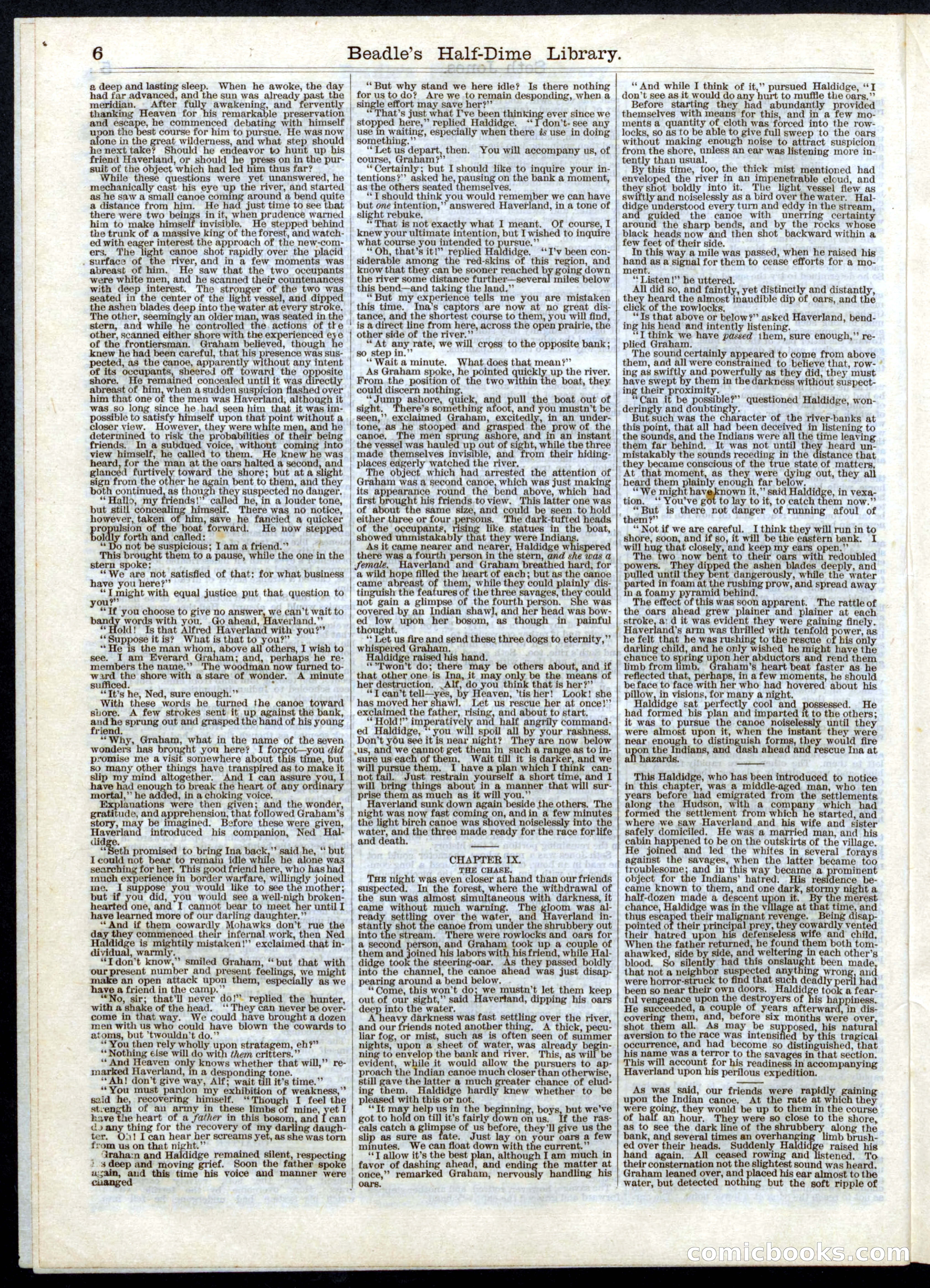
A restored page from Pulp Fiction, 1877. Page through the whole issue in the reader above.
📄 Transcribed text from this page (OCR, searchable)
Machine-transcribed from the original scan — historical spelling and the odd misread are preserved.
A A ET A A - ~_—_— oo - . > — a 6 | | Beadle’s Half-Dime Library. ea deep and lasting sleep. When he awoke, the day | had far advanced, and the sun was already past the | forustodo? Are we to remain desponding, when a meridian. _ After ty. awakening, and fervently thankmg Heaven for his remarkable preservation and escape, he commenced debating with himself upon the best course for him to pursue. He was now one in the great wilderness, and what step should he next take? Should he endeavor to hunt up his friend Haverland, or should he press on in the pur- | suit of the object which had led him thus far? While these questions were yet unanswered, he mechanically cast his eye up the river, and started as he saw a small canoe coming around a bend quite a distance from him. He had just time to see that there were two beings in it, when prudence warned him to make himself invisible. eé stepped behind the trunk of a massive king of the forest, and watch- ed with eager interest the approach of the new-com- ers. The light canoe shot rapidly over the placid . surface of the river, and in a few moments was abreast of him. He saw that the two occupants were white men, and he scanned their countenances with deep interest. The stronger of the two was seated in the center of the light vessel, and dip the ashen blades deep into the water at every stroke, The other, peo 5 an older tr was seated in the stern, and while he controlled the actions of tre other, scanned either shore with the i PF on ee of the frontiersman. Graham believed, though he knew he had been careful, that his presence was sus- pected, as the canoe, apparently without any intent of its occupants, sheered off toward the opposite shore. He remained concealed until it was directly abreast of him, when a sudden suspicion flashed over him that one of the men was Haverland, although it was so long since he had seen him that it was im- possible to satisfy himself upon that point without a closer view. However, they were white men, and he determined to risk the probabilities of their being friends. In a subdued voice, without coming into view himself, he called to them. He knew he was heard, for the man at the oars halted a second, and glanced ary toward the shore; but at a slight sign from the other he again bent to them, and they both continued, as though they suspected no danger, “Hallo, my friends!” call he, in a louder tone, but still Oo a himself. There was no notice, however, taken of him, save he fancied a quicker gh ong of the boat forward. He now stepped oldly forth and called: “Do not be suspicious; I am a friend.” : This brought them to a pause, while the one in the stern spoke; “We are not satisfied of that: for what business have you here?” ~ alent with equal justice put that question to ou ? “Tf you choose to give no answer, we can’t wait to bandy words with you. Go ahead, Haverland.” “Hold! Is that Alfred Haverland with you?” ‘*Suppose itis? What is that to you?” “He is the man whom, above all others, I wish to see. I am Everard Graham; and, Dernpe he re- members the name.” The woodman now turned to- ward the shore with a stare of wonder. A minute sufficed. ““Tt’s he, Ned, sure enough.” With these words he turned the canoe toward shore. A few strokes sent it up against the bank, oe sprung out and grasped the hand of his young r e . “Why, Graham, what in the name of the seven wonders has gd? you here? I forgot—you did promise me a visit somewhere about this time, but so many other things have transpired as to make it slip my mind altogether. And I can assure you, I have had enough to break the heart of any ordinary mortal,’ he added, in a choking voice. Explanations were then given; and the wonder, gratitude, and apprehension, that followed Graham’s story, may be imagined. Before these were given, Haverland introduced his companion, Ned Hal- didge. “Beth promised to bring Ina back,” said he, ‘‘ but I could not bear to remain idle while he alone was searching for her, This good friend here, who has had much experience in border warfare, willingly joined me. I suppose you would like to see the mother; but if you did, you would see a well-nigh broken- hearted one, and I cannot bear to meet her until I have learned more of our darling daughter,” “And if them cowardly Mohawks don’t rue the day they commenced their infernal work, then Ned ae is htily mistaken!’’ exclaimed that in- dividual, w y. — ee “oe = haar, “but that with our present number and present feelings, we ht make an open attack upon them, especially i have a friend in the camp.” “*No, sir; that'll never do!” replied the hunter, with a shake of the head. ‘*‘ They can never be over- come in that way. We could have brought a dozen men with us who could have blown the cowards to atoms, but ‘twouldn’t do.” “You then rely wholly upon stratagem, eh?” “Nothing else will do with ‘hem critters.” “And Heaven only knows whether that will,’’ re- marked Haverland, in a despon tone. “Ah! don't give way, Alf; wait it’s time.” ““You must pardon my exhibition of weakness,”’ said he, recovering himself. “Though I feel the stven of an army in these limbs of mine, yet I have the heart of a father in this bosom, and I can cd» any thing for the recovery of = | d daugh- ter. O14! I can hear her screams yet, as she was torn from us on that night.” _ Graha:n and Haldidge remained silent, respec : sdeep and moving grief. Soon the father spoke Sieaved”* this time his voice and manner were Oe ee eee tone, as he stooped and grasped t SS ee ——_— | tentions?’’ asked he, pausi “But why stand we here idle? Is there nothing single effort may save her?”’ “That’s just what I’ve been thinking ever since we stopped here,” replied Haldidge. ‘I don't-see any use in waiting, especially when there és use in doing something.”’ ** Let us depart, then. You will accompany us, of course, Graham?” “Certainly; but I should like to inquire your in- on the bank a moment, as the others seated themselves. ‘I should think you would remember we can have but one intention,”’ answered Haverland, in a tone of slight rebuke, ‘That is not exactly what I meant. Of course, I knew your ultimate intention, but I wished to inquire what course you intended to pursue,”’ ‘** Oh, that’s it!” replied Haldidge. ‘‘I’v been con- siderable among the red-skins of this region, and know that they can be sooner reached by going down the river some distance further—several miles below this bend—and taking the land.”’ * But my experience tells me you are mistaken this time. Ina’s captors are now at no great dis- tance, and the shortest course to them, you will find, is a direct line from here, across the open prairie, the other side of the river.” “At any rate, we will cross to the opposite bank; so step in.”’ “Wait a minute. What does that mean?” As Graham spoke, he pointed Sea up the river. From the position of the two within the boat, they could discern nothing. “Jump ashore, quick, and pull the boat out of sight. There’s something afoot, and you mustn't be seen,’’ exclaimed Graham, ree. in an under- e prow of the canoe, The men sprung ashore, and in an instant the vessel was hauled up out of sight, while the three made themselves invisible, and from their hiding- places eagerly watched the river, The object which had arrested the attention of Graham was a second canoe, which was just makin its appearance round the bend above, which h first brought his friends.to view. This latter one was of about the same size, and could be seen to hold either three or four persons. The dark-tufted heads of the occupants, rising like statues in the boat, showed unmistakably that they were Indians. As it came nearer and nearer, Haldidge w red there was a f person in the stern, and she was a Jemale. Haverland and Graham breathed hard, for a wild hope filled the heart of each; but as the canoe came abreast OF them, while they could plainly dis- tinguish the features of the three savages, ee could not gain a glimpse of the fourth person. She was covered by an Indian shawl, and her head was bow- - tid upon her bosom, as though in painful thought. ‘* Let us fire and send these three dogs to eternity,” Graham Went ; Haldidge raised his hand. “°Twon't do; there may be others about, and if that other one is Ina, it may only be means of her destruction, .Alf, do you think that is her?’’ “T can’t tell—yes, by Heaven, *tis her! Look! she has moved her shawl. Let us rescue her at once!’ exclaimed the father, rising, and about to start. “Hold!” imperativel and half angrily command- ed Haldidge, *‘ you will spoil all by your rashness. Don't you see it is near night? They are now below us, and we cannot get them in such a range as to in- sure us each of them, Wait till it is darker, and we will pursue them. I have a plan which I think can- not fail. Just restrain yourself a short time, and I will bring things about in a manner that will sur- prise them as much as it will you.”’ Haverland sunk down again de the others. The night was now fast coming on, andin a few minutes the light birch canoe was shoved noiselessly into the water, and the three made ready for the race for life _ and death. | suspec | ' : | | _ out of our sight,” said CHAPTER IX. THE CHASE. THE night was even closer at hand than our friends In the forest, where the withdrawal of the sun was almost simultaneous with darkness, it came without much warning. The gloom was al- ready settling over the water, and Haverland in- stantly shot the canoe from under the shrubbery out into the There were rowlocks and oars for a second person, and G took up a couple of them and joined his labors with his friend, while Hal- didge took the steering-oar. they passed boldly into the channel, the canoe ahead was just disap- pearing around a bend below. “Come, this won't do; we mustn't let them keep Havertand, dipping his oars _ deep into the water. | ' ting | _—_ a A I te AT TT OL LLL LEA LLL LE LI SS A ae darkness was fast settling over the river, and our friends noted another thing, A thick, pecu- liar fog, or mist, such as is often seen of summer nights, upon a sheet of water, was already begin- to envelop the bank and river. This, as be evident, while it would allow the pursuers to ap- proach the Indian canoe much closer than otherwise, still gave the latter a much greater chance of elud- ing them. Haldidge hardly knew whether to be pleased with this or not. ‘It may help us in the ry gest boys, but we’ve got to hold on till it’s fairly down on us. If the ras- cals catch a glimpse of us before, they'll give us the = as sure as fate. Just lay on your oars a few minutes. We can float down with the current.” ‘*T allow it’s the best ag: although Iam much in favor of dashing ahead, and ane the matter at once,” remarked Graham, nervously handling his oars. ——_ — —<— ——__—.<== ‘*And while I think of it,’ pursued Haldidge, “I don’t see as it would do any hurt to muffle the oars,” Before starting they had abundantly provided themselves with means for this, and in a few mo- ments a quantity of cloth was forced into the row- locks, so as to be able to give full sweep to the oars without making enough noise to attract suspicion from the shore, unless an ear was listening more in- tently than usual, ; By this time, too, the thick mist mentioned had enveloped the river in an impenetrable cloud, and they shot boldly into it. The light vessel flew as swiftly and noiselessly as a bird over the water. Hal- didge understood every turn and eddy in the stream, and guided the canoe with unerring certainty around the sharp bends, and by the rocks whose black heads now and then shot backward within a few feet of their side. In this way a mile was passed, when he raised his —_ as a Signal for them to cease efforts for a mo- ment. ** Listen!” he uttered. All did so, and faintly, yet distinctly and distantly, they heard the almost inaudible dip of oars, and the click of the rowlocks, “Is that above or below?” asked Haverland, bend- ing his head and intently listening. ‘I think we have passed them, sure enough,” re- plied Graham. The sound certainly appeared to come from above them, and all were constrained to believe that, row- ing as perittly and power as they did, they must have swept by them in the darkness without suspect- ing their proximity. “Can it be possible?’ questioned Haldidge, won- deringly and ‘gt oan oF But such was the character of the river-banks at this point, that all had been deceived in listening to the sounds, and the Indians were all the time leaving them far behind. It was not until they heard un- mistakably the sounds ig ag in the distance that they became conscious of the true state of matters, At that moment, as they were dying out, they all heard them plainly enough far below. “We might haveknown it,” said Haldidge, in vexa- tion. ‘* You've got to lay to it, to catch them now.” * But is there not danger of running afoul of them?” ‘“ Not if we are careful. I think they will run in to shore, soon, and if so, it will be the eastern bank. I will hug that closely, and keep my ears open.” The two now bent to their oars with redoubled powers. They dipped the ashen blades deeply, and pulled until they bent dangerously, while the water ey in foam at the rushing prow, and spread away na foamy pyramid behind. The effect of this was soon apparent. The rattle of the oars ahead grew plainer and plainer at each stroke, a: d it was evident they were gaining finely. Haverland’s arm was thrilled with tenfold power, as he felt pe he was rushing to the rescue of his only darling d, and he only wished he might have the chance to spring upon her abductors and rend them limb from limb. Graham’s heart beat faster as he reflected that, nr A in a few moments, he should be face to face with her who had hovered about his pillow, in visions, for many a night. Haldidge sat perfectly cool and possessed. He had formed his plan and imparted it to the others; it was to pursue the canoe noiselessly until they were almost upon it, when the instant they were near enough to distingnien forms, they would fire pees ie Lae and dash ahead and rescue Ina at This Haldidge, who has been introduced to notice in this chapter, was a middle-aged man, who ten years before had e ated from the settlements along the Hudson, with a company which had formed the settlement from which he started, and where we saw Haverland and his wife and sister safely domiciled. He was a married man, and his cabin happened to be on the outskirts of the village. He joined and led the whites in several forays against the savages, when the latter became too troublesome; and in this way became a prominent object for the Indians’ hatred. dence be- came known to them, and one dark, stormy night a half-dozen made a descent upon it. By the merest chance, Haldidge was in the v e at that time, and thus escaped their malignant revenge. Being disap- inted of their principal prey, they cowardly vented heir hatred upon defenseless wife and child, When the father returned, he found them both tom- ahawked, side by side, and weltering in each other’s blood. So silently had this apeeeety ap been made that not a neighbor suspected anything wrong, and were horror-struck to find that such deadly peril had been so near their own doors. ger took a fear- ful v ce upon the destroyers of his happiness. He succeeded, a ig of years afterward, in dis- covering them, and, before six months were over shot them all. As may be supposed, his natural aversion to the race was intensified by this tragical occurrence, and had become so distinguished, that his name was a terror to the savages in that section. This will account for his readiness in accompanying Haverland upon his perilous expedition. As was said, our friends were rapidly gaining upon the Indian canoe, At the rate at which they were going, they would be up to them in the course of half an hour. They were so close to the shore, as to see the dark line of the shrubbery along the bank, and several times an nica oe Fr limb brush- ed over their heads. Suddenly Haldidge raised his hand again, All ceased rowing and listened. To their consternation not the slightest sound was heard. Graham leaned over, and placed his ear almost to the water, but detected nothing but the soft ripple of EomiIcboo