
Pulp Fiction, 1879 · page 4 of 16
Beadle's Half Dime Library, Vol. III, No. 78 — page 4: what you’re looking at
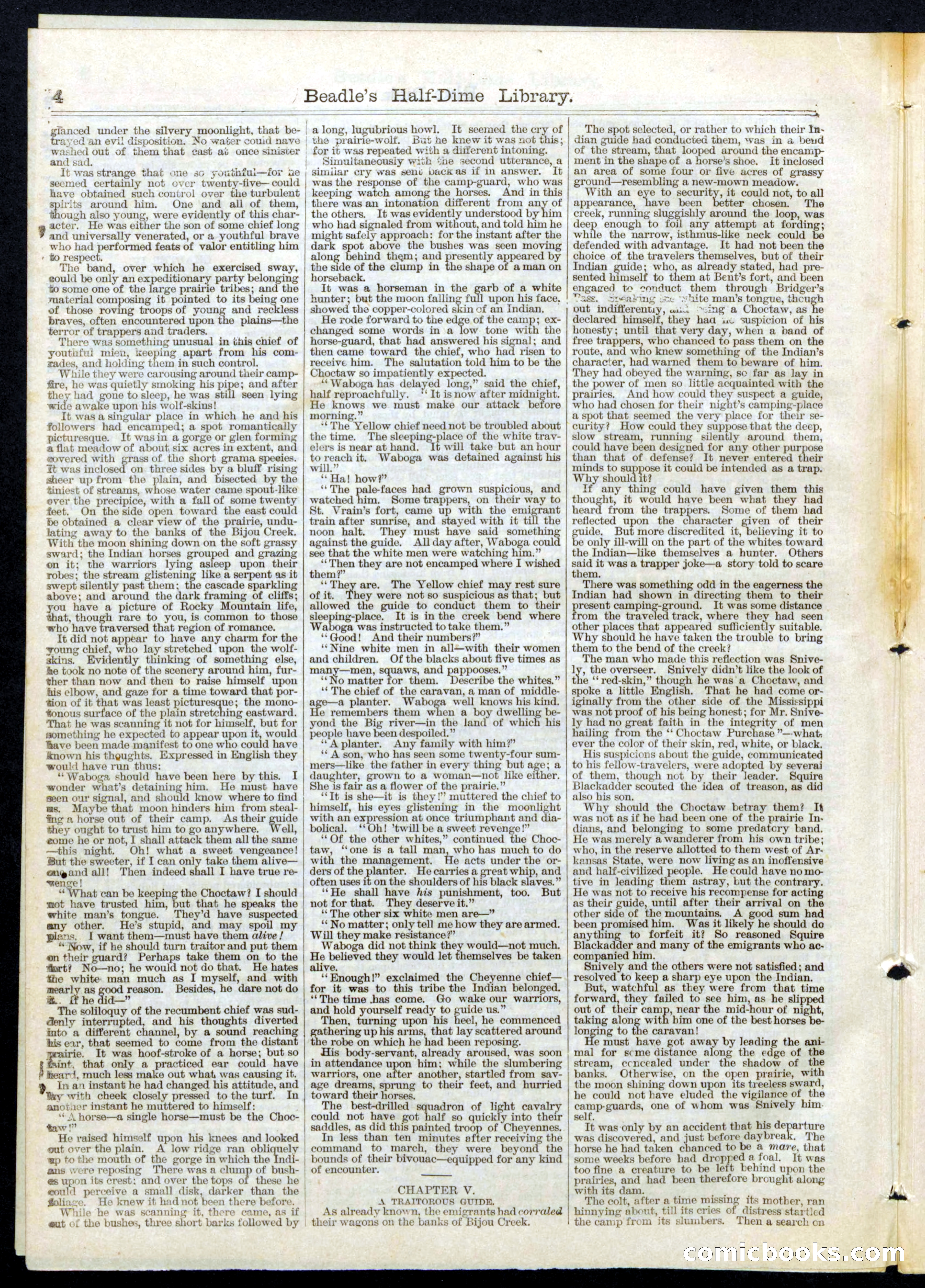
A restored page from Pulp Fiction, 1879. Page through the whole issue in the reader above.
📄 Transcribed text from this page (OCR, searchable)
Machine-transcribed from the original scan — historical spelling and the odd misread are preserved.
y ee - ee —_ glanced under the silvery moonlight, that be- trayed an evil disposition. No water coud nave | washed out of them that cast at once sinister and sad. It was strange that one so youthifui—for ae seemed certainly not over twenty-five— could have obtained such control over the turbulent spirits around him. One and ali of them, Roark also young, were evidently of this char- acter. He was either the son of some chief long and universally venerated, or a youthful brave who had performed feats of valor entitling him ‘ Go respect. Pay with cheek closely pressed to the turf. The band, over which he exercised sway, eould be only an expeditionary party belonging to some one of the large prairie tribes; and the material composing it pointed to its being one of those roving troops of young and reckless braves, often encountered upon the plains—the terror of trappers and traders. There was something unusual in this chief of youthful mien, keeping apart from his com- rades, and holding them in such control. While they were carousing around their camp- fire, he was quietly smoking his ne and after they had gone to sleep, he was still seen lying wide awake upon his wolf-skins! It was a singular place in which he and his followers had encamped; a spot romantically picturesque. It wasin a gorge or glen forming a flat meadow of about six acres in extent, and eovered with grass of the short grama speeies. Tt was inclosed on three sides by a bluff rising sheer up from the plain, and bisected by the tiniest of streams, whose water came spout-like over the precipice, with a fall of some twenty feet. On the side open toward the east could be obtained a clear view of the prairie, undu- lating away to the banks of the Bijou Creek. With the moon shining down on the soft grassy sward; the Indian horses grouped and grazing on it; the warriors lying asieep upon their robes; the stream glistening like a serpent as it swept silently past them; the cascade sparkling above; and around the dark framing of cliffs; you have a picture of Rocky Mountain life, that, though rare to you, is common to those who have traversed that region of romance. It did not ee to have any charm for the young chief, who lay stretched upon the wolf- skins. Evidently thinking of something else, he took no note of the scenery around him, fur- ther than now and then to raise himself upon his elbow, and gaze for a time toward that por- tion of it that was least picturesque; the mono- tonous surface of the plain stretching eastward. That he was scanning it not for himself, but for something he expected to appear upon it, would have been made manifest to one who could have known his theughts. Expressed in English they would have run thus: ‘“Waboga should have been here by this. I wonder what’s detaining him. He must have seen our signal, and should know where to find ws. Maybe that moon hinders him from steal- fng a horse out of their camp. As their they ought to trust him to go anywhere. Well, gome he or not, I shall attack them all the same —this night. Oh! what a sweet vengeance! But the sweeter, if I can only take them alive— omeand all! Then indeed shall I have true re- sence | “What can be keeping the Choctaw? I should mot have trusted him, but that he speaks the white man’s tongue. They’d have suspected any other. He’s stupid, and may spoil my ns, I want them—must have them alive / * Now, if he should turn traitor and put them on their guard? Perhaps take them on to the tert? No—no; he would not do that. He hates the white man much as I myself, and with mearly as good reason. Besides, he dare not do a it he did—” The soliloquy of the recumbent chief was sud- denly interrupted, and his thoughts diverted into a different channel, by a sound ry Te his ear, that seemed to come from the distan irie. It was hoof-stroke of a horse; but so faint. that only a practiced ear could have heard, much less make out what, was causing it. In an instant he had changed his attitude, nae n anotier instant he muttered to himself: ‘* \ horse—a single horse—must be the Choc- taw 179 He raised himself upon his knees and looked out over the plain. uide | | bolical. SS sss —" ener lt LLL LLL ————— eee A low ridge ran obliquely | wp tothe mouth of the gorge in which the Indi- | ans were reposing There was a clump of busbh- | @s upon its crest: and over the tops of these he | eould perceive a small disk, darker than the | foliaze. He knew it had not been there before. While he was scanning it, there came, as if a long, lugubrious howl. It seemed the cry of the prairie-wolf. But he knew it was not this; for it was repeated with a diiferent intoning. Simuitaneously with *ne second utterance, a similar ery was sent backas if in answer. It was the response of the camp-guard, who was keeping watch among the horses. And in this there was an intonation different from any of the others. It was evidently understood by him who had signaled from without, and told him he might safely approach: for the instant after the dark spot above the bushes was seen moving along behind them; and presently appeared by the side of the clump in the shape of a man on horseback. It was a horseman in the garb of a white hunter; but the moon falling full upon his face, showed the copper-colored skin of an Indian, He rode forward to the edge of the camp; ex- changed some words in a low tone with the horse-guard, that had answered his signal; and then came toward the chief, who had risen to receive him. The salutation told him to be the Choctaw so impatiently expected. “*Waboga has delayed long,” said the chief, half reproachfully. ‘‘ It isnow after midnight. He knows we must make our attack before morning.” **The Yellow chief need not be troubled about the time. The sleeping-place of the white trav- elers is near at hand. It will take but an hour to reach it. Waboga was detained against his will.” ‘** Ha! how?” ‘*The pale-faces had grown suspicious, and watched him. Some trappers, on their way to St. Vrain’s fort, came up with the emigrant train after sunrise, and stayed with it till the noon halt. They must have said somethin against the guide. All day after, Waboga pould see that the white men were watching him.” “ Then they are not encamped where I wished them?” ‘‘They are. The Yellow chief may rest sure of it. They were not so suspicious as that; but allowed the guide to conduct them to their sleeping-place. It is in the creek bend where Waboga was instructed to take them.” ‘*Good! And their numbers?” ‘‘Nine white men in all—with their women and children. Of the blacks about five times as a squaws, and pappooses.” ‘*No matter for them. Describe the whites.” ‘* The chief of the caravan, a man of middle- age—a planter. Waboga well knows his kind. e remembers them when a boy dwelling be- yond the Big river—in the land of which his people have been despoiled.” “A planter. Any family with him?’ ‘* A son, who has seen some twenty-four sum- mers—like the father in every thing but age; a daughter, grown to a woman—not like either. She is fair as a flower of the prairie.” ‘It is she—it is they!’ muttered the chief to himself, his eyes glistening in the moonlight with an expression at once triumphant and dia- ‘*Oh! ‘twill be a sweet revenge!” ‘‘Of the other whites,” continued the Choc- taw, ‘‘one is a tall man, who has much to do with the management. He acts under the or- ders of the planter. He carries a great whip, and often uses it on the shoulders of his black slaves.” ‘‘He shall have Ais punishment, too. But not for that. They deserve it.” ‘The other six white men are—” ‘No matter; only tell me how they are armed. Will they make resistance?” Waboga did not think they would—not much, He believed they would let themselves be taken alive. ‘*Enough!” exclaimed the Cheyenne chief— for it was to this tribe the Indian belonged. ‘‘The time .has come. Go wake our warriors, and hold yourself ready to guide us.” Then, turning upon his heel, he commenced thering up his arms, that lay scattered around the robe on which he had been reposing. His body-servant, already aroused, was soon in attendance upon him: while the slumbering warriors, one after another, startled from sav- age dreams, sprung to their feet, and hurried toward their horses. The best-drilled squadron of light caval could not have got half so quickly into their saddles, as did this painted troop of Cheyennes. In less than ten minutes efter receiving the command to march, they were beyond the bounds of their bivouac—equipped for any kind of encounter. CHAPTER V. A TRAITOROUS GUIDE. As already known, the emigrants had corraled eut of the bushes, three short barks followed by | their wagons on the banks of Bijou Creek. Beadle’s Half-Dime Library. The spot selected, or rather to which their In- dian guide had conducted them, was in a beud of the stream, that looped around the encamp- ment in the shape of a horse’s shoe. It inclosed an area of some four or five acres of grassy ground—resembling a new-mown meadow. With an eye to security, it could not, to all appearance, have been tter chosen. The creek, running sluggishly around the loop, was deep enough to foil any attempt at fording; while the narrow, isthmus-like neck could be defended with advantage. It had not been the choice of the travelers themselves, but of their Indian guide; who, as already stated, had pre- sented himself to them at Bent’s fort, and been engaged te conduct them through Bridger’s oe sealing occ ~~hite man’s tongue, thcugh out indifferentuy, ai. ~ing a Choctaw, as he declared himself, they haa 1 suspicion of his honesty; until that very day, when a band of free trappers, who chanced to pass them on the route, and who knew something of the Indian’s character, had warned them to beware of him. They had obeyed the warning, se far as lay in the power of men so little acquainted with the prairies. And how could they suspect a guide, who had chosen for their night’s camping-place a spot that seemed the very place for their se- curity? How could they suppose that the deep, slow stream, running silently around them, could have been designed for any other purpose than that of defense? It never entered their minds to an Arg it could be intended as a trap. Why should it? If any thing could have given them this thought, it would have been what they had heard from the trappers. Some of them had reflected upon the character given of their guide, But more discredited it, believing it to be only ill-will on the part of the whites toward the Indian—like themselves a hunter. Others ae it was a trapper joke—a story told to scare them. There was something odd in the eagerness the Indian had shown in directing them to their resent Sere: ound. It was some distance rom the traveled track, where they had seen other places that appeared sufliciently suitable. Why should he have taken the trouble to bring them to the bend of the creek? The man who made this reflection was Snive- ly, the overseer. Snively didn’t like the look of the ‘‘ red-skin,” though he was a Choctaw, and spoke a little English. That he had come or- iginally from the other side of the Mississippi was not proof of his being honest; for Mr. Snive- ly had no great faith in the integrity of men hailing from the ‘‘ Choctaw Purchase ”—-what. ever the color of their skin, red, white, or black. His suspicions about the guide, communicated to his fellow-travelers, were adopted by severai of them, though not by their leader. Squire Blackadder scouted the idea of treason, as did also his son, Why should the Choctaw betray them? It was not as if he had been one of the prairie In- dians, and belonging to some predatcry band. He was merely a wanderer from his own tribe; who, in the reserve allotted to them west of Ar- kansas State, were now living as an inoffensive and half-civilized people. He could have nomo- tive in leading them astray, but the contrary. He was not to receive his recompense for acting as their guide, until after their arrival on the other side of the mountains. A good sum had been promised him. Was it likely he should do anything to forfeit it? So reasoned Squire Blackadder and many of the emigrants who ac- companied him. Snively and the others were not satisfied; and resolved to keep a sharp eye upon the Indian. But, watchful as they were from that time forward, they failed to see him, as he slipped out of their camp, near the mid-hour of night, taking og. with bim one of the best horses be- longing to the caravan! e must have got away by leading the ani- mal for scme distance along the edge of the stream, ccncealed under the shadow of the banks. Otherwise, on the open prairie, with the moon shining down upon its treeless sward, he could not have eluded the vigilance of the camp-guards, one of whom was Snively him. self aT a It was only by an accident that his departure was discovered, and just before daybreak. The horse he had taken chanced to be a mare, that some weeks before had dropped a foal. It was too fine a creature to be left behind upon the prairies, and had been therefore brought along with its dam. Meee The colt, after a time missing its mother, ran hinnying about, till its cries of distress startled the camp from its slumbers. Then a search on €om Eboo S (E(0) Ot ee e nae — ~ a - me cen ab