
Pulp Fiction, 1878 · page 15 of 16
Beadle's Half Dime Library No. 74 — page 15: what you’re looking at
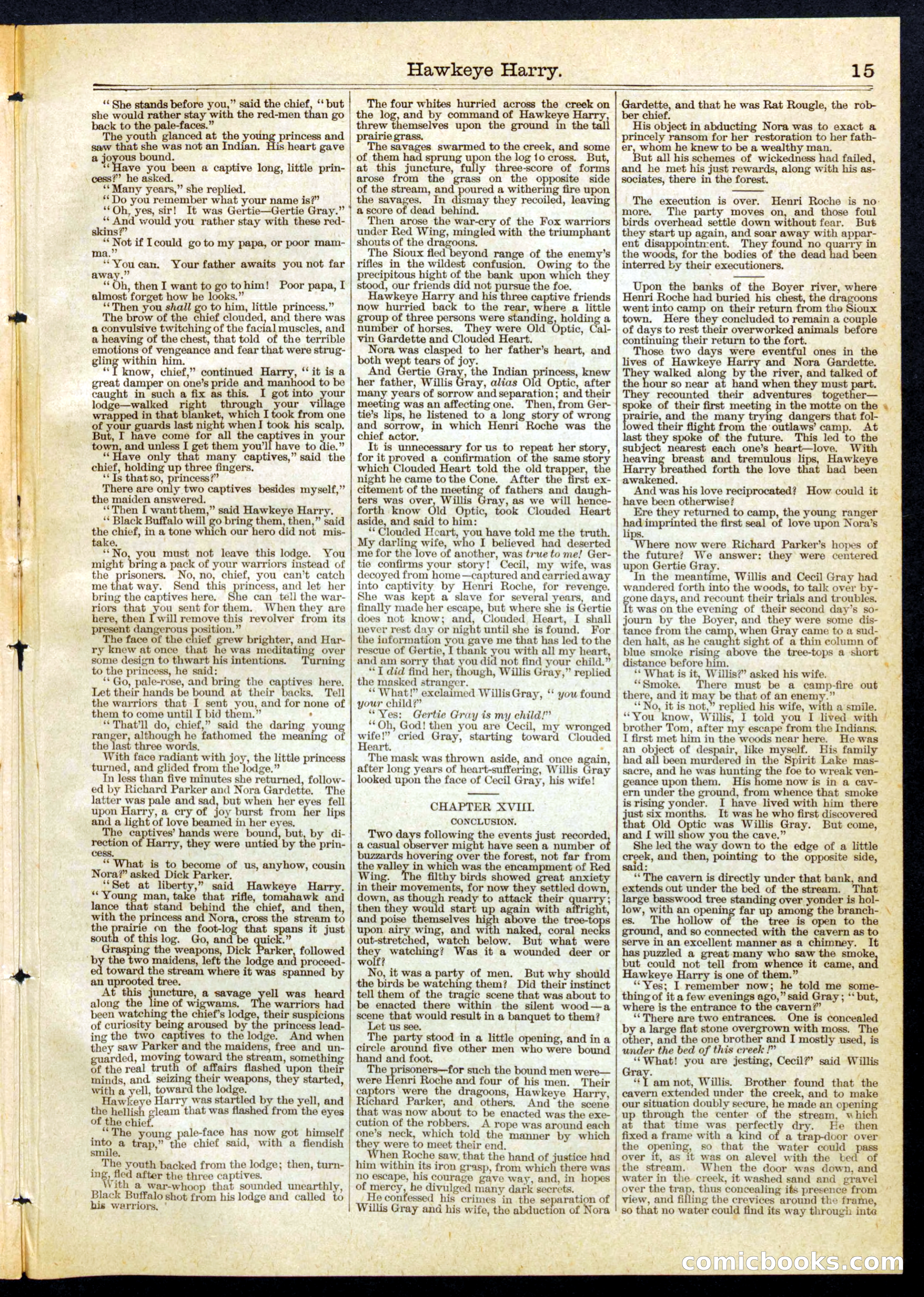
A restored page from Pulp Fiction, 1878. Page through the whole issue in the reader above.
📄 Transcribed text from this page (OCR, searchable)
Machine-transcribed from the original scan — historical spelling and the odd misread are preserved.
—eee eee +e es : Eee arr. — Ew — = ~" < ’ ‘‘ She stands before you,” said the chief, ‘‘ but she would rather stay with the red-men than go | the log back to the pale-faces.” The youth glanced at the yo saw that she was not an Indian. a joyous bound. ‘*Have you been a captive long, little prin- cess?’ he asked. ‘*Many years,” she replied. **Do you remember what your name is?” ‘*Oh_ yes, sir! It was Gertie—Gertie Gray.” ‘* And would you rather stay with these red- skins?’ - Not if Tcould goto my papa, or poor mam- ma. “You can. Your father awaits you not far away.” din, then I want to go tohim! Poor papa, I almost forget how he looks.” ‘‘Then you shall go to him, little princess.” The brow of the chief clouded, and there was a convulsive twitching of the facial muscles, and a heaving of the chest, that told of the terrible emotions of vengeance and fear that were strug- gling within him. ‘‘T know, chief,” continued Harry, “it is a great damper on one’s pride and manhood to be caught in such a fix as this. I got into your lodge—walked right through your village wrapped in that blanket, which I took from one of your guards last night when I took his scalp. But, I have come for all the ere in your town, and unless I get them you’ll have to die.” “ Have only that many captives,” said the chief, holding up three fingers. ‘* Is that so, Sep ta q”? There are only two captives besides myself,” the maiden answered. ‘Then I wantthem,” said Hawkeye Harry. ‘* Black Buffalo will go bring them, then,” said the chief, in a tone which our hero did not mis- take. ‘No, you must not leave this lodge. You might bring a pack of your warriors instead of the prisoners. No, no, chief, you can’t catch me that way. Send this princess, and let her bring the captives here. She can tell the war- riors that you sent for them. When they are here, then I will remove this revolver from its present dangerous position.” The face of the chief grew brighter, and Har- ry knew at once that he was meditating over some design to thwart his intentions. Turning to the princess, he said: ‘* Go, pale-rose, and bring the ay Spam here. Let their hands be bound at their backs. Tell the warriors that I sent you, and for none of them to come until I bid them.” , ‘That'll do, chief,” said the daring young ranger, although he fathomed the meaning of the last three words. With face radiant with joy, the little princess turned, and glided from the lodge.” Tn less than five minutes she returned, follow- ed by Richard Parker and Nora Gardette. The latter was pale and sad, but when her eyes fell upon Harry, a cry of joy burst from her lips and a light of love beamed in her eyes. The captives’ hands were bound, but, by di- rection of Harry, they were untied by the prin- ce princess and is heart gave Ss. “What is to become of us, anyhow, cousin Nora?” asked Dick Parker. ‘Set at liberty,” said Hawkeye Harry. “Young man, take that rifle, tomahawk and lance that stand behind the chief, and then, with the princess and Nora, cross the stream to the prairie on the foot-log that spans it just south of this log. Go, and be quick.” Grasping the weapons, Dick Parker, followed yy the two maidens, left the lodge and proceed- toward the stream where it was spanned by an uprooted tree. At this ee a savage yell was heard along the line of wigwams. e warriors had been watching the chief’s lodge, their suspicions of curiosity being aroused by the princess lead- ing the two captives to the lodge. And when they saw Parker and the maidens, free and un- arded, moving toward the stream, something of the real truth of affairs flashed upon their minds, and seizing their weapons, they started, Hawkeye Harry was startled by the yell, and the hellish gleam that was flashed from the eyes of the chief. “The young pale-face has now got himself into a trap,” the chief said, with a fiendish smile. _ The youth backed from the lodge; then, turn- me fled after the three captives. Vith & war-whoop that sounded unearthly, Black Buffalo shot from his lodge and called to his warriors, ' Hawkeye Harry. —_—-—-- The four peng pad a = —_ on an command of Hawkeye Harry threw thomaclves upon the ground s the tall prairie grass, The savages swarmed to the creek, and some of them had sprung upon the log tocross. But, at this juncture, fully three-score of forms arose from the grass on the opposite side of the stream, and poured a withering fire upon the savages. In dismay they recoiled, leaving a score of dead behind. Then arose the war-cry of the Fox warriors under Red Wing, mingled with the triumphant shouts of the dragoons. The Sioux fled beyond range of the enemy’s rifles in the wildest confusion. Owing to the precipitous hight of the bank upon which they stood, our friends did not pursue the foe. Hawkeye Harry and his three captive friends now hurried back to the rear, where a little group of three persons were standing, holding a number of horses. They were Old Optic, Cal- vin Gardette and Clouded Heart. Nora was clasped to her father’s heart, and both or tears of joy. And Gertie Gray, the Indian princess, knew her father, Willis Gray, alias Old Optic, after many years of sorrow and separation; and their meeting was an affecting one. Then, from Ger- tie’s lips, he listened to a long story of wrong and sorrow, in which Henri Roche was the chief actor. It is unnecessary for us to repeat her story, for it proved a confirmation of the same story which Clouded Heart told the old trapper, the night he came tothe Cone. After the first ex- citement of the meeting of fathers and daugh- ters was over, Willis Gray, as we will hence- forth know Old Optic, took Clouded Heart aside, and said to him: ** Clouded Heart, you have told me the truth. My darling wife, who I believed had deserted me for the love of another, was true to me! Ger- tie confirms your story! Cecil, my wife, was decoyed from home —captured and carried away into captivity by Henri Roche, for revenge. She was kept a slave for several years, and finally made her escape, but where she is Gertie does not know: re Clouded Heart, I shall never rest day or night until she is found. For the information you gave me that has led to the rescue of Gertie, I thank you with all my heart, and am sorry that you did not find your child.” “I did find her, though, Willis Gray,” replied the masked stranger. ‘** What!” exclaimed Willis Gray, ‘‘ you found your child?” “Yes: Gertie Gray is my child!” ‘Oh, God! then you are Cecil, my wronged wife!” cried Gray, starting toward Clouded Heart. The mask was thrown aside, and once again, after long years of heart-suffering, Willis Gray looked upon the face of Cecil Gray, his wife! CHAPTER XVIIL. CONCLUSION. Two sa i «Far the events just recorded a casual observer might have seen a number of buzzards hovering over the forest, not far from the valley in which was the encampment of Red Wing. e filthy birds showed great anxiety in their movements, for now they settled down, down, as though ready to attack their quarry; then they would start up again with affright, and poise themselves high above the tree-tops upon airy wing, and with naked, coral nec out-stretched, watch below. But what were eo watching? Was it a wounded deer or wo No, it was a party of men. But why should the birds be watching them? Did their instinct tell them of the tragic scene that was about to be enacted there within the silent wood—a scene that would result in a banquet to them? Let us see. The party stood in a little opening, and in a circle around five other men who were bound hand and foot. The A Day tem such the bound men were— were Henri Roche and four of his men. Their captors were the dragoons, Hawkeye Harry. Richard Parker, and others, And the scene that was now about to be enacted was the exe- cution of the robbers. A rope was around each one’s neck, which told the manner by which they were to meet their end. When Roche saw, that the hand of justice had him within its Iron grasp, from which there was no escape, his courage gave way, and, in hopes of mercy, he divulged many dark secrets. He confessed his crimes in the separation of Willis Gray and his wife, the abduction of Nora 15 Gardette, and that he was Rat Rougle, the rob- ber chief. His object in abducting Nora was to exact a princely ransom for her restoration to her fath- er, whom he knew to be a wealthy man. ut all his schemes of wickedness had failed, and he met his just rewards, along with his as- sociates, there in the forest. The execution is over. more. The party moves on, and those foul birds overhead settle down without fear. But they start up again, and soar away with appar- ent disappointn-ent. They found no quarry in the woods, for the bodies of the dead had been interred by their executioners. Upon the banks of the Boyer river, where Henri Roche had buried his chest, the dragoons went into —_ on their return from the Sioux town. Here they concluded to remain a couple of days to rest their overworked animals before continuing their return to the fort. Those two days were eventful ones in the lives of Hawkeye greed and Nora Gardette. They walked along by the river, and talked of the hour so near at hand when they must pai They recounted their adventures together— spoke of their first meeting in the motte on the peed i and the many trying dangers that fol- owed their flight from the outlaws’ camp. At last they spoke of the future. This led to the subject nearest each one’s heart—love. With heaving breast and tremulous lips, Hawkeye Harry breathed forth the love that bad been awakened. | And was his love reciprocated? How could it have been otherwise? Ere they returned to camp, the young ranger had imprinted the first seal of love upon Nora’s lips. ‘Where now were Richard Parker’s hopes of the future? We answer: they were centered upon Gertie Gray. In the meantime, Willis and Cecil Gray had wandered forth into the woods, to talk over by- gone days, and recount their trials and troubles. It was on the evening of their second day’s so- journ by the Boyer, and they were some dis- tance from the camp, when Gray came to a sud- den halt, as he caught sight of a thin column of blue smoke rising above the tree-tops a short distance before him. ‘* What is it, Willis?” asked his wife. “Smoke. There must be a camp-fire out there, and it may be that of an enemy.” : No, it is not,” replied his wife, with a smile. ‘You know, Willis, I told you I lived with brother Tom, after my escape from the Indians. I first met him in the woods near here. He was an object of despair, like myself. His family had all been murdered in the Spirit Lake mas- sacre, and he was hunting the foe to wreak ven- | geance upon them. His home now is in a cav- ern under the ground, from whence that smoke is rising yonder. I have lived with him there just six months. It was he who first discovered that Old Optic was Willis Gray. But come, and [ will show you the cave.” She led the way down to the edge of a little pot and then, pointing to the opposite side, sald: ‘‘ The cavern is directly under that bank, an extends out under the bed of the stream. large basswood tree standing over yonder is hol- low, with an opening far up among the branch- es. The hollow of the tree is open to the ground, and so connected with the cavern as to serve in an excellent manner as a chimney. It has puzzled a t many who saw the smoke but could not tell from whence it came, an Hawkeye Harry is one of them.” ‘Yes; I remember now; he told me some- thing of it a few evenings ago,” said Gray ; ‘‘ but, where is the entrance to the cavern?’ ‘“There are two entrances. One is concealed by a large flat stone overgrown with moss. The other, and the one brother and I mostly used, is under the bed of this creek !” ‘‘What! you are jesting, Cecil?’ said Willis Gray. ref am not, Willis. Brother found that the cavern extended under the creek, and to make our situation doubly secure, he made an openin up through the center of the stream, whic at that time was perfectly dry. He then fixed a frame with a kind o the opening, so that the water could over it, as it was on alevel with the bed of the stream. When the door was down, and water in the creek, it washed sand and gravel over the op, thus concealing ifs presence from © il view, and filling the crevices around the frame, so that no water could find its way through inte ' Eboo (E (0) KS com Henri Roche is no: d That a trap-door over A - a : POA ae