
Pulp Fiction, 1891 · page 8 of 16
Beadle's Half Dime Library No. 707 — page 8: what you’re looking at
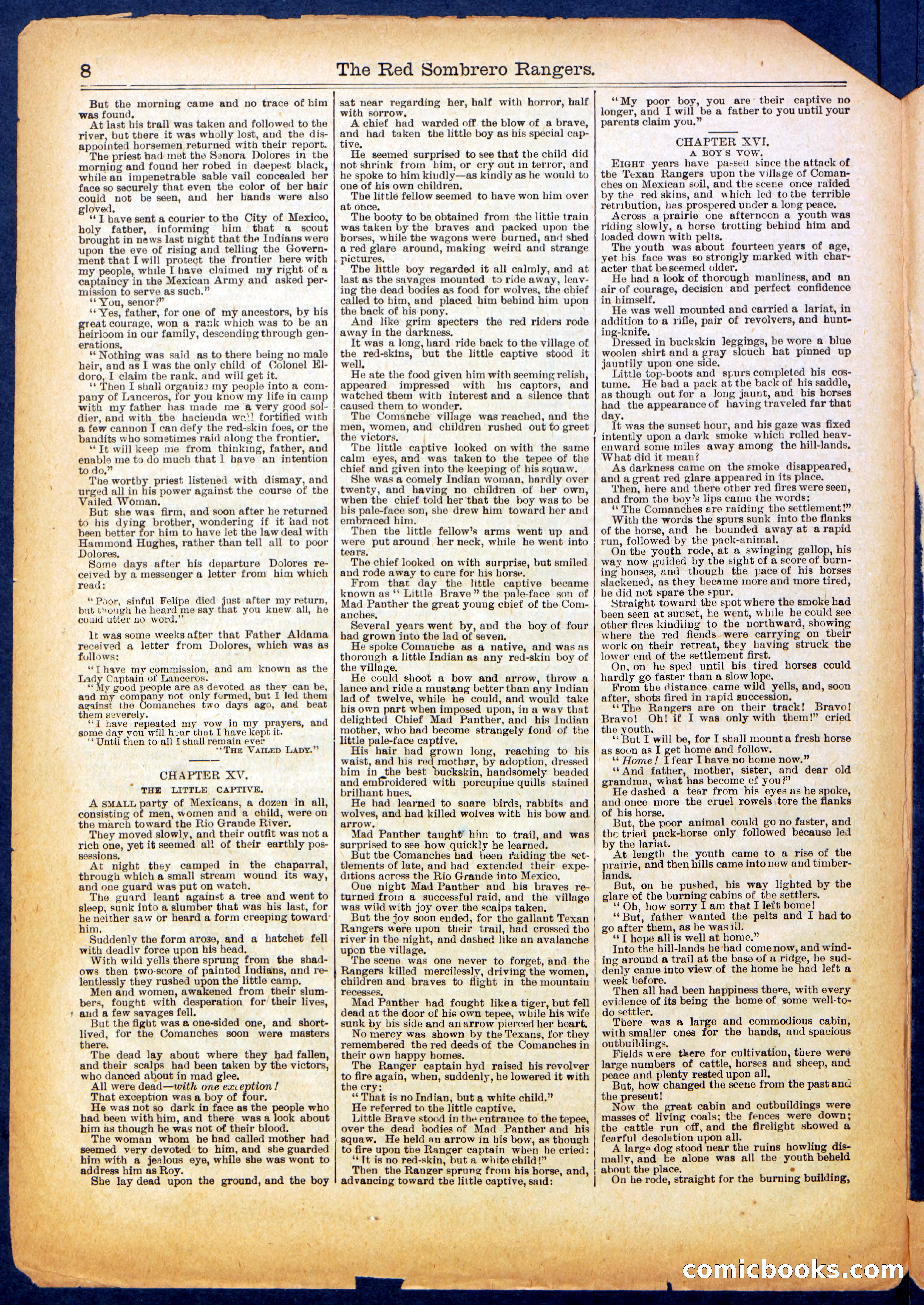
A restored page from Pulp Fiction, 1891. Page through the whole issue in the reader above.
📄 Transcribed text from this page (OCR, searchable)
Machine-transcribed from the original scan — historical spelling and the odd misread are preserved.
- 8 _— The Red Sombrero Rangers. But the morning came and no trace of bim was found, At last his trail was taken and followed to the river, but there it was wholly lost, and the dis- appointed horsemen returned with their report. The priest had met the Senora Dolores in the morning and found her robed in daepest black, while an impenetrable sable vail concealed her face so securely that even the color of her hair could not be seen, aud her hands were also gloved, ‘‘T have sent a courier to the City of Mexico, holy father, informing him that a _ scout brought in news last night that the Indians were upon the eve of rising and telling the Govern- ment that I will protect the frontier here with my people, while | bave claimed my right of a captaincy in the Mexican Army and asked per- mission to serve as such.” ‘*'You, senor?” ‘*‘ Yes, father, for one of my ancestors, by bis great courage, won a rank which was to be an heirloom in our family, descending through gen- erations, ‘* Nothing was said as to there being no male heir, and as I was the only child of Colonel El- doro, I claim the rank, and will get it. ‘¢ Then I shall orgauiz>2 my people into a com- pany of Lanceros, for you know my life in camp with my father has made me a very good sol- dier, and with the hacienda wre’! fortified with a few cannon I can defy the red-skin foes, or the bandits who sometimes raid along the frontier. ‘*Tt will keep me from thinking, father, aud enable me to do much that 1 have an intention to do,” The wortby priest listened with dismay, and urged all in his power against the course of the Vailed Woman, But she was firm, and soon after he returned to his dying brother, wondering if it had not been better for him to have let the law deal with Hammond Hughes, rather than tell all to poor Dolores. Some days after his departure Dolores re- ceived by a messenger a letter from him which read: * Poor, sinful Felipe died pnge after my return, but though he heard me say that you knew all, he could utter no word,” lt was some weeks after that Father Aldama received a letter from Dolores, which was as follows: ‘“T have my commission, and am known as the mady: Captain of Lanceros. ‘* My good people are as devoted as they can be, and my company not only furmed, but I led them against the Comanches two days ago, and beat them severely. ‘‘T have repeated my vow in my prayers, and some day you will hear that I have kept it. ‘* Until then to all I shall remain ever “THe VAILED LADY.” CHAPTER XV. ‘ "HE LITTLE CAPTIVE. A SMALL party of Mexicans, a dozen in all, consisting of men, women and a child, were on the march toward the Rio Grande River. They moved slowly, and their outfit was not a rich one, yet it seemed ali of their earthly pos- sessions, At night they camped in the chaparral, through which a small stream wound its way, and one guard was put on watch. The guard leant against a tree and went to sleep, sunk into a slumber that was his last, for he neither saw or heard a form creeping toward’ him, Suddenly the form arose, and a hatchet fell with deadlv foree upon his head, With wild yells there sprung from the shad- ows then two-score of painted Indians, and re- lentlessly they rushed upon the little camp, Men and women, awakened from their slum- bers, fought with desperation for’ their lives, aud a few savages fell. But the fight was a one-sided one, and short- lived, for the Comanches soon were masters there. The dead lay about where they had fallen, and their scalps had been taken by the victors, who danced about in mad glee. All were dead—with one exception ! That exception was a boy of four. He was not so dark in face as the ple who had been with him, and there was a look about him as though he was not of their blood. The woman whom he had called mother had seemed very devoted to him, and she guarded him with a jealous eye, while she was wont to address him as Roy. She lay dead upon the ground, and the boy sat near regarding her, half with horror, half with sorrow, A chief had warded off the blow of a brave, and had taken the little boy as his special cap- tive, He seemed surprised to see that the child did not shrink from him, or cry out in terror, and he spoke to him kiudly—as kindly as he would to one of his own children. The little fellow seemed to have won him over at once, The booty to be obtained from the littie train was taken by the braves and packed upon the borses, while the wagons were burned, and shed ared glare around, making weird and strange pictures. The httle boy regarded it all calmly, and at last as the savages mounted to ride away, leav- ing the dead bodies as food for wolves, the chief called to him, and placed him behind him upon the back of his pony. And like grim specters the red riders rode away in the darkness, It was a long, hard ride back to the village of at tine but the little captive stood it well, He ate the food given him with seeming relish, appeared impressed with his captors, and watched them with interest and a silence that caused them to wonder, The Comanche village was reached, and tho men, women, and children rushed out to greet the victors. The little captive looked on with the same calm eyes, and was taken to the tepee of the chief and given into the keeping of his squaw. She was a comely Indian woman, hardly over twenty, and having no children of her own, when the chief told her'that the boy was to be his pale-face son, she drew him toward her and embraced him. Then the little fellow’s arms went up and were put around her neck, while he went into tears, The chief looked on with surprise, but smiled and rode away to care for his horse. From that day the little captive became known as *‘ Little Brave” the pale-face son of Mad Panther the great young cbief of the Com- anches, Several years went by, and the boy of four had grown into the lad of seven. He spoke Comanche as a native, and was as thorough a little Indian as any red-skin boy of the village, He could shoot a bow and arrow, throw a lance and ride a mustang better than any Indian lad of twelve, while he could, and would take his own part when imposed upon, in a way that delighted Chief Mad Panther, and his Indian mother, who had become strangely fond of the little pale-face captive. His hair had grown long, reaching to his waist, and his red mother, by adoption, dressed him inthe best buckskin, handsomely beaded and embroidered with porcupine quills stained brilhant hues, He had learned to snare birds, rabbits and wolves, and had killed wolves witk his bow and arrow, Mad Panther taught’ him to trail, and was surprised to see how quickly he learned. But the Comanches had been raiding the set- tlements of late, and bad extended their expe- ditions acress the Rio Grande into Mexico, One night Mad Panther and his braves re- turned froin a successful raid, and the village was wild with joy over the scalps taken. But the joy soon ended, for the gallant Texan Rangers were upon their trail, had crossed the river in the night, and dashed like an avalanche upon the village, The scene was one never to forget, and the Rangers killed mercilessly, driving the women, children and braves to flight in the mountain recesses, Mad Panther had fought likea tiger, but fell dead at the door of his own tepee, while his wife sunk by bis side and an arrow pierced her beart, No merey was shown by the Texans, for they remembered the red deeds of the Comanches in their own happy homes. The Ranger captain hyd raised bis revolver KS fire again, when, suddenly, he lowered it with e cry: “That is no Indian, but a white child.” He referred to the little captive. Little Brave stood in the entrance to the tepee, over the dead bodies of Mad Panther and his squaw. He held an arrow in his bow, as though to fire upon the Ranger captain when he cried: ** It is no red-skin, but a white child!” ‘““My poor boy, you are their captive no longer, and I will be a father to you until your parents claim you.” CHAPTER XVI, A BOYS VOW. EIGHT years have passed since the attack of the Texan Rangers upon the villuge of Coman- ches on Mexican soil, and the scene once raided by the red skins, and which led to tbe terrible retribution, has prospered under a long peace, Across a prairie one afternoon a youth was riding slowly, a herse trotting behind him and loaded down with pelts. The youth was about fourteen years of age, yet his face was so strongly marked with char- acter that be seemed older. He bad a look of thorough manliness, and an air of courage, decision and perfect confidence in himself, He was well mounted and carried a lariat, in addition to a rifle, pair of revolvers, and hunt- ing-knife, Dressed in buckskin leggings, he wore a blue woolen shirt and a gray slouch hat pinned up javutily upon one side. ‘ Little top-boots and spurs completed his cos- tume. He bad a pack at the back of his saddle, as though out for a long jaunt, and bis horses had the appearance of having traveled far that day. it was the sunset hour, and his gaze was fixed intently upon a dark smoke which rolled heav- enward some miles away among the hill-lands, What did it mean? As darkness came on the smoke disappeared, and a great red glare appeared in its place. ‘Then, bere and there other red fires were seen, and from the boy’s lips came the words: ‘¢'The Comanches are raiding the settlement!” With the words the spurs sunk into the flanks of the horse, and he bounded away at a rapid run, followed by the pack-animal. : On the youth rode, at a swinging gallop, his way now guided by the sight of a score of burn- ing houses, and though the pace of his horses slackened, as they became more and wore tired, he did not spare the spur. Straight toward the spot where the smoke had been seen at sunset, he went, while he could see other fires kindling to the northward, showing where the red fiends were carrying on their work on their retreat, they baving struck the lower end of the settlement first. On, on he sped until his tired horses could hardly go faster than a slow lope, From the distance came wild yells, and, soon after, shots fired in rapid succession, ‘‘The Rangers are on their track! Bravo! Bravo! Oh! if I was only with them!” cried the youth. ‘‘ But I will be, for I shall mount a fresh horse as soon as I get home and follow. ‘‘ Home! I fear Lhave no home now.” ‘‘ And father, mother, sister, and dear old grandma, what has become cf you?” He dashed a tear from his eyes as he spoke, and once more the cruel rowels tore the flanks of his horse. But, the poor animal could go no faster, and the tried pack-horse only followed because led by the lariat. At length the youth came to a rise of the rairie, and then hills came into new and timber- ands, But, on he pushed, bis way lighted by the glare of the burning cabins of the settlers. “Oh, how sorry I am that I left home! ‘“But, father wanted the pelts and I had to go after them, as be wasill. ‘‘T hope all is well at home.” Into the hill-lands be‘had come now, and wind- ing around a trail at the base of a ridge, he sud- denly came into view of the home he had left a week before. Then all had been happiness there, with every evidence of its being the home of some well-to- do settler. There was a large and commodious cabin, with smaller ones for the hands, and spacious outbuildings. ’ Fields were tere for cultivation, tuere were large numbers of cattle, horses and sheep, anc peace and plenty rested upon all. ; But, how changed the scene from the past anu the preseut! ve. Now the great cabin and outbuildings were masses of living coals; the fences were down; the cattle run off, and the firelight showed a fearful desolation upon all. ; ; A large dog stood near the ruins howling dis- mally, and ke alone was all the youth beheld o On be rode, straight for the burning building, Then the Ranger sprung from his horse, and, ; about the place. advancing toward tbe little captive, said: s ‘ 7 ‘ oly y » Ss 1_| * , ae a a. ‘ . f -\ * “ ee