
Pulp Fiction, 1891 · page 11 of 16
Beadle's Half Dime Library No. 707 — page 11: what you’re looking at
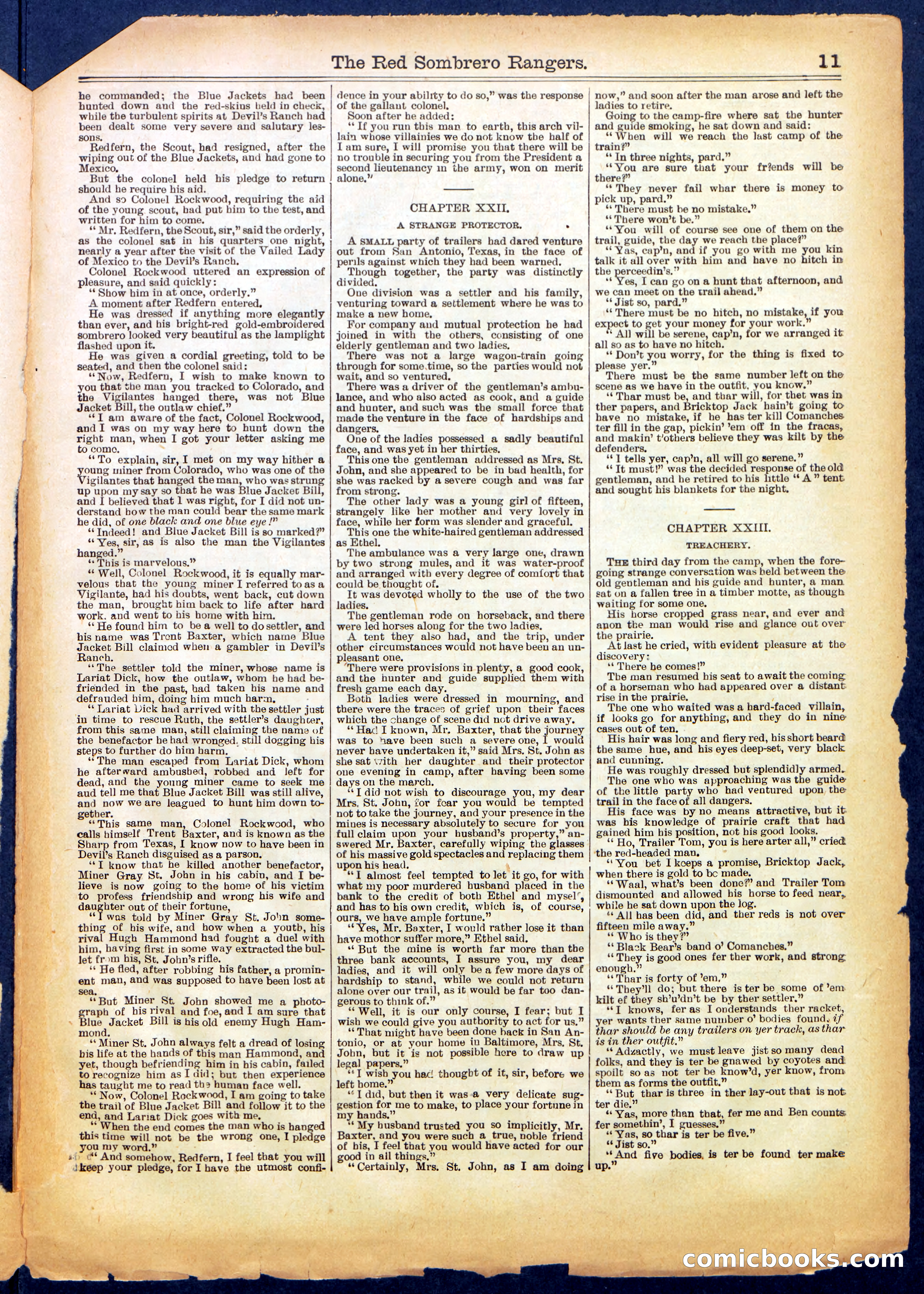
A restored page from Pulp Fiction, 1891. Page through the whole issue in the reader above.
📄 Transcribed text from this page (OCR, searchable)
Machine-transcribed from the original scan — historical spelling and the odd misread are preserved.
The Red Sombrero Rangers. LE he commanded; the Blue Jackets had been hunted down and the red-skins beld in check, while the turbulent spirits at Devil’s Ranch had been dealt some very severe and salutary les- sons. Redfern, the Scout, had resigned, after the wiping out of the Blue Jackets, and had gone to Mexico, But the colonel held his pledge to return should he require his aid. And so Colonel Rockwood, requiring the aid of the young scout, bad put him to the test, and written for him to come, ** Mr, Redfern, the Scout, sir,” said the orderly, as the colonel sat in his quarters one night, nearly a year after the visit of the Vailed Lady of Mexico to the Devil’s Ranch. Colonel Rockwood uttered an expression of pleasure, and said quickly: ‘¢ Show him in at once, orderly.” A moment after Redfern entered, He was dressed if anything more elegantly than ever, and his bright-red gold-embroidered sombrero looked very beautiful as the lamplight flashed upon it. He was given a cordial greeting, told to be seated, and then the colonel said: ‘Now, Redfern, I wish to make known to you that the man you tracked to Colorado, and the Vigilantes hanged there, was not Blue Jacket Bill, the outlaw chief.” ‘“‘T am aware of the fact, Colonel Rockwood, and I was on my way here to hunt down the right man, when I got your letter asking me to come, ‘To explain, sir, I met on my way hither a ene miner from Colorado, who was one of the Tigilantes that hanged the man, who was strung up upon my say so that he was Blue Jacket Bill, and I believed that 1 was right, for I did not un- derstand how the man could bear the same mark he did, of one black and one blue eye !” ‘¢ Indeed! and Blue Jacket Bill is so marked?” ‘Yes, sir, as is also the man the Vigilantes hanged.” ‘This is marvelous.” “ Well, Colonel Rockwood, it is equally mar- velous that the young miner I referred toasa Vigilante, had his doubts, went back, cut down the man, brought him back to life after hard work. and went to his home with him. ‘* He found him to be a well to dosettler, and his name was Trent Baxter, which name Blue Jacket Bill claimed when a gambler in Devil’s Ranch. ‘‘The settler told the miner, whose name is Lariat Dick, how the outlaw, whom he had be- friended in the past, had taken his name and defrauded him, doing him much harm, ‘** Lariat Lick had arrived with the settler just in time to rescue Ruth, the settler’s daughter, from this same man, still claiming the name of the benefactor he had wronged. still dogging his steps to further do him harm, ‘The man escaped from Lariat Dick, whom he afterward ambusbed, robbed and left for dead, and the young miner came to seek me aud tell me that Blue Jacket Bill was still alive, and now we are leagued to hunt him down to- gether. “This same man, Colonel Rockwood, who calls himself Trent Baxter, and is known as the Sharp from Texas, I know now to have been in Devil’s Ranch disguised as a parson, ‘‘T know that he killed another benefactor, Miner Gray St. John in his cabin, and I be- lieve is now going to the home of his victim to profess friendship and wrong his wife and daughter out of their fortune, “Twas told by Miner Gray St. John some- thing of his wife, and how when a youtb, his rival Hugh Hammond had fought a duel with him, having first in some way extracted the bul- let from his, St. John’s rifle. ‘* He fled, after robbing his father, a promin- ent man, 40d was supposed to have been lost at sea, “But Miner St. John showed me a photo- graph of his rival and foe, and I am sure that ae Jacket Bill is his old enemy Hugh Ham- mond. ‘‘ Miner St. John always felt a dread of losing bis life at the hands of this man Hammond, and yet, though befriending him in his cabin, failed to recognize him as I did; but then experience has taught me to read th3 human face well. ‘* Now, Colonel Rockwood, I am going to take the trail of Blue Jacket Bill and follow it to the end, and Lariat Dick goes with me, ** When the end comes the man who is hanged this time will not be the wrong one, I pledge you my word.” s &* And somehow, Redfern, I feel that you will ikeéep your pledge, for I have the utmost confi- nn dence in your ability to do so,” was the response of the gallant colonel, Soon after he added: ** Tf you run this man to earth, this arch vil- lain whose villainies we do not know tbe half of I am sure, I will promise you that there will be no trouble in securing you from the President a second lieutenancy in the army, won on merit alone,” CHAPTER XXII, A STRANGE PROTECTOR. . A SMALL party of trailers had dared venture out from San Antonio, Texas, in the tace of perils against which they had been warned. Though together, the party was distinctly divided, One division was a settler and his family, venturing toward a settlement where he was to make a new home, For company and mutual protection he had joined in with the others, consisting of one elderly gentleman and two ladies, There was not a large wagon-train going through for some.time, so the parties would not wait, and so ventured. There was a driver of the gentleman’s ambu- lance, and who also acted as cook, and a guide and hunter, and such was the small force that made the venture in the face of hardships and dangers, One of the ladies possessed a sadly beautiful face, and was yet in her thirties. This one the gentleman addressed as Mrs, St. John, and she appeared to be in bad health, for she was racked by a severe cough and was far from strong. The other lady was a young girl of fifteen, strangely like her mother and very lovely in face, while ber form was slender and graceful. This one the white-haired gentleman addressed as Ethel. The ambulance was a very large one, drawn by two strong mules, and it was water-proof and arranged with every degree of comfort that could be thought of, It was devoted wholly to the use of the two ladies. The gentleman rode on horseback, and there were led horses along for the two ladies, A tent they also had, and the trip, under other circumstances would not have been an un- pleasant one, ‘There were provisions in plenty, a good cook, and the hunter and guide supplied them with fresh game each day. Both ladies were dressed in mourning, and there were the traces of grief upon their faces which the change of scene did not drive away. **Had I known, Mr, Baxter, that the journey was to have been such a severe one, | would never have undertaken it,” said Mrs. St. John as she sat \7ith her daughter and their protector one evening in camp, after having been some days on the march. ‘¢T did not wish to discourage you, my dear Mrs. St. Jobn, for foar you would be tempted not to fake the journey, and your presence in the mines is necessary absolutely to secure for you full claim upon your husband’s property,” an- swered Mr. Baxter, carefully wiping the glasses of his massive gold spectacles and replacing them upon his head. **T almost feel tempted to let it go, for with what my poor murdered husband placed in the bank to the credit of both Ethel and mysel’, and has to his own credit, which is, of course, ours, we have ample fortune.” ‘© Yes, Mr. Baxter, I would rather lose it than have mothor suffer more,” Ethel said. ‘“* But the mine is worth far more than the three bank accounts, I assure you, my dear ladies, and it will only be a few more days of hardship to stand, while we could not return alone over our trail, as if Would be far too dan- gerous to think of.” ** Well, it is our only course, I fear; but I wish we could give you authority to act for us.” ‘*That might have been done back in San An- tonio, or at your home iu Baltimore, Mrs, St. Jobn, but it is not possible here to draw up legal papers.” ob ‘¢T wish you hac! thougbt of it, sir, before we left home.” ‘© did, but then it was-a very delicate sug- gestion for me to make, to place your fortune in my hands.” ‘* My husband trusted you so implicitly, Mr. Baxter, and you were such a true, noble friend of bis, I feel that you would have acted for our good in ail things,” “‘Certainly, Mrs, St. John, as I am doing now,” and soon after the man arose and left the ladies to retire. Going to the camp-fire where sat the hunter and guide smoking, he sat down and said: ‘“* When will we reach the last camp of the train?” ‘* In three nights, pard.” ‘‘You are sure that your fr?ends will be there?” ‘*They never fail whar there is money to pick up, pard.” ‘* There must be no mistake.” **There won’t be.” ‘*You will of course see one of them on the trail, guide, the day we reach the place?” : ‘Yas, cap’n, and if you go with me you kin talk it all over with him and have no hitch in the perceedin’s.” ‘* Yes, I can go on a hunt that afternoon, and we can meet on the trail ahead.” ‘* Jist so, pard.” ‘‘ There must be no hitch, no mistake, if you expect to get your money for your work.” ** Al) will be serene, cap’n, for we arranged it all so as to have no hitch. ‘** Don’t you worry, for the thing is fixed to please yer.” There must be the same number left on the scene as we have in the outfit, you know.” t ‘‘ Thar must be, and thar will, for thet was in ther papers, and Bricktop Jack hain’t going to have no mistake, if he has ter kill Comanches ter fill in the gap, pickin’ em off in the fracas, and makin’ t’others believe they was kilt by the defenders. ‘*] tells yer, cap’n, all will go serene.” ‘Tt must!” was the decided response of the old gentleman, and he retired to his little “* A” tent and sought his blankets for the night, CHAPTER XXIII. TREACHERY. THE third day from the camp, when the fore- going strange conversation was held between the old gentleman and his guide and hunter, a man sat on a fallen tree in a timber motte, as though waiting for some one, His horse cropped grass near, and ever and anon tbe man would rise and glance out over the prairie. At last he cried, with evident pleasure at the discovery: ‘* There he comes!” Tbe man resumed his seat to await the coming of a horseman who had appeared over a distant rise in the prairie. The one who waited was a hard-faced villain, if looks go for anything, and they do in nine cases out of ten. His hair was long and fiery red, his short bear@ the same hue, and his eyes deep-set, very black and cunning. He was roughly dressed but splendidly armed. The one who was approaching was the guide of the little party who had ventured upon the trail in the face of all dangers. ; His face was by no means attractive, but it was bis knowledge of prairie craft that had gained him his position, not his good looks, _ ‘‘ Ho, Trailer Tom, you is here arter all,” cried the red-headed man, 3 ‘You bet I kceps a promise, Bricktop Jack, when there is gold to be made. ‘¢ Waal, what’s been done?’ and Trailer Tom dismounted and allowed his horse to feed near, while he sat down upon the log. ‘All has been did, and ther reds is not over fifteen mile away.” ‘* Who is they?” ‘* Black Bear’s band o’ Comanches,” ‘They is good ones fer ther work, and strong. enough.” ‘‘Thar is forty of ’em,” “They'll do; but there is ter be some of ’em kilt ef they sh’u’dn’t be by ther settler,” ‘*T knows, feras I onderstands ther racket, yer wants ther same number 0’ bodies found, ¢/ thar should be any trailers on yer track, as thar is in ther outfit.” ‘** Adzactly, we must leave jistso many dead folks, and they is ter be gnawed by coyotes and spoilt so as not ter be know’d, yer know, from them as forms the outfit.” ‘ ‘‘But thar is three in ther lay-out that is not ter die.” ‘‘ Yas, more than that, fer me and Ben counts fer somethin’, I guesses.” ‘Yas, so thar is ter be five.” “ Jist so.” ‘* And five bodies, is ter be found ter make up. ot ae = | \ s 1. se eT