
Pulp Fiction, 1890 · page 13 of 16
Beadle's Half Dime Library No. 684 — page 13: what you’re looking at
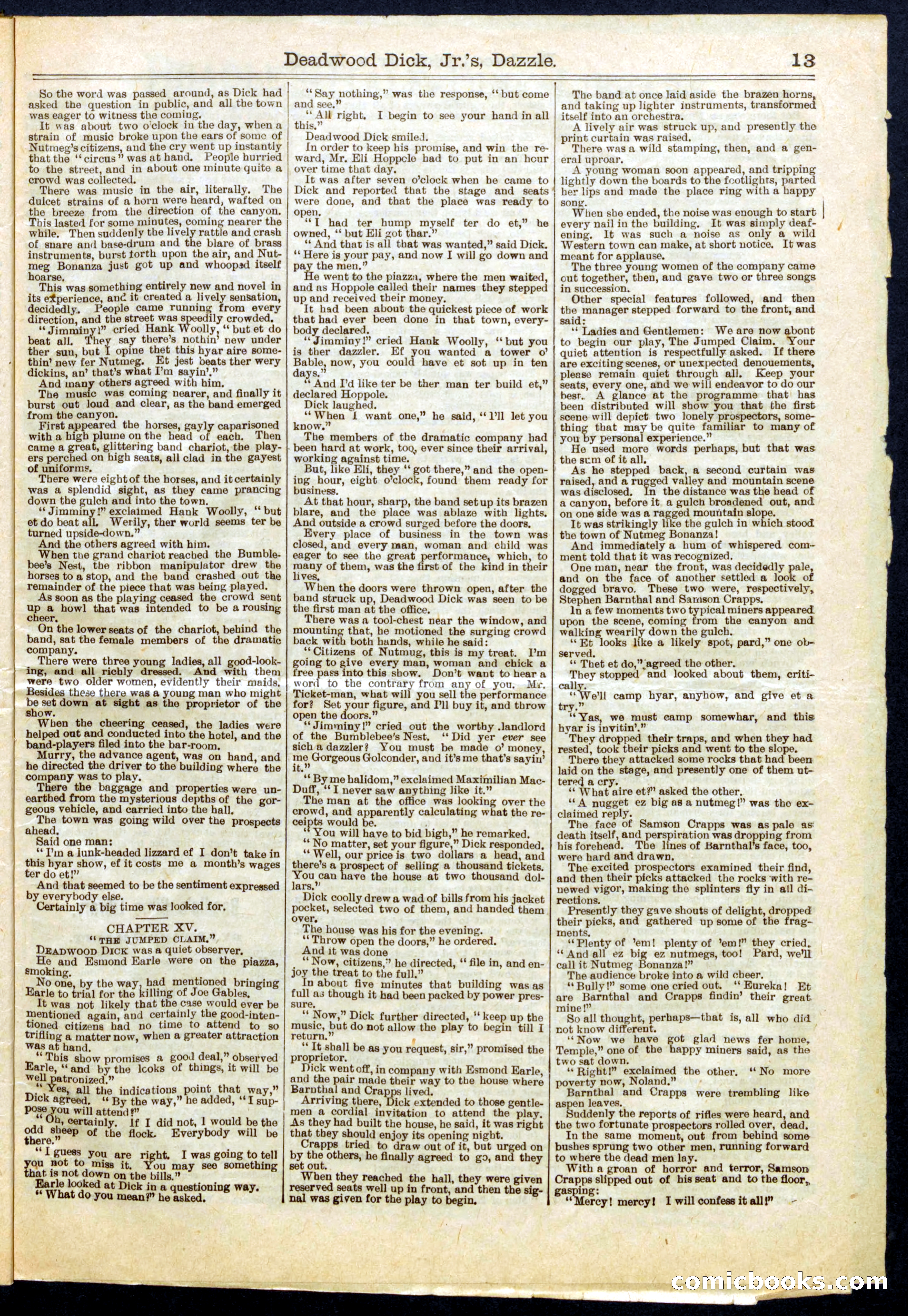
A restored page from Pulp Fiction, 1890. Page through the whole issue in the reader above.
📄 Transcribed text from this page (OCR, searchable)
Machine-transcribed from the original scan — historical spelling and the odd misread are preserved.
So the word was passed around, as Dick had | asked the question in public, and all the town was eager to witness the coming. It was about two o'clock in the day, strain of music broke upon the ears of some of Nutmeg’s citizens, and the cry went up instantly that the ‘‘circus” was at hand. People hurried to the street, and in about one minute quite a crowd was collected. There was music in the air, literally, The dulcet strains of a born were heard, wafted on the breeze from the direction of the canyon. This lasted for some minutes, coming nearer the while, Then suddenly the lively rattle and crash of snare and base-drum and the blare of brass instruments, burst forth upon the air, and Nut- meg Bonanza just got up and whoopad itself hoarse, This was something entirely new and novel in its etperience, anc it created a lively sensation, decidedly. People came running from every direction, and the street was = eng crowded, “ Jimminy)” cried Hank Woolly, “ but et do beat all. They say there’s nothin’ new under ther sun, but I opine thet this hyar aire some- thin’ new fer Nutmeg. Et jest beats ther wery dickins, an’ that’s what I’m sayin’,” And many others agreed with him. The music was coming nearer, and finally it burst out loud and clear, as the band emerged from the canyon. First appeared the horses, gayly caparisoned with a high plume on the head of each, Then came a great, glittering band chariot, the play- ers perched on high seats, all clad in the gayest of uniforms, There were eightof the horses, and it certainly was a Splendid sight, as they came prancing down the gulch and into the town. ‘‘ Jimminy!” exclaimed Hank Woolly, “‘ but et do beat all, Werily, ther world seems ter be turned upside-down,” And the others agreed with him. When the grand chariot reached the Bumble- ’s Nest, the ribbon manipulator drew the horses to a stop, and the band crashed out the remainder of the piece that was being played. As soon as the playing ceased the crowd sent uP a howl that was intended to be a rousing cheer, On the lower seats of the chariot, behind the band, sat the female members of the dramatic company. There were three young ladies, all good-look- ing, and all richly dressed. And with them were two older women, evidently their maids, Besides these there was a young man who might pe set down at sight as the proprietor of the ow. When the cheering ceased, the ladies were _ helped out and conducted into the hotel, and the band-players filed into the bar-room. Murry, the advance agent, was on hand, and he directed the driver to the building where the company was to play. There the baggage and properties were un- earthed from the mysterious depths of the gor- geous vehicle, and carried into the hall, The town was going wild over the prospects ahead, Said one man: **T’'m a lunk-headed lizzard ef I don’t take in this hyar show, ef it costs me a month’s wages ter do et!” And that seemed to be the sentiment expressed by everybody else. Certainly a big time was looked for, CHAPTER XV. ‘‘THE JUMPED CLAIM,” Drapwoop Dick was a quiet observer, He and Esmond Earle were on the piazza, rolteroa had mentioned b 0 one, by the way, had mentioned bringin Earle to trial for the killing of Joe Gables, Sp It was not likely that the case would ever be mentioned again, and certainly the good-inten- tioned citizens had no time to attend to so trifling a matter now, when a greater attraction Was at hand. “This show promises a good deal,” observed Earle, “and by the Icoks of things, it will be well patronized.” * Yes, all the indications point that way,” Dick agreed, By the way,” he added, ‘*T sup- aa will attend?” h, certainly, if I did not, 1 would be the odd sheep of the flock. Everybody will be aw ‘I guess you are right. I was going to tell ou not to miss it, You may see something tis not down on the bills.” Earle looked at i «What do you Dick in a questioning way. mean?” he asked. ‘9 ae ating tll ar % ace: ow “ Deadwood Dick, whena | this,” —— tents Hi | ‘Say nothing,” was the response, ‘* but come and see,” ‘All right, I begin to see your hand in all Deadwood Dick smiled. In order to keep his promise, and win the re- ward, Mr. Eli Hoppcle had to put in an hour over time that day, It was after seven o’clock when he came to Dick and reported that the stage and seats were done, and that the place was ready to open. ‘‘T had ter hump myself ter do et,” he owned, *‘ but Eli got thar.” ‘** And that is all that was wanted,” said Dick. ‘** Here is your pay, and now I will go down and pay the men,” e went to the piazza, where the men waited, and as Hoppole called their names they stepped up and received their money. It had been about the quickest piece of work that had ever been done in that town, every- body declared. ‘*Jimminy!” cried Hank Woolly, ‘‘ but you is ther dazzler. Ef you wanted a tower o’ coon now, you could have et sot up in ten s. ‘** And I'd like ter be ther man ter build et,” declared Hoppole. Dick laughed. ‘“When {£ want one,” he said, ‘Vl let you know,” The members of the dramatic company had been hard at work, too, ever since their arrival, working against time. But, like Eli, they ‘‘ got there,” and the open- ing hour, eight o’clock, found them ready for business. At that hour, sharp, the band set up its brazen blare, and the place was ablaze with lights. And outside a crowd surged before the doors, Every place of business in the town was closed, and every man, woman and child was eager to see the great performance, which, to roany of them, was the first of the kind in their ives, When the doors were thrown open, after the band struck up, Deadwood Dick was seen to be the first man at the office. There was a tool-chest near the window, and mounting that, he motioned the surging crowd back with both hands, while he said: “Citizens of Nutmug, this is my treat. I’m going to give every man, woman and chick a free pass into this show. Don’t want to heara word to the contrary from any of you. Mr. Ticket-man, what will you sell the performance for? Set your figure, and Pll buy it, and throw open the doors.” “‘Jimminy!” cried out the worthy landlord of the Bumblebee’s Nest, ‘‘ Did yer ever see sich a dazzler? You must be made o’ money, m4 Gorgeous Golconder, and it’s me that’s sayin’ ‘** By me halidom,” exclaimed Maximilian Mac- Doff, ‘I never saw anything like it.” The man at the office was looking over the crowd, and apparently calculating what the re- ceipts would be. ** You will have to bid bigh,” he remarked, ** ‘No matter, set your figure,” Dick responded, ‘* Well, our price is two dollars a head, and there’s a praspect of selling a thousand tickets, a ao ave the house at two thousand dol- ars,” Dick coolly drew a wad of bills from his jacket pocket, selected two of them, and handed them. over, The house was his for the evening. Throw open the doors,” he ordered. And it was done _ “Now, citizens,” he directed, “ file in, and en- joy the treat to the full.” In about five minutes that building was as ae a3 though it had been packed by power pres- ure, ‘* Now,” Dick further directed, ‘‘ keep up the music, but do not allow the play to begin till I return,” . “ It shall be as you request, sir,” promised the proprietor. Dick went off, in company with Esmond Earle, and the pair made their way to the house where Barnthal and Crapps lived. Arriving there, Dick extended to those gentle- men a cordial invitation to attend the play. As they had built the house, he said, it was right that they should enjoy its opening night. Crapps tried to draw out of it, but urged on by the others, he finally agreed to go, and they set out. When they reached the hall, they were given reserved seats well up in front, and then the sig- nal was given for the play to begin, Jr.’s, Dazzle. ERR eee eee’ —— ere 13 a —_—_— - = The band at once laid aside the brazen horns, and taking up lighter instruments, transformed itself into an orchestra. A lively air was struck up, and presently the print curtain was raised, There was a wild stamping, then, and a gen- eral uproar. A young woman soon appeared, and tripping lightly down the boards to the feotlights, parted her lips and made the place ring with a happy song. When she ended, the noise was enough to start every nailin the building. It was simply deaf- ening. It was such a noise as only a wild Western town can make, at short notice. It was meant for applause. The three young women of the company came out together, then, and gave two or three songs in succession. Other special features followed, and then the manager stepped forward to the front, and said: ‘* Ladies and Gentlemen: We are now abont to begin our play, The Jumped Claim, our quiet attention is respectfully asked. If there are exciting scenes, or unexpected denouements, please remain quiet through all. Keep your seats, every one, and we will endeavor to do our besr. A glance at the programme that has been distributed will show you that the first scene will depict two lonely prospectors, some- thing that may be quite familiar to many of you by personal experience.” He used more words perhaps, but that was the sum of it all, As he stepped back, a second curtain was raised, and a rugged valley and mountain scene was disclosed, In the distance was the head of a canyon, before it a guich broadened out, and on one side was a ragged mountain slope. It was strikingly like the gulch in which stood the town of Nutmeg Bonanza! And immediately a hum of whispered com~ ment told that it was recognized. One man, near the front, was decidedly mer and on the face of another settled a look of dogged bravo. These two were, respectively, Stephen Barnthal and Samson Crapps. ln a few moments two typical miners appeared. upon the scene, coming from the canyon and walking wearily down the gulch. ‘*Et looks like a likely spot, pard,” one ob- served. ‘* Thet et do,” agreed the other. They stopped and looked about them, criti- cally. “Well camp hyar, anyhow, and give et a ws a ‘*Yas, we must camp somewhar, and this hyar is invitin’.” They dropped their traps, and when they had rested, took their picks and went to the slope. There they attacked some rocks that had been — laid on the stage, and presently one of them ut- tered a cry. ‘‘ What aire et?’ asked the other, “A nugget ez big as a nutmeg!” was tho ex- claimed reply. The face of Samson Crapps was as pale as death itself, and perspiration was dropping from his forehead. The lines of Barnthal’s face, too, were hard and drawn, The excited prospectors examined their find, and then their picks attacked the rocks with re- newed vigor, making the splinters fly in all di- rections. Presently they gave shouts of delight, dropped their picks, and gathered up some of the frag- ments, ‘Plenty of ’em! plenty of ’em!” they cried. ‘And all ez big ez nutmegs, too! Pard, we'll call it Nutmeg Bonanza!” The audience broke into a wild cheer, ‘‘ Bully!” some one cried out. ‘‘ Eureka! Et are Barnthal and Crapps findin’ their great. mine!” | So all thought, perbaps—that is, all who did not know different. ‘‘Now we have got glad news fer home, Temple,” one of the happy miners said, as the two sat down. . ‘‘ Right!” exclaimed the other. ‘‘ No more poverty now, Noland.” ' Barntbal and Crapps were trembling like n leaves. uddenly the reports of rifles were heard, and the two fortunate prospectors rolled over, dead, In the same moment, out from behind some bushes sprung two other men, running forward to where the dead men lay. With a groan of horror and terror, Samson Crapps slipped out of his seat and to the floor, ing: “Mercy! mercy! I willconfessitall!” ~- as 4 les ae OL >