
Pulp Fiction, 1890 · page 2 of 16
Beadle's Half Dime Library No. 662 — page 2: what you’re looking at
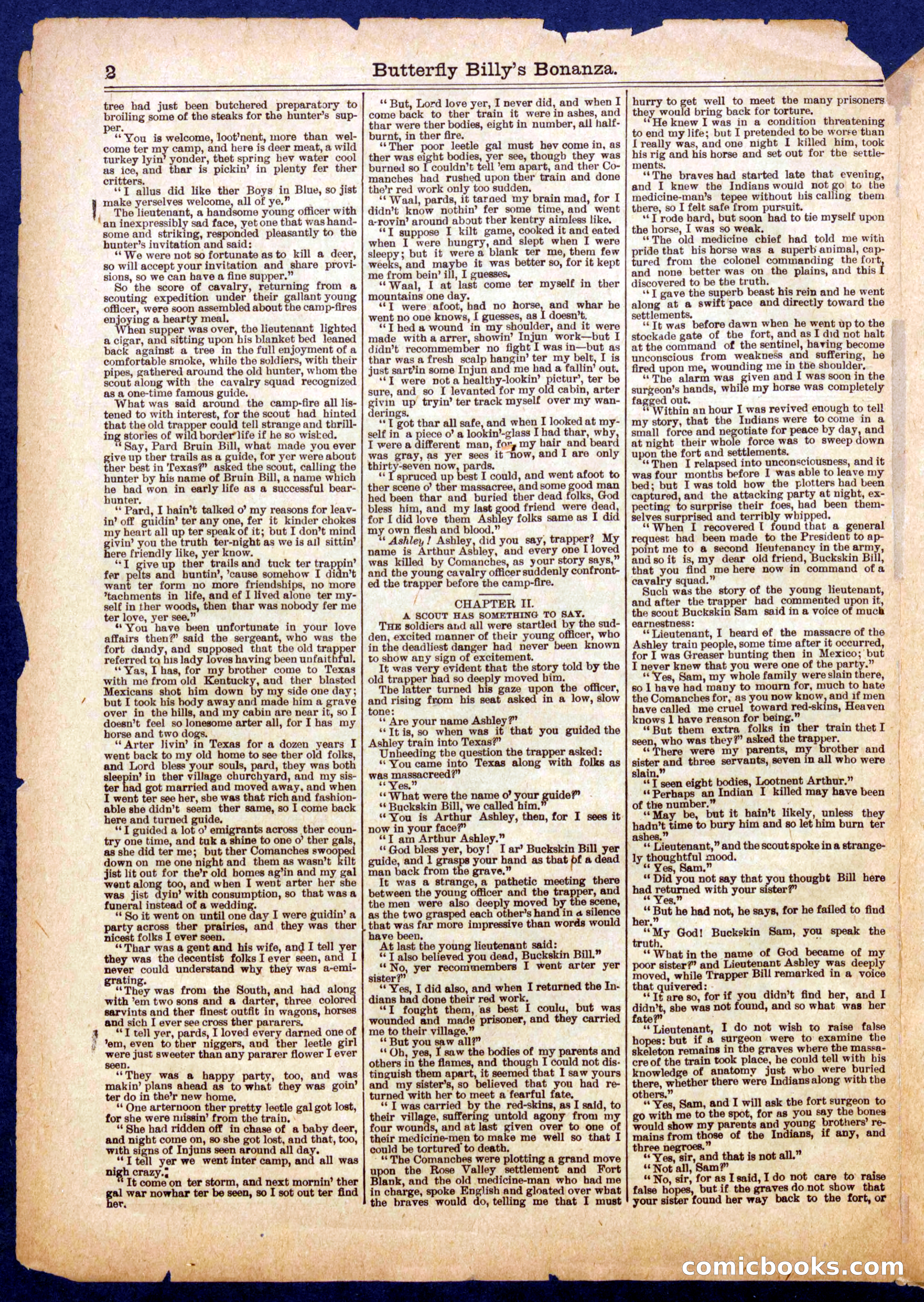
A restored page from Pulp Fiction, 1890. Page through the whole issue in the reader above.
📄 Transcribed text from this page (OCR, searchable)
Machine-transcribed from the original scan — historical spelling and the odd misread are preserved.
> a < * 2 Butterfly Billy’s Bonanza. tree had just been butchered preparatory to broiling some of the steaks for the hunter’s sup- P. ‘‘ You is welcome, loot’nent, more than wel- come ter my camp, and here is deer meat, a wild turkey lyin’ yonder, thet spring hev water cool as ice, and thar is pickin’ in plenty fer ther critters. ‘‘T allus did like ther Boys in Blue, so jist make yerselves welcome, all of ye.” The lieutenant, a handsome young officer with ‘an inexpressibly sad face, yet one that was hand- some and striking, responded pleasantly to the bunter’s invitation and said: ‘‘ We were not so fortunate as to kill a deer, so will accept your invitation and share provi- sions, so we can have a fine supper.” So the score of cavalry, returning from a scouting expedition under their gallant young officer, were soon assembled about the camp-fires enjoying a hearty meal. Vhen supper was over, the lieutenant lighted a cigar, and sitting upon his blanket bed leaned back against a tree in the full enjoyment of a comfortable smoke, while the soldiers, with their pipes, gathered around the old hunter, whom the scout along with the cavalry squad recognized as a one-time famous guide. What was said around the camp-fire all lis- tened to with interest, for the scout had hinted that the old trapper could tell strange and thrill- ing stories of wild border’life if he so wisked. ‘Say, Pard Bruin Bill, what made you ever give up ther trails as a guide, for yer were about ther best in Texas?” asked the scout, calling the hunter by his name of Bruin Bill, a name which he had won in early life as a successful bear- hunter. ‘* Pard, I hain’t talked o’ my reasons for leav- in’ off guidin’ ter any one, fer it kinder chokes my heart all up ter speak of it; but I don’t mind givin’ you the truth ter-night as we is all sittin’ here friendly like, yer know. “TI give up ther trails and tuck ter trappin’ fer pelts and huntin’, ’cause somehow I didn't want ter form no more friendships, no more "tachments in life, and ef I lived alone ter my- self in ther woods, then thar was nobody fer me ter love, yer see.” “You have been unfortunate in your love gh or yt “ge ent then? who was the ort dandy, and sup that the old trapper referred ta his lady loves having been unfaithful. ‘* Yas, I has, for my brother come to Texas with me from old Kentucky, and ther blasted Mexicans shot him down by my side one day; but I took his hody away and made him a grave over in the hills, and my cabin are near it, so I doesn’t feel so lonesome arter all, for I has my horse and two dogs. ‘Arter livin’ in Texas for a dozen years I went back to my old home to see ther old folks, and Lord bless your souls, pard, they was both sleepin’ in ther village cakes ne and my sis- ter had got married and moved away, and when I went ter see her, sbe was that rich and fashion- able she didn’t seem ther same, so I come back here and turned guide, ‘*T guided a lot o’ emigrants across ther coun- try one time, and tuk a shine to one o’ ther gals as she did ter me; but ther Comanches swoo down on me one night and them as wasn’t kilt jist lit out for the’r old homes ag’in and my gal went along too, and when I went arter her she was jist dyin’ with consumption, so that was a funeral instead of a wedding. ‘‘ So it went on until one day I were guidin’ a party across ther prairies, and they was ther nicest folks I ever seen. “Thar was a gent and his wife, and I tell yer they was the decentist folks I ever seen, and I never could understand why they was a-emi- grating. “They was from the South, and had alon with ’em two sons and a darter, three colore¢ sarvints and ther finest outfit in wagons, horses and sich I ever see cross ther pararers. “‘T tell yer, pards, I loved every darned one of ’em, even to ther niggers, and ther leetle girl were just sweeter than any pararer flower I ever seen. ‘They was a happy party, too, and was makin’ plans ahead as to what they was goin’ ter do in the’r new home. ** One arternoon ther pretty leetle gal got lost, for she were missin’ from the train, ‘‘ She had ridden off in chase of a baby deer, and night come on, so she got lost, and that, too, with signs of Injuns seen around all day. a tell yer we went inter camp, and all was Cc - razy. It come on ter storm, and next mornin’ ther gal war nowhar ter be seen, so I sot out ter find er. ‘¢ But, Lord love yer, I never did, and when I come back to ther train it were in ashes, and thar were ther bodies, eight in number, all half- burnt, in ther fire. ** Ther r leetle gal must hev come in, as ther was eight bodies, yer see, though they was burned so I couldn’t tell ’em apart, and ther Co- manches had rushed upon ther train and done the’r red work only too sudden, ‘‘ Waal, pards, it taraed my brain mad, for I didn’t know nothin’ fer some time, and went a-rovin’ around about ther kentry aimless like. ‘TI suppose I kilt game, cooked it and eated when I were hungry, and slept when I were sleepy; but it werea blank ter me, them few weeks, and maybe it was better so, for it kept me from bein’ ill, I guesses, ‘‘ Waal, I at last come ter myself in ther mountains one day. ‘‘T were afoot, had no horse, and whar he went no one knows, I guesses, as I doesn’t, ‘‘T hed a wound in my shoulder, and it were made with a arrer, showin’ Injun work—but I didn’t recommember no fight I was in—but as thar was afresh scalp hangin’ ter my belt, I is just sarv’in some Injun and me had a fallin’ out. ‘‘T were not a healthy-lookin’ pictur’, ter be sure, and so I levanted for my old cabin, arter givin up tryin’ ter track myself over my wan- derings. ‘*T got thar all safe, and when I looked at my- self in a piece o’ a lookin’-glass [ had thar, why I were a different man, fory my hair and beard was gray, as yer sees it now, andl are only thirty-seven now, pards. ‘‘T spruced up best I could, and went afoot to ther scene o’ ther massacree, and some good man hed been thar and buried ther dead folks, God bless him, and my last good friend were dead, for [ did love them Ashley folks same as I did my own flesh and blood.” “* Ashley ! Ashley, did you say, trapper? My name is Arthur Ashley, and every one | loved was killed by Comanches, as your story says,” and the young cavalry officer suddenly confront- ed the trapper before the camp-fire. CHAPTER II. A SCOUT HAS SOMETHING TO SAY. THE soldiers and all were startled by the sud- den, excited manner of their young officer, who in the deadliest danger had never been known to show ary sign of excitement. It was very evident that the story told by the old trapper had so deeply moved him. The latter turned his gaze upon the officer, and rising from his seat asked in a low, slow tone: ‘* Are your name Ashley?” ‘‘It is, so when was it that you guided the Ashley train into Texas?” Unheeding tbe question the trapper asked: ‘‘ You came into Texas along with folks as was massac se Yes. ” ‘¢ What were the name o’ your guide ‘¢ Buckskin Bill, we called him, ‘You is Arthur Ashley, then, for I sees it now in your face?” ‘‘T am Arthur Ashley.” ‘‘ God bless yer, boy! I ar’ Buckskin Bill yer guide, and | grasps your hand as that bf a dead man back from the grave.” It was a strange, a pathetic meeting there between the young officer and the trapper, and the men were also deeply moved by the scene, as the two grasped each other’s hand in a silence that was far more impressive than words would have been, At last the young lieutenant said: | “T also believed you dead, Buckskin Bill.” ‘‘ No, yer recommembers I went arter yer sister?” ‘Yes, I did also, and when I returned the In- dians had done their red work. “T fought them, as best [ coulu, but was wounded and made prisoner, and they carried me to their village.” ‘* But you saw all?” ‘¢ Oh, yes, I saw the bodies of my parents and others in the flames, and ee I could not dis- tinguish them apart, it seemed that I saw yours and my sister’s, so believed that you had re- turned with her to meet a fearful fate, ‘‘ T was carried by the red-skins, as I said, to their village, suffering untold agony from my four wounds, and at last given over to one of their medicine-men to make me well so that I could be tortured to death. ‘‘The Comanches were plotting a grand move ee the Rose Valley settlement and Fort Blank, and the old medicine-man who had me in charge, spoke English and gloated over what the braves would do, telling me that I must ‘ hurry to get well to meet the many prisoners” they would bring back for torture, ‘“He knew I was in a condition threatening to end my life; but I pretended to be worse than [ really was, and one night I killed him, took his rig and his horse and set out for the settle- ments. ‘‘The braves had started late that evening, and I knew the Indians would not go to the medicine-man’s tepee without his calling them there, so I felt safe from pursuit. ‘*T rode bard, but soon had to tie myself upon the horse, I was so weak, ‘‘The old medicine chief had told me with pride that his horse was a superb avimal, cap- tured from the colonel commanding the fort and none better was on the plains, and this discovered to be the truth. ‘*T gave the superb beast his rein and he went along at a swift pace and directly toward the settlements. ‘“Tt was before dawn when he went up to the stockade gate of the fort, and as I did not halt at the command of the sentinel, having become unconscious from weakness and suffering, he fired upon me, wounding me in the shoulder, “The alarm was given and I was soon in the surgeon’s hands, while my horse was completely fagged out. ‘Within an hour I was revived enough to tell my story, that the Indians were tocome in a small force and negotiate for peace by day, and at night their whole force was to sweep down upon the fort and settlements. _ “Then I relapsed into unconsciousness, and it was four months before I was able to leave my bed; but I was told how the plotters had been captured, and the attacking party at night, ex- pecting to surprise their foes, had been them- selves surprised and terribly whipped. ‘‘ When I recovered I found that a general request had been made to the President to ap- point me to a second lieutenancy in the army, and so it is, my dear old friend, Buckskin Bill, that you find me here now in command ofa cavalry squad.” Such was the story of the young lieutenant, and after the trapper bad commented upon it, the scout Buckskin Sam said in a voice of much earnestness: ‘‘Lieutenant, I heard ef the massacre of the Ashley train people, some time after it occurred, for I was Greaser bunting then in Mexico; but I never knew that you were one of the inde Ee ‘Yes, Sam, my whole family were slain there, so 1 have had many to mourn for, much to hate the Comanches for, as you now know, and if men have called me cruel toward red-skins, Heaven knows 1 have reason for being.” ‘But them extra folks in ther train thet I seen, who was they?” asked the wate. ta “There were my parents, my brother and sister and three servants, seven in all who were slain.” “T seen eight bodies, Lootnent Arthur.” ‘Perhaps an Indian I killed may have been of the number.” ‘‘May be, but it hain’t likely, unless they hadn’t time to bury him and so let him burn ter ashes. ‘¢ Lieutenant,” and the scout spoke in a strange- ly thoughtful mood. ** Yes, Sam.” - Did you not say that you thougbt Bill here had —— with your sister?” ” But he had not, he says, for he failed to find her, PaaK ot God! Buckskin Sam, you speak the ‘‘ What in the name of God became of my poor sister?’ and Lieutenant Ashley was deeply moved, while Trapper Bill remarked in a voice that quivered: ‘Tt are so, for if you didn’t find her, and I didn’t, she was not found, and so what was her fate?” ‘‘ Lieutenant, I do not wish to raise false hopes: but if a surgeon were to examine the skeleton remains in the graves where the massa- ere of the train took place, he could tell with bis knowledge of anatomy just who were buried there, whether there were Indians along with the others.” “Yes, Sam, and I will ask the fort surgeon to go with me to the spot, for as you Say the bones would show my parents and young brothers’ re- mains from those of the Indians, if any, and three negroes. ‘Yes, sir, and that is not all.” ‘‘ Not all, Sam?’ “No, sir, for as Isaid, Ido not care to raise false ho but if the graves do not show that your sister found her way back to the fort, or cbooks.com A a te a 7“ DN