
Pulp Fiction, 1890 · page 4 of 16
Beadle's Half Dime Library, No. 660 — page 4: what you’re looking at
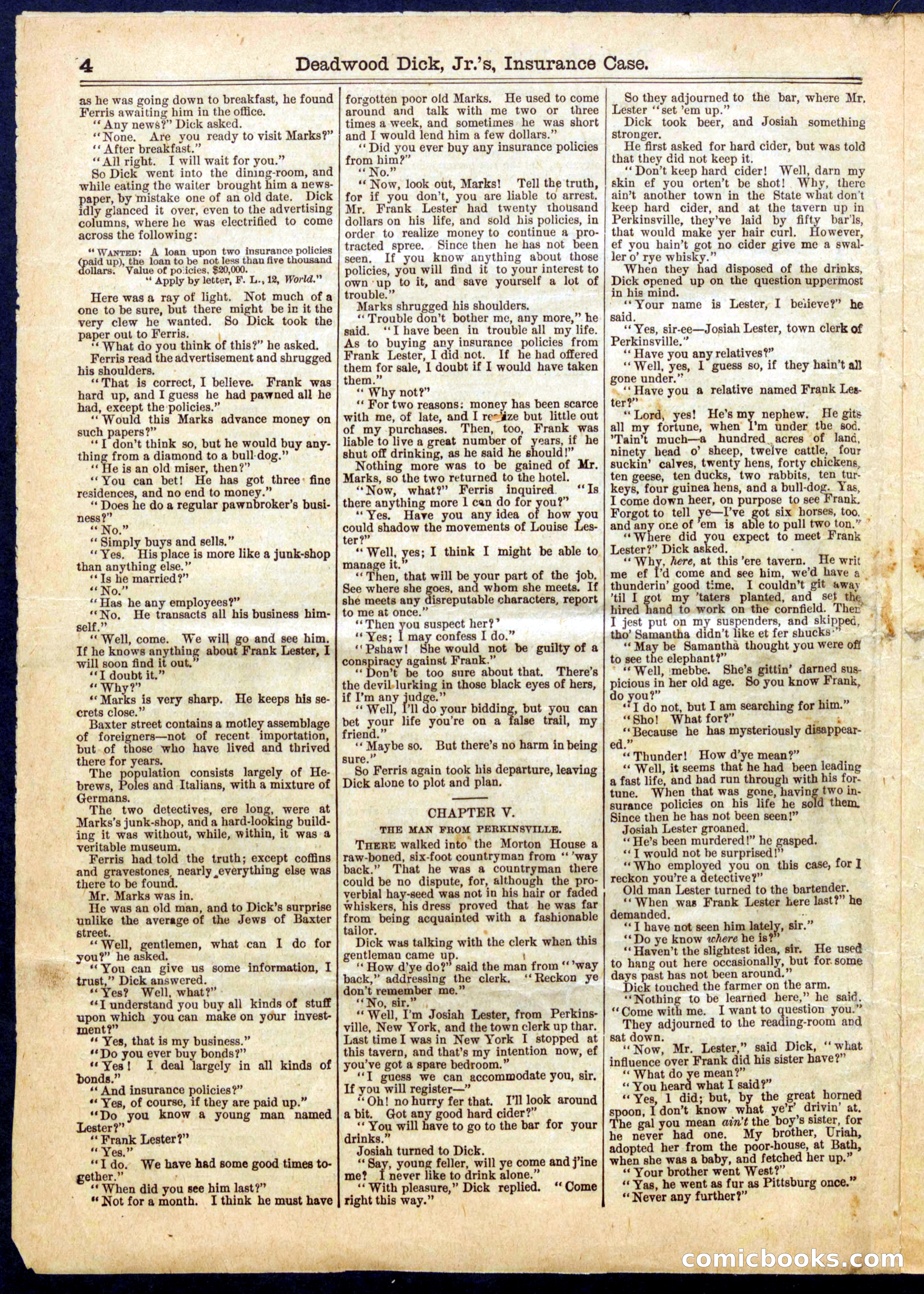
A restored page from Pulp Fiction, 1890. Page through the whole issue in the reader above.
📄 Transcribed text from this page (OCR, searchable)
Machine-transcribed from the original scan — historical spelling and the odd misread are preserved.
4 Deadwood Dick, Jr.’s, Insurance Case. as he was going down to breakfast, he found Ferris awaiting him in the office. ** Any news?” Dick asked. ‘‘None. Are you ready to visit Marks?” ‘« After breakfast.” “Allright. I will wait for you.” So Dick went into the dining-room, and while eating the waiter brought him a news- paper, by mistake one of an old date. Dick idly glanced it over, even to the advertising columns, where he was electrified to come across the following: “Wantep: A loan upon two insurance policies a up), the loan to be not less than five thousand Ollars. Value of po:icies, $20,000. ‘“* Apply by letter, F. L., 12, World.” Here was a ray of light. Not much ofa one to be sure, but there might be in it the very clew he wanted. So Dick took the paper out to Ferris. ’ ‘¢ What do you think of this?” he asked. Ferris read the advertisement and shrugged his shoulders. | ‘That is correct, I believe. Frank was hard up, and I guess he had pawned all he had, except the policies.” ‘‘Would this Marks advance money on such papers?” ) ‘I don’t think so, but he would buy any- thing from a diamond to a bull-dog.” ‘¢ He is an old miser, then?” ‘“‘“You can bet! He has got three: fine residences, and no end to money.” ‘Does he do a regular pawnbroker’s busi- ness?” “é No.” “ Simply buys and sells,” ‘‘Yes, His place is more like a junk-shop than anything else.” | **Is he married?” Nog’ ‘‘Has he any employees?” ‘‘No. He transacts all his business him- self.” - "Well, come. We will go and see him. If he knows saything about Frank Lester, I will soon find it out.” ‘*T doubt it.” se Why?” ‘* Marks is very sharp. He keeps his se- crets close.” Baxter street contains a motley assemblage of foreigners—not of recent importation, but.of those who have lived and thrived there for years. The population consists largely of He- brews, Poles and Italians, with a mixture of Germans. The two detectives, ere long, were at Marks’s junk-shop, and a hard-looking build- ing it was without, while, within, it was a veritable museum, Ferris had told the truth; except coffins and gravestones, nearly everything else was there to be found. Mr. Marks was in. witha He was an old man, and to Dick’s surprise unlike the average of the Jews of Baxter street. | ‘‘Well, gentlemen, what can I do for you?” he asked. ‘‘You can give us some information, I - trust,” Dick answered. ‘“Yes? Well, what?” - ay “‘T understand you buy all kinds of st upon which you can make on your invest- ment?” ‘* Yes, that is my business.” **Do you ever buy bonds?” ag Yes | I deal largely in all kinds of « And insurance policies?” ** Yes, of course, if they are paid up.” “Do you know a young man named r . . Frank Lester?” he do. We have had some good times to- ether.” : ‘* When did you see him last?” . “Not fora month. I think he must have forgotten poor old Marks. He used to come around and talk with me two or three times a week, and sometimes he was short and I would lend him a few dollars.” ‘‘Did you ever buy any insurance policies from him?” se Bad ‘« Now, look out, Marks! Tell the truth, for if you don’t, you are liable to arrest, Mr. Frank Lester had twenty thousand dollars on his life, and sold his policies, in order to realize money to continue a pro- tracted spree. Since then he has not been seen. If you know anything about those policies, you will find it to your interest to own up to it, and save yourself a lot of trouble.” Marks shrugged his shoulders. ‘Trouble don’t bother me, any more,” he said. ‘‘I have been in trouble all my life. As to buying any insurance policies from Frank Lester, I did not. If he had offered them for sale, 1 doubt if I would have taken them.” ‘* Why not?” ‘* For two reasons: money has been scarce with me, of late, and I pias but little out of my purchases. Then, too, Frank was liable to live a great number of years, if he shut off drinking, as he said he should!” Nothing more was to be gained of Mr. Marks, so the two returned to the hotel. “Now, what?’ Ferris inquired. ‘Is there anything more | cen do for you?” ‘Yes. Have you any idea of how you fe shadow the movements of Louise Les- ter?” ‘“* Well, yes; I think I might be able to manage it.” ‘‘Then, that will be your part of the job, See where she goes, sad whom she meets. If she meets any disreputable characters, report to me at once.” ‘‘Then you suspect her?’ ‘¢-Yes: mar confess I do,” ‘‘Pshaw! She would not be guilty of a conspiracy against Frank.” ‘‘Don’t be too sure about that. There’s the devil-lurking in those black eyes of hers, if I’m any jad e.”’ ‘* Well, V’ll do your pee but you can bet Neg life you're on a false trail, my friend.” ‘‘Maybe so. But there’s no harm in being sure.” So Ferris again took his departure, leaving Dick alone to plot and plan. CHAPTER V. THE MAN FROM PERKINSVILLE. THERE walked into the Morton House a raw-boned, six-foot countryman from ‘‘ way back.” That he was a countryman there could be no dispute, for, although the pro- verbial hay-seed was not in his hair or faded whiskers, his dress proved that he was far rot being acquainted with a fashionable tailor. . Dick was talking with the clerk when this gentleman came up. | ‘* How d’ye do?” said the man from ‘‘’way back,” addressing the clerk, ‘‘Reckon ye don't re me.” } ‘*No, sir.” , ‘‘ Well, I’m Josiah Lester, from Perkins- ville, New York, and the town clerk up thar. Last time I was in New York I stopped at this tavern, and that’s my intention now, ef you’ve got a spare bedroom.” “T guess we can accommodate you, sir. If you will register—” ‘Oh! no hurry fer that. I'll look around a bit. Got any good hard cider?” * You will have to go to the bar for your drinks. Josiah turned to Dick. “Say, young feller, will ye come and j’ine me? I never like to drink alone.” ‘‘ With pleasure,” Dick replied. right this way.” ‘* Come : ¥ > » 's ° Ree oe SP ee HE rrr — °0°0bhwS ee ee ee nn — ee eee Ee —— So they adjourned to the bar, where Mr, ester ‘‘set ’em up.” Dick took beer, and Josiah something stronger. He first asked for hard cider, but was told that they did not keep it. ‘‘Don’t keep hard cider! Well, darn my skin ef you orten’t be shot! Why, there ain’t another town in the State what don't keep hard cider, and at the tavern up in Perkinsville, they’ve laid by fifty bar'ls, that would make yer hair curl. However, ef you hain’t got no cider give me a swal- ler o’ rye whisky.” When they had disposed of the drinks, Dick opened up on the question uppermost in his mind. ‘‘Your name is Lester, I beiieve?”’ he said. ‘‘- Yes, sir-ee—Josiah Lester, town clerk of Perkinsville.” ‘* Have you any relatives?” ‘‘ Well, yes, 1 guess so, if they hain’t a} gone under.” - ; Have you a relative named Frank Les- ps Lord; yes! He’smy nephew. He gits all my fortune, when I’m under the sod. ’Tain’t much—a hundred_acres of land, ninety head o’ sheep, twelve cattle, four suckin’ calves, twenty hens, forty chickens, ten geese, ten ducks, two rabbits, ten_tur- keys, four guinea hens, and a bull-dog. Yas, I come down heer, on purpose to see I'rank, Forgot to tell ye—l've and an ‘Where did Lester?” Dick a ze8 expect to meet Frank sked, ““Why, here, at this’ere tavern. He writ thunderin’ good time, I couldn’t git away til I got my ’taters planted, and set hired hand to work on the cornfield. T I jest put on my suspenders, and skipped, tho’ Samantha didn’t like et fer shucks’” . ‘‘May be Samantha thought you were off to see the elephant?” oS ' «Well, :mebbe. She’s gittin’ darned sus- picious in her old age. So you know Frank, do yout” . ‘TY do not, but I am searching for him.” “Sho! What for?” ae OY ca he has mysteriously disappear- e ” a ““Thunder! How d’ye mean?” , ‘“‘ Well, it seems that he had been leading a fast life, and had run through with his for- tune. When that was gone, having two in- surance policies on his life he sold them, Since then he has not been seen!” Josiah Lester groaned. ‘“‘He’s been murdered!” he gasped. ‘‘T would not be surprised!” “Who employed you on this case, for] reckon you're a detective?” Old man Lester turned to the bartender. ‘‘When was Frank Lester here last?” he Peri “ -. ‘*T have not seen him. , sir.” **Do ye know where wa . ‘“‘ Haven't the slightest idea, sir. He used to hang out here occasionally, but for. some days past has not been around.” Dick touched the farmer on the arm. ‘‘Nothing to be learned here,” he said. “Come with me. I want to “Sem you.” They adjourned to the reading-room and sat down. : ’ ‘Now, Mr. Lester,” said Dick, * what influence over Frank did his sister have?” ‘What do ye mean?” ‘You heard what I said?” “Yes, 1 did; but, by the great horned spoon, | don’t know what ye’r’ drivin’ at, e gal you mean ain’t the boy’s sister, for he never had one, My brother, Uriah, adopted her from the poor-house, at Bath, when she was a baby, and fetched her up.” “Your brother went West?” ‘‘-Yas, he went as fur as “Never any further?” ’ ‘ J . - } : i . ies . ~~ ECOmMmIicnvood (Jy ot six horses, too, . ore of ‘em is able to pull two ton.” ° me ef I’d come and see him, we'd have q ys her’ 4 A Pittsburg once.” se ae” r,t | | ee a _ y