
Pulp Fiction, 1890 · page 2 of 16
Beadle's Half Dime Library, No. 660 — page 2: what you’re looking at
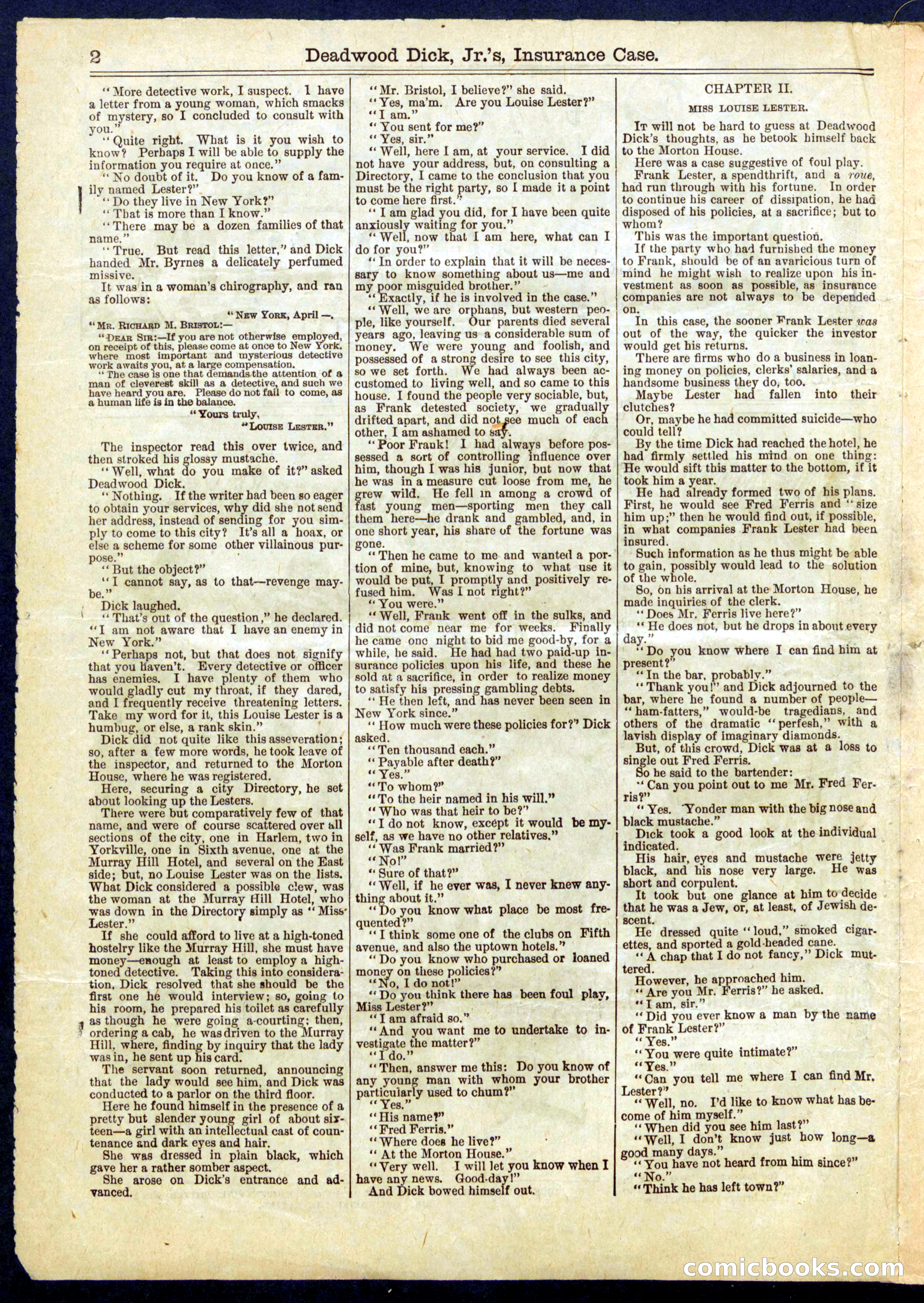
A restored page from Pulp Fiction, 1890. Page through the whole issue in the reader above.
📄 Transcribed text from this page (OCR, searchable)
Machine-transcribed from the original scan — historical spelling and the odd misread are preserved.
2 ed om —) > Deadwood Dick, Jr.’s, Insurance Case. ‘More detective work, I suspect. 1 have a letter from a young woman, which smacks of mystery, so I concluded to consult with rou.” ate Quite right. What is it you wish to know? Perbaps I will be able to supply the information you require at once.” “No doubt of it. Do you know of a fam- ily named Lester?” ‘Do they live in New York?” ‘“Tbat is more than I know.” ‘There may be a dozen families of that name.” “True. But read this letter,” and Dick handed Mr, Byrnes a delicately perfumed missive. It was in a woman’s chirography, and ran as follows: “New York, April —. “Mr. RicHARD M, BRISsTOL:— “Dear Str:—If you are not otherwise employed, on receipt of this, please come at once to New York. where most important and mysterious detective work awaits you, at a large compensation. ‘* The case is one that demands.the attention of a man of cleverest skill as a detective, and such we have heard you are. Please do not fail to come, as a human life is in the balance. “* Yours truly, * Louise LESTER.” The inspector read this over twice, and then stroked his glossy mustache. ‘‘Well, what do you make of it?” asked Deadwood Dick. ‘Nothing. Ifthe writer had been so eager to obtain your services, why did she not send her address, instead of sending for you sim- ply to come to this city? It’s all a hoax, or else a scheme for some other villainous pur- a” , ‘* But the object?” s ‘‘T cannot say, as to that—revenge may- e. ” Dick laughed. ‘ That’s out of the question,” he declared. “T am not aware that I have an enemy in New York.” ‘*Perhaps not, but that does not signify that you Haven’t. Every detective or officer has enemies. I have plenty of them who would gladly cut my throat, if they dared, and I frequently receive threatening letters. Take my word for it, this Louise Lester is a humbug, or else, a rank skin.” Dick did not quite like this asseveration; so, after a few more words, he took leave of the inspector, and returned to the Morton House, where he was registered, Here, securing a city Directory, he set about looking up the Lesters. There were but comparatively few of that name, and were of course scattered over all sections of the city, one in Harlem, two in Yorkville, one in Sixth avenue, one at the Murray Hill Hotel, and several on the East side; but, no Louise Lester was on the lists. What Dick considered a possible clew, was the woman at the Murray dill Hotel, who was down in the Directory simply as ‘‘ Miss: Lester.” | If she could afford to live at a high-toned hostelry like the Murray Hill, she must have money—enough at least to employ a high- toned detective. Taking this into considera- tion, Dick resolved that she should be the first one he would interview; so, going to his room, he prepared his toilet as carefully as though he were going a-courting; then, ordering a cab, he wasdriven to the Murray Hill, where, finding by inquiry that the lady was in, he sent up his card. The servant soon returned, announcing that the lady would see him, and Dick was conducted to a parlor on the third floor. Here he found himself in the presence of a pretty but slender young girl of about six- teen—a girl with an intellectual cast of coun- tenance and dark eyes and hair. She was dressed in plain black, which gave her a rather somber aspect. She arose on Dick’s entrance and ad- vanced, ‘Mr. Bristol, I believe?” she said. ‘Yes, ma’m. Are you Louise Lester?” cé I am.” ‘You sent for me?” te ey ‘‘ Well, here I am, at your service. I did not have your address, but, on consulting a Directory, I came to the conclusion that you must be the right party, so | made it a point to come here first.” ‘‘T am glad you did, for I have been quite anxiously waiting for you.” ‘* Well, now that I am here, what can I[ do for you?” ‘* In order to explain that it will be neces- sary to know something about us—me and my pose misguided brother.” ‘« Exactly, if he is involved in the case.”’ ‘‘Well, we are orphans, but western peo- ple, like yourself. ur parents died several years ago, leaving us a considerable sum of money. We were young and foolish, and possessed of a strong desire to see this city, so we set forth. e had always been ac- customed to living well, and so came to this house. I found the people very sociable, but, as Frank detested society, we gradually drifted apart, and did not.see much of each other, I am ashamed to a ‘Poor Frank! I had always before pos- sessed a sort of controlling influence over him, though I was his junior, but now that he was in a measure cut loose from me, he rew wild. He fell in among a crowd of ast young men—sporting men they call them here—he drank and gambled, and, in one short year, his share vf the fortune was one. aoe Then he came to me and wanted a por- tion of mine, but, knowing to what use it would be put, I promptly and positively re- fused him. Was I not right?” ‘* You were.” ‘‘Well, Frank went off in the sulks, and did not come near me for weeks. Finally he came onc night to bid me good-by, for a while, he said. He had had two paid-up in- surance policies upon his life, and these he sold at a sacrifice, in order to realize money to satisfy his pressing gambling debts. ‘‘ He then left, and has never been seen in New York since.” ‘‘ How much were these policies for?” Dick asked. ‘“Ten thousand each.” ‘‘ Payable after death?” Le, “To whom?” ‘‘To the heir named in his will.” ‘‘ Who was that heir to be?” ‘‘I do not know, excépt it would be my- self, as we have no other relatives,” ‘¢ Was Frank married?” sé No!” “Sure of that?” ‘‘Well, if he ever was, I never knew any- thing about it.” ‘Do you know what place be most fre- quented?” ‘‘T think some one of the clubs on Fifth avenue, and also the uptown hotels.” ‘To you know who purchased or loaned money on these policies?” ‘*No, I do not!” ‘‘Do you think there has been foul play, Miss Lester?” : “‘T am afraid so.” ‘And you want me to undertake to in- vestigate the matter?” : se if do. ”» ‘“Then, answer me this: Do you know of any young man with whom your brother ah ns used to chum?” ce es ” ‘‘His name?” ‘‘ Fred Ferris.” ‘¢ Where does he live?” ‘¢ At the Morton House.” “Very well. I will let you know when I have any news. Good-day!” And Dick bowed himself out. OS - -+--—_e----_---_— —-———— os eee—-,— A eae see - ls i LL LLL ALLL LE LALA LLL A LN come of him myself. CHAPTER II. MISS LOUISE LESTER. It will not be hard to guess at Deadwoaod Dick’s thoughts, as he betook himself back to the Morton House. Here was a case suggestive of foul play. Frank Lester, a spendthrift, and a roue, had run through with his fortune. In order to continue his career of dissipation, he had disposed of his policies, at a sacrifice; but to whom? This was the important question. If the party who had furnished the money to Frank, should be of an avaricious turn of mind he might wish to realize upon his in- vestment as soon as possible, as insurance companies are not always to be depended on. In this case, the sooner Frank Lester was out of the way, the quicker the investor would get his returns. There are firms who do a business in loan- ing money on policies, clerks’ salaries, and a handsome business they do, too. Maybe Lester had fallen clutches? Or, maybe he had committed suicide—who | could tell? By the time Dick had reached the hotel, he had firmly settled his mind on one thing: He would sift this matter to the bottom, if it took him a year. He had already formed two of his plans. First, he would see Fred Ferris and ‘size him up;” then he would find out, if possible, in what companies Frank Lester had been insured. Such information as he thus might be able to gain, possibly would lead to the solution of the whole. So, on his arrival at the Morton House, he made inquiries of the clerk. ‘‘ Does Mr, Ferris live here?” ? ‘* He does not, but he drops in about every a Be Do you know where I can find him at © present?” “In the bar, probably.” ‘‘Thank you!” and Dick adjourned to the bar, where he found a number of people— ‘‘ham-fatters,” would-be tragedians, and others of the dramatic ‘‘perfesh,” With a lavish display of imaginary diamonds. But, of this crowd, Dick was at a loss to single out Fred Ferris. o he said to the bartender: : Page you point out to me Mr. Fred Fer- ris ‘‘Yes, “Yonder man with the big nose and black mustache.” ie Dick took a good look at the individual indicated. : His hair, eyes and mustache were jetty black, and his nose very large. € was short and corpulent. ; It took but one glance at him to decide that he was a Jew, or, at least, of Jewish de- scent. : He dressed quite ‘‘loud,” smoked Cigar- ettes, and sported a gold-headed cane. ‘‘A chap that I do not fancy,” Dick mut- tered. ; However, he approached him. « Are you Mr. Ferris?” he asked. «Tam, sir.” ‘Did you ever know a man by the name of Frank Lester?” gh i ee ‘You were quite intimate?” bs ay ‘Can you tell me where I can find Mr, Lester?” | ‘* Well, no. into their I'd like to know what has be- ‘When did you see him last?” ‘‘Well, I don’t know just how long—a ood many days.” ier ‘“You have not heard from him since?” ac ”? ‘‘Think he has left town?” fe IOOK