
Pulp Fiction, 1878 · page 9 of 16
Beadle's Half Dime Library, No. 66 — page 9: what you’re looking at
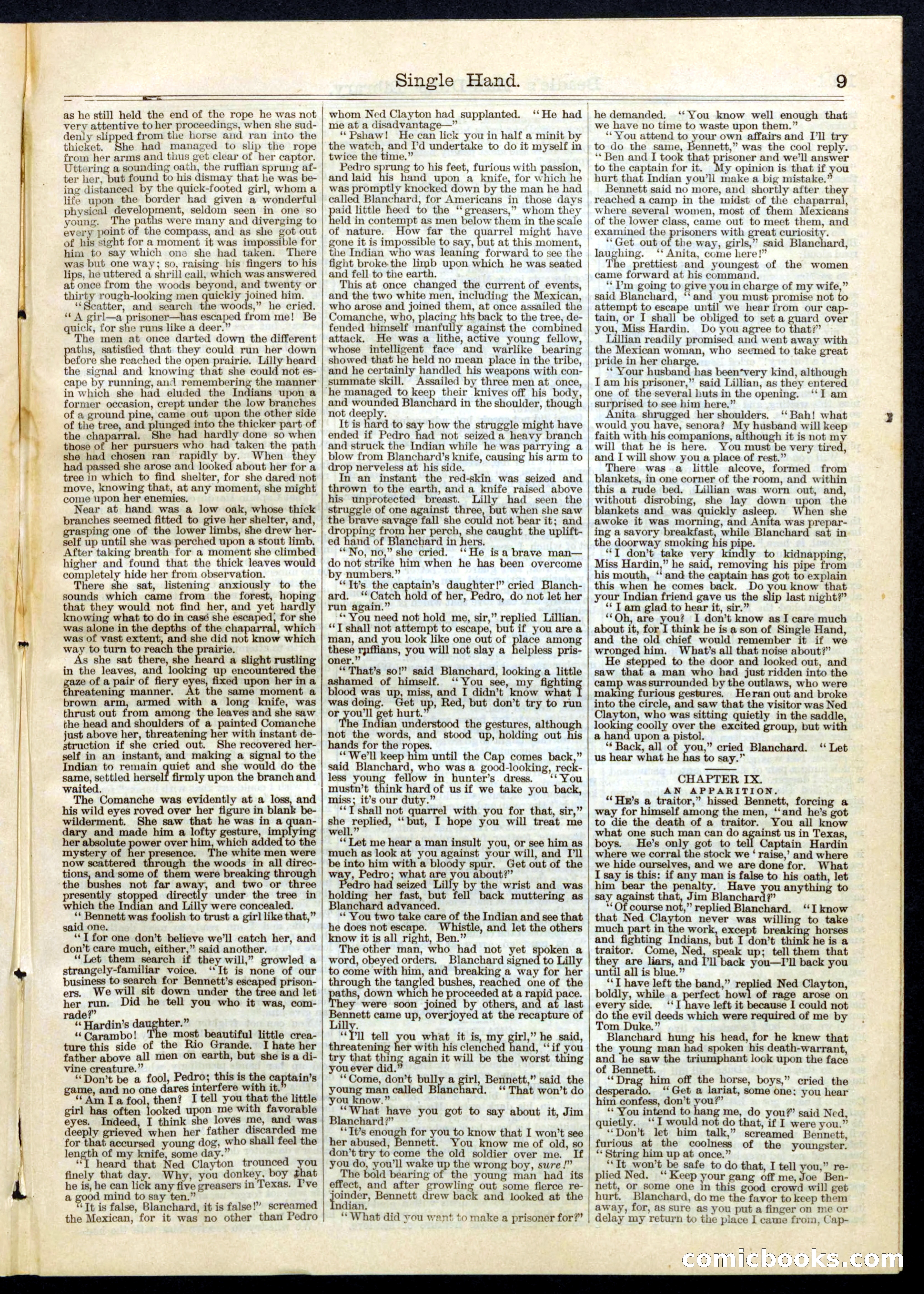
A restored page from Pulp Fiction, 1878. Page through the whole issue in the reader above.
📄 Transcribed text from this page (OCR, searchable)
Machine-transcribed from the original scan — historical spelling and the odd misread are preserved.
host RECTOR ET a CE ——_— as SE as he still held the end of the rope he was not | whom Ned Clayton had supplanted. ‘‘He had very attentive to her proceedings, when she sud- denly slipped from the horse and ran into the thicket. She had managed to slip the rope from her arms and thus get clear of her captor. Uttering a sounding oath, the ruffian sprung af- ter her. but found to his dismay that he was be- ing distanced by the quick-footed girl, whom a | life upon the border had given a wonderful physical development, seldom seen in one so young. The paths were many and diverging to every point of the compass, and as she got out of his sight for a moment it was impossible for him to say which one she had taken. There | fight broke-the limb upon which he was seated | was but one way; so, raising his fingers to his lips, he uttered a shrill call, which was answered at once from the woods beyond, and twenty or thirty rough-looking men quickly Conn him. ‘‘Scatter, and search the woods,” he cried. ‘« A girl—a prisoner—has escaped from me! Be quick, for she runs like a deer.” The men at once darted down the different aths, satisfied that they could run her down fore she reached the open prairie. Lilly heard the signal and knowing that she could not es- cape by running, and remembering the manner in which she had eluded the Indians upon a former occasion, crept under the low branches of a ground pine, came out upon the other side of the tree, and plunged into the thicker part of the chaparral. She had hardly done so when those of her pursuers who had taken the path she had chosen ran a ee by. When they had passed she arose and looked about her for a tree in which to find shelter, for she dared not move, knowing that, at any moment, she might come upon her enemies. Near at hand was a low oak, whose thick branches seemed fitted to give her shelter, and, grasping one of the lower limbs, she drew her- self up until she was perched upon a stout limb. After taking breath for a moment she climbed higher and found that the thick leaves would completely hide her from observation. There she sat, listening anxiously to the sounds which came from the forest, hoping that they would not find her, and yet hardly knowing what to do in casé she escaped, for she was alone in the depths of the cha rral, which was of vast extent, and she did not know which way to turn to reach the oe As she sat there, she heard a slight rustling in the leaves, and looking up encountered the of a pair of fiery eyes, fixed upon her ina Coukentier manner. t the same moment a brown arm, armed with a long knife, was thrust out from among the leaves and she saw the head and shoulders of a painted Comanche just above her, threatening her with instant de- struction if she cried out. She recovered her- self in an instant, and making a signal to the Indian to remain quiet and she would do the same, settled herself firmly upon the branch and waited. The Comanche was evidently at a loss, and his wild eyes roved over her figure in blank be- wilderment. She saw that he was in a en dary and made him a lofty gesture, im g her absolute power over him, which added to the mystery of her presence. e white men were now scattered gh the woods in all direc- tions, and some of them were breaking through the bushes not far awa , and two or three presently sto directly under the tree in which the Indian and Lilly were concealed. ‘* Bennett was foolish to trust a girl like that,” said one. ‘I for one don’t believe we'll catch her, and don’t care much, either,” said another. ‘“‘Let them search if they will,” growled a strangely-familiar voice. ‘It is none of our business to search for Bennett’s escaped prison- ers. Wewill sit down under the tree and let | her run. Did he tell you who it was, com- ’ ra ardin’e daughter.” “‘ Carambo! e most beautiful little crea- ture this side of the Rio Grande. I hate her father above all men on earth, but she is a di- vine creature.” Don't be a fool, Pedro; this is the captain’s game, and no one dares interfere with it.” ‘‘AmIa fool, then? I tell you that the little girl has often looked upon me with favorable eyes. Indeed, I think she loves me, and was deeply grieved when her father discarded me for that accursed young dog, who shall feel the a of my knife, some day.’ “JT heard that Ned Clayton trounced you finely that day. Why, you donkey, boy that he is, he can lick any five greasers in Texas. Pve a good mind to say ten.” ‘It is false, Blanchard, it is false!” screamed the Mexican, for it was no other than Pedro Single Hand. me at a disadvantage—” “Pshaw! He can lick you in half a minit by the watch, and I'd undertake to do it myself in twice the time.” Pedro sprung to his feet, furious with passion, and laid his hand upon a knife, for which he was promptly knocked down by the man he had called Blanchard, for Americans in those days aid little heed to the ‘“‘ greasers,” whom they eld in contempt as men below them in the scale of nature. How far the quarrel might have gone it is impossible to say, but at this moment, the Indian who was leaning forward to see the and fell to the earth. This at once changed the current of events, and the two white men, including the Mexican, who arose and joined them, at once assailed the | Comanche, who, placing his back to the tree, de- fended himself manfully against the combined whose intelligent face and warlike bearing showed that he held no mean place in the tribe, summate skill. Assailed by three men at once, he managed to keep their knives off his body, and wounded Blanchard in the shoulder, though not deeply. It is hard to say how the struggle might have ended if Pedro had not seized a heavy branch and struck the Indian while he was parrying a blow from Blanchard’s knife, causing his arm to drop nerveless at his side. In an instant the red-skin was seized and thrown to the earth, and a knife raised above his unprotected breast. Lilly had seen the struggle of one against three, but when she saw the brave savage fall she could not bear it; and dropping from her perch, she caught the uplift- ed hand of Blanchard in hers. ‘*“'No, no,” she cried. ‘‘He isa brave man— do not strike him when he has been overcome by numbers.” “It’s the captain’s daughter!” cried Blanch- ard. ‘Catch hold of her, Pedro, do not let her run again.” ** You need not hold me, sir,” replied Lillian. “I shall not attempt to escape, but if you area man, and you look like one out of place among these ryffians, you will not slay a helpless pris- oner. ‘“* That’s so!” said Blanchard, looking a little ashamed of himself. ‘‘You see, my fightin blood was up, miss, and I didn’t know what was doing. Get up, Red, but don’t try to run or you'll get hurt.’ e Indian understood the gestures, although not the words, and stood up, holding out his hands for the ropes. ‘* We'll keep him until the Cap comes back,” said Blanchard, who was a good-looking, reck- less young fellow in hunter’s dress. ‘‘ You mustn’t think hard of usif we take you back, miss; it’s our duty.” “T shall not quarrel with you for that, sir,” ail replied, ‘but, I hope you will treat me well. ‘“* Let me hear a man insult you, or see him as much as look at you against your will, and I'll be into him with a bloody spur. Get out of the way, Pedro; what are you about?’ edro had seized Lilly by the wrist and was holding her fast, but fell back muttering as Blanchard advanced. ‘* You two take care of the Indian and see that he does not escape. Whistle, and let the others know it is all right, Ben.” The other man, who had not yet B. emg a word, obeyed orders. Blanchard signed to Lilly to come with him, and breaking a way for her through the tangled bushes, reached one of the potas, down which he proceeded at a rapid pace. ey were soon joined by others, and at last ae came up, overjoyed at the recapture of Lilly. oP tell = what it is, my girl,” he said, threatening her with his clenched hand, “if you try that thing again it will be the worst thing youever did. ‘*Come, don’t bully a girl, Bennett,” said the young man called Blanchard. ‘“ That won’t do you know.” ‘What have you got to say about it, Jim Blanchard?” ** It’s enough for you to know that I won’t see her abused, Bennett. You know me of old, so don’t try to come the old soldier over me. you do, you’ll wake up the wrong boy, sure!” The bold bearing of the young man had its effect, and after growling out some fierce re- joinder, Bennett drew back and looked at the ndian. ‘** What did you want to make a prisoner for?” to do the same, _ you, Miss Hardin. attack. He was a lithe, active young fellow, | _ pride in her charge. and he certainly handled his weapons with con- | 9 he demanded. ‘‘ You know well enough that we have no time to waste upon them.” ‘* You attend to your own affairs and I'll try ennett,” was the cool reply. ‘* Ben and I took that prisoner and we'll answer to the captain for it. My opinion is that if you hurt that Indian you’ll make a big mistake.’ Bennett said no more, and shortly after the reached a camp in the midst of the chaparral, where several women, most of them Mexicans of the lower class, came out to meet them, and examined the prisoners with great curiosity. ‘Get out of the way, girls,” said Blanchard, laughing. ‘* Anita, come here!” The prettiest and youngest of the women came forward at his command. ‘Tm going to give youin charge of my wife,” said Blanchard, *‘ mi you must promise not to attempt to escape until we hear from our cap- tain, or I shall be obliged to set a guard over Do you agree to that?” Lillian readily promised and went away with the Mexican woman, who seemed to take great ‘* Your husband has been*very kind, although I am his prisoner,” said Lillian, as they entered one of the several huts in the opening. ‘‘I am surprised to see him here.” Anita shrugged her shoulders. ‘‘ Bah! what would you have, senora? My husband will keep faith with his companions, although it is not my will that he is here. You must be very tired, and I will show you a place of rest.” There was a little alcove, formed from blankets, in one corner of the room, and within this a rude bed. Lillian was worn out, and, without disrobing, she lay down upon the blankets and was quickly asleep. When she awoke it was morning, and Anita was prepar- ing a savory breakfast, while Blanchard sat in the doorway smoking his pipe. ‘I don’t take very kindly to kidnapping, Miss Hardin,” he said, removing his pipe from his mouth, ‘‘ and the captain has got to explain this when he comes back. Do you know that your Indian friend gave us the slip last night?” ‘* T am glad to hear it, sir.” ‘*Oh, are you? I don’t know as I care much about it, for I think he is a son of Single Hand, and the old chief would remember it if we wronged him. What's all that noise about?” He stepped to the door and looked out, and saw that a man who had just ridden into the camp was surrounded by the outlaws, who were making furious gestures. Heran out and broke into the circle, and saw that the visitor was Ned Clayton, who was sitting quietly in the saddle, looking coolly over the excited group, but with a hand upon a — Oo “* Back, all ou,” cried Blanchard. ‘ Let us hear what he has to say.” CHAPTER IX. AN APPARITION. “‘Hr’s a traitor,” hissed Bennett, forcing a way for himself among the men, ‘‘and he’s got to die the death of a traitor. You all know what one such man can do inst us in Texas, boys. He’s only got to tell Captain Hardin where we corral the stock we ‘ raise,’ and where we hide ourselves, and we are done for. What I say is this: if any man is false to his oath, let him bear the penalty. Have you anything to say against that, Jim Blanchard?” ‘‘Of course not,” replied Blanchard. ‘I know that Ned Clayton never was willing to take much part in the work, except breaking horses and fighting Indians, but I don’t think he is a traitor. Come, Ned, speak up; tell them that they are liars, and [ll back you—Ill back you until all is blue.” ‘‘T have left the band,” ee Ned Clayton, boldly, while a perfect howl of rage arose on every side. ‘‘I have left it because I could not do the evil deeds which were required of me by Tom Duke.” Blanchard hung his head, for he knew that the young man had spoken his death-warrant, and he saw the triumphant look upon the face of Bennett. ‘““Drag him off the horse, boys,” cried the desperado. ‘Get a lariat, some one: you hear him confess, don’t you?’ ‘* You intend to g me, do you?” said Ned, quietly. “I would not do that, if I were you.” ‘Don’t let bim talk,” screamed Bennett, furious at the coolness of the youngster. ‘String him up at once.” “Tt won’t be safe to do that, I tell you,” re- plied Ned. “‘ Keep your gang off me, Joe Ben- nett, or some one in this good crowd will get hurt. Blanchard, do me the favor to keep them away, for, as sure as you put a finger on me or delay my return to the place I came from, Cap- EOomichboo cS