
Pulp Fiction, 1878 · page 4 of 16
Beadle's Half Dime Library, No. 66 — page 4: what you’re looking at
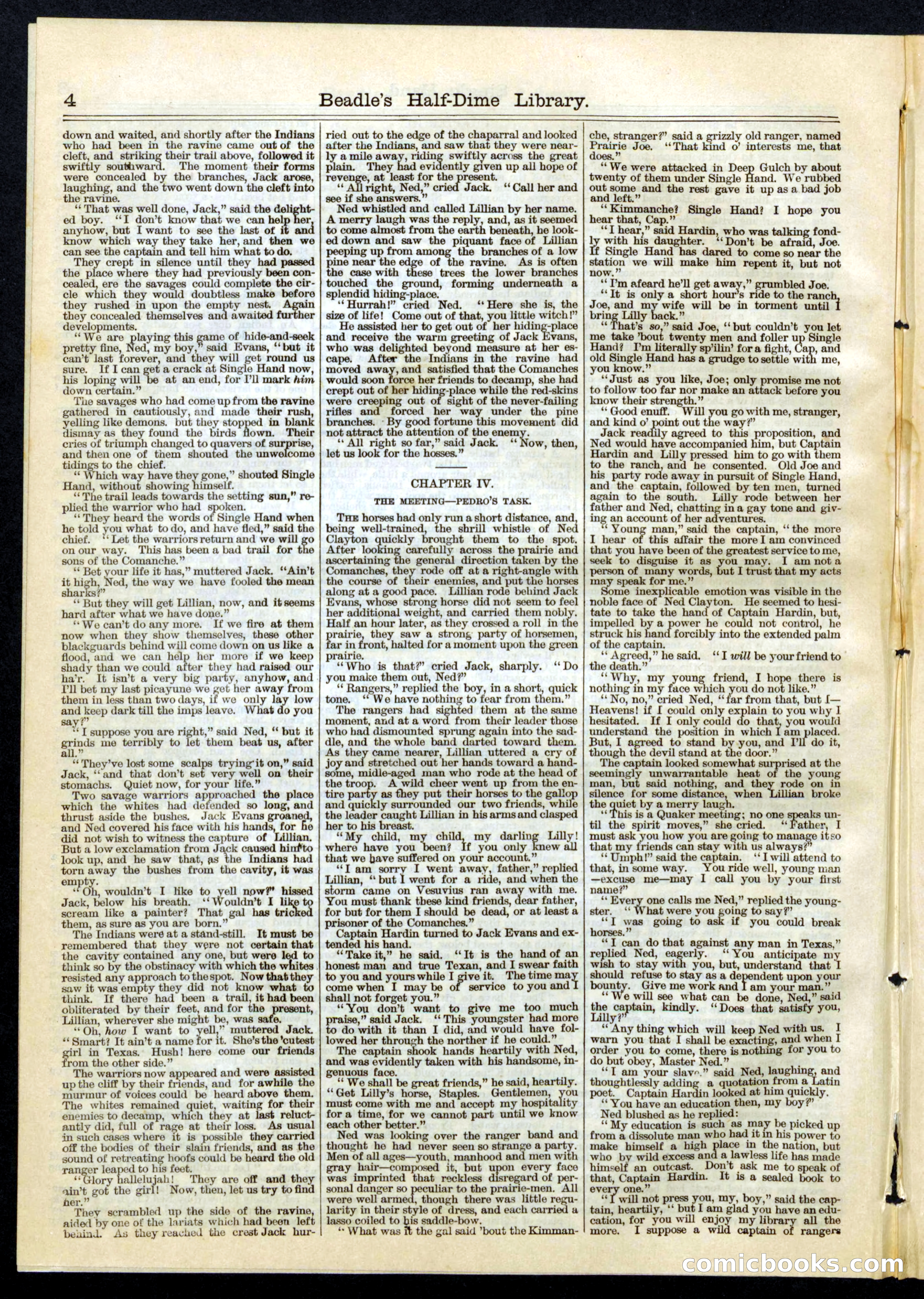
A restored page from Pulp Fiction, 1878. Page through the whole issue in the reader above.
📄 Transcribed text from this page (OCR, searchable)
Machine-transcribed from the original scan — historical spelling and the odd misread are preserved.
of Beadle’s Half-Dime Library. down and waited, and shortly after the Indians who had been in the ravine came out of the cleft, and striking their trail above, followed it swiftly southward. The moment their forms were concealed by the branches, Jack arose, laughing, and the two went down the cleft into the ravine. ‘* That was well done, Jack,” said the delight- ed boy. ‘“‘I don’t know that we can help her anyhow, but I want to see the last of it an know which way they take her, and then we can see the captain and tell him what to do. They crept in silence until they had passed the place where they had previously been con- cealed, ere the savages could complete the cir- cle which they would doubtless make before they rushed in upon the empty nest. n they concealed themselves and awaited her developments. “We are laying this game of hide-and-seek pretty fine, Ned, my boy,” said Evans, “but it can’t last forever, and they will get round us sure. If I can get a crack at Single Hand now, his loping will at an end, for ’U mark him down certain.” The savages who had come up from the ravine gathered in cautiously, and made their rush, yelling like demons. but they stopped in blank dismay as they found the birds flown. Their cries of triumph changed to quavers of surprise, and then one of them shouted the unwelcome tidings to the chief. “Which way have they gone,” shouted Single Hand, without showing himself. ‘The trail leads towards the setting sun,” re- plied the warrior who had spoken. ‘‘They heard the words of Single Hand when he told you what todo, and have fled,” said the chief. ‘‘ Let the warriors return and we will go onour way. This has been a bad trail for the sons of the Comanche.” ‘* Bet your life it has,” muttered Jack. ‘‘Ain’t it high, Ned, the way we have fooled the mean sharks?” ‘* But they will get Lillian, now, and it seems hard after what we have done.” ‘*We can’t do any more. If we fire at them now when they show themselves, these other blackguards behind will come down on us like a flood, and we can help her more if we keep shady than we could after they had raised our ha’r. It isn’t a very big party, anyhow, and I'll bet my last picayune we get her away from them in less than two days, if we only lay low and keep dark till the imps leave. What do you say?” te I suppose you are right,” said Ned, “ but it grinds me terribly to let them beat us, after all 9 ‘*They’ve lost some scalps trying‘it on,” said Jack, ‘‘and that don’t set very well on their stomachs. Quiet now, for your life.” Two savage warriors approached the place which the whites had defended so long, and thrust aside the bushes. Jack Evans groaned, and Ned covered his face with his hands, for he did not wish to witness the capture of Lillian. But a low exclamation from Jack caused hinfto look up, and he saw that, as the Indians had torn away the bushes from the cavity, it was empty. i Oh, wouldn’t I like to yell now?” hissed Jack, below his breath. ‘‘Wouldn’t I Bie'tp scream like a painter? That gal has tric them, as sure as you are born.” The Indians were at a stand-still. It must be remembered that they were not certain that the cavity contained any one, but were led to think so by the obstinacy with which the whites. resisted any approach to thespot. Now that they saw it was empty they did not know what to think. If there had been a trail, it had been obliterated by their feet, and for the resent, Lillian, wherever she might be, was safe. ‘Oh, how I want to yell,” muttered Jack. ‘‘Smart? It ain’t a name for it. She’s the ’cutest irl in Texas. Hush! here come our friends rom the other side.” The warriors now appeared and were assisted up the cliff by their friends, and for awhile the murmur of voices could be heard above them. The whites remained quiet, waiting for their enemies to decamp, which they at last reluct- antly did, full of rage at their loss. As usual in such cases where it is possible they carried off the bodies of their slain friends, and as the sound of retreating hoofs could be heard the old ranger leaped to his feet. ** Glory hallelu jah! They are off and they ain’t got the girl! Now, then, let us try to find her.” They scrambled up the side of the ravine, aided by one of the lariats which had been left behind. As they reached the crest Jack hur- ried out to the edge of the chaparral and looked after the Indians, and saw that they were near- ly a mile away, riding swiftly across the great plain. They evidently given up all hope of revenge, at least for the present. e right, Ned,” cried Jack. ‘Call her and see if she answers.” Ned whistled and called Lillian by her name. A merry laugh was the reply, and, as it seemed to come almost from the earth beneath, he look- ed down and saw the piquant face of Lillian peeping up from among the branches of a low pine near the e of the ravine. As is often the case with these trees the lower branches touched the ground, forming underneath a splendid hiding-place. ‘‘Hurrah!” cried Ned. ‘* Here she is, the size of life! Come out of that, you little witch!” He assisted her to get out of her pany Feet and receive the warm greeting of Jack Evans, who was delighted beyond measure at her es- cape. After the Indians in the ravine had moved away, and satisfied that the Comanches would soon force her friends to decamp, she had crept out of her hiding-place while the red-skins were creeping out of sight of the never-failing rifles and forced her way under the pine branches. - By good fortune this movement did not attract the attention of the enemy. ‘* All right so far,” said Jack. “ Hoe, then, let us look for the hosses.” CHAPTER IV. THE MEETING—PEDRO’S TASK. THE horses had only run a short distance, and being well-trained, the shrill whistle of Ne Clayton S eege brought them to the spot. After loo ing carefully across the prairie and ascertaining the general direction taken by the Comanches, they rode off at a right-angle with the course of their enemies, and put the horses along at a good pace. Lillian rode behind Jack Evans, whose strong horse did not seem to feel her additional weight, and carried them nobly. Half an hour later, as they crossed a roll in the rairie, they saw a strong party of horsemen, far in front, halted for a moment upon the green prairie. ‘‘Who is that?’ cried Jack, sharply. you make them out, Ned?” ‘** Rangers,” replied the boy, in a short, quick tone. ‘* We have nothing to fear from them.” The rangers had sighted them at the same moment, and at a word from their leader those who had dismounted sprung again into the sad- dle, and the whole band darted toward them. As they came nearer, Lillian uttered a cry of joy and stretched out her hands toward a hand- some, midle-aged man who rode at the head of the troop. A wild cheer went up from the en- tire pa y as they put their horses to the nme and quickly surrounded our two friends, while the leader caught Lillian in his arms and clasped her to his breast. “My child, my arp my darling Lilly! where have you been? If you only knew all that we bave suffered on your account.” ‘“‘T am sorry I went away, father,” replied Lillian, “‘ but I went for a ride, and when the storm came on Vesuvius ran away with me. You must thank these kind friends, dear father, for but for them I should be dead, or at least a prisoner of the Comanches.” Captain Hardin turned to Jack Evans and ex- tended his hand. “Take it,” he said. “It is the hand of an honest man and true Texan, and I swear faith to you and yours while I give it. The time ma come when I may be of service to you and shall not forget you.” ‘You don’t want to give me too much praise,” said Jack. ‘This youngster had more to do with it than I did, and would have fol- lowed her through the norther if he could.” The captain shook hands heartily with Ned, and was evidently taken with his handsome, in- genuous face. ‘* We shall be great friends,” he said, heartily. “Get Lilly’s horse, Staples. Gentlemen, you must come with me and accept my hospitality for a time, for we cannot part until we know each other better.” Ned was looking over the ranger band and thought he had never seen so prem a party. Men of all ages—youth, manhood and men with gray hair—composed it, but upon every face was imprinted that reckless disregard of per- sonal danger so iar to the prairie-men. All were well armed, though there was little regu- larity in their style of dress, and each carried a lasso coiled to bis saddle-bow. ‘* What was it the gal said bout the Kimman- sé Do che, stranger?” said a grizzly old ranger, named -bewrng Joe. ‘That kind o’ interests me, that oes.” ‘*We were attacked in Deep Gulch by about twenty of them under Single Hand. We rubbed out some and the rest gave it up as a bad job ““'Kimmanche? Single H immanche e Hand? I ho ou hear that, Cap.” ae ‘“T hear,” said Hardin, who was talking fond- ly with his daughter. ‘‘Don’t be afraid, Joe. Single Hand has dared to come so near the station we will make him repent it, but not now.”’ ‘“ Pm afeard he’ll get away,” grumbled Joe. “It is only a short heute ride to the ranc Joe, and my wife will be in torment until bring Lilly back.” ‘“That’s so,” said Joe, ‘‘ but couldn’t you let me take *bout twenty men and foller up Single Hand? Im literally sp’ilin’ fora fight, Cap, and old Single Hand has a grudge to settle with me, you know.” ‘‘Just as you like, Joe; only promise me not to follow too far nor make an attack before you know their strength.” ‘** Good enuff. Will you go with me, stranger, and kind o’ point out the way?’ Jack veadity agreed to this proposition, and Ned would have accompanied him, but Captain Hardin and Lilly pressed him to go with them to the ranch, and he consented. Old Joe and his party rode away in pursuit of Single Hand and the captain, followed by ten men, turned in to the south. Lilly rode between her father and Ned, chatting ina gay tone and giv- ing an account of her adventures. ‘Young man,” said the captain, ‘‘ the more I hear of this affair the more I am convinced that you have been of the greatest service to me, seek to disguise it as you may. I am nota person of many words, but I trust that my acts me speak for me.” me inexplicable emotion was visible in the noble face of Ned Clayton. He seemed to hesi- tate to take the hand of Captain Hardin, but, impelled by a power he could not control, he struck his hand forcibly into the extended palm of the captain. ‘** Agreed,” he said. the death.” ‘‘Why, my young friend, I hope there is nothing in my face which you do not like.” ‘“‘No, no,” cried Ned, “far from that, but [— Heavens! if [ could only explain to you why I hesitated. If I only could do that, you would understand the position in which I am placed. ‘“*T will be your friend to But, I eed to stand by you, and I'll do it, though the devil stand at the door.” The captain looked somewhat surprised at the seemingly unwarrantable heat of the young man, but said nothing, and they rode on in silence for some distance, when Lillian broke the quiet by a merry laugh. ‘*This is a Quaker meeting; no one ks un- til the spirit moves,” she cried. “Father, I must ask you how you are going to manage itso that my friends can stay with us always?” ‘‘Umph!” said the captain. ‘‘ I will attend to that, in some way. You ride well, young man —excuse me—may I call you by your first name?” ‘* Every one calls me Ned,” replied the young- ster. ‘‘ What were you going to say?” ‘““T was going to ask if you could break horses.” “T can do that against any man in Texas,” replied Ned, eagerly. “You anticipate m wish to stay with you, but, understand that should refuse to stay as a dependent upon your bounty. Give me work and I am your man.” ‘* We will see what can be done, Ned,” said —. ~*. ata kindly. ‘Does that satisfy you, y ’ “Any thing which will keep Ned with us. I warn you that I shall be exacting, and when I order you to come, there is nothing for you to do but obey, Master Ned.” ; ‘“T am your slave.” said Ned, laughing, and thoughtlessly adding a quotation from a Latin poet. Captain Hardin looked at him quickly, ‘You have an education then, my boy?” Ned blushed as he replied: “My education is such as may be picked up from a dissolute man who had it in his power to make himself a high place in the nation, but who by wild excess and a lawless life has made himself an outcast. Don’t ask me to speak of that, Captain Hardin. It is a sealed book to every one.” ‘‘T will not press gps my, boy,” said the cap- tain, heartily, ‘‘ but I am glad you have an edu- cation, for you will en Joy my lib all the more. I suppose a wild captain of rangers GOMLERDOOKS :