
Pulp Fiction, 1878 · page 12 of 16
Beadle's Half Dime Library, No. 66 — page 12: what you’re looking at
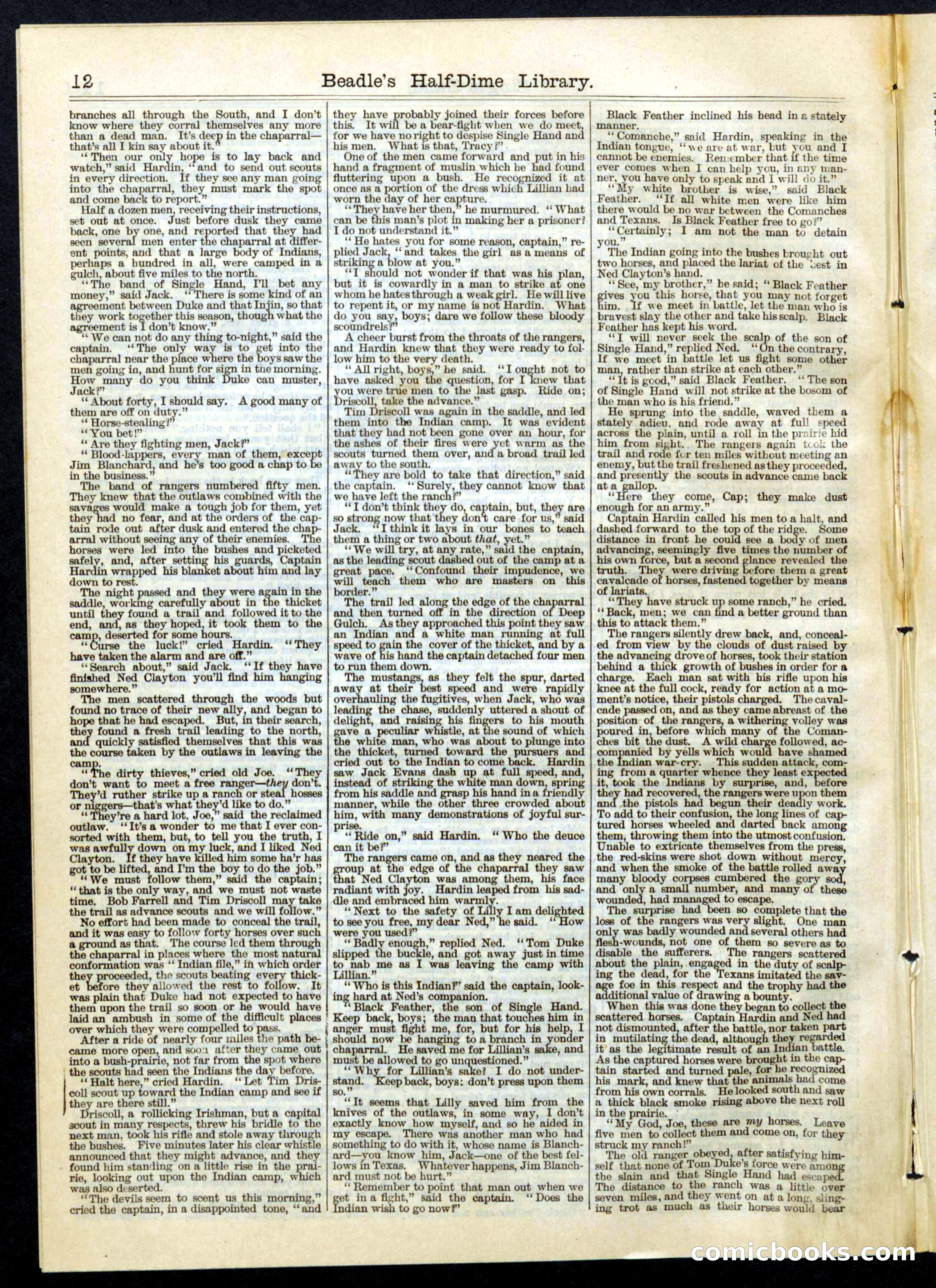
A restored page from Pulp Fiction, 1878. Page through the whole issue in the reader above.
📄 Transcribed text from this page (OCR, searchable)
Machine-transcribed from the original scan — historical spelling and the odd misread are preserved.
- Se —— ——— LT LS — 12 branches all through the South, and I don’t know where they corral themselves any more than a dead man. It’s deep in the chaparral— that’s all I kin say about it. ‘‘Then our only hope is to lay back and watch,” said Hardin, ‘‘and to send out scouts in every direction. it they see any man going into the chaparral, they must mark the spot and come back to report.” Half a dozen men, receiving their instructions, set out at once. Just before dusk they came back, one by one, and hi eg that they had seen several men enter the chaparral at differ- ent points, and that a large body of Indians, perhaps a hundred in all, were camped in a gulch, about five miles to the north. ‘The band of Single Hand, I'll bet any money,” said Jack. ‘* There is some kind of an agreement between Duke and that Injin, so that they work together this season, though what the agreement is | don’t know.” ‘* We can not do any thing to-night,” said the captain. ‘‘The only way is to get into the chaparral near the place where the boys saw the men going in, and hunt for sign in the morning. How many do you think ke can muster, Jack?” ‘* About forty, I should say. A good many of them are off on duty.” ‘“* Horse-stealing? ‘You bet!” ** Are they fighting men, Jack?” ‘** Blood-lappers, every man of them, except Jim Blanchard, and he’s too good a chap to in the business.’ The band of rangers numbered fifty men. They knew that the outlaws combined with the savages would make a tough job for them, yet they had no fear, and at the orders of the cap- tain rode out after dusk and entered the chap- arral without seeing any of their enemies. The horses were led into the bushes and picketed safely, and, after oe. his guards, Captain Hardin wrapped his blanket about him and lay down to rest. The night passed and they were again in the saddle, working carefully about in the thicket until they found a trail and followed it to the end, and, as they hoped, it took them to the camp, deserted for some hours. - the luck!” cried Hardin. ‘‘ They have taken the alarm and are off.” “Search about,” said Jack. ‘‘If they have finished Ned Clayton you'll find him hanging somewhere.” The men scattered through the woods but found no trace of their new ally, and began to hope that he had escaped. But, in their search, they found a fresh trail leading to the north, uel quickly satisfied themselves that this was the course taken by the outlaws in leaving the camp. “The di thieves,” cried old Joe. ‘The don’t want meet a free ranger—they don’t. They’d ruther strike up a ranch or s hosses or niggers that's what they’d like to do.” ‘“‘They’re a hard lot, Joe,” said the reclaimed outlaw. ‘It’s a wonder to me that I ever con- sorted with them, but, to tell you the truth, I was awfully down on my luck, and I liked Ned Clayton. they have killed him some ha’r has got to be lifted, and I’m the boy to do the job.” ‘“‘We must follow them,” said the captain; “that is the only way, and we must not waste time. Bob Farrell and Tim Driscoll may take the trail as advance scouts and we will follow.” No effort had been made to conceal the trail, and it was easy to follow forty horses over such a ground as that. The course led them through the chaparral in places where the most natural conformation was ‘‘ Indian file,” in which order they proceeded, the scouts beating every thick- et before they allowed the rest to follow. It was plain that Duke had not expected to have them upon the trail so soon or he would have laid an ambush in some of the difficult places over which they were compelled to pass. After a ride of nearly four miles the path be- came more open, and soon after they came out into a bush-prairie, not far from the spot where the scouts had seen the Indians the day before. ‘‘ Halt here,” cried Hardin. ‘Let Tim Dris- coll scout up toward the Indian camp and see if they are there still.” Driscoll, a rollicking Irishman, but a capital scout in many respects, threw his bridle to the next man, took his rifle and stole away through the bushes. Five minutes later his clear whistle announced that they might advance, and they - =_— —_ . found him standing on a little rise in the prai- rie, looking out upon the Indian camp, which was also deserted. “The devils seem to scent us this morning,” cried the captain, in a disappointed tone, “‘ and ‘ . ee ——e Beadle’s Half-Dime Library. ee ee - they have prppensy joined their forces before this. It will be a bear-fight when we do meet for we have noright to despise Single Hand and his men. What is that, Tracy?’ One of the men came forward and put in his hand a fragment of muslin which he had found fluttering upon a bush. He recognized it at once as a portion of the dress which Lillian had worn the day of her capture. ‘*They have her then,” he murmured. ‘‘ What can be this man’s plot in making her a prisoner? I do not understand it.” ‘* He hates you for some reason, captain,” re- plied Jack, ‘‘ and takes the girl as a means of striking a blow at you.” “T should not wonder if that was his plan, but it is cowardly in a man to strike at one whom he hatesthrough a weak girl. He will live to repent it, or my name is not Hardin. What do you say, boys; dare we follow these bloody scoundrels?” A cheer burst from the throats of the rangers, and Hardin knew that they were ready to fol- low him to the very death. ‘‘ All right, boys,” he said. ‘‘I ought not to have asked you the question, for I knew that you were true men to the last gasp. Ride on; Driscoll, take the advance.” Tim Driscoll was again in the saddle, and led them into the Indian camp. It was evident that they had not been gone over an hour, for the ashes of their fires were yet warm as the scouts turned them over, and a broad trail led away to the south. “They are bold to take that direction,” said the captain. ‘“ perme they cannot know that we have left the ranch?” **T don’t think they do, oo genes but, they are so strong now that they don’t care for us,” said Jack. ‘‘I think it lays in our bones to teach them a thing or two about that, yet.” ‘‘We will try, at any rate,” said the captain, as the leading scout dashed out of the camp at a great pace. ‘‘Confound their impudence, we will teach them who are masters on this border.” The trail led along the edge of the gre grok and then turned off in the direction of Deep Gulch. As they approached this point they saw an Indian and a white man running at full speed to gain the cover of the thicket, and by a wave of his hand the captain detached four men to run them down. The mustangs, as they felt the spur, darted away a their best speed and were rapidly overhauling the fugitives, when Jack, who was leading the chase, suddenly uttered a shout of delight, and raising his fingers to his mouth ave a peculiar whistle, at the sound of which the white man, who was about to plunge into the thicket, turned toward the pursuers and cried out to the Indian to come back. Hardin saw Jack Evans dash up at full speed, and, instead of striking the white man down, spring from his saddle and his hand ina friendly manner, while the other three crowded about him, with many demonstrations of joyful sur- prise. ‘Ride on,” said Hardin. ‘‘ Who the deuce can it be?” The rangers came on, and as they neared the oup at the edge of the chaparral they saw at Ned Clayton was among them, his face radiant with joy. Hardin leaped from his sad- dle and embraced him warmly. ‘Next to the safety of Li yi am delighted to see you free, my dear Ned,” he said. ‘‘ How were you used?” ‘Badly enough,” replied Ned. ‘‘Tom Duke slipped the buckle, and got away just in time to nab me as I was leaving the camp with Lillian.” : “Who is this Indian?’ said the captain, look- ing hard at Ned’s companion. ‘Black Feather, the son of Single Hand. Keep back, boys; the man that touches him in anger must fight me, for, but for his help, I should now be hanging to a branch in yonder cha He saved me for Lillian’s e, and must be allowed to go unquestioned.” *“Why for Lillian’s e? I do not under- stand. eep back, boys: don’t press upon them so. “It seems that Lilly saved him from_ the knives of the outlaws, in some way, I don’t exactly know how myself, and so he aided in my escape. There was another man who had something to do with it, whose name is Blanch- ard—you know him, Jack—one of the best fel- lows in Texas. Whatever happens, Jim Blanch- ard must not be hurt.” ‘* Remember to point that man out when we get in a fight,” said the captain. ‘‘ Does the dian wish to go now?” ji, ee —————__ — ee Black Feather inclined his head in a stately manner. ‘‘ Comanche,” said Hardin, speaking in the Indian tongue, ‘we are at war, but you and I cannot be enemies. Rem:ember that if the time ever comes when I can help you, in any man- ner, you have only to speak and I will do it.” ‘‘My white brother is wise,” said Black Feather. “If all white men were like him there would be no war between the Comanches and Texans. Is Black Feather free to go?” ‘ Certainly ; I am not the man to detain ou. The Indian going into the bushes brought out two horses, and placed the lariat of the Dest in Ned Clayton’s hand. ‘‘See, my brother,” he said; “‘ Black Feather ives you this horse, that you may not torget Eine f we meet in battle, let the man who is bravest slay the other and take hisscalp. Black Feather has kept his word. ‘“‘T will never seek the scalp of the son of Single Hand,” replied Ned. ‘On the contrary, If we meet in battle let us fight some other man, rather than strike at each other.” “Tt is good,” said Black Feather. ‘‘ The son of Single Hand will not strike at the bosom of the man who is his friend.” He sprung into the saddle, waved them a stately adieu, and rode away at ful! speed across the plain, until a roll in the prairie hid him from sight.. The rangers again tcol the trail and rode for ten miles without meeting an enemy, but the trail freshened as they proceeded, _— al pga the scouts in advance came back ata op. ‘“‘Here they come, Cap; they make dust enough for an army.” Captain Hardin called his men to a halt, and dashed forward to the top of the ridge. Some distance in front he could see a y of men advancing, seemingly five times the number of his own force, but a second glance revealed the truth. They were driving before them a great cavalcade of horses, fastened together by means of lariats. “They have struck up some ranch,” he cried. ‘* Back, men; we can find a better ground than this to attack them.” The rangers silently drew back, and, conceal- ed from view by the clouds of dust raised by the advancing drove of horses, took their station behind a thick growth of bushes in order for a charge. Each man sat with his rifle upon his knee at the full cock, ready for action at a mo- ment’s notice, their pistols charged. The caval- cade on, and as they came abreast of the position of the rangers, a withering volley was poured in, before which many of the Coman- ches bit the dust. A wild c followed, ac- companied by yells which would have shamed the war-cry. This sudden attack, com- ing from a quarter whence they least e it, took the Indians by surprise, and, before ym g had recovered, the rangers were upon them and the pistols had begun their deadly work. To add to their confusion, the long lines of cap- tured horses wheeled and darted back amon them, throwing them into the utmost confusion. Unable to extricate themselves from the press, the red-skins were shot down without mercy, and fe pee] smoke of Lie! notes. rolled awa man y corpses cumber @ go and “onl a small number, and many of then wounded, had managed to escape. The s ise had been so complete that the loss of the rangers was very slight. One man only was badly wounded and several others had flesh-wounds, not one of them so severe as to disable the sufferers. The rangers scattered about the plain,.enga in the duty of scalp- ing the dead, for the Texans imitated the sav- age foe in this respect and the trophy had the ditional value of drawing a bounty. When this was done they began to collect the scattered horses. Captain Hardin and Ned had not dismounted, after the battle, nor taken part in mutilating the dead, although they re ed it as the legitimate result of an Indian battle, As the captured horses were brought in the cap- tain started and turned pale, for he reco his mark, and knew that the animals had come from his own corrals. Helooked south and saw a thick black smoke rising above the next roll in the prairie. ~ ‘““My God, Joe, these are my horses. Leave five men to collect them and come on, for they struck my ranch!” Lah The old ranger epeyed,, after satisfying him- self that none of Tom Duke’s force were amon the slain and that Single Hand had esca The distance to the ranch was a little over seven miles, and they went on at a long, sling- ing trot as much as their horses winista bear Glovga TT ENOOKS: L. ales I |