
Pulp Fiction, 1878 · page 8 of 16
Beadle's Half Dime Library, No. 59 — page 8: what you’re looking at
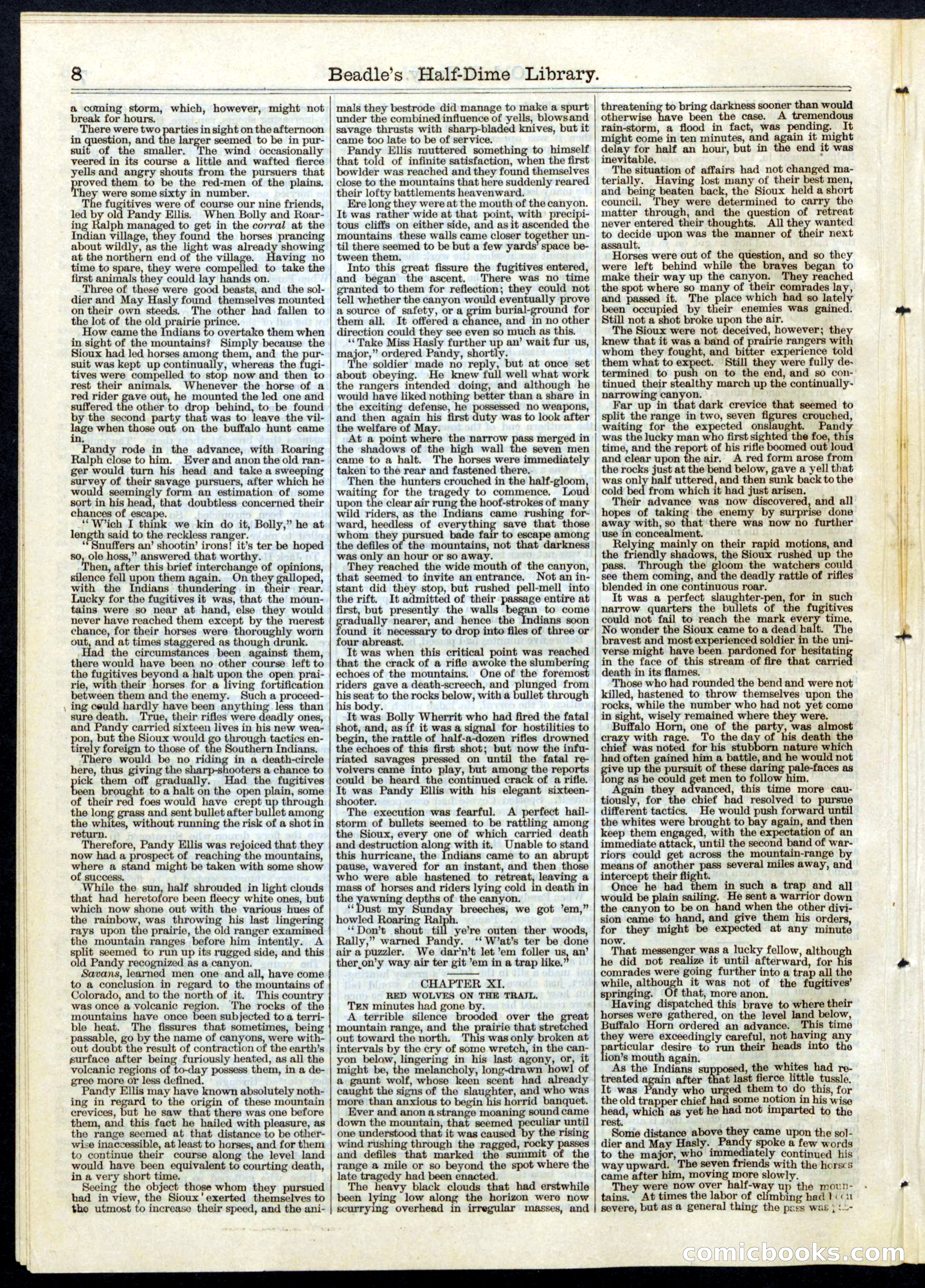
A restored page from Pulp Fiction, 1878. Page through the whole issue in the reader above.
📄 Transcribed text from this page (OCR, searchable)
Machine-transcribed from the original scan — historical spelling and the odd misread are preserved.
8 Beadle’s Half-Dime ‘Libr oe eee ee a vn a coming storm, which, however, might not break for hours. , There were two parties in sight on the afternoon in question, and the larger seemed to be in pur- suit of the smaller. ‘The wind occasionally veered in its course a little and wafted fierce yells and angry shouts from the pursuers that proves them to be the red-men of the plains. ‘hey were some sixty in number. The fugitives were of course our nine friends, led by old Pandy Ellis. When Bolly and Roar- ing ph managed to get in the corral at the Indian village, they found the horses prancing about wildly, as the light was already showing at the northern end of the village. aving no time to spare, they were compelled to take the first animals they could lay hands on. Three of these were good beasts, and the sol- dier and May Hasly found themselves mounted on their own steeds. The other had fallen to the lot of the old prairie prince. How came the Indians to overtake them when in sight of the mountains? Simply because the Sioux had led horses among them, and the pur- suit was kept up continually, whereas the fugi- tives were compelled to stop now and then to rest their animals. Whenever the horse of a red rider gave out, he mounted the led one and suffered the other to drop behind, to be found by the second party that was to leave the vil- lage when those out on the buffalo hunt came in, Pandy rode in the advance, with Roaring Ralph close to him. Ever and anon the old ran- ger would turn his head and take a sweeping survey of their savage pursuers, after which he would seemingly form an estimation of some sort in his head, that doubtless concerned their chances of escape. ‘“'W’ich I think we kin do it, Bolly,” he at length said to the reckless ranger. ‘* Snuffers an’ shootin’ irons! it’s ter be hoped 80, ole hoss,” answered that worthy. hen, after this brief interchange of opinions, silence fell upon them again. On ney galloped, with the Indians thundering in their rear. Lucky for the fugitives it was, that the moun- tains were so near at hand, else they would never have reached them except by the merest chance, for their horses were thoroughly worn out, and at times staggered as though drunk. Had the circumstances been against them, there would have been no other course left to the fugitives beyond a halt upon the open prai- rie, with their horses for a living fortification between them and the enemy. Such a proceed- , ing ceuld hardly have been anything less than sure death. True, their rifles were deadly ones, and Pandy carried sixteen lives in his new wea- n, but the Sioux would go through tactics en- irely foreign to those of the Southern Indians. ‘ snere would ag ne =i fp, oni g ere, thus giving the ooters a chance to rete ge pg ually. Had the fugitives n brought to a halt on the open plain, some of their ted foes would have crept “4 through the long grass and sent bullet after bullet among the whites, without running the risk of a shot in return. Therefore, Pandy Ellis was rejoiced that they now had a prospect of reaching the mountains, where a stand might be taken with some show of success. While the sun, half shrouded in light clouds that had heretofore been fleecy white ones, but which now shone out with the various hues of the rainbow, was throwing his last oe rays upon the prairie, the old ranger examin the mountain ranges before him intently. A lit seemed to run up its rugged side, and this old Pandy recognized as a canyon. Savans, learned men one and all, have come to a conclusion in regard to the mountains of Colorado, and to the north of it. This country was once a volcanic region. The rocks of the mountains have once been subjected to a terri- ble heat. The fissures that sometimes, being passable, go by the name of canyons, were with- out doubt the result of contraction of the earth’s surface after being furiously heated, as all the volcanic regions of to-day possess them, in a de- gree more or less defined. Pandy Ellis may have known absolutely noth- ing in regard to the origin of these mountain crevices, but he saw that there was one before them, and this fact he hailed with pleasure, as the range seemed at that distance to be other- wise inaccessible, at least to horses, and for them to continue their course along the level land would have been equivalent to courting death, in a very short time. Seeing the object those whom they pursued had in view, the Sioux' exerted themselves to the utmost to increase their speed, and the ani- mals they bestrode did manage to make a spurt under the combined influence of yells, blowsand savage thrusts with sharp-bladed knives, but it came too late to be of service. Pandy Ellis muttered something to himself that told of infinite satisfaction, when the first bowlder was reached and they found themselves close to the mountains that here suddenly reared their lofty battlements heavenward. Ere long they were at the mouth of the canyon. | It was rather wide at that point, with precipi- tous cliffs on either side, and as it ascended the mountains these walls came closer together un- til there seemed to be but a few yards’ space be- tween them. Into this great fissure the fugitives entered, and began the ascent. There was no time granted to them for reflection; they could not tell whether the canyon would eventually prove a source of safety, or a grim burial-ground for them all. It offered a chance, and in no other direction could they see even so much as this. ‘‘Take Miss Hasly further up an’ wait fur us, major,” ordered Pandy, shortly. The soldier made no reply, but at once set about obeying. He knew full well what work the rangers intended doing, and although he would have liked nothing better than a share in the exciting defense, he — no weapons, and then again his first duty was to look after the welfare of May. At a point where the narrow merged in the shadows of the high wall the seven men came to a halt. The horses were immediately taken to the rear and fastened there. Then the hunters crouched in the half-gloom waiting for the tragedy to commence, Lou upon the clear air rung the hoof-strokes of many wild riders, as the Indians came rushing for- ward, heedless of everything save that those whom they pursued bade fair to escape among the defiles of the mountains, not that darkness was only an hour or so away. They reached the wide mouth of the canyon, that seemed to invite an entrance. Not an in- stant did they stop, but rushed pell-mell into the rift. It admitted of their passage entire at first, but presently the walls began to come gradually nearer, and hence the Indians soon ound it necessary to drop into files of three or four abreast. It was when this critical point was reached that the crack of a rifle awoke the slumberin echoes of the mountains. One of the forem riders gave a death-screech, and ta from his seat to the rocks below, with a bullet through his body. It was Bolly Wherrit who had fired the fatal shot, and, as if it was a signal for hostilities to begin, the rattle of half-a-dozen rifles drowned the echoes of this first shot; but now the infu- riated sav ressed on until the fatal re- volvers came into play, but among the reports could be heard the continued crack of a rifle. It was Pandy Ellis with his elegant sixteen- shooter. The execution was fearful. A perfect hail- storm of bullets seemed to be rattling amon the Sioux, every one of which carried deat and destruction along with it. Unable to stand this hurricane, the Indians came to an abrupt pause, wavered for an instant, and then those who were able hastened to retreat, leaving a mass of horses and riders lying cold in death in the yawning depths of the canyon. ‘*Dust my Sunday breeches, we got ’em,” howled Roaring Ralph. ‘‘Don’t shout till ye’re outen ther woods, Rally,” warned Pandy. ‘‘ W’at’s ter be done air a puzzler. We dar’n’t let ’em foller us, an’ ther.on’y way air ter git ’em in a trap like.’ CHAPTER XI. RED WOLVES ON THE TRAIL. TEN minutes had gone by. A terrible silence brooded over the great mountain range, and the prairie that stretched out toward the north. This was only broken at intervals by the cry of some wretch, in the can- yon below, lingering in his last agony, or, it might be, the melancholy, long-drawn how! of a gaunt wolf, whose keen scent had already caught the signs of the slaughter, and who was more than anxious to begin his horrid banquet. Ever and anon a strange moaning sound came down the mountain, that seemed uliar until one ——s rows ~ — caused by a rising wind rushing ug era , TOCKY passes and defiles that marked ae eimads of the range a mile or so beyond the spot where the late tragedy had been enacted. The heavy black clouds that had erstwhile been lying low along the horizon were now scurrying overhead in i masses, and ary. threatening to bring darkness sooner than would otherwise have been the case. tremendous rain-storm, a flood in fact, was pending. It might come in ten minutes, and again it might delay for half an hour, but in the end it was inevitable. The situation of affairs had not changed ma- terially. Having lost many of their best men, and being beaten back, the Sioux held a short council. They were determined to carry the matter through, and the question of retreat never entered their thoughts. All a. wanted to decide upon was the manner of their next assault. 7 , Horses were out of the yg ee and so they were left behind while the braves began to make their way up the canyon. They reached the spot where so many of their comrades lay, and passed it. The place which had so lately been occupied by their enemies was gained. Still not a shot broke upon the air. The Sioux were not deceived, however; the knew that it was a band of prairie rangers with whom they fought, and bitter experience told them what to e . Still they were fully de- termined to p on to the end, and so con- tinued their stealthy march up the continually- narrowing canyon. Far up in that dark crevice that seemed to split the range in two, seven fi crouched, waiting for the expected onslaught. Pandy was the lucky man who first sighted the foe, this time, and the report of his rifle boomed out loud and clear upon the air. A red form arose from the rocks just at the bend below, gave a yell that was only half uttered, and then sunk back to the cold from which it had just arisen. Their advance was now discovered, and all hopes of taking the enemy by surprise done away with, so that there was now no further use in concealment. Relying mainly on their rapid motions, and the friendly shadows, the Sioux rushed up the pass. Through see them coming, and the deadly rattle of rifles blended in one continuous roar. It was a perfect ae ee for in such narrow quarters the bullets of the fugitives could not fail to reach the mark ev time. No wonder the Sioux came to a dead halt. The bravest and most experienced soldier in the uni- verse might have been pardoned for hesitatin in the face of this stream of fire that carri death in its flames. Those who had rounded the bend and were not killed, hastened to throw themselves upon the rocks, while the number who had not yet come in sight, wisely remained where they were. Buffalo Horn, one of the party, was almost c with rage. To the day of his death the chief was noted for his stubborn nature which had often gained him a battle, and he would not ive up the pursuit of these daring pale-faces as Tong as he could get men to follow him. Again they advanced, this time more cau- tiously, for the chief had resolved to pursue different tactics. He would push forward until the whites were brought to bay again, and then keep them engaged, with the expectation of an immediate attack, until the second band of war- riors could get across the mountain-range by means of another pass several miles away, and intercept their flight. Once he had them in such a trap and all would be plain sailing. He sent a warrior down the canyon to be on hand when the other divi- sion came to hand, and give them his orders, for they might be expected at any minute now. That messenger was a lucky fellow, although he did vot realize it until afterward, for his comrades were going further into a trap all the while, although it was not of the fugitives’ ringing. Of that, more anon. Having dispatched this brave to where their horses were gathered, on the level land below, Buffalo Horn ordered an advance. This time they were exceedingly careful, not having any icular desire to run their heads into the ion’s mouth again. : As the Indians su , the whites had re- treated cpa after t last fierce little tussle. It was Pandy who aged them to do this, for the old trapper chief had some notion in his wise head, which as yet he had not imparted to the rest. Some distance above they came upon the sol- dier and May Hasly. Pandy spoke a few words to the major, who immediately continued his way upward. The seven friends with the horscs came after him, moving more slowly. They were now over half-wa up the movn- tains. At times the labor of mbing had 1« «11 severe, but as a general thing the pzss was } :..- GOMIGERVOOKS Eco the gloom the watchers could