
Pulp Fiction, 1878 · page 3 of 16
Beadle's Half Dime Library, No. 59 — page 3: what you’re looking at
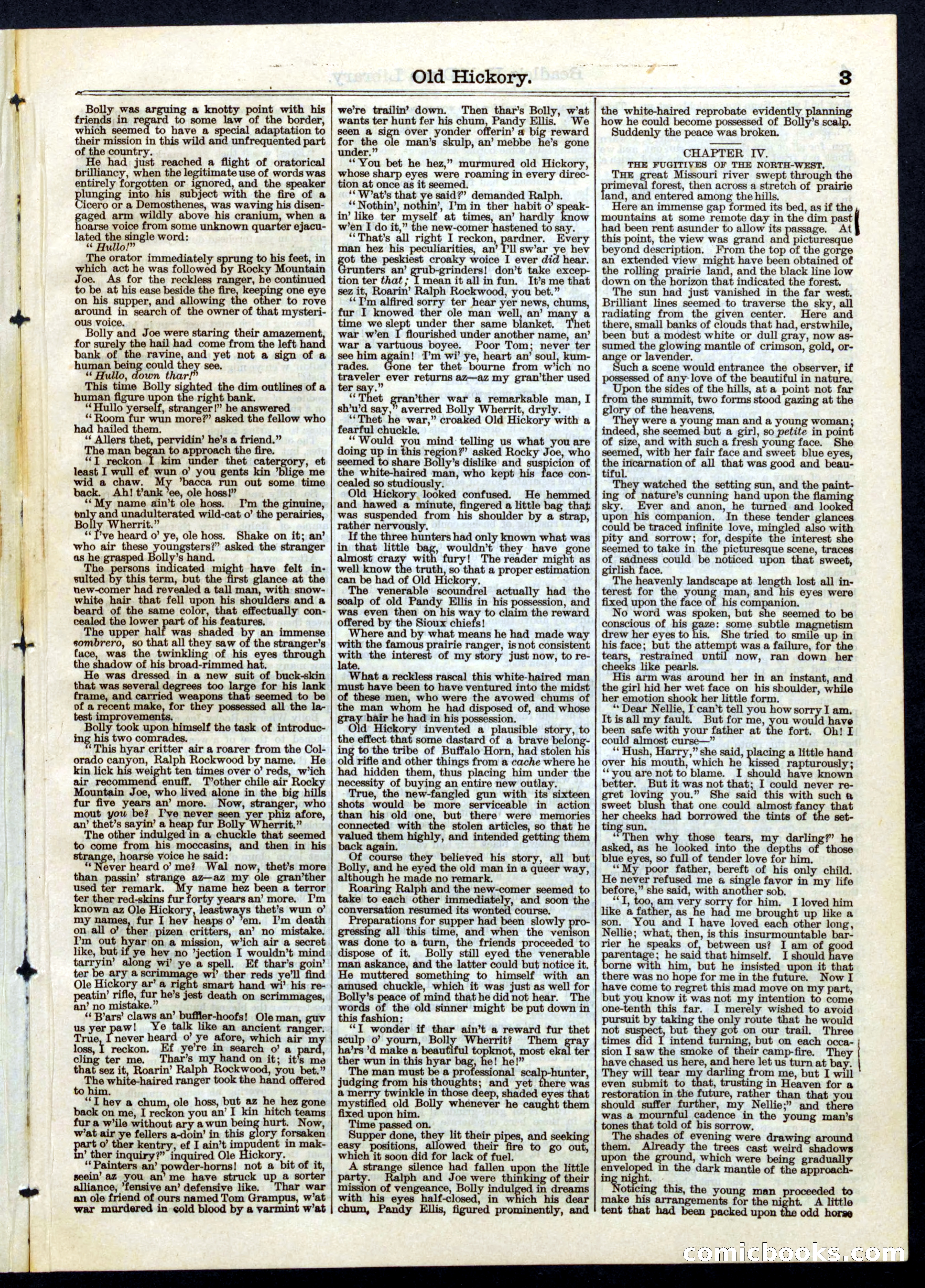
A restored page from Pulp Fiction, 1878. Page through the whole issue in the reader above.
📄 Transcribed text from this page (OCR, searchable)
Machine-transcribed from the original scan — historical spelling and the odd misread are preserved.
Bolly was arguing a knotty point with his triensta in regard to some law of the border, which seemed to have a special adaptation to their mission in this wild and unfrequented part of the country. He had just reached a flight of oratorical brilliancy, when the legitimate use of words was entirely forgotten or ignored, and the speaker lungi into his subject with the fire of a icero or a Demosthenes, was waving his disen- aged arm wildly above his cranium, when a pore voice from some unknown quarter ejacu- lated the single word: “« Hullo!” The orator immediately sprung to his feet, in which act he was followed by Rocky Mountain Joe. As for the reckless ranger, he continued to be at his ease beside the fire, keeping one eye on his supper, and allowing the other to rove around in search of the owner of that mysteri- ous voice. Bolly and Joe were staring their amazemen for surely the hail had come from the left han bank of the ravine, and yet not a sign of a human being could they see. “ Hullo, down thar This time Bolly sighted the dim outlines of a human figure upon the right bank. ‘Hullo yerself, stranger!” he answered m fur wun more?” asked the fellow who had hailed them. ‘* Allers thet, pervidin’ he’s a friend.” The man to approach the fire. ‘“‘T reckon I kim under thet ca ry, et least I wull ef wun o’ you gents kin ’blige me wid a chaw. My *bacca run out some time back. Ah! t’ank ’ee, ole hoss!” ‘*My name ain’t ole hoss. I’m the ginuine, only and unadulterated wild-cat o’ the perairies, Bolly Wherrit.” = ve heard o’ ye, ole hoss. Shake on it; an’ who air these youngsters?” asked the stranger as he grasped Bolly’s hand. ight have felt in- The ons indicated sulted by this term, but the glance at the new-comer had revealed a tall man, with snow- white hair that fell upon his shoulders and a beard of the same color, that effectually con- cealed the lower of his features. The upper half was shaded by an immense sombrero, so that all they saw of the stranger’s face, was the twinkling of his eyes through the shadow of his broad-rimmed hat. He was dressed in a new suit of buck-skin that was several degrees too for his lank frame, and carried weapons that seemed to be of a recent make, for they possessed all the la- test improvemen Bolly took upon himself the task of introduc- ing his two comrades. ‘This hyar critter air a roarer from the Col- orado canyon, Ralph Rockwood by name. He kin lick his weight ten times over o’ reds, w’ich air recommend enuff. T’other chile air mere Mountain Joe, who lived alone in the big hi fur five years an’ more. Now, stranger, who mout you be? I’ve never seen yer phiz afore, an’ thet’s sayin’ a heap fur Bolly Wherrit.” The other indulged in a ch e that seemed to come from his moccasins, and then in his strange, hoarse voice he said: = Rover heard o’ me? Wal now, thet’s more than passin’ s ® az—az my ole gran’ther used ter remark. My name hez been a terror ter ther red-skins fur forty yearsan’ more. [I’m known az Ole Hickory leastways thet’s wun o’ fur I hev heaps o’ ’em. I’m death on all o’ ther pizen critters, an’ no mistake. Pm out hyar on a mission, w’ich air a secret like, but if ye hev no ’jection I wouldn’t mind tarryin’ along wi’ ye a spell. Ef thar’s goin’ ter be ary re wi’ ther reds ye’ll find Ole Hickory ar’ a right smart hand wi’ his re- peatin’ rifle, fur he’s jest death on scrimmages, an’ no . ‘ B’ars’ claws an’ buffler-hoofs! Ole man, guv us yerpaw! Ye like an ancient ranger. True, I never heard o’ ye afore, which air m loss, I reckon. Ef ye’re in search o’ a pard, cling ter me. Thar’s my hand on it; it’s me that sez it, Roarin’ Ralph Rockwood, you bet.” git amatred ranger took the hand offered ‘“‘IT hev a chum, ole hoss, but az he hez gone back on me, I reckon you an’I kin hitch teams fur a w’ile without ary a wun being hurt. Now, w’at air ye fellers a-doin’ in this glory forsaken 0’ ther kentry, ef I ain’t impudent in mak- in’ ther inquiry?” inquired Ole Hickory. : ‘Painters an’ powder-horns! not a bit of it, seein’ az you an’me have struck up a sorter alliance, ’fensive an’ defensive like. Thar war an ole friend of ours named Tom Grampus, w’at war m in ¢old blood by a varmint w’at Old Hickory. we're trailin’ down. Then thar’s Bolly, w’at wants ter hunt fer his chum, Pandy Ellis. e seen a sign over yonder offerin’ @ big reward for the ole man’s skulp, an’ mebbe he’s gone under.” ‘You bet he hez,” murmured old Hickory, whose sharp eyes were roaming in every direc- tion at once as it seemed. ‘* 'W’at’s that ye said?’ demanded Ralph. ** Nothin’, nothin’, I’m in ther habit o’ gene in’ like ter myself at times, an’ hardly know w’en I do it,” the new-comer hastened to say. ‘“‘That’s all right I reckon, pardner. Every man hez his peculiarities, an’ [ll sw’ar ye hev got the peskiest croaky woice I ever did hear. runters an’ b-grinders! don’t take excep- tion ter that ; I mean it allin fun. It’s me that SEZ it, Roarin’ Ralph Rockwood, you bet.” ‘Tm alfired sorry ter hear yer news, chums, fur I knowed ther ole man well, an’ many a time we slept under ther same blanket. et war w’en I flourished under another name, an’ war a vartuous boyee. Poor Tom; never ter see him in! I’m wi’ ye, heart an’ soul, kum- rades. ne ter thet bourne from w’ich no traveler ever returns az—az my gran’ther used ter i ** Thet gran’ther war a remarkable man, I sh’u’d say,” averred Bolly Wherrit, dryly. ‘‘Thet he war,” croaked Old Hickory with a fearful chuckle. ‘Would you mind telling us what you are doing up in this region?’ asked Rocky Joe, who seemed to share Bolly’s dislike and icion of the white-haired man, who kept his face con- cealed so studiously. Old Hickory looked confused. He hemmed and hawed a minute, fingered a little bag that was suspended from his shoulder by a strap, rather nervously. If the three hunters had only known what was in that little , wouldn’t they have gone almost c with fury! The reader might as well know the truth, so that a proper estimation can be had of Old Hickory. The venerable weeandeal actually had the scalp of old Pandy Ellis in his possession, and was even then on his way to claim the reward offered by the Sioux chiefs! ere and by what means he had made way with the famous prairie ranger, is not consistent Her cay the interest of my story just now, to re- What a reckless rascal this white-haired man must have been to have ventured into the midst of these men, who were the avowed chums of the man whom he had disposed of, and whose hair he had in his possession. Old Hickory invented a plausible story, to the effect that some dastard of a brave be ong- ing to the tribe of Buffalo Horn, had stolen his old rifle and other things from a cache where he had hidden them, thus placing him under the necessity of buying an entire new outlay. True, the new-fangled gun with its sixteen shots would be more serviceable in action than his old one, but there were memories connected with the stolen articles, so that he valued them highly, and intended getting them back again. Of course they believed his story, all but Bolly, and he eyed the old man in a queer way, although he made no remark. Roariee Ralph and the new-comer seemed to take to each other immediately, and soon the conversation resumed its wonted course. Preparations for supper had been slowly pro- gressing all this time, and when the venison was done to a turn, the friends proceeded to dispose of it, Bolly still eyed the venerable man askance, and the latter could but notice it. He muttered something to himself with an amused chuckle, which it was just as well for Bolly’s peace of mind that he did not hear. The words of the old sinner might be put down in this fashion: “Il wonder if thar ain’t a reward fur thet sculp o’ yourn, Bolly Wherrit? Them y ha’rs ’d make a beau topknot, most ekal ter ther wun in this hyar bag, he! he!” The man must be a professional scalp-hunter, judging from his thoughts; and yet re was a merry twinkle in those deep, shaded eyes that mystified old Bolly whenever he caught them fixed upon him. a d “th lit thei d seekin upper done, they eir pi and see — tions, allowed their fire to go out which it soon did for lack of fuel. A strange silence had fallen upon the little cee Ralph and Joe were thinking of their mission of vengeance, Bolly ind in dreams with his eyes half-closed, in which his dear chum, Pandy Ellis, figured prominently, and 3 the white-haired reprobate evidently planning how he could become possessed of Bolly’s scalp, Suddenly the peace was broken. CHAPTER IV. THE FUGITIVES OF THE NORTH-WEST. THE great Missouri river swept through the bret. forest, then across a stretch of prairie and, and entered among the hills. Here an immense gap formed its bed, as if the mountains at some remote day in the dim past had been rent asunder to allow its passage. At this point, the view was grand and picturesque beyond description. From the top of the gorge an extended view might have been obtained of the rolling prairie land, and the black line low down on the horizon that indicated the forest. The sun had just vanished in the far west. Brilliant lines seemed to traverse the sky, all radiating from the given center. Here and there, small banks of clouds that had, erstwhile, been but a modest white or dull gray, now as- sumed the glowing mantle of crimson, gold, or- ange or lavender. uch a scene would entrance the observer, if of any: love of the beautiful in nature. Upon the sides of the hills, at a point not far from the summit, two forms stood gazing at the glory of the heavens, + we § were a young man and a young woman; indeed, she seemed but a girl, so petite in point of size, and with such a fresh young face. She seemed, with her fair face and sweet blue eyes, the ene of all that was good and beau- tiful. They watched the setting sun, and the paint- ing of nature’s cunning hand upon the flamin sky. Ever and anon, he turned and look upon his companion. In these tender glances could be infinite love, mingled also with pity and sorrow; for, despite the interest she seemed to take in the picturesque scene, traces of sadness could be noticed upon that sweet, girlish face. The heavenly landscape at length lost all in- terest for the young man, and his eyes were fixed upon the face of his companion. No word was spoken, but she seemed to be conscious of his : some subtle magnetism drew her eyes to Fis She tried to smile up in his face; but the sete a was a failure, for the tears, restrained until now, ran down her cheeks like pearls. His arm was around her in an instant, and the girl hid her wet face on his shoulder, while her emotion shook her little form. “Dear Nellie, I can’t tell you how sorry I am. It is all my fault. But for me, you would have been safe with your father at the fort. Oh! J could almost curse—” ‘** Hush, Harry,” she said, pane a little hand over his mouth, which he kissed rapturously; ‘you are not to blame. I should have known better. But it was not that; I could never re- t lo you.” She said this with such @ sweet blush that one could almost fancy that her cheeks had borrowed the tints of the set- ting sun. ‘Then why those tears, my darling?’ he asked, as he looked into the depths of those blue eyes, so full of tender love for him. ‘‘My poor father, bereft of his only child. He never refused me a a le favor in my life before,” she said, with another sob. _**T, too, am vey eee | for him. I loved him like a father, as he had me brought up like a son. You and I have loved a other long, Nellie; what, then, is this insurmountable bar- rier he speaks of, between us? I am of ntage; he said that himself. I should ve rne with him, but he insisted upon it that there was no hope for me in the future. Now I have come to regret this mad move on my part, but you know it was not my intention to come one-tenth this far. I merely wished to avoid pursuit by taking the only route that he would not a but they got on our trail. Three times did I intend furning, but on each occa- sion I saw the smoke of their camp-fire. They have chased us here, and here let us turn at bay. They will tear as from me, but I will even submit to t, trusting in Heaven for a restoration in the future, rather than that you should suffer further, my Nellie;” and there was a mo cadence in the young man’s es . somes told ‘yp bis sorrow. e es of evening were drawing around them. Already the trees cast weird shadows upon the ground, which were being gradually envelo in the dark mantle of the approach- oticing this, the young man proceeded to make his arrangements for the night. A little tent that had been packed upon odd horse GOMLERDOVOIKS EO