
Pulp Fiction, 1878 · page 8 of 16
Beadle's Half Dime Library, No. 58 — page 8: what you’re looking at
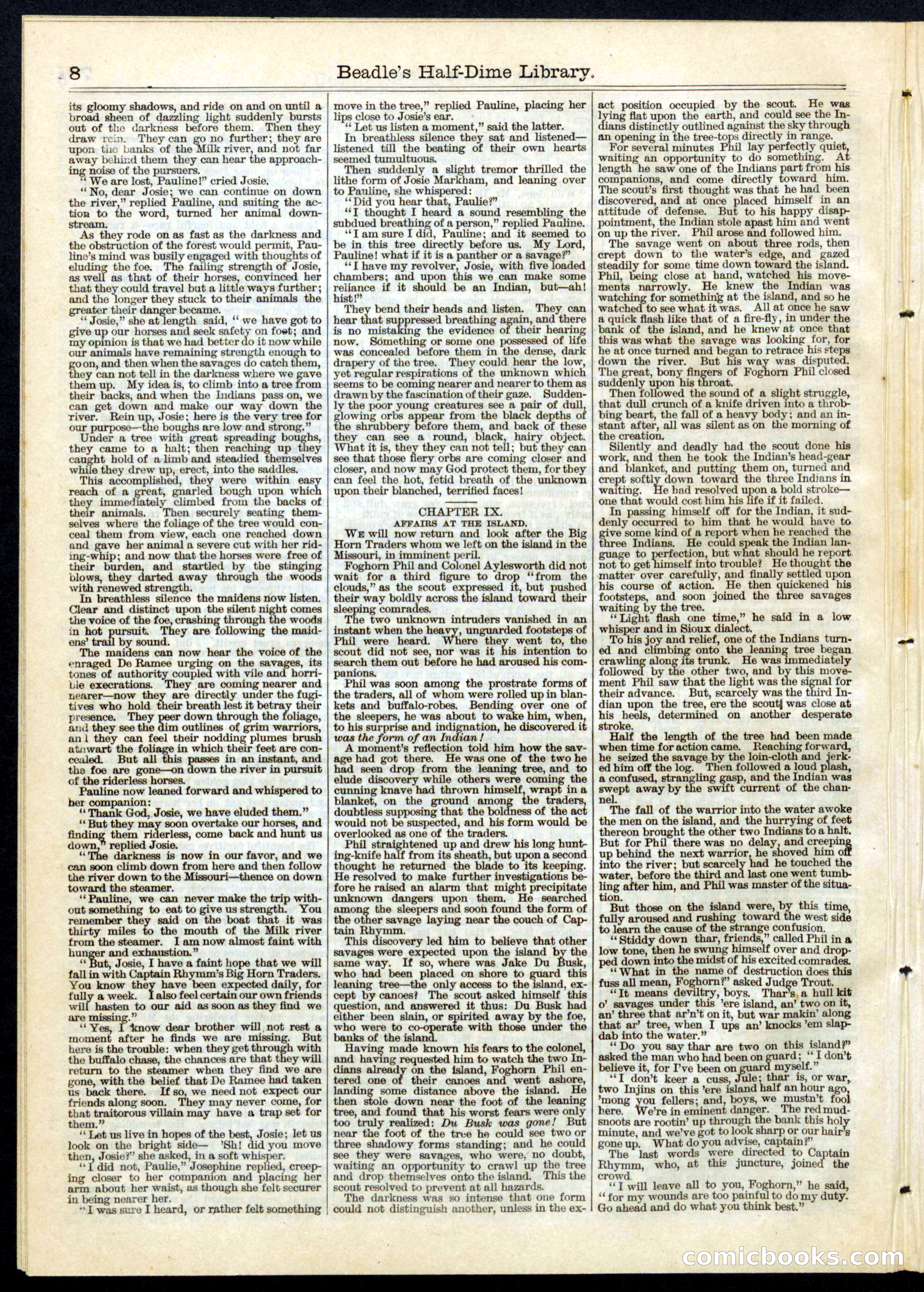
A restored page from Pulp Fiction, 1878. Page through the whole issue in the reader above.
📄 Transcribed text from this page (OCR, searchable)
Machine-transcribed from the original scan — historical spelling and the odd misread are preserved.
Beadle’s Half-Dime Library. 2 — ee ee ee — its gloomy shadows, and ride on and on until a broad sheen of dazzling light suddenly bursts out of the darkness before them. Then they draw rein. They can go no further; they are upon tlio banks of the Milk river, and not far away behind them they can hear the approach- ing noise of the pursuers. ‘We are lost, Pauline!” cried Josie. ‘‘No, dear Josie; we can continue on down the river,” replied Pauline, and suiting the ac- tion to the word, turned her animal down- stream. As they rode on as fast as the darkness and the obstruction of the forest would permit, Pau- line’s mind was busily engaged with thoughts of eluding the foe. The failing strength of Josie, as well as that of their horses, convinced her that they could travel but a little ways further; and the longer they stuck to their animals the greater their danger became. ‘* Josie,” she at length said, ‘‘ we have got to give up our horses and seek safety on foet; and my opinion is that we had better do it now while our animals have remaining strength enough to oon, and then when the savages do catch them, hey can not tell in the darkness where we gave them up. My idea is, to climb into a tree from their backs, and when the Indians pass on, we can get down and make our way down the river. Rein up, Josie; here is the very tree for our purpose—the boughs are low and strong.” Under a tree with great spreading eas, they came to a halt; then reaching up they com hold of a limb and steadied themselves while they drew up, erect, into the saddles. This accomplished, they were within reach of a great, gnarled bough upon whic they immediately climbed from the backs of their animals. Then securely seating them- selves where the foliage of the tree would con- ceal them from view, each one reached down and gave her animal a severe cut with her rid- ing-whip; and now that the horses were free of their burden, and startled by the stinging blows, they away through the woods with renewed strength. In breathless silence the maidens now listen. Clear and distinct upon the silent night comes the voice of the foe, crashing through the woods in hot pursuit. ey are following the maid- ens’ by sound. The maidens can now hear the voice of the enraged De Ramee urging on the savages, its tones of authority coupled with vile and horri- ble execrations. They are coming nearer and nearer—now they are directly under the fugi- tives who a t nae! er lest ly me their presence, ey own through the foliage, and they see the fies outlines of grim warriors, anil they can feel their nodding plumes brush atowart the foli in which their feet are con- cealed. But all in an instant, and the foe are gone—on down the river in pursuit of the riderless horses. Pauline now leaned forward and whispered to her companion: “Thank God, Josie, we have eluded them.” “But they sort soon overtake our horses, and finding them riderless, come back and hunt us down,” replied Josie. “The darkness is now in our favor, and we can soon climb down from here and then follow the river down to the Missouri—thence on down toward the steamer. ‘‘ Pauline, we can never make the trip with- out something to eat to give us strength. You remember they said on the boat that it was thirty miles the mouth of the Milk river from the steamer. I am now almost faint with hu and exhaustion.” ‘* But, Josie, I have a faint hope that we will fall in with Captain Rhymm’s Big Horn Traders. You know they have been expected daily, for fully a week. ILalso feel certain our own friends will hasten to our aid as soon as they find we are missing.” ‘* Yes, ares dear brother will, not rest a moment after he finds we are missing. But here is the trouble: when they get through with the buffalo chase, the chances are that they will return to the steamer when they find we are gone, with the belief that De Ramee had taken us back there. If so, we need not expect our friends along soon. They may never come, for that traitorous villain may have a trap set for them. ‘‘ Let us live in hopes of the best, Josie; let us look on the bright side— ’Sh! did you move then, Josie?’ she asked, in a soft whisper. “{ did not, Paulie,” Josephine replied, creep- ing closer to her companion and placing her arm about her waist, as though she felt securer in being nearer her. I was sure I heard, or rather felt something move in the tree,” replied Pauline, placing her lips close to Josie’s ear. ‘* Let us listen a moment,” said the latter. In breathless silence they sat and listened— listened till the beating of their own hearts seemed tumultuous. Then suddenly a slight tremor thrilled the lithe form of Josie Markham, and leaning over to Pauline, she whispered: ‘*Did you hear that, Paulie?” “T thought I heard a sound resembling the subdued breathing of a person,” replied Pauline. ‘*T am sure I did, Pauline; and it seemed to be in this tree directly before us. My Lord, Pauline! what if it is a panther or a savage?” ‘*T have my revolver, Josie, with five loaded chambers; and upon this we can make some ene if it should be an Indian, but—ah! ist! ine bend their heads and listen. They can hear that suppressed breathing again, and there is no mistaking the evidence of their hearing now. Something or some one possessed of life was concealed before them in the dense, dark drapery of the tree. They could hear the low, yet regular respirations of the unknown which seems to be coming nearer and nearer to them as gs by the fascination of their gaze. oy on the poor young creatures see a pair o vans des orbs appear from the black depths of he shrubbery before them, and back of these they can see a round, black, hairy object. What it is, they they can not tell; but they can see that those fiery orbs are coming closer and closer, and now may God protect them, for they can feel the hot, fetid breath of the unknown upon their blanched, terrified faces! CHAPTER IX. AFFAIRS AT THE ISLAND. We will now return and look after the Big Horn Traders whom we left on the island in the Missouri, in imminent peril. Foghorn Phil and Colonel Aylesworth did not wait for a third figure to drop “from the clouds,” as the scout expressed it, but pushed their way boldly across the island tow their sleeping comrades. The two unknown intruders vanished in an instant when the heavy, unguarded footsteps of Phil were heard. ere they went to, the scout did not see, nor was it his intention to search them out before he had aroused his com- panions. Phil was soon among the prostrate forms of the traders, all of whom were rolled up in blan- kets and buffalo-robes. Bending over one of the sleepers, he was about to wake him, when to his surprise and ger oe Kee he discovered it was the form of an Indian! A moment’s reflection told him how the sav- age had got there. He was one of the two he had seen drop from the leaning tree, and to elude discovery while others were coming the cunning knave had thrown self, wrapt ina blanket, on the ground among the trade doubtless supposing that the boldness of the ac would not be suspected, and his form would be overlooked as one of the traders. Phil straightened up and drew his long hunt- ing-knife half from its sheath, but upon a second thought he returned the blade to its keeping. He resolved to make further investigations be- fore he raised an alarm that might precipitate unknown dangers upon them. He searched among the sleepers and soon found the form of ev ot ~ savage laying near the couch of Cap- m R ; This discovery led him to believe that other savages were expected upon the island by the same way. If so, where was Jake Du Busk, who had been placed on shore to guard this leaning tree—the only access to the island, ex- cept by canoes? The scout asked himself this question, and answered it thus: Du Busk had either been slain, or eS away by the foe, who were to nk ng with those under the banks of the islan Having made known his fears to the colonel, and having requested him to watch the two In- dians or on the island, Foghorn Phil en- tered one of their canoes and went ashore, landing some distance above the island. He then stole down near the foot of the leaning tree, and found that his worst fears were only too truly realized: Du Busk was gone! But near the foot of the tree he could see two or three shadowy forms standing; and he could see they were savages, who were, no doubt, waiting an opportunity to crawl up the tree and drop themselves onto the island. This the scout resolved to prevent at all hazards. The darkness was so intense that one form could not distinguish another, unless in the ex- act position occupied by the scout. He was he g flat upon the earth, and could see the In- ians distinctly outlined against the sky through an opening in the tree-tops directly in range. For several minutes Phil lay perfectly quiet waiting an opportunity to do something. t length he saw one of the Indians part from his companions, and come directly toward him. The scout’s first thought was that he had been discovered, and at once placed himself in an attitude of defense. But to his happy disap- pointment, the Indian stole apast him and went on up the river. Phil arose and followed him. The savage went on about three rods, then crept down to the water’s edge, and gazed steadily for some time down toward the island. Phil, being close at_hand, watched his move- ments narrowly. He knew the Indian was watching for something at the island, and so he watched to see what it was. All at once he saw a quick flash like that of a fire-fly, in under the bank of the island, and he knew at once that this was what the savage was looking for, for he at once turned and began to retrace his steps down the river. But his way was disputed, The great, bony je. beg Hoghorn Phil closed suddenly upon his t t. Then followed the sound of a slight struggle, that dull crunch of a knife driven into a throb- bing beart, the fall of a heavy body; and an in- stant after, all was silent as on the morning of the creation, Silently and deadly had the scout done his work, and then he took the Indian’s head-gear and blanket, and putting them on, turned and crept softly down toward the three Indians in waiting. e had resolved upon a bold stroke— one that would cost him his life if it failed. In passing himself off for the Indian, it sud- denly occurred to him that he would have to ive some kind of a report when he reached the t Indians. He could the Indian lan- guage to perfection, but what should he report. not Aim get himself into trouble? He thought the matter over carefully, and finally settled upon his course of action. He then quickened his footsteps, and soon joined the t savages waiting by the tree. : “Tight flash one time,” he said in a low whisper and in Sioux dialect. To his joy and relief, one of the Indians turn- ed and climbing onto the leaning tree began crawling alon trunk. He was immediately followed by the other two, and by this move- ment Phil saw that the light was the signal for their advance. But, scarcely was the third In- dian upon the tree, ere the scout] was close at his meen determined on another desperate stroke. Half the length of the tree had been made when time for actioncame. Reaching forward, he seized the savage by the loin-cloth and oh ed him off the log. Then followed a loud p a confused, erengene , and the Indian was —_ away by the t current of the chan- ne The fall of the warrior into the water awoke the men on the island, and the hurrying of feet thereon brought the other two Indians to a halt. But for Phil there was no delay, and creepin up behind the next warrior, he shoved him o into the river; but preps | had he touched the water, before the third and last one went tumb- ling after him, and Phil was master of the situa- tion. But those on the island were, by this time, fully aroused and rushing toward the west side to learn the cause of the strange confusion. ‘‘Stiddy down thar, friends,” called Phil ina low tone, then he swung himself over and drop- ped down into the midst of his excited comrades. ‘What in the name of destruction does this fuss all mean, Foghorn?” asked Judge Trout. “Tt means deviltry, boys. Thar’s,a hull kit 0’ sav under this ’ere island, an’ two on it, an’ three that ar’n’t on it, but war makin’ along that ar’ tree, when I ups an’ knocks ’em slap- dab into the water.” “Do you say thar are two on this island?” asked the man who had been on guard; “I don’t believe it, for ve been on myself.” ‘““T don’t keer a cuss, Jule; thar is, or war, two Injins on this ’ere island half an hour ago ’mong you fellers; and, boys, we mustn’t foo here, e’re in eminent danger. The red mud- snoots are rootin’ up through the bank this holy minute, and we’ve got to look sharp or our hair’s goneup. What do you advise, captain?” The last words were directed to Captain Rhymm, who, at this juncture, joined the crowd ‘‘T will leave all to you, Foghorn,” he said, ‘for my wounds are too painful to do my duty. Go ahead and do what you think best.” Gomichooks.co