
Pulp Fiction, 1878 · page 10 of 16
Beadle's Half Dime Library, No. 58 — page 10: what you’re looking at
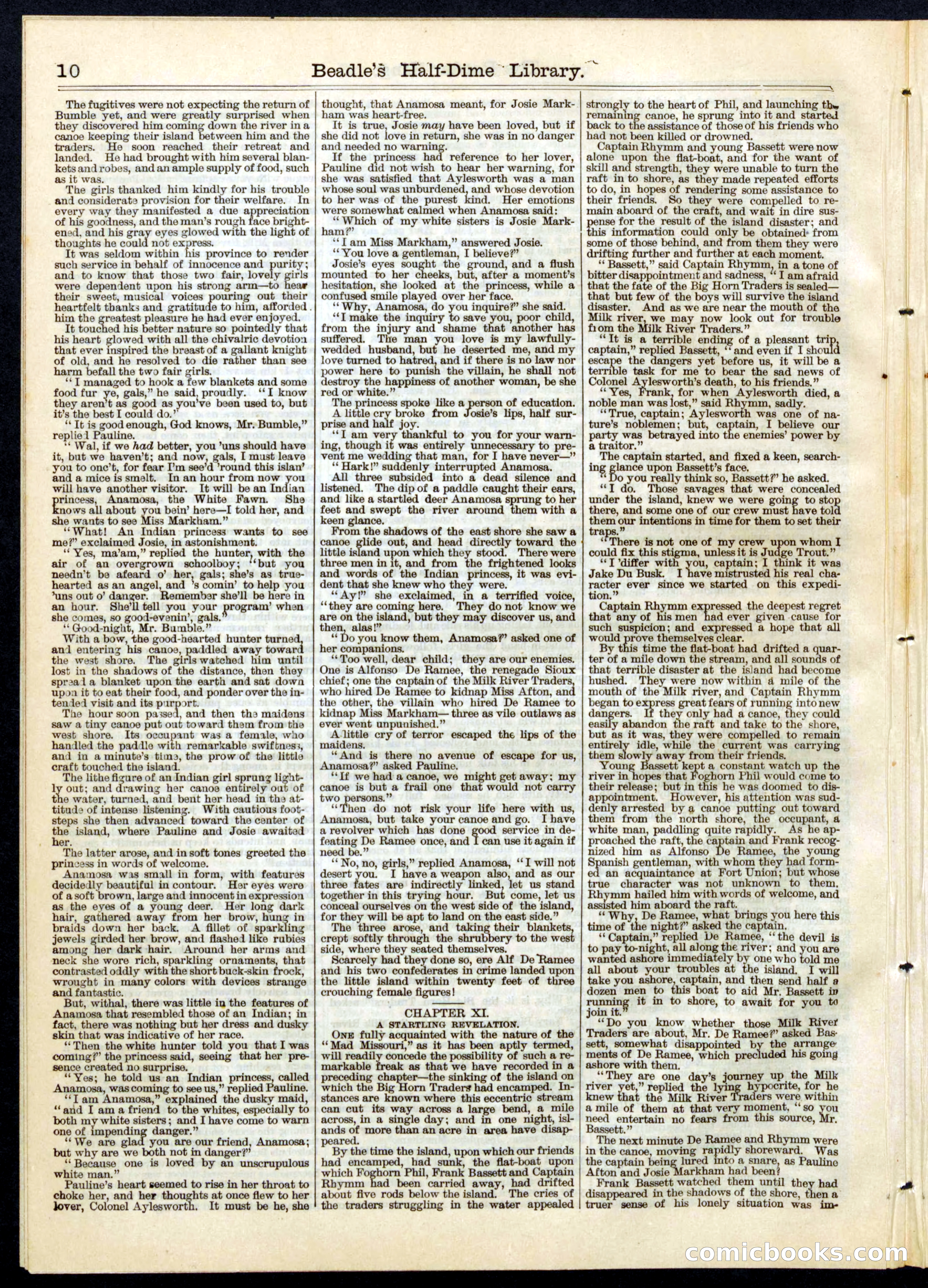
A restored page from Pulp Fiction, 1878. Page through the whole issue in the reader above.
📄 Transcribed text from this page (OCR, searchable)
Machine-transcribed from the original scan — historical spelling and the odd misread are preserved.
— ee ee “+ ee oe 6 ee ee ee ee > ~ 10 The fugitives were not expecting the return of Bumble yet, and were greatly surprised when they discovered him coming down the river ina canoe keeping their island between him and the traders. e soon reached their retreat and landed. He had brought with him several blan- kets and robes, and an ample supply of food, such as it was. The girls thanked him kindly for his trouble and considerate provision for their welfare. In every way they manifested a due appreciation of his goodness, and the man’s rough face bright- ened, and his gray eyes glowed with the light of thoughts he could not express. It was seldom within his province to render such service in behalf of innocence and purity; and to know that those two fair, lovely girls were dependent upon his strong arm—to hear their sweet, musical voices pouring out their heartfelt thanks and gratitude to him, afforded. him the greatest pleasure he had ever enjoyed. It touched his better nature so pointedly that his heart glowed with all the chivalric devotion that ever inspired the breast of a gallant knight of old, and he resolved to die rather than see harm befall the two fair girls. ‘*T managed to hook a few blankets and some food fur ye, gals,” he said, proudly. ‘‘I know they aren’t as good as you’ve been used to, but it’s the best I could do.”’ ‘* It is good enough, God knows, Mr. Bumble,” repliel Pauline. ‘* Wal, if we had better, you ’uns should have it, but we haven’t; and now, gals, [ must leave you to one’t, for fear I’m see’d ’round this islan’ and a mice is smelt. In an hour from now you will have another visitor. It will be an Indian rincess, Anamosa, the White Fawn. She nows all about you bein’ here—I told her, and she wants to see Miss Markham.” ‘*What! An Indian princess wants to see me?” exclaimed Josie, in astonishment. ‘* Yes, ma’am,” replied the hunter, with the air of an overgrown schoolboy; ‘‘but you needn’t be afeard o’ her, gals; she’s as true- hearted as an angel, and ’s comin’ to help you *uns out o’ danger. Remember she’ll be here in an hour. She'll tell you your program’ when she comes, so good-evenin’, gals. ‘*Good-night, Mr. Bumble.” With a bow, the good-hearted hunter —— ani entering his canoe, paddled away towar the west shore. The girls watched him until lost in the shadows of the distance, then they spreala blanket upon the earth and sat down upon it to eat their food, and ponder over the in- tended visit and its purport. The hour soon pa3sed, and then the maidens saw a tiny canoe put out toward them from the west shore. Its occupant was a female, who handled the paddle with remarkable swiftness, and in a minute’s tima, the prow of the little craft touched the island. The lithe figure of an Indian girl sprung light- ly out; and drawing her canoe entirely out of the water, turned, and bent her head in the at- titude of intense listening. With cautious foot- steps she then advanced toward the center of a island, where Pauline and Josie awaited er. The latter arose, and in soft tones greeted the princess in words of welcome. Anamosa was small in form, with features decidedly beautiful in contour. Her eyes were of asoft brown, large and innocent in expression as the eyes of a young deer. Her long dark hair, gathered away from her brow, hung in braids down her back. A fillet of sparkling jewels girded her brow, and flashed like rubies among her dark hair. Around her arms and neck she wore rich, sparkling ornaments, that contrasted oddly with the short buck-skin frock, wrought in many colors with devices strange and fantastic. But, withal, there was little in the features of Anamosa that resembled those of an Indian; in fact, there was nothing but her dress and dusky skin that was indicative of her race. ‘*Then the white hunter told you that I was coming?” the princess said, seeing that her pre- sence created no surprise. ‘Yes; he told us an Indian princess, called osa, Was coming to see us,” replied Pauline. ‘‘T am Anamosa,” explained the dusky maid, “‘and I am a friend to the whites, especially to both diode sisters; and I have come to warn one of impending danger.” ‘‘We are g you are our friend, Anamosa; but why are we both not in danger?” ‘‘ Because one is loved by an unscrupulous white man.” Pauline’s heart seemed to rise in her throat to choke her, and her thoughts at once flew to her lover, Colonel Aylesworth. It must be he, she Beadle’ SS SS = Se oe SS ee ee ee ee ——ewe ee = thought, that Anamosa meant, for Josie Mark- ham was heart-free. It is true, Josie may have been loved, but if she did not love in return, she was in no danger and needed no a If the princess had reference to her lover, Pauline did not wish to hear her warning, for she was satisfied that Aylesworth was a man whose soul was unburdened, and whose devotion to her was of the purest kind. Her emotions were somewhat calmed when Anamosa said: ‘ ‘““Which of my white sisters is Josie Mark- am?” ‘*l am Miss Markham,” answered Josie. ‘*'You love a gentleman, I believe?’ Josie’s eyes sought the ground, and a flush mounted to her cheeks, but, after a moment’s hesitation, she looked at the princess, while a confused smile played over her face. ‘“Why, Anamosa, do you inquire?” she said. ‘“‘T make the inquiry to save you, poor child, from the injury and shame that another has suffered. The man you love is my lawfully- wedded husband, but he deserted me, and my love turned to hatred, and if there is no law nor power here to punish the villain, he shall not destroy the happiness of another woman, be she red or white.” The princess spoke like a fate of education. A little cry broke from Josie’s lips, half sur- prise and half joy. ‘*T am very thankful to you for your warn- ing, though it was entirely unnecessary to pre- vent me wedding that man, for I have never—” ‘* Hark!” suddenly interrupted Anamosa. All three subsided into a dead silence and listened. The dip of a paddle caught their ears, and like a startled deer Anamosa sprung to her feet and swept the river around them with a keen glance. From the shadows of the east shore she saw a canoe — out, and head directly toward the little island upon which they stood. There were three men in it, and from the frightened looks and words of the Indian princess, it was evi- dent that she knew who they were. “Ay!” she exclaimed, in a terrified voice, ‘they are coming here. They do not know we are on the island, but they may discover us, and then, alas!” “Do you know them, Anamosa?’ asked one of her companions. ‘*Too well, dear child; they are our enemies. One is Alfonso De Ramee, the renegade Sioux chief; one the captain of the Milk River Traders who hired De Ramee to kidnap Miss Afton, and the other, the villain who hired De Ramee to kidnap Miss Markham— three as vile outlaws as ever went unpunished.” A little cry of terror escaped the lips of the maidens. “And is there no avenue of escape for us, Anamosa?” asked Pauline. ‘‘If we had a canoe, we might get away: my canoe is but a frail one that would not carry two persons.” “Then do not risk your life here with us, Anamosa, but take your canoe and go. I have a revolver which has done good service in de- feating De Ramee once, and I can use it again if need be.” ‘* No, no, girls,” replied Anamosa, ‘I will not desert you. I have a weapon also, and as our three fates are indirectly linked, let us stand together in this trying hour. But come, let us conceal ourselves on the west side of the island, for they will be apt to land on the east side.” The three arose, and fe Bree blankets crept softly through the shrubbery to the west side, where they seated themselves. Scarcely had they done so, ere Alf De Ramee and his two confederates in crime landed upon the little island within twenty feet of three crouching female figures! CHAPTER XI. A STARTLING REVELATION. One fully acquainted with the nature of the ‘Mad Missouri,” as it has been aptly termed, will readily concede the possibility of such a re- markable as that we have recorded in a preceding chapter—the si of the island on which the Big Horn Traders had encamped. In- stances are known where this eccentric stream can cut its way across a large bend, a mile across, in a single day; and in one night, isl- ands of more than an acre in area have disap- ared. » By the time the island, upon which our friends had encamped, had sunk, the flat-boat upon which Foghorn Phil, Frank Bassett and Captain ymm been carried away, had drifted about five rods below the island. The cries of the traders struggling in the water appealed $8 Half-Dime Library. ——— —— - - strongly to the heart of Phil, and launching th. ee canoe, he sprung into it and started back to the assistance of those of his friends who had not been killed or drowned. Captain cog boner and young Bassett were now alone upon the flat-boat, and for the want of skill and strength, they were unable to turn the raft in to shore, as they made repeated efforts to do, in hopes of rendering some assistance to their friends. So they were compelled to re- main aboard of the craft, and wait in dire sus- pense for the result of the island disaster; and this information could only be obtained» from some of those behind, and from them they were drifting further and further at each moment. ** Bassett,” said Captain Rhymm, in a tone of bitter disappointment and sadness, “‘ I am afraid that the fate of the Big Horn Traders is sealed— that but few of the boys will survive the island disaster. And as we are near the mouth of the Milk river, we may now look out for trouble fiom the Milk River Traders.” “It is a terrible ending of a pleasant yer captain,” replied Bassett, ‘‘ and even if I sho d escape the dangers yet before us, it will be a terrible task for me to bear the sad news of Colonel gi Ae Se death, to his friends.” wes k, for when Aylesworth died, a noble man was lost,” said Rhymm, sadly. “True, captain; Aylesworth was one of na- ture’s noblemen; but, captain, I believe our party was betrayed into the enemies’ power by a traitor.” The captain started, and fixed a keen, search- ing lance upon Bassett’s face, ‘Do you really think so, Bassett?’ he asked. “TI do. Those savages that were concealed under the island, knew we were going to sto there, and some one of our crew must have tol ere our intentions in time for them to set their aps. ‘There is not one of my crew upon whom I could fix this stigma, unless it is Nader Trout.” ‘“*T ‘differ with you, captain; I think it was Jake Du Busk. I have mistrusted his real cha- racter ever since we started on this expedi- tion. Captain Rhymm expressed the deepest regret that any of his men had ever given cause for such suspicion; and expressed a hope that all would prove themselves clear. time the flat-boat had drifted a quar- ter of a mile down the stream, and all sounds of that terrible disaster at the island had become hushed. They were now within 4 mile of the mouth of the Milk river, and Captain Rhymm began to express great fears of running into new dangers. they only had a canoe, they could easily abandon the raft and take to the shore, but as it was, they were compelled to remain entirely idle, while the current was carrying them sg Hotatr from their friends. biter 8 tt kept a constant watch up the river in hopes that Foghorn Phil would come to their release; but in this he was doomed to dis- appointment. However, his attention was sud- denly arrested by a canoe putting out toward them from the north shore, the occupant, a white man, paddling quite rapidly. As he ap- proached the raft, the captain and Frank recog- nized him as Alfonso De Ramee, the young —— gentleman, with whom they had form- an acquaintance at Fort Union; but whose true character was not unknown to them, Rhymm hailed him with words of welcome, and assisted him aboard the raft. “ Why, De Ramee, what brings you here this time of ‘the night?” asked the captain. ‘‘ Captain,” replied De Ramee, “‘the devil is to pay to-night, all a river; and you are wanted ashore immediately yf Sey who told me all about your troubles at the island, I will take you ashore, captain, and then send half a dozen men to this boat to aid Mr. Bassett in running it in to shore, to await for you to join it. “Do you know whether those Milk River Traders are about, Mr. De Ramee?” asked Bas: sett, somewhat disappointed by the arrange ments of De Ramee, which precluded his going ashore with them. “They are one day’s journey up the Milk river yet,” replied the 1 h rite, for he knew that the Milk River ers were within a mile of them at that very moment, “‘so you need entertain no fears from this source, Mr. Bassett.” _ The next minute De Ramee and Rhymm were in the canoe, moving rapidly shoreward. Was the captain being lured into a snare, as Pauline Afton and Josie Markham had been Frank Bassett watched them until they had disappeared in the shadows of the shore, then a truer sense of his lonely situation was im- GomiGcnoee “S