
Pulp Fiction, 1888 · page 14 of 16
Beadle's Half Dime Library No. 560 — page 14: what you’re looking at
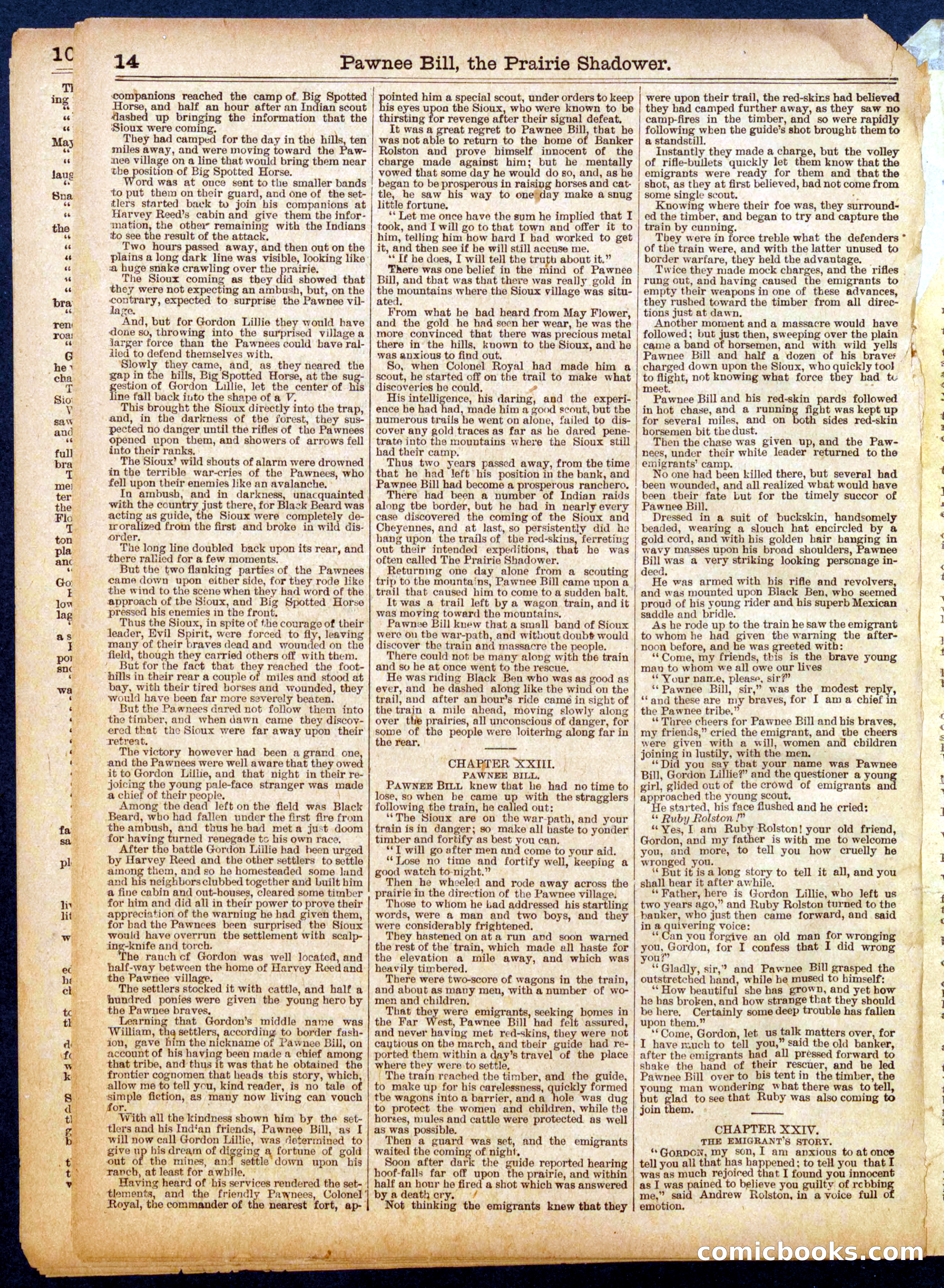
A restored page from Pulp Fiction, 1888. Page through the whole issue in the reader above.
📄 Transcribed text from this page (OCR, searchable)
Machine-transcribed from the original scan — historical spelling and the odd misread are preserved.
Toa! ce a ® > o, a | ‘* . oad or _r Ae, “ ome 4 nd . 4, ‘ . J . Ve Ae a B. ‘ ’ TAL " we me | * f wh “ : u ohh en » oe i a - * A 7 * ‘ ot v . 4 -,' e > - - i Ly ‘ he is J q 4 ’ . « A » 7, r 1 . | dash _. The settlers stocked it with cattle, ~aie William, the x _ that tribe, and thus ere ca Ne ee » 2" ark ni ai oh -.- owe ‘ee a>, et Ay ‘ eS 14 companions reached the camp of. Big Spotted | ian scout ‘Sales and half an hour after an In Sioux were coming, They had camped for the day in the hills, ten miles away, and were moving toward the Paw- nee village on a line that would bring them near the position of Big Spotted Horse. ord was at once sent to the smaller bands to put them on their guard, and one of the set- tlers started back tv join his companions at Harvey Reed’s cabin and give them the infor- ere * Oe ks, Uae Lage ko nyt? FEB, Fite : SO HRE PSS Ao ae e Tt . / y 7 . x : a b - Pawnee ed Bair . \! rn we ve a] - —_————_ Sipkots him a special scout, under orders to keep is eyes upon the Sioux, who were known to be up bringing the information that the | thirsting for revenge after their signal defeat, It was a great regret to Pawnee Bill, that he was not able to return to the home of Banker Rolston and prove himself innocent of the charge made against him; but he mentally vowed that some day he would do so, and, as he began to be prosperous in raising horses and cat- | tle, he saw his way to one’day make a snug little fortune, A ‘* Let me once have the sum he implied that I mation, the othe remaining with the Indians | took, and I will go to that town and offer it to ito see the result of the attack, Two hours passed away, and then out on the plains a long dark line was visible, looking like a huge snake crawling over the prairie. The Sioux coming as they dia showed that thoy were not expecting an ambush, but, on the ete expected to surprise the Pawnee vil- are. And, but for Gordon Lillie they would have done so, throwing into the surprised villagea larger force than the Pawnees could bave ral- died to defend themselves with. Slowly they came, and, as they neared the gap in the hills, Big Spotted Horse, at the sug- restion of Gordon Lillie, let the center of his ine fall back into the shape of a V. This brought the Sioux directly into the trap, and, in the darkness of the forest, they sus- pected no danger until the rifles of the Pawnees opened upon them, and showers of arrows fell into their ranks, The Sioux’ wild shouts of alarm were drowned in the terrible war-cries of the Pawnees, who fell upon their enemies like an avalanche, | In ambush, and in darkness, unacquainted | with the country just there, for Black Beard was acting us guide, the Sioux were completely de- eet ized from the first and broke in wild dis- order. The long line doubled back upon its rear, and there raliied for a few moments. But the two flanking parties of the Pawnees came down upon either side, for they rode like the wind to the scene when they had word of the approach of the Sioux, and Big Spotted Horse pressed his enemies in the front, — : Thus the Sioux, in spite of the courage of their leader, Evil Spirit, were forced to fly, leaving many of their braves dead and wounded on the field, though they carried others off with them. But for the fact that they reached the foot- ‘hills in their rear a couple of miles and stood at bay, with their tired horses and wounded, they would have been far more severely beaten. But the Pawnees dared not follow them into the timber, and when dawn came they discoy- ered that the Sioux were far away upon their retreat. The victory however had been a grand one, and the Pawnees were well aware that they owed it to Gordon Lillie, and that night in their re- joicing the young pale-face stranger was made a chief of their people. Among the dead left on the field was Black Beard, wbo had fallen under the first fire from the ambush, and thus he bad meta just doom for having turned renegade tc his own race, After the battle Gordon Lillie had been urged by Harvey Reed and the other settlers to settle among them, and so he homesteaded some lund and his neighbors clubbed together and built bim a fine cabin and out-houses, cleared some timber for him and did all in their power to prove their appreciation of the warning he had given them, for bad the Pawnees been surprised the Sioux would have overrun the settlement with scalp- ' gneg-knife and torch. The rauch cf Gordon was well located, and half-way between the home of Harvey Reed and the Pawnee village. and half a hundred ponies were given the young hero by the Pawnee braves, Learning that Gordon’s middle name was 1@ settlers, according to border fash- jon, gave him the nickname of Pawnee Bill, on account of his eA been made a chief among t was that he obtained the frontier cognomen that heads this story, which, allow me to tell you, kind reader, is no tale of as ioe fietion, as many now living can vouch LaOre * cy _ With all the kindness shown him by the set- tlers and his oan friends, Pawnee Bill, as I See now call Gordon Lillie, was determined to give up his dream of digging a fortune of gold of the mines, and settle" down pon" hts ranch, at least for awhile, — ip Having heard of his services rendered the set- we ‘ Last 4 i ae nay ape De it ak op os 7a" iF S ad Ue | ‘Wat i yal, the commander of t Jv - . ° be . eta % &r ioe 7 “a Ps ip : -e* Tae Pia “ee p : - an a. © ry * = . > ae Sh 8 + ‘ge tay « ras fy is at 7 SI ‘ 7 , m % yt . ‘5 ‘im ? Ot sae a him, telling him how hard I bad worked to get it, and then see if he will still accuse me. ‘** If he does, I will tell the truth about it.” There was one belief in the mind of Pawnee Bill, and that was that there was really gold in the Ge NEN where the Sioux village was situ- ated. From what he bad heard from May Flower, and the gold he had seen her wear, he was the more convinced that there was precious metal there in the hills, known to the Sioux, and he was anxious to find out. So, when Colonel Royal had made him a scout, he started off on the trail to make what discoveries he could, His intelligence, his daring, and the experi- ence he had had, made him a good scout, but the numerous trails be went on alone, failed to dis- cover any gold traces as far as he dared pene- trate into the mountains where the Sioux still had their camp. Thus two years passed away, from the time that he had left his position in the bank, and Pawnee Bill had become a prosperous ranchero, There had been a number of Indian raids along tbe border, but he had in nearly every case discovered the coming of the Sioux and Cheyennes, and at last, so persistently did he hang upon the trails of the red-skins, ferreting out their intended expeditions, that he was often called The Prairie Shadower. Returning one day alone from a scouting trip to the mountains, Pawnee Bill came upon a trail that caused him to come to a sudden balt. It was a trail left by a wagon train, and it was moving toward the mountains. Pawnee Bill knew that a small band of Sioux were on the war-path, and without doubt would discover the train and massacre the people. There could not be many along with the train and su he at once went to the rescue. He was riding Black Ben who was as good as ever, and he dashed along like the wind on the trail, and after an hour’s ride came in sight of the train a mile ahead, moving slowly along over the prairies, all unconscious of danger, for some of the people were loitering along far in the rear. CHAPTER XXIII. — PAWNEE BILL, PAWNEE Bri. knew that he had no time to lose, so when be came up with the stragglers following the train, he called out: ‘The Sioux are on the war-path, and your train isin danger; so make all haste to yonder timber and fortify as best you can. **T will go after men and come to your aid. ‘Lose no time and fortify well, keeping a good watch to-night.” Then he wheeled and rode away across the prairie in the direction of the Pawnee village. Those to whom he bad addressed his startling words, were a man and two boys, and they were considerably frightened. They hastened on at a run and soon warned the rest of the train, which made all haste for the elevation a mile away, and which was heavily timbered. There were two-score of wagons in the train, and about as many men, with a number of wo- men and children, : > hat mo were emigrants, seeking homes in the Far West, Pawnee Bill had felt assured, and never having met red-skins, they were not caytious on the march, and their guide had re- ported them within a day’s travel of the place where they were to settle, ; The train reached the timber, and the guide, to make up for his carelessness, quickly formed tbe wagons into a barrier, anda hole was dug to protect the women and children, while the horses, mules and cattle were protected. as well as was possible. , Then a guard was set, and the emigrants waited the coming of night, | Soon after dark the guide reported hearing hoof-falls far off upon the prairie, and within half an hour he fired a shot which was answered _ Not thinking the emigrants knew that they a re J tert ‘ F és “~* a id a ar ee an UP Ly . Ve ul ing Po ~ . | ate 7, }. barge to LS x ~~. * * hal < a ¥A eo bo a * - f _ Bs ‘£5 7 if 7 r ' rN ‘ Cae 5) Ser Fas ‘ Ov, 4 A : 4 FT h stat Bill, the Prairie Shadower. | LD LDBBDLDLLBL LLL LE LL LLL LLL LLL LLL LLL LL i Tt tt —— << ; a) + ‘ é ‘ ay were upon their trail, the red-skins had believed they had camped further away, as they saw no camp-fires in the timber, and so were rapidly following when the guide’s shot brought them to a standstill. Instantly they made a charge, but the volley of rifle-bullets quickly let them know that the emigrants were ready for them and that the | Shot, as they at first believed, bad not come from some single scout. . Knowing where their foe was, they surround- ed the timber, and began to try and capture the train by cunning. They were in force treble what the defenders of the train were, and with the latter unused to border warfare, they held the advautage. Twice they made mock charges, and the rifles . rung out, and having caused the emigrants to empty their weapons in one of these advances, they rushed toward the timber from all direc- tions just at dawn. Another moment and a massacre would have followed; but just then, sweeping over the plain came a band of horsemen, and with wild yells Pawnee Bill and half a dozen of his braves | charged down upon the Sioux, who quickly tool to flight, not knowing what force they had tu meet. Pawnee Bill and his red-skin pards followed in hot chase, and a dyer | fight was kept up for several miles, and on both sides red-skin horsemen bit thedust. | Then the chase was given up, and the Paw- nees, under their white leader returned to the emigrants’ camp. No one had been killed there, but several had been wounded, and all realized what would have been their fate but for the timely succor of Pawnee Bill. Dressed in a suit of buckskin, handsomely beaded, wearing a slouch hat encircled by a gold cord, and with his golden hair hanging in wavy masses upon his broad shoulders, Pawnee Bill was a very striking looking personage in- deed, He was armed with his rifle and revolvers, and was mounted upon Black Ben, who seemed saddle and bridle. ; As he rode up to the train he saw the emigrant to whom he had given the warning the after- noon before, and he was greeted with: ‘*Come, my friends, this is the brave young man to whom we all owe our lives ‘Your name, please, sir?” ‘Pawnee Bill, sir,” was the modest reply, ‘‘ ond these are my braves, for I am a chief in the Pawnee tribe.” ‘‘ Three cheers for Pawnee Bill and his braves, my friends,” cried the emigrant, and the cheers were given with a will, women and cbildren joining in lustily, with the men. ‘“‘Did you say that your name was Pawnee girl, glided out of the crowd of emigrants an approached the young scout, | e started, his face flushed and he cried: ‘* Ruby Rolston !” “Yes, I am Ruby Rolston! your old friend, Gordon, and my father is with me to welcome you, and more, to tell you how cruelly he wronged you. ‘* But it isa long story to tell it all, and you shall bear it after awhile, : 7 ** Father, here is (Jordon Lillie, who left us two years ago,” and Ruby Rolston turned to the banker, who just then came forward, and said in a Sao rat voice: 4 ‘Can vou forgive an old man for wronging you, Gordon, for I confess that I did wrong ou? ‘“‘Gladly, sir,? and Pawnee Bill grasped the outstretched hand, while he mused to himself: ‘* How beautiful she has grown, and yet how he has broken, and how strange that they should be here, Certainly some deep trouble has fallen upon them.” ‘‘Come, Gordon, let us talk matters over, for I have much to tell you,” said the old banker, after the emigrants had all pressed forward to shake the hand of their rescuer, and he led Pawnee Bill over to bis tent in the timber, the oung man wondering what there was to tell, but glad to see that Ruby was also coming to join them. © CHAPTER XXIV. THE EMIGRANT’S STORY. ‘“Gorpon, my son, I am anxious to at once tell you all that has happened; to teH you that I was as much rejoiced that I found you innocent as I was pained to believe you guilty of rcbbin me,” said Andrew Rolston, in a voice oO emotion, — Lam wae ~ 4 : > | , = ie asia peat as phe AoE eee ~ * "he 7 ’ ~> " » Cw ¢: , L% : J aay iy" ' fe | ™. ¥ ‘G 3 Bill, Gordon Lillie?” and the questioner a young | 1 eo if be - a 7 7: " proud of his young rider and his superb Mexican © Ma i Se eee ~ = x 7. + i) ‘ t " pia af it a ’ ‘ rm . . 4 me ot ok euad wed ties FA A —* * ~ ’ v , « es s