
Pulp Fiction, 1878 · page 9 of 16
Beadle's Half Dime Library No. 56 — page 9: what you’re looking at
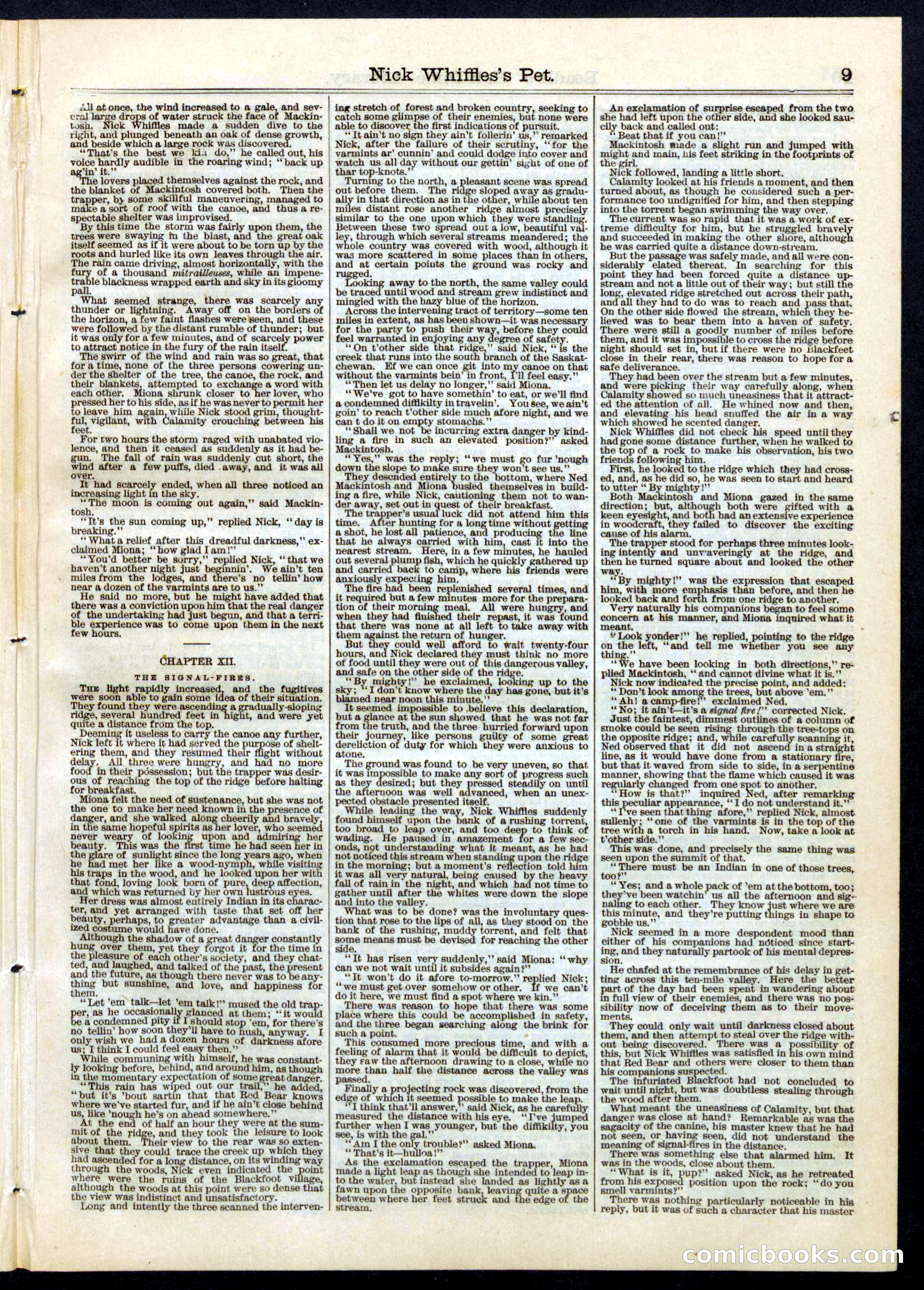
A restored page from Pulp Fiction, 1878. Page through the whole issue in the reader above.
📄 Transcribed text from this page (OCR, searchable)
Machine-transcribed from the original scan — historical spelling and the odd misread are preserved.
L . ——— All at once, the wind increased to a gale, and sev- eral e drops of water struck the face of Mackin- tosh. ck Whiffles made a sudden dive to the right, and plunged beneath an oak of dense growth, and beside which a large rock was discovered. “That's the best we kia do,” he called out, his voice hardly audible in the roaring wind; ‘“‘ back up ‘in’ ad “She lovers placed themselves against the rock, and the blanket of Mackintosh covered both. Then the trapper, by some skillful maneuvering, managed to make a sort of roof with the canoe, and thus a re- spectable shelter was improvised. By this time the storm was fairly upon them, the trees were aah m the blast, and the great oak itself seemed as if it were about to be torn up by the roots and hurled like its own leaves through the air. The rain came driving, almost horizontally, with the of a thousand mitrailleuses, while an impene- “in le blackness wrapped earth and sky in its gloomy pall, What seemed strange, there was scarcely any thunder or lightning. Away off on the borders of the horizon, a few faint flashes were seen, and these were followed by the distant rumble of thunder; but it was only for a few minutes, and of scarcely power to attract notice in the fury of the rain itself. The swirr of the wind and rain was so great, that for a time, none of the three persons cowering un- der the shelter of the tree, the canoe, the rock, and their blankets, attempted to exch a word with each other. Miona shrunk closer to her lover, who pressed her to his side, as if he was never to permit her to leave him again, while Nick stood grim, thought- one vigilant, with Calamity crouching between his eet. For two hours the storm raged with unabated vio- lence, and then it ceased as suddenly as it had be- gun. The fall of rain was suddenly cut short, the wind after a few puffs, died .away, and it was all over. It had scarcely ended, when all three noticed an increasing light in the sky. ‘ ‘Li moon is coming out again,’”’ said Mackin- osh, ‘It’s the sun coming up,” replied Nick, “‘ day is breaking.” ‘‘Whata relief after this dreadful darkness,” ex- claimed Miona; “ how glad I am!”’ “You'd better be sorry,’’ replied Nick, ‘‘ that we haven't another night just nin’. Weain’t ten miles from the lodges, and there’s no tellin’ how near a dozen of the varmints are to us.”’ He said no more, but he might have added that there was a conviction upon him that the real danger of the undertaking had just begun, and that a terri- oe se ming was to come upon them in the next ew hours. GHAPTER XII. THE SIGNAL-FIRES. THE light rapi and the fugitives were soa hulete pain some idea of their situation. They found they were asce a ually-sloping ridge, several hundred feet in hight, and were yet quite a distance from the top. Deeming it useless to carry the canoe any further, Nick left it where it had served the purpose of shelt- ering them, and they resumed their flight without delay. All three were hungry, and had no more food in their possession; but the trapper was desir- ous of reaching the top of the ridge before halting for breakfast. Miona felt the need of sustenance, but she was not the one to make her need known in the presence of danger, and she walked along cheerily and bravely in the same hopeful spirits as her lover, who seem never weary of look upon and admiring her beauty. This was the time he had seen her in the glare of sunlight since the long ge ago, when he met her like a wood-nymph, while visi his traps in the wood, and he looked upon her wit that fond, loving look born of pure, deep affection, and which was returned by her own lustrous eyes. Her dress was almost entirely Indian in its charac- Ly _ yet arranged with taste ag Set Of her eauty, perhaps, to greater advantage than a civil- ized costume would have done. Although the shadow of a poet tanger constantly hung over them, yet they forgot it for the time in the pleasure of each other’s society, and they chat- ted, and laughed, and talked of the past, the present and the future, as though there never was to any- thing but sunshine, and love, and happiness for them. “Let ‘em talk—let ’em talk!’ mused the old trap- per, as he siege og glanced at them; “it would a condemned pity I should stop ‘em, for there's no tellin’ how soon theyll have to hush, anyway. I only wish we had a dozen hours of darkness afore us; I think I could feel easy then.” While communing with himself, he was constant- ly looking before, behind, and around him, as though momentary expectation of some great danger. “This rain has wiped out our trail,” he added, “but it’s "bout sartin that that Red Bear knows where we've started fur, and if he ain’t close behind us, like "nough he’s on ahead somewhere,” At the end of half an hour they were at the sum- mit of the ridge, and they took the leisure to look about them. Their view to the rear was so exten- sive that they could trace the creek up which they had ascended for a long distance, on its winding way through the woods, Nick even indicated the point where were the ruins of the Blackfoot village, although the woods at this point were so dense that the view was indistinct and unsatisfactory. — Long and intently the three scanned the interven- Nick Whiffles’s Pet. ing stretch of forest and broken country, seeking to catch some glimpse of their enemies, but none were able to discover the first indications of pursuit. “Tt ain't no they ain’t follerin’ us,’’ remarked Nick, after the failure of their scrutiny, “‘for the varmints ar’ cunnin’ and could dodge into cover and watch us all day without our gettin’ sizht of one of thar top-knots.”’ Turning to the north, a pleasant scene was spread out before them. The ridge slo away as gradu- ally in that direction as in the other, while about ten miles distant rose another ridge almost precisely similar to the one upon which they were standing. Between these two spread out a low, beautiful val- ley, through which several streams meandered; the whole country was covered with wood, although it was more scattered in some places than in others and at certain points the ground was rocky and ed. Hos away to the north, the same valley could be tra until w and stream grew indistinct and mingled with the hazy blue of the horizon. Across the interve tract of territory—some ten miles in extent, as has been shown—it was necessary for the party to push their way, before they could feel warranted in enjoying any degree of gy A “On t’other side that ridge,’’ said Nick, “‘ is the creek that runs into the south branch of the Saskat- chewan. Ef we can once git into my canoe on that without the varmints bein’ in front, I'll feel easy.” “Then let us delay no longer,”’ said Miona. ‘We've got to have somethin’ to eat, or we'll find a condemned diffikilty in travelin’. You see, we ain’t goin’ to reach t’other side much afore night, and we can t do it on empty stomachs.” ‘Shall we not be incurring extra danger by kind- ling a fire in such an elevated position?’ asked Mackintosh. “Yes,"’ was the reply; “‘we must go fur *nough down the slope to make sure they won't see us.” They descended entirely to the bottom, where Ned Mackintosh and Miona busied themselves in build- ing a fire, while Nick, cautioning them not to wan- der away, set out in quest of their breakfast. The trapper’s luck did not attend him this time. After hunting for a longtime without getting a shot, he lost all patience, an producing the line that he always carried with him, cast it into the nearest stream. Here, in a few minutes, he hauled out several plump fish, which he quickly gathered up and carried back to camip, where his friends were anxiously e ting him. The fire had been replenished several times, and it required but a few minutes more for the prepara- tion of their morning meal, All were hungry, and when they had finished their repast, it was found that there was none at all left to take away with them agen. the return of hunger. But ey could well afford wait twenty-four hours, and Nick declared they must think no more of food until they were out of this dangerous valley, and safe on the other side of the ridge. 2 mighty!’’ he exclaimed, looking up to the sky; “‘I don’t know where the day has gone, but it’s blamed near noon this minute,"’ It seemed impossible to .believe this declaration, but a glance at the sun showed that he was not far from the truth, and the three hurried forward upon their journey, like persons guilty of some great dereliction of duty for which they were anxious to atone. The grouna was found to be very uneven, so that it was im ible to make any sort of progress such as they desired; but they pressed steadily on until the afternoon was well advanced, when an unex- pected obstacle presented itself. While leading the way, Nick Whiffles suddenly found himself upon the bank of a rushing torrent too broad to leap over, and too deep to think of wading. He paused in amazement for a few sec- onds, not understanding what it meant, as he had not noticed this stream when standing upon the ridge in the morning; but a moment’s reflection told him it was all very natural, being caused by the heavy fall of rain in the night, and which had not time to gather until after the whites were down the slope and into the valley. What was to be done? was the involuntary ques- tion that rose to the lips of all, as they stood on the bank of the rushing, muddy torrent, and felt that Rg means must be devised for reaching the other e, “It has risen very suddenly,’’ said Miona: “ why can we not wait until it subsides again?” “It won't do it afore to-morrow.” replied Nick; ‘““we must get over somehow or other. If we can’t do it here, we must find a spot where we kin.” There was reason to hope that there was some place where this could be accomplished in safety, and the three began searching along the brink for such a point. , This consumed more precious time, and with a feeling of alarm that it would be difficult to depict, they saw the afternoon drawing to a close, while no more than half the distance across the valley was passed. Finally a rojecting rock was discovered, from the edge of which it seemed possible to make the leap. "I think that'll answer,” said Nick, as he carefully measured the distance with his eye. ‘I’ve jumped further when I was younger, but the diffikilty, you see, is with the * ‘*Am I the only trouble?’ asked Miona, ** That's it—hulloa!”’ As the exclamation escaped the trapper, Miona made a light leap as though she intended to leap in- to the water, but instead she landed as > aay as a fawn upon the opposite bank were ae as between where her feet struck and the edge of the stream. 9 oe An exclamation of surprise eseaped from the two she had left upon the other side, and she looked sau- cily back and called out: ‘Beat that if you can!”’ Mackintosh made a slight run and Jumped with might ane main, his feet striking in the footprints of the girl. Nick followed, landing a little short. Calamity looked at his friends a moment, and then turned about, as though he considered such a per- formance too undignified for him, and then stepping into the torrent began swimming the way over. The current was so rapid that it was a work of ex- treme difficulty for him, but he struggled bravel and succeeded in making the other shore, althoug he was carried quite a distance down-stream. But the peneat was safely made, and all were con- siderably ela thereat. In searching for this point they had been forced quite a distance u stream and not a little out of their way; but still the long, elevated ridge stretched out across their path, and all they had to do was to reach and pass that. On the other side flowed the stream, which they be- lieved was to bear them into a haven of safety. There were still a goodly number of miles before them, and it was impossible to cross the ridge before night should set in, but if there were no blackfeet close in their rear, there was reason to hope fora safe deliverance. They had been over the stream but a few minutes, and were picking their way carefully along, when Calamity showed so much uneasiness that it attract- ed the attention of all. He whined now and then, and eleva his head snuffed the air in a way which showed he scented danger. Nick Whiffies did not check his speed until they had gone some distance further, when he walked to the top of a rock to make his observation, his two friends following him. First, he looked to the ridge which they had cross- ed, and, as he did so, he was seen to start and heard to utter “ By malay hd Both Mackintosh and Miona gazed in the same direction; but, although both were gifted with a keen eyesight, and both had an extensive experience in woodcraft, they failed to discover the exciting cause of his alarm. The trapper stood for perhaps three minutes look- ing intently and unvaveringly at the ridge, and then he turned square about and looked the other way. “By mighty!’ was the expression that escaped him, with more emphasis than before, and then he looked back and forth from one ridge to another. Very naturally his companions be to feel some concern at his manner, and Miona inquired what it meant. . * Look yonder!"’ he replied, pointing to the ri on the left, “‘and tell me whether you see — thing.” “We have been looking in both directions,” re- plied Mackintosh, ‘‘ and cannot divine what it is.” Nick now indicated the precise point, and added: ** Don’t look among the trees, but above ’em.”’ ‘Ah! a camp-fire!’’ exclaimed Ned. “No; it ain’t—it’s a signal fire/’’ corrected Nick. Just the faintest, dimmest outlines of a column of smoke could be seen ir ges through the tree-tops on the opposite ridge; and, while carefully scan it Ned observed that it did not ascend ina straight line, as it would have done from a stationary fire, but that it waved from side to side, in a serpentine manner, showing that the flame which ca it was regularly changed from one — another. ‘How is that?” inquired Ned, after remarking this uliar appearance, ‘‘I do not understand it.”’ ‘“*T’ve seen that thing afore,”’ replied Nick, almost enly; ‘“‘one of the varmints is in the top of the tree with a torch in his hand. Now, take a look at t’other side.”’ This was done, and precisely the same thing was seen upon the summit of that. Fara must be an Indian in one of those trees, “Yes; and a whole pack of ’em at the bottom, too; they’ve been watchin’ us all the afternoon and sig-: naling to each other. They know just where we are this minute, and they’re putting things in shape to gobble us.”’ Nick seemed in a more despondent mood than either of his companions had ndticed since start- ing, and they naturally partook of his mental depres- sion. He chafed at the remembrance of his delay in get- ting across this ten-mile valley. Here the better rt of the day had been spent in wandering about in full view of their enemies, and there was no pos- sibility now of deceiving them as to their move- ments. They could only wait until darkness closed about them, and then attempt to steal over the ridge with- out being discovered. There was a ne, of this, but Nick Whiffies was satisfied in his own mind that Red Bear and others were closer to them than his companions ted. The infuriated Blackfoot had not concluded to wait until night, but was doubtless stealing through the wood after them. What meant the uneasiness of Calamity, but that er was close at hand? Remarkable as was the ity of the canine, his master knew that he had not seen, or having seen, did not understand the meaning of signal-fires in the distance. There was something else that alarmed him. It was in the woods, close about them. ‘*What is it, pup?" asked Nick, as he retreated from his exposed position upon the rock; “do you smell varmints?”’ There was nothing particularly noticeable in his reply, but it was of such a character that his master Eomichbooks.co