
Pulp Fiction, 1887 · page 2 of 16
Beadle's Half Dime Library No. 522 — page 2: what you’re looking at
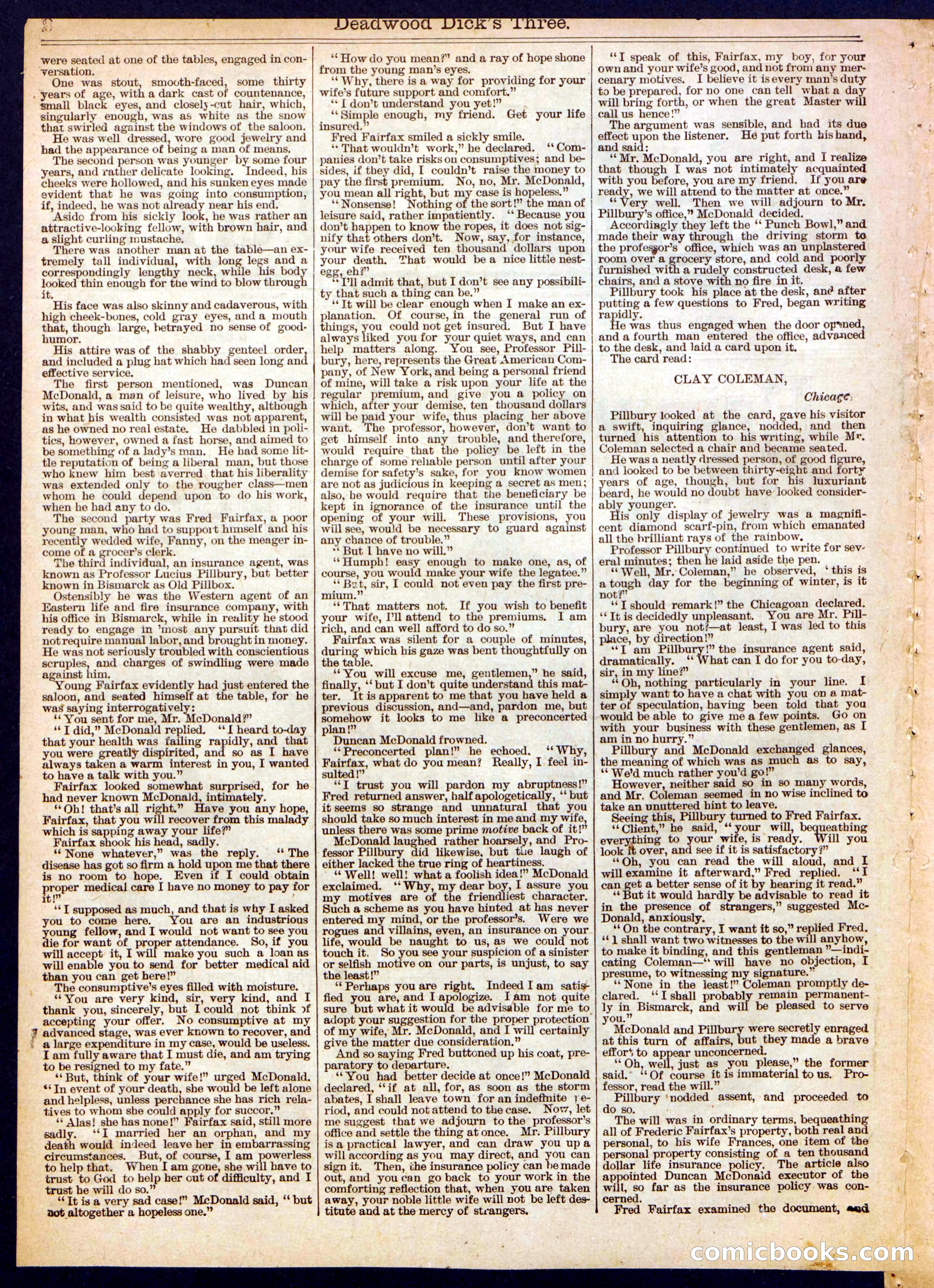
A restored page from Pulp Fiction, 1887. Page through the whole issue in the reader above.
📄 Transcribed text from this page (OCR, searchable)
Machine-transcribed from the original scan — historical spelling and the odd misread are preserved.
were seated at one of the tables, engaged in con- vyersation. One was stout, smovth-faced, some thirty |. years of age, with a dark cast of countenance, small black eyes, and closely-cnt hair, which, singularly enough, was as white as the snow that swirled against the windows of the saloon. He was well dressed, wore good jewelry and had the appearance of being a man of means. The second person was younger by some four years, and rather delicate looking. Indeed, his cheeks were hollowed, and his sunken eyes made evident that he was going into consumption, if, indeed, he was not already near his end. Asido from his sickly look, he was rather an attractive-looking fellow, with brown hair, and a slight curling mustache. There was another man at the table—an ex- tremely tall individual, with long legs and a correspondingly lengthy neck, while his body Jooked thin enough for the wind to blow throug it. His face was also skinny and cadaverous, with high cheek-bones, cold gray eyes, and a mouth that, though large, betrayed no sense of good- humor. His attire was of the shabby genteel order and included a plug hat which had seen long and effective service. The first person mentioned, was Duncan McDonald, a man of leisure, who lived by his wits, and was said to be quite wealthy, although in what bis wealth consisted was not apparent, as he owned no real estate. He dabbled m poli- tics, however, owned a fast horse, and aimed to be something of a lady’s man. He bad some lit- tle reputation of being a liberal man, but those who knew him best averred that his liberality was extended only to the rougher class—men whom he could depend upon to do his work, when he had any to do. The second party was Fred Fairfax, a poor young man, who had to support himself and his recently wedded wife, Fanny, on the meager in- come of a grocer’s clerk. The third individual, an insurance agent, was known as Professor Lucius Pillbury, but better known in Bismarck as Old Pillbox. Ostensibly he was the Western agent of an Eastern life and fire insurance company, with his office in Bismarck, while in reality he stood ready to engage in ’most any pursuit that did not require manual labor, and brought in money. He was not seriously troubled with conscientious scruples, and charges of swindling were made against him, oung Fairfax evidently had just entered the saloon, and seated himself at the table, for he was saying interrogati e ‘*- You sent for me, Mr. McDonald?” ‘“*T did,” McDonald replied. ‘I heard to-day that your health was failing rapidly, and that you were greatly dispirited, and so as I have always taken a warm interest in you, I wanted to have a talk with you.” Fairfax looked somewhat surprised, for he had never known McDonald, intimately. ‘*Oh! that’s all right.” Have you any hope, Fairfax, that you will recover from this malady which is sapping away your life?” Fairfax shook his head, sadly. ‘¢ None whatever,” was the reply. ‘* The disease has got so firm a hold upon me that there is no room to hope. Even if I could obtain oe medical care I have no money to pay for ; ; ‘‘T supposed as much, and that is why I asked you to come here. You are an industrious young fellow, and I would not want to see you die for want of a attendance. So, if you will avecue it, I will make you such a loanas will enable you to send for better medical aid than you can get here!” The consumptive’s eyes filled with moisture. ‘‘You are very kind, sir, very kind, and I thank you, sincerely, but I could not think >f accepting your offer. No consumptive at my advanced stage, was ever known to recover, and a large expenditure in my case, would be useless. I am fully aware that I must die, and am trying to be resigned to my fate.” ‘‘ But, think of your wife!” urged McDonald. **In event of your death, she would be left alone and helpless, unless perchance she has rich rela- tives to whom she could apply for succor.” ‘* Alas! she has none!” Fairfax said, still more sadly. ‘‘I married her an orphan, and my death would indeed leave her in embarrassing circumstances. But, of course, I am powerless to help that. When I am gone, she will have to trust to God to help her out of difficulty, and I trust he will do so.” _ “Tt is a very sad case!” McDonald said, ‘* but aot altogether a hopeless one.” WMeaadawood V1Ck ee, ‘*How do you mean?” and a ray of hope shone from the young man’s eyes. ‘‘ Why, there is a way for providing for your wife’s future support and comfort.” ‘* [T don’t understand you yet!” ‘‘Simple enough, my friend. Get your life insured.” Fred Fairfax smiled a sickly smile. ‘* That wouldn’t work,” he declared. ‘*Com- panies don’t take risks on consumptives; and be- sides, if they did, I couldn’t raise the money to pay the first premium, No, no, Mr. McDonald, you mean all right, but my case is hopeless.” ‘Nonsense! Nothing of the sort!” the man of leisure said, rather impatiently. ‘* Because you don’t happen to know the ropes, it does not sig- nify that others don’t. Now, say, for instance, your wife received ten thousand dollars upon your death. That would bea nice littie nest- egg, eh?” ‘I'll admit that, but I don’t see any possibili- ty that such a thing can be.” ‘*Tt will be clear enough when I make an ex- planation. Of course,in the general run of things, a could not get insured. But I have always liked you for your quiet ways, and can help matters along. You see, Professor Pill- bury, here, represents the Great American Com- pany, of New York, and being a personal friend of mine, will take a risk upon your life at the regular premium, and give you a policy on which, after your demise, ten thousand dollars will be paid your wife, thus placing her above want. The professor, however, don’t want to get himself into any trouble, and therefore, would require that the policy be left in the charge of some reliable person until after your demise for safety’s sake, for you know women are not as judicious in keeping a secret as men; also, he would require that the beneficiary be kept in ignorance of the insurance until the opening of your will, These provisions, you will see, would be necessary to guard against any chance of trouble.” ** But L have no will.” ‘*Humph! easy enough to make one, as, of course, you would make your wife the legatee.” ‘* Bet, sir, I could not even pay the first pre- mium.” ‘‘That matters not. If you wish to benefit your wife, Pll attend to the premiums, I am rich, and can well afford to do so.” Fairfax was silent for a couple of minutes, during which bis gaze was bent thoughtfully on the table. ‘‘*You will excuse me, gentlemen,” he said, finally, ‘‘ but I don’t quite understand this mat- ter. It is apparent to me that you have held a previous discussion, and—and, pardon me, but somehow it looks to me like a preconcerted plan!” Duncan McDonald frowned. ‘‘Preconcerted plan!” he echoed. ‘‘ Why, Fairfax, what do you mean? Really, I feel in- sulted!” “T trust you will pardon my abruptness!” Fred returned answer, half apologetically, ‘* but it seems so strange and unnatural that you should take so much interest in me and my wife, unless there was some prime motive back of it!” McDonald se Te rather hoarsely, and Pro- fessor Pillbury did likewise, but the laugh of either lacked the true ring of heartiness. ‘‘ Well! well! what a foolish idea!” McDonald exclaimed. ‘‘ Why, my dear boy, I assure you my motives are of the friendliest character. Such a scheme as you have hinted at has never entered my mind, or the professor’s. Were we rogues and villains, even, an insurance on your life, would be naught to us, as we could not touch it, So you see your suspicion of a sinister or selfish motive on our parts, is unjust, to say the least!” ‘‘ Perhaps you are right. Indeed [am satis fied you are, and I ee Iam not quite sure but what it would be advisable for me to adopt your suggestion for the proper protection of my wife, Mr. McDonald, and I will certainly give the matter due consideration,” And so saying Fred buttoned up his coat, pre- paratory to departure. ‘‘You had better decide at once!” McDonald declared, ‘‘if at all, for, as soon as the storm abates, I shall leave town for an indefinite } e- riod, and could not attend to the case. Nov, let me suggest that we adjourn to the professor’s office and settle the thing atonce. Mr. Pillbury is a practical lawyer, and can draw you upa will according as you may direct, and you can sign it. Then, the insurance policy can be made out, and youcan go back to your work in the comforting reflection that, when you are taken away, your noble little wife will not be left des- titute and at the mercy of strangers, ‘‘T speak of this, Fairfax, my boy, for your own and your wife’s good, and not from any mer- cenary motives. I believe it isevery man’s duty to be prepared, for no one can tell what a day will bring forth, or when the great Master will call us hence!” The argument was sensible, and had its due effect upon the listener. He put forth his hand, and said: ‘‘Mr, McDonald, you are right, and I realize that though [ was not intimately acquainted with you before, you are my friend, If you are ready, we will attend to the matter at once.” “Very well. Then we will adjourn to Mr. Pillbury’s office,” McDonald decided. Accordingly they left the ‘‘ Punch Bowl,” and made their way through the driving storm te the profesgor’s office, which was an unplastered room over a grocery store, and cold and poorly furnished with a rudely constructed desk, a few chairs, and a stove with no fire in it. Pillbury took his place at the desk, an¢ after putting a few questions to Fred, began writing ad ap le was thus engaged when the door opyned and a fourth man entered the office, advance to the desk, and Jaid a card upon it. The card read: CLAY COLEMAN, Pillbury looked at the card, gave his visitor a swift, inquiring glance, nodded, and then turned his attention to his writing, while Mr. Coleman selected a chair and became seated. He was a neatly dressed person, of good figure, and looked to be between thirty-eight and forty years of age, though, but for his luxuriant beard, he would no doubt have looked consider- ably younger. 7 is only display of jewelry was a magnifli- cent diamond scarf-pin, from which emanated all the brilliant rays of the rainbow, Professor Pillbury continued to write for sev- eral minutes; then he laid aside the pen. ‘‘Well, Mr. Coleman,” he observed, * this is a tough day for the beginning of winter, is it not?’ ‘‘T should remark!” the Chicagoan declared. ‘‘ Tt is decidedly unpleasant. You are Mr. Pill- bury, are you not?—at least, I was led to this ce, by direction!” ‘“T am Pillbury!” the insurance agent said, dramatically. ‘‘ What can I do for you to-day, sir, in my line?” ‘Oh, nothing particularly in your line. I simply want to have a chat with you on a mat- ter of speculation, having been told that you would be able to give me a few points. Go on with your business with these gentlemen, as [ am in no hurry.” Pillbury and McDonald exchanged glances, the meaning of which was as much as to say, ‘¢ We'd much rather you’d go!” However, neither said so in so many words, and Mr. Coleman seemed in no wise inclined to take an unuttered hint to leave. Seeing this, Pillbury turned to Fred Fairfax. ‘¢Client,” he said, ‘‘ your will, ueathing everything to your wife, is ready. ill you look it over, and see if it is satisfactory?” ‘‘Oh, you can read the will aloud, and IL will examine it afterward,” Fred replied. “I can get a better sense of it by hearing it read.” ‘‘ But it would hardly be advisable to read it in the presence of strangers,” suggested Mc- Donald, anxiously. ‘On the contrary, I want it so,” replied Fred. ‘¢) shall want two witnesses to the will anyhow, to make it binding, and this gentleman ”—indi- cating Coleman—‘ will have no objection, I resume, to witnessing my signature.” ‘None in the least!” Coleman promptly de- clared. ‘‘I shall probaly remain permanent- ly in Bismarck, and wi ou. McDonald and Pillbury were secretly e at this turn of affairs, effort to appear unconcern said.” ‘‘Of course it is immaterial tous. Pro- fessor, read the will.” Pillbury ‘nodded assent, and proceeded to O SO. The will was in ordinary terms, bequeathin all of Frederic Fairfax’s property, both real an personal property consisting of a ten thousand dollar life insurance policy. The article also appointed Duncan McDonaid executor of the will, so far as the insurance policy. was con- cerned. Fred Fairfax examined the document, aad com (e 200ks, be pleased to serve © ed . ut they made a brave | ‘‘ Oh, well, just as you please,” the former personal, to his wife Frances, one item of the : , ~ a ee a — Se! rr a -